
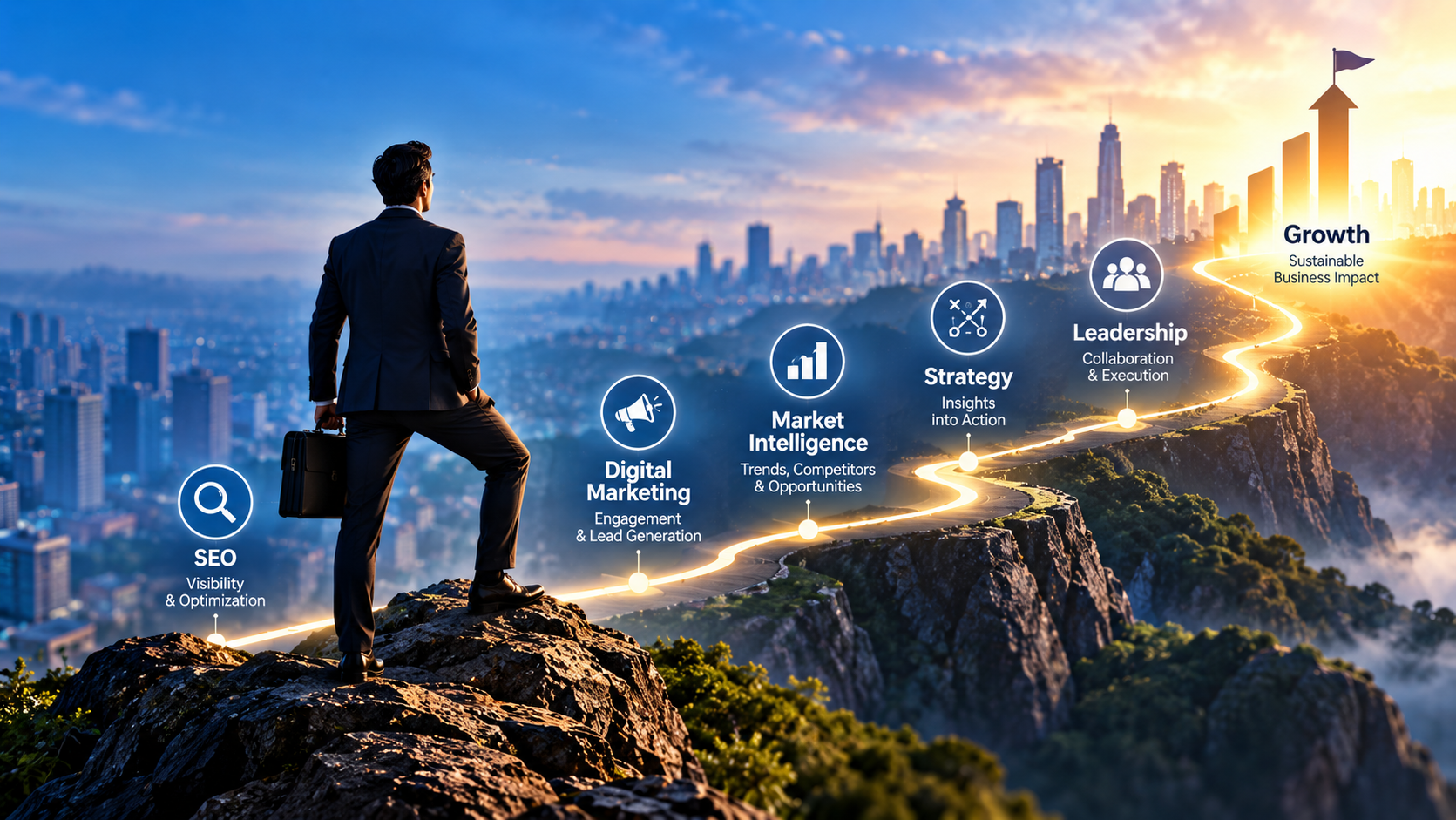
This case study examines Krishna Raut’s professional evolution from SEO and digital marketing into a broader role connecting digital performance, market intelligence, research, strategy, and leadership. Based on his profile in Decisions Advisors Magazine, the case explores how digital expertise can evolve into a strategic capability focused on understanding markets.
Case Study: From SEO Execution to Strategic Growth — Krishna Raut’s Evolution into Digital and Market Intelligence Leadership
Executive Overview
The digital business environment has changed considerably.
SEO and digital marketing were once frequently treated as specialized functions focused on search rankings, website traffic, content visibility, and online promotion. Today, digital channels can provide organizations with information about customers, competitors, market movements, and emerging opportunities.
The professional journey of Krishna Raut, featured as “The Business Strategist” in the September 2026 issue of Decisions Advisors Magazine, provides a useful case study of this evolution. His profile describes more than 14 years of experience across SEO, digital marketing, performance marketing, market research, and leadership.
Rather than presenting a conventional career biography, this case study examines the progression as a strategic transformation:
SEO → Digital Marketing → Market Intelligence → Strategy → Leadership → Growth
1. The Starting Point: Building Digital Visibility
The challenge
For organizations competing online, being discoverable is an essential first step.
However, achieving visibility requires more than publishing content. Websites need to be optimized, search behaviour needs to be understood, competitors need to be evaluated, and digital campaigns need to be monitored continuously.
Raut's professional profile highlights experience in areas including:
- SEO research
- Technical SEO
- On-page optimization
- Off-page SEO
- Outreach and link building
- Guest blogging
- Content marketing
- Lead generation
- Social media optimization
These capabilities established the foundation of his digital expertise.
The initial objective
At this stage, the primary objective can be understood as:
Improve digital visibility and create stronger connections between businesses and their target audiences.
But visibility alone does not explain whether a business is moving in the right direction.
That creates the next challenge.
2. The Challenge: Moving Beyond Rankings and Visibility
Digital performance can generate enormous amounts of information.
Search trends can reveal what people are looking for.
Website analytics can reveal how users behave.
Content performance can reveal what attracts attention.
Competitor activity can reveal changing market dynamics.
The challenge is turning these individual signals into something useful for business decision-making.
The magazine profile describes Raut's approach as moving beyond keywords and rankings toward user behaviour, market trends, competitor activity, business goals, and market research.
This represents a significant shift in perspective.
Instead of asking only:
“How do we rank better?”
the strategic question becomes:
“What is the market telling us, and what should the business do about it?”
3. The Strategic Approach: Connecting Digital Marketing With Market Intelligence
The next stage of the journey involved connecting digital expertise with broader market intelligence.
The profile describes Raut's responsibilities as extending beyond digital marketing into market research operations and organizational growth at Spherical Insights LLP. It highlights areas such as market opportunities, industry trends, competitor analysis, customer requirements, SEO, social media, content marketing, and lead generation.
This creates an important strategic connection.
Digital marketing provides signals.
Market research provides context.
Strategy provides direction.
When these elements are considered together, digital activity can become more than a marketing function. It can contribute to understanding the market itself.
4. The Transformation: From Data to Insight
One of the strongest themes in the profile is the movement from information toward actionable intelligence.
The magazine describes a mission centered on turning market intelligence into action—helping businesses understand market dynamics, identify opportunities, manage risks, and make informed strategic decisions.
The transformation can therefore be represented as:
| Stage | Business Question | Strategic Contribution |
|---|---|---|
| SEO | How can we improve visibility? | Discoverability |
| Digital Marketing | How can we reach and engage audiences? | Audience connection |
| Analytics | What are users and campaigns telling us? | Performance insight |
| Market Intelligence | What is happening in the wider market? | Market understanding |
| Strategy | What should we do with these insights? | Strategic direction |
| Leadership | How do we execute collectively? | Organizational growth |
This progression is an editorial synthesis of the profile rather than a claim that these were formal stages with measured numerical outcomes.
5. Building a Technology-Driven Research Approach
The case also highlights the growing role of technology in market research.
The magazine profile identifies technology-driven research as one of three growth strategies. The approach involves using digital technologies, data analytics, and innovative research methodologies to improve research quality, efficiency, and the usefulness of resulting insights.
This is particularly relevant in markets where information changes rapidly.
Organizations need to understand:
- What customers want
- How industries are changing
- Where competitors are moving
- Which opportunities are emerging
- What risks could affect growth
Technology can help collect and analyze information, but strategic interpretation remains essential.
6. From Individual Expertise to Leadership
The transformation did not stop with technical expertise.
The profile also highlights team engagement and leadership, including collaboration across research, sales, content, and marketing. Communication, knowledge sharing, constructive discussion, and respect for different perspectives are identified as important elements of effective teamwork.
This introduces another dimension to the case.
A strong digital strategy cannot exist entirely within one person or one department.
Research teams generate information.
Content teams communicate ideas.
Marketing teams reach audiences.
Sales teams engage potential customers.
Leadership connects these functions around common objectives.
The progression therefore moves from individual digital execution toward cross-functional strategic leadership.
7. The Growth Blueprint
The magazine profile outlines three strategic priorities that provide a broader framework for sustainable growth.
01 — Expand Industry and Geographic Reach
Developing broader industry and geographic coverage allows organizations to address emerging markets and evolving customer requirements through customized research and consulting solutions.
02 — Strengthen Technology-Driven Research
Using technology, analytics, and innovative research methodologies can improve research quality and help produce more actionable intelligence.
03 — Build Long-Term Relationships and Partnerships
Long-term relationships and strategic partnerships can strengthen capabilities, expand market presence, and create sustainable business opportunities.
Together, these priorities demonstrate that growth is viewed as a combination of market understanding, technological capability, and strong relationships.
8. The Result: A Broader Strategic Capability
Unlike a traditional marketing case study, this profile does not provide specific numerical before-and-after results such as percentage increases in traffic, revenue, rankings, or lead generation.
Instead, the documented outcome is a broader professional capability.
The profile describes a journey from SEO and digital promotion toward:
Market Intelligence → Digital Strategy → Leadership → Business Growth
It demonstrates how experience in one specialized digital discipline can become the foundation for understanding broader business questions.
The value is therefore not limited to improving online visibility.
It lies in connecting information with decisions.
9. Key Lessons From the Case
Lesson 1: Visibility is only the beginning
Ranking well or generating digital engagement can create opportunities, but understanding what those results mean is equally important.
Lesson 2: Data needs context
Digital performance data becomes more useful when considered alongside customer behaviour, competitors, market trends, and industry developments.
Lesson 3: Research and digital marketing can complement each other
Digital channels provide real-world behavioural signals, while market research provides a broader framework for understanding markets.
Lesson 4: Strategy connects information with action
The objective is not simply to collect more data. The objective is to transform information into insights that can support better decisions.
Lesson 5: Growth requires collaboration
Research, marketing, content, sales, analytics, and leadership can create greater value when they work toward shared strategic objectives.
10. The Strategic Framework
The overall case can be summarized through one simple framework:
DATA
↓
INSIGHTS
↓
MARKET UNDERSTANDING
↓
STRATEGY
↓
EXECUTION
↓
GROWTH
This reflects the central philosophy presented in the magazine profile:
“Turning data into insights, insights into strategy and strategy into growth.”
Conclusion
Krishna Raut's professional journey, as documented by Decisions Advisors Magazine, illustrates an important shift in the role of digital professionals.
The journey begins with SEO and digital visibility but develops toward a broader understanding of markets, customers, competitors, data, research, strategy, and leadership.
The case demonstrates that digital expertise does not have to remain confined to digital channels.
When combined with market intelligence and strategic thinking, it can become a tool for understanding broader business opportunities.
The central lesson is therefore straightforward:
SEO can create visibility.
Data can create information.
Market intelligence can create understanding.
Strategy can turn understanding into action.
And leadership can turn action into sustainable growth.