
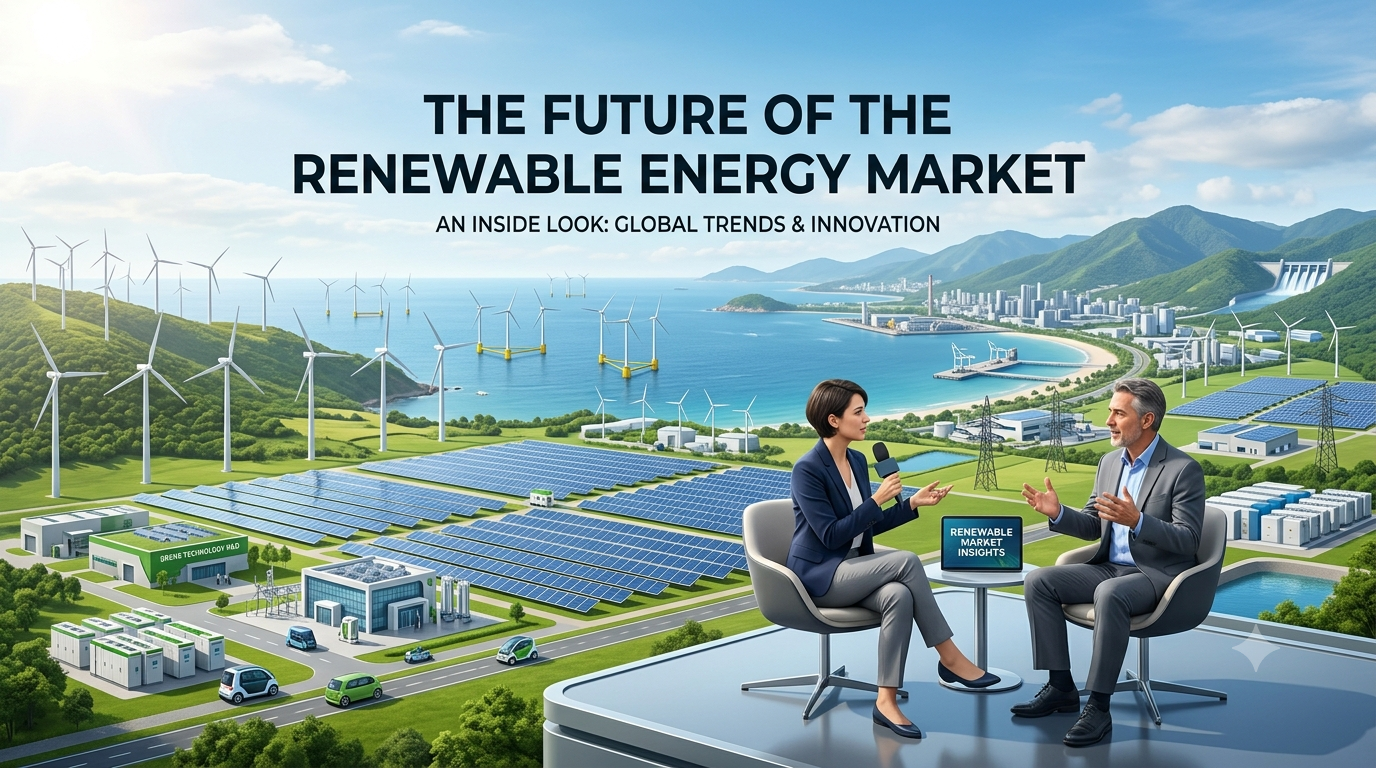
Integrated Clean Energy & Grid Decarbonization: The Path Ahead
An Executive Conversation with Daniel Mercer, CEO of Renova Grid
The global renewable energy sector is transitioning from pure generation to an era of integrated, intelligent energy infrastructure. As commercial consumers and utilities demand greater reliability alongside decarbonization, executives face a new set of strategic priorities: pairing solar and storage with digital monitoring, navigating grid interconnection bottlenecks, and managing capital disciplined long-term growth.
In this executive feature, Daniel Mercer, CEO of Renova Grid, breaks down his leadership philosophy, approach to practical technology adoption, and vision for the future of clean energy infrastructure.
1. Leadership, Strategy & Execution
Q1: What is your long-term strategic vision for Renova Grid?
Daniel Mercer: Our focus is making clean energy practical, reliable, and commercially viable. The industry is moving past the stage where simply adding generation capacity is enough. We are entering an era defined by integrated energy systems—where generation, utility-scale storage, digital monitoring, and automated demand management work in unison.
Sustainability is the baseline, but to win commercial adoption, solutions must deliver grid-grade reliability and an unquestionable financial return on investment.
Q2: What primary macro drivers will shape the industry over the next 3–5 years?
Daniel Mercer: Three interconnected forces will dictate market trajectories:
-
Storage Intermediation: Balancing variable generation with real-time load profiles.
-
Grid Modernization: Updating legacy transmission networks to support multi-directional power flows.
-
Rapid Demand Expansion: Meeting rising power needs driven by data centers, electrification, and heavy industry.
"Technology is only one part of the equation; policy and capital deployment are equally critical. The markets that build resilient, future-ready infrastructure and clear regulatory pathways will win the energy transition."
Q3: What are the chief operational priorities for clean energy executives today?
Daniel Mercer: Resilience. Energy leaders must simultaneously navigate volatile supply chains, shifting interest rates, evolving regulatory frameworks, and rapid technological change.
Staying resilient requires strict financial discipline while maintaining targeted investments in talent and core technologies. Growth remains vital, but sustainable, margin-focused expansion will always outperform rapid growth built on a weak foundation.
Q4: How do you balance short-term profitability with long-term capital allocation?
Daniel Mercer: We categorize every dollar by evaluating whether it is a operational expense or a strategic capability builder. Short-term projects generate immediate cash flow, but longer-horizon investments in software platforms or grid technologies ensure we retain market leadership down the road.
If an investment strengthens core customer retention, expands platform capabilities, or hedges against regulatory shifts, it justifies a longer capital return cycle.
Q5: What leadership qualities are essential in a fast-moving, capital-intensive sector?
Daniel Mercer: Adaptability, accountability, and active listening. In a rapidly evolving market, operate under the assumption that legacy playbooks can become obsolete overnight.
Equal in importance is operational consistency. Teams need explicit clarity on organizational direction. When leadership communicates transparently and owns strategic trade-offs, it builds execution confidence across the company.
2. Technology & Innovation Strategy
                          ┌──────────────────────────┐
                          │   BUSINESS PROBLEM       │
                          │ (Predictability / Cost)  │
                          └─────────────┬────────────┘
                                        │
                                        ▼
                          ┌──────────────────────────┐
                          │     PILOT / PROVING      │
                          │   (Real-world load testing)│
                          └─────────────┬────────────┘
                                        │
                                        ▼
    ┌───────────────────────────────────┴──────────────────────────────────┐
    │                                                                      │
    ▼                                                                      ▼
┌───────────────────────────────┐                      ┌───────────────────────────────┐
│     QUALIFIED DEPLOYMENT      │                      │      REJECT / RE-ENGINEER    │
│ • Scalable ROI                │                      │ • High Integration Friction   │
│ • Strong Cybersecurity        │                      │ • Low Practical Reliability   │
│ • Compatible with Existing Stack│                    └───────────────────────────────┘
└───────────────────────────────┘
Q6: How are digital tools changing field operations and asset management?
Daniel Mercer: Digitization brings intelligence to physical infrastructure. Real-time telemetry allows us to monitor remote assets, optimize performance dynamically, and deploy predictive maintenance before equipment fails.
For our enterprise customers, pairing renewables with digital analytics transforms energy from an unpredictable overhead cost into a controllable operational parameter.
Q7: Which emerging technologies hold the most tangible enterprise value?
Daniel Mercer: Two technologies stand out:
-
Next-Generation Battery Energy Storage Systems (BESS): Advanced storage bridges the gap between variable generation and constant load profiles.
-
Artificial Intelligence & Predictive Analytics: AI drastically improves generation forecasting, automated dispatch, and asset health monitoring.
However, novelty alone does not justify deployment. The winning technologies will be those that solve immediate operational challenges reliably and cost-effectively.
Q8: How does Renova Grid structure its R&D and innovation pipeline?
Daniel Mercer: We start with the problem statement, not the technology stack. If we identify an issue in forecast accuracy or thermal management, we evaluate potential solutions against rigorous performance criteria.
We also mandate real-world load testing. Emerging tech often looks exceptional in pilot environments but degrades under harsh field conditions. Rigorous operational testing protects capital before scaling.
Q9: What are the primary barriers to adoption for enterprise energy tech?
Daniel Mercer: Beyond capital costs, four hurdles consistently emerge:
-
Legacy Infrastructure Compatibility: Integrating modern software with aging hardware.
-
Cybersecurity Standards: Protecting critical energy infrastructure from digital threats.
-
Workforce Upskilling: Ensuring field teams can operate complex digital tools.
-
Organizational Inertia: Overcoming reluctance to change established operational workflows.
Q10: What framework do you use to evaluate investment viability?
| Metric / Dimension | Strategic Evaluation Standard |
| Financial Return | Does it offer a clear risk-adjusted IRR and short payback timeline? |
| Interoperability | Can it integrate smoothly with our existing software and hardware stack? |
| Operational Reliability | Does it perform reliably under extreme environment/load stress? |
| Strategic Alignment | Does it directly address a core customer need or cost inefficiency? |
3. Market Dynamics & The Industry Outlook
Q11: How is the customer-provider relationship evolving?
Daniel Mercer: The industry is moving away from transactional energy sales toward integrated solution partnerships. Commercial customers want actionable control over energy costs and sustainability targets without managing complex generation infrastructure themselves. This shift requires energy providers to act as long-term strategic partners rather than simple power suppliers.
Q12: Where are the most lucrative commercial opportunities emerging?
Daniel Mercer: The biggest growth opportunities lie at the intersection of power and software:
-
Distributed Energy Resource Management Systems (DERMS)
-
Commercial & Industrial (C&I) Storage Infrastructure
-
Microgrid Resilience and On-Site Power Generation
-
Virtual Power Plants (VPPs) & Automated Demand Response
Q13: What macro challenges threaten sector expansion?
Daniel Mercer: Grid interconnect queues and transmission capacity. Generation assets can be constructed quickly, but upgrading transmission networks and clearing interconnection backlogs takes significantly longer.
Additionally, managing capital cost fluctuations, regulatory uncertainty, and supply chain constraints requires proactive risk management throughout the multi-year development cycle.
Q14: What is your 5-year outlook for the global renewable energy landscape?
Daniel Mercer: Over the next five years, the division between "legacy" and "renewable" power will fade. Clean generation, paired with advanced energy storage and smart grid software, will form the backbone of the global energy system. The market winners will be the organizations that best combine clean electrons with enterprise-grade reliability and low cost.
Industry Context & Global Market Trends
Market Data & Context
Global Additions: Global renewable capacity stands at 5,149 GW, with a record 692 GW added in a single year (IRENA Statistics Report). Solar energy led this growth, contributing approximately 511 GW of new installations.
India Market Snapshot: India's total installed renewable capacity reached 291.73 GW (MNRE Data). Solar infrastructure leads national expansion at 164.59 GW, followed by wind power at 58.14 GW.
Strategic Imperative: To sustain this growth trajectory, global infrastructure development must prioritize high-voltage transmission networks, utility-scale battery storage, and digital grid automation.
Note: This article features a hypothetical executive interview created to illustrate current market trends, operational strategies, and leadership paradigms within the renewable energy and smart grid sectors.