
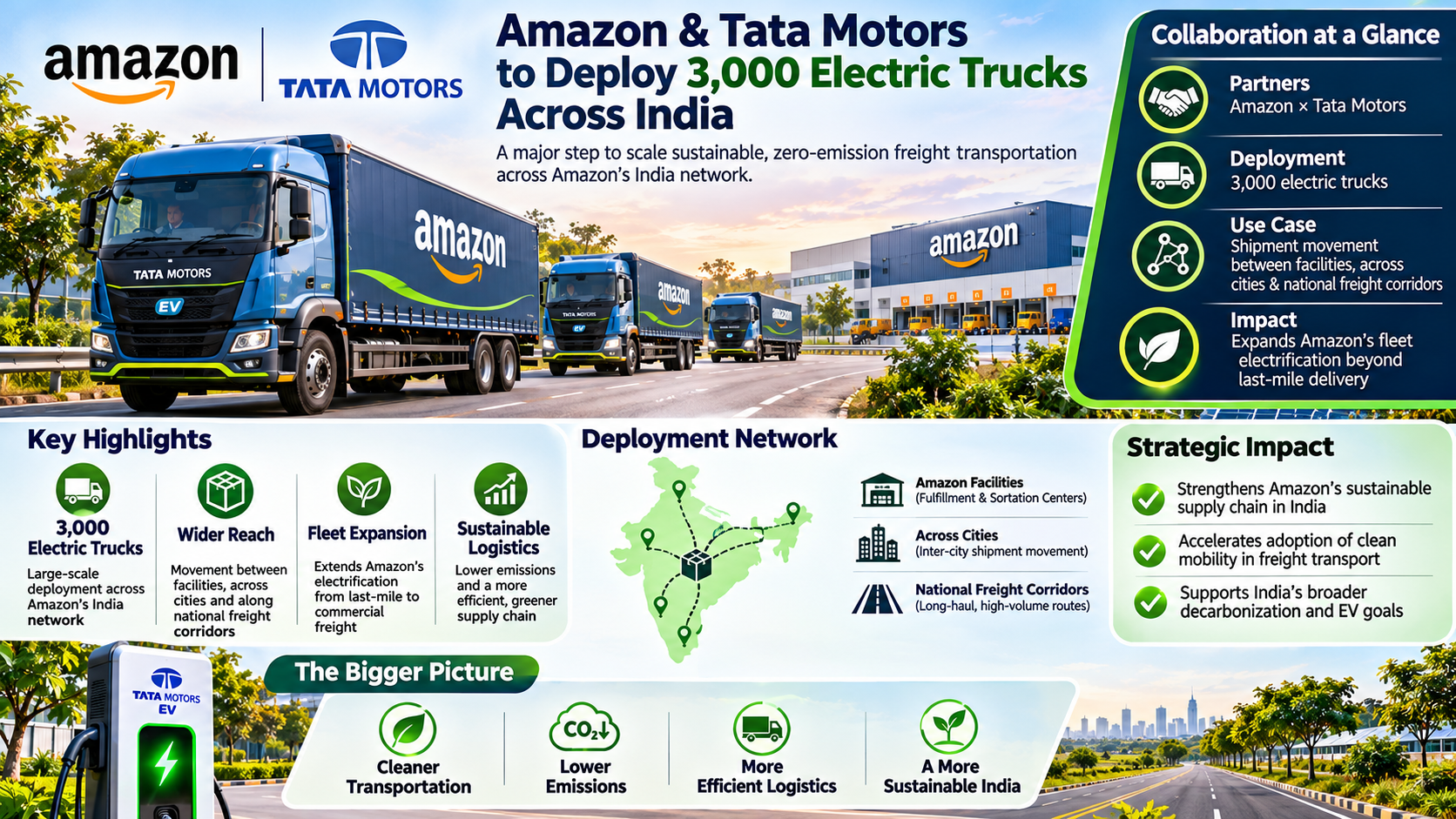
Amazon and Tata Motors have announced a collaboration to deploy 3,000 electric trucks across Amazon's transportation network in India.
Amazon and Tata Motors have announced a collaboration to deploy 3,000 electric trucks across Amazon's transportation network in India. The initiative will support shipment movement between facilities, across cities and along national freight corridors. The planned deployment marks a major expansion of Amazon's fleet electrification efforts beyond last-mile delivery into commercial freight transportation.
Main Announcement
Under the collaboration, Tata Motors will supply electric trucks to meet Amazon's transportation requirements, while Amazon's carrier partners will own and operate the vehicles. The initial rollout will begin in Delhi with light- and medium-duty electric trucks serving Amazon's middle-mile network. The first batch of vehicles was flagged off in New Delhi on October 27. The deployment will subsequently expand towards major national highways, including the Delhi–Bengaluru–Chennai corridor along NH48. Dedicated charging infrastructure, including hubs being developed with charging infrastructure provider Yahhvi, is expected to support the expansion.
Business Significance
The collaboration addresses the challenge of electrifying commercial freight, where vehicle range, charging access, operating costs and service availability can influence adoption. Amazon's logistics demand provides a potential operating base for electric trucks, while Tata Motors contributes vehicle manufacturing, engineering and service capabilities. The initiative could also support the development of electric commercial-vehicle infrastructure in India. Its wider impact will depend on vehicle utilisation, charging availability, operating performance and the pace of deployment.
Important Facts and Statistics
The companies have disclosed the following details:
Planned deployment: 3,000 electric trucks across Amazon's Indian transportation network.
Initial location: Delhi, with deployment beginning during the festive season.
Freight corridor: A planned expansion towards the 2,800-kilometre Delhi–Bengaluru–Chennai corridor along NH48.
Geographic coverage: The proposed corridor spans seven states and connects six major e-commerce regions.
Vehicle ownership: Amazon's carrier partners will own and operate the trucks.
Infrastructure: Charging hubs being developed with Yahhvi will support the rollout.
Executive Quotations
Abhinav Singh, Vice President of Operations for Amazon across Asia-Pacific, the Middle East, Africa and Turkey, said: “Electrifying our logistics and transportation network is an important part of Amazon’s goal to achieve net-zero carbon emissions by 2040.” Rajesh Kaul, Vice President and Business Head – Trucks at Tata Motors, said: “Electric trucking in India is moving beyond the pilot stage and entering a phase of wider adoption.” Both statements reflect the companies' stated objectives of expanding fleet electrification and supporting the wider adoption of electric commercial vehicles.
Future Plans and Developments
The initial deployment will focus on city freight operations in Delhi before expanding to major highway routes. The companies aim to extend electric-truck operations along the Delhi–Bengaluru–Chennai corridor, supported by dedicated charging infrastructure. The pace of expansion will depend on vehicle deployment, charging facilities and operational requirements.
About the Companies
Amazon is a global technology and e-commerce company with businesses spanning online retail, cloud computing, digital services and logistics. In India, its transportation network supports the movement of customer shipments between fulfilment facilities and delivery locations. Amazon has stated that its goal is to achieve net-zero carbon emissions by 2040.
Tata Motors is an Indian commercial-vehicle manufacturer offering trucks, buses and mobility solutions. Its commercial-vehicle business is developing electric trucks and related services for freight and logistics operations. Under this collaboration, Tata Motors will supply the vehicles, while Amazon's carrier partners will operate them.