
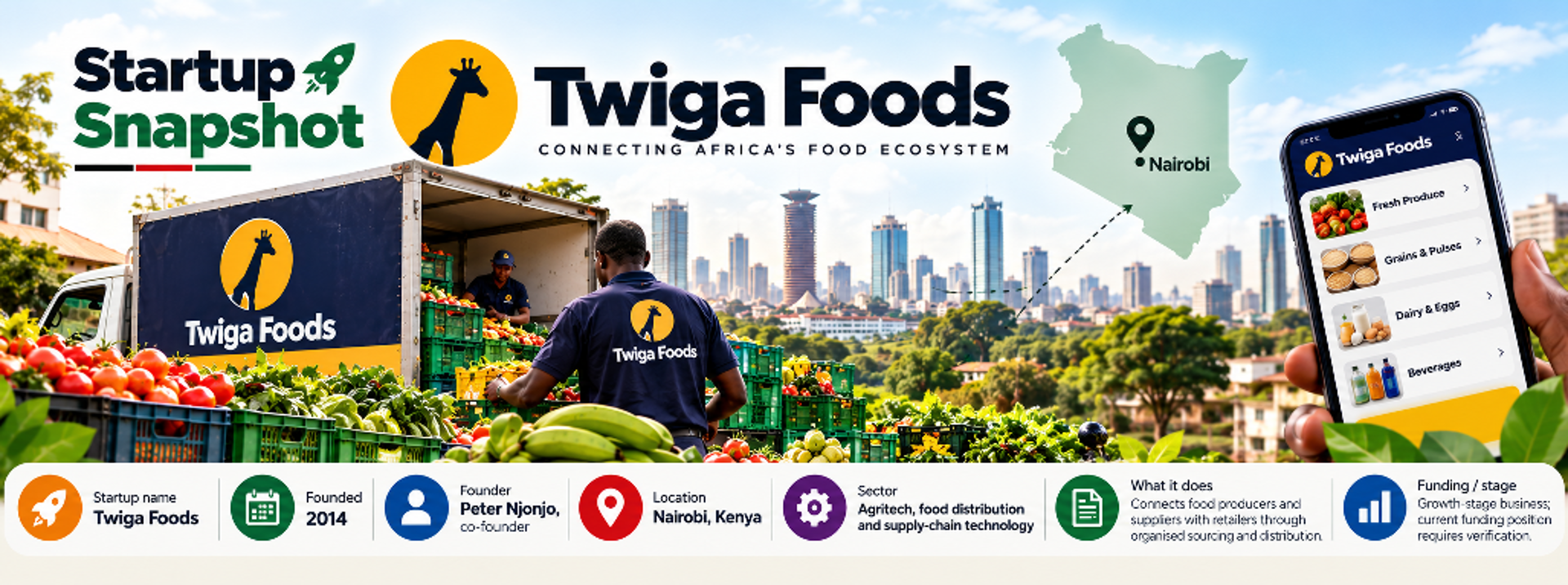
About Twiga Foods
The Kenyan agritech company is using technology and supply-chain coordination to connect farmers, vendors and consumers in a fragmented food market.
1. The Spark
Kenya's fresh-food supply chain has traditionally relied on multiple intermediaries connecting farmers with traders, kiosks, shops and other retailers. Fragmented sourcing, inconsistent supply, limited market information and food spoilage can increase costs for businesses while reducing the returns farmers receive.
Twiga Foods was established in 2014 to address these challenges by organising the movement of fresh produce and other consumer goods between suppliers and retailers. Its underlying business proposition was straightforward: use technology, procurement coordination and distribution infrastructure to make food supply more efficient. The opportunity extended beyond selling produce. It involved improving the reliability of transactions in a market where small retailers and farmers often operate with limited resources.
2. The Product
Twiga Foods developed a technology-enabled distribution model that connects producers and suppliers with retailers. Rather than requiring every small shop to negotiate separately with multiple suppliers, an organised platform can consolidate orders and coordinate deliveries. For farmers, this approach can create additional routes to market and potentially improve access to buyers. For retailers, consolidated procurement can simplify ordering, improve product availability and reduce the time spent sourcing stock.
The model also creates opportunities to use transaction data to understand purchasing patterns, forecast demand and plan deliveries. However, the commercial benefits depend on execution: procurement prices, delivery reliability, spoilage, payment terms and customer retention all influence profitability.
3. The Journey
Building a food-distribution business requires more than a digital ordering platform. The company must coordinate physical operations, including sourcing, quality checks, warehousing, transportation and delivery schedules. Twiga's development reflects a wider challenge facing African technology startups: digital innovation must be supported by reliable offline infrastructure. A platform may attract retailers, but repeat business depends on whether the correct products arrive on time and at competitive prices.
The company has attracted international investor attention during its growth. Its history also illustrates why expansion in food distribution requires careful management of working capital, logistics and operating costs. As the business evolves, the central question is how to build a commercially sustainable network while serving customers with relatively small purchasing budgets.
4. The Traction
Twiga Foods has operated in Kenya's organised food-distribution market and has attracted investment to develop its business. Its model addresses a large, recurring need: retailers must replenish food and consumer products continuously. However, current revenue, active retailer numbers, annual produce volumes, profitability and workforce figures should not be quoted without recent company disclosures or independently verified records.
For a rigorous business profile, useful performance indicators include monthly active retailers, repeat-order rates, average order value, delivery costs per order, spoilage rates and gross margins. These figures reveal whether distribution efficiency translates into sustainable commercial returns rather than merely increasing transaction volumes.
5. The Challenges
Food distribution is a low-margin, operationally demanding business. Fuel prices, vehicle maintenance, warehouse expenses and changing farm-gate prices can quickly affect margins.
Fresh produce adds another risk because tomatoes, avocados and other perishable products can lose value when deliveries are delayed, or demand is overestimated. The business must balance sufficient inventory with the risk of unsold stock. Competition from traditional wholesalers, independent distributors and emerging digital platforms can also constrain pricing power. Access to working capital is essential because suppliers, transport operators and employees must be paid even when retailers delay payments.
Ultimately, technology creates an advantage only when it improves measurable outcomes such as delivery efficiency, customer retention or the cost of fulfilling each order.
6. What's Next?
Twiga's longer-term opportunity lies in improving distribution economics, strengthening supplier relationships and using data to align procurement with retailer demand. Potential growth areas include better demand forecasting, inventory management, route optimisation and partnerships with producers and institutional buyers. Expansion into new regions or product categories would require evidence of sufficient demand, dependable supply and attractive unit economics.
Investors and industry observers should monitor verified financial disclosures, operational performance and the company's current strategic direction before assessing its future growth potential.