
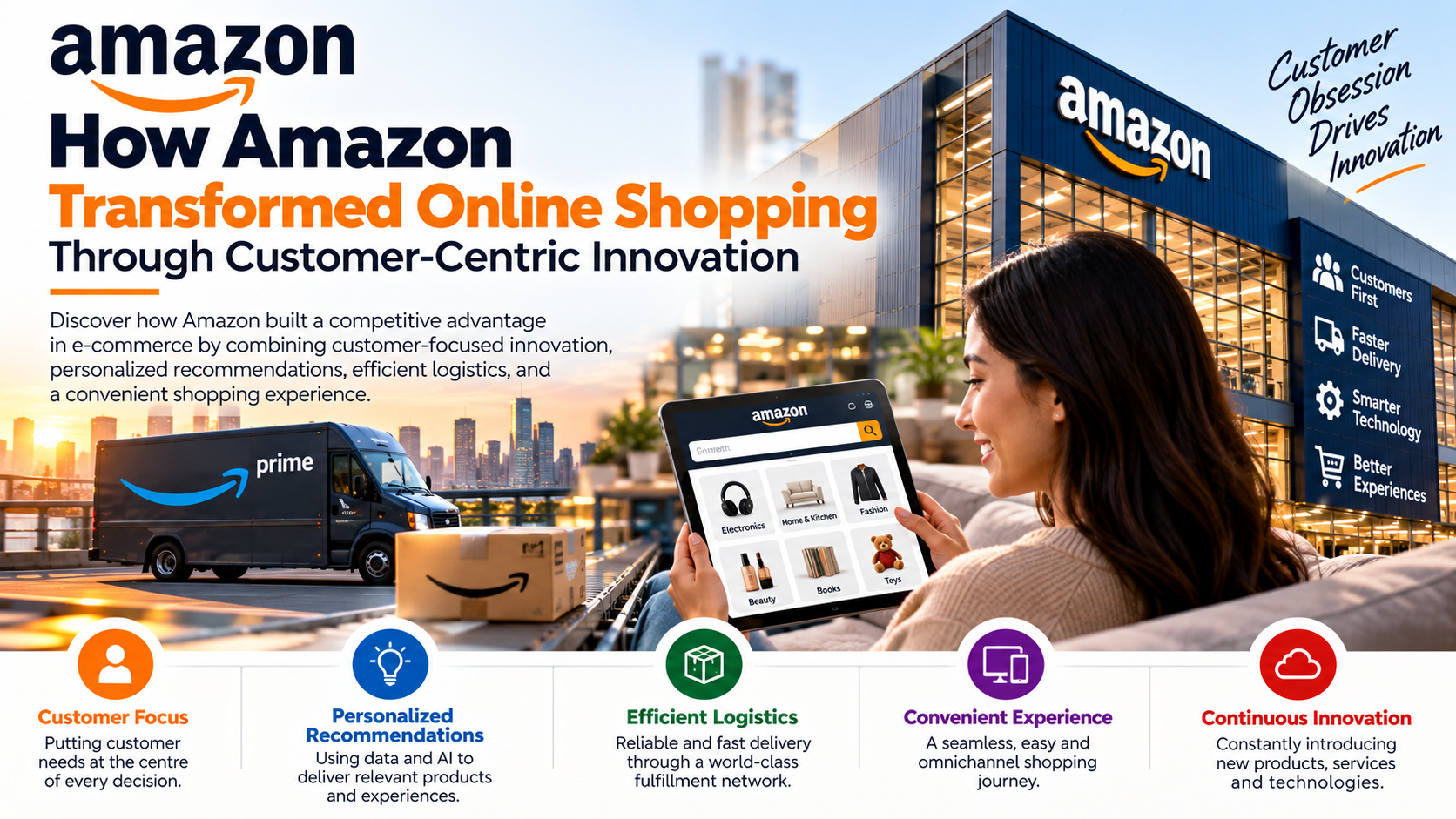
Discover how Amazon built a competitive advantage in e-commerce by combining customer-focused innovation, personalized recommendations, efficient logistics, and a convenient shopping experience.
Introduction
E-commerce success depends on more than attracting customers; businesses must also deliver orders quickly, reliably, and cost-effectively. Dragon Glassware, a kitchenware and home décor brand, faced this challenge as its online business expanded across multiple sales channels. Managing orders, inventory, and shipping through a growing operation became increasingly complex. The company turned to Amazon’s Multichannel Fulfillment (MCF) service to streamline logistics and support its expansion. Its experience demonstrates how fulfillment technology can help e-commerce businesses scale efficiently.
The Challenge
As consumer preferences shifted toward online shopping, Dragon Glassware expanded beyond a single sales channel to reach customers across multiple e-commerce platforms. This strategy created opportunities for revenue growth but also introduced operational challenges.The company needed to manage increasing order volumes while maintaining consistent delivery standards. Processing orders from different platforms could create additional administrative work, complicate inventory management, and increase the risk of fulfillment delays.Logistics costs were another concern. Picking, packing, shipping, and coordinating deliveries required resources that could otherwise support product development, marketing, and customer acquisition. For a growing business, these expenses could reduce profit margins and make expansion more difficult.
Customers also expected fast, dependable deliveries regardless of where they purchased products. Delays or inconsistent service could negatively affect satisfaction, repeat purchases, and brand reputation. Dragon Glassware therefore needed a fulfillment solution capable of supporting multiple sales channels without requiring the company to build an increasingly complex logistics operation. Its objective was to improve delivery speed, control costs, and maintain reliable service while continuing to grow its online business.
The Big Idea / Strategy
Dragon Glassware’s strategy centered on simplifying fulfillment through Amazon Multichannel Fulfillment, a service that allows businesses to use Amazon’s fulfillment network to process orders originating from other sales channels. Rather than expanding its own warehousing and shipping infrastructure in proportion to every increase in demand, the company could leverage an established logistics network. This approach helped it focus on its core strengths, including product quality, merchandising, branding, and customer relationships.
The strategy had three primary objectives.
First, centralize fulfillment operations by using an established provider to handle essential warehouse activities, including picking, packing, and shipping.Second, improve delivery performance by drawing on an established fulfillment network designed to process orders efficiently and serve customers across different locations.
Third, control operating costs by reducing the complexity associated with managing fulfillment independently across multiple e-commerce channels.The broader business principle was straightforward: growth should not require a proportionate increase in operational complexity. By treating logistics as a strategic capability rather than simply a back-office function, Dragon Glassware aimed to make its multichannel business more scalable, efficient, and responsive to customer expectations.
The Execution
Dragon Glassware implemented Amazon MCF to support order fulfillment across its e-commerce channels. The service provided access to Amazon’s logistics infrastructure, allowing the company to outsource essential fulfillment activities instead of managing every operational step independently.The implementation focused on making order processing more consistent. Once customer orders entered the fulfillment process, the service handled picking, packing, and shipping, reducing the manual coordination required from the business.
This approach also helped simplify multichannel operations. Rather than developing a separate logistics workflow for every online marketplace or storefront, the company could use a common fulfillment solution to support orders originating from different channels. The business could consequently direct more attention toward customer demand, product assortment, sales opportunities, and brand development. Meanwhile, a specialized fulfillment network handled much of the physical work involved in delivering purchases.
Reliable shipping performance remained essential throughout execution. Faster delivery had to be accompanied by consistent order handling and dependable service, ensuring that operational improvements translated into a better customer experience. By integrating external fulfillment capabilities into its operating model, Dragon Glassware established a more practical foundation for managing growth without building an equally complex in-house logistics operation.
The Results
Dragon Glassware reported measurable improvements after adopting Amazon Multichannel Fulfillment. The company improved shipping speeds by 50% and reduced logistics costs by 35%. It also achieved an on-time delivery rate exceeding 99%.These outcomes demonstrate how fulfillment optimization can improve both operational efficiency and customer service. Faster shipping helps customers receive their purchases sooner, while reliable delivery supports confidence in the online shopping experience.
The reduction in logistics costs also gives businesses greater flexibility when managing growth. Lower fulfillment expenses can help protect margins and free resources for marketing, product innovation, and customer acquisition.Most importantly, the results illustrate the value of aligning operational infrastructure with business strategy. By using an established fulfillment network, Dragon Glassware improved delivery performance without relying entirely on expanding its own logistics capabilities.
Although these figures are specific to the company, they offer a useful benchmark for e-commerce businesses evaluating outsourced fulfillment solutions.
Overall Results
50% faster shipping: Improved delivery speed and customer convenience.
35% lower logistics costs: Reduced the expense of fulfilling online orders.
Over 99% on-time delivery: Supported consistent and dependable service.
Simplified multichannel operations: Enabled fulfillment across multiple sales channels.
Greater scalability: Helped the business support growth without equivalent investment in internal logistics infrastructure.