
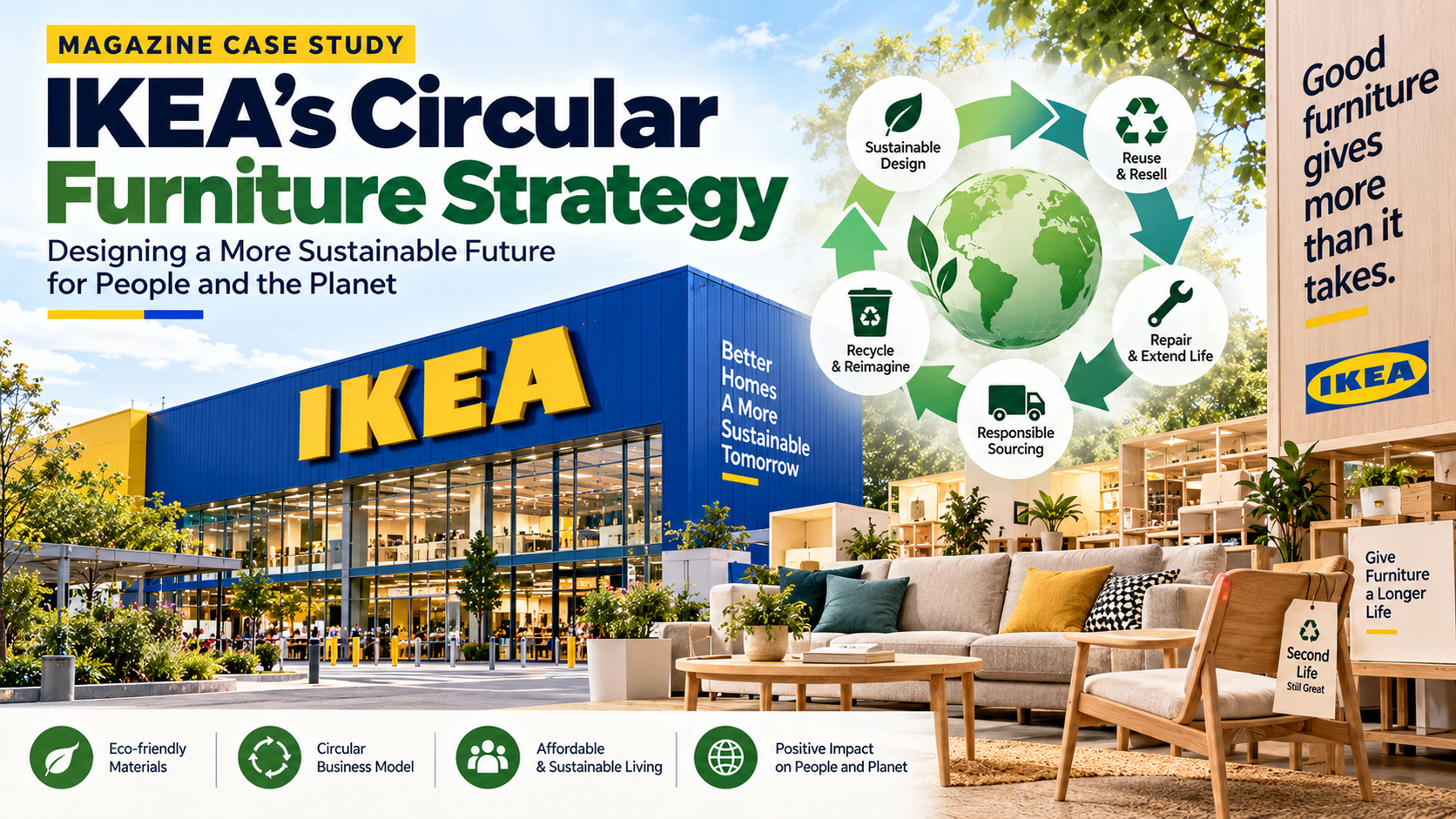
How IKEA turned used furniture into a circular business opportunity through buy-back, resale, and reuse helping customers save money while extending product life.
Introduction
As sustainability becomes an important consideration for retailers, IKEA is rethinking what happens to furniture after its first owner no longer needs it. Instead of treating used products as waste, the company is building a circular business model that encourages customers to return, reuse, and resell furniture. Its Buyback & Resell initiative gives eligible products another life while offering customers store credit. The approach connects environmental responsibility with affordability and creates opportunities beyond traditional retail sales.
The Challenge
Traditional furniture retail largely follows a linear model: products are manufactured, sold, used, and eventually discarded. This creates challenges involving material consumption, waste generation, and the environmental impact of producing replacement furniture. Customers also face practical difficulties when moving homes, changing interiors, or replacing furniture. Selling used items independently can require considerable time and effort, while disposing of functional products may seem wasteful. At the same time, new furniture can be expensive for budget-conscious households.
For IKEA, the challenge was to make reuse convenient, accessible, and commercially relevant without compromising product quality or customer confidence. A successful second-hand offering needed reliable condition checks, transparent pricing, and a process for collecting and reselling eligible items.The company also needed to make circular consumption part of its broader business model rather than a temporary sustainability campaign. This meant creating systems that could keep products in use for longer, attract value-conscious shoppers, and support more responsible resource consumption.
The Big Idea
IKEA's strategy was to make circular consumption a practical alternative to buying everything new. Through its Buyback & Resell service, eligible customers can return used IKEA furniture in exchange for an IKEA refund card. Accepted products are then resold, allowing another customer to purchase pre-owned furniture at a lower price.
The concept creates value for three groups. Existing customers receive an incentive to return unwanted furniture. New customers gain access to more affordable products. IKEA extends product life and creates another customer touchpoint beyond the original sale.The approach also supports the company's wider ambition to become more circular by encouraging customers to acquire, care for, repair, and pass on products. Rather than relying exclusively on recycling at the end of a product's life, IKEA prioritises keeping usable items in circulation. The key strategic insight is that sustainability becomes more practical when customers receive a tangible financial benefit and an easy way to participate.
The Execution
IKEA developed a structured process for accepting and reselling eligible furniture. Customers first check the programme's requirements and submit information or photographs of their items. The company assesses eligibility, and the furniture is inspected before a final buy-back value is determined. Accepted products must meet specified conditions, including being clean, complete, functional, and suitable for resale. Customers receive an IKEA refund card, while accepted furniture enters the company's designated resale areas or eligible online channels.
IKEA also uses its Circular Hub and As-Is areas to offer customers access to second-chance products. These can include returned items, display furniture, discontinued products, and functional products with cosmetic imperfections. The execution depends on clear eligibility rules and quality checks. These measures help customers understand what they are purchasing while reducing uncertainty around second-hand furniture. In India, the Buyback & Resell service is currently listed as available only at IKEA Hyderabad. Its availability and terms should therefore be checked locally before customers participate.
The Results
IKEA's circular initiatives have achieved measurable scale. The company sourced nearly 686,500 used IKEA products through its global Buyback service, up from 495,000 in FY24. This demonstrates growing participation in a model that extends product life through resale.
The company's earlier FY24 reporting also recorded more than 260,000 customers returning 495,000 furniture pieces through the service across 28 markets. These figures show that buy-back can operate as a substantial retail activity rather than simply a small environmental experiment.
Beyond the reported figures, the model creates opportunities to attract budget-conscious shoppers, strengthen customer engagement, and retain value from products already in circulation. However, the reported numbers measure programme participation and products sourced, not the total reduction in waste or emissions attributable to buy-back alone.
Overall Results
686,500 products sourced: Global Buyback volume reported for FY25.
Greater affordability: Pre-owned furniture gives customers lower-cost options.
Extended product life: Functional furniture can find new owners.
Circular business model: Resale complements traditional retail.
Customer participation: Refund cards encourage customers to return eligible items.