
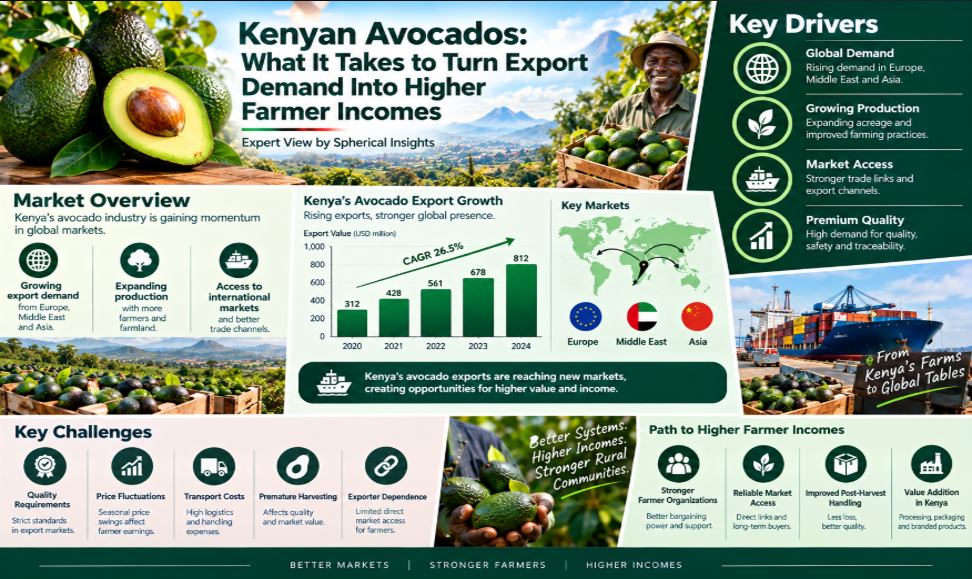
Kenya’s avocado exports are growing, but better farmer incomes depend on quality standards, efficient supply chains, market access and local value addition.
Kenya’s avocado industry is benefiting from international demand, expanding production, and access to markets across Europe, the Middle East, and Asia. However, higher export earnings do not automatically translate into better farmer incomes. Quality requirements, seasonal price fluctuations, transport costs, premature harvesting, and dependence on exporters continue to shape what growers receive. Turning export growth into lasting rural income gains will require stronger farmer organizations, reliable market access, better post-harvest handling, and greater value addition within Kenya.
Kenyan Avocado Exports Are Growing, but Are Farmers Receiving Enough Value?
Kenya exported approximately $160.14 million worth of fresh or dried avocados in 2025, representing 120,893 tonnes, according to World Bank World Integrated Trade Solution (WITS) data based on UN Comtrade statistics. The Netherlands was the largest destination by value, receiving approximately $38.82 million, followed by the United Arab Emirates at $30.87 million. Spain and France were also major destinations. These figures demonstrate the commercial importance of export markets, although export earnings should not be confused with the income retained by farmers after production, aggregation, packing, and logistics costs.
The USDA Foreign Agricultural Service estimated Kenya’s avocado output at approximately 694,000 tonnes in 2025, supported by increased cultivation and improvements in productivity. Average yields were estimated at around 19.5 tonnes per hectare, although results differ according to orchard management, planting material, and irrigation. This expansion creates opportunities for growers, but a larger harvest only improves profitability when fruit quality, market access, and selling prices keep pace with production.
The challenge is visible in the difference between producing fruit and supplying export-ready avocados. Overseas buyers require appropriate maturity, consistent dry matter content, traceability, careful grading, and reliable delivery. Fruit harvested too early can ripen poorly and damage buyer confidence. In February 2026, the Strathmore Agri-Food Innovation Centre highlighted inconsistent dry matter content as a major obstacle to positioning Kenyan avocados as a premium product in China. The issue is therefore not demand alone, but whether Kenyan suppliers can consistently meet the standards needed to secure repeat orders and stronger prices.
We assess that Kenya has established a substantial export business, but the next stage of growth must focus on the value retained by producers. Farmers need transparent farm-gate pricing, predictable purchasing arrangements, affordable compliance support, and access to buyers who reward quality. Without these improvements, export growth can coexist with narrow farm margins and significant exposure to seasonal price changes.
Kenya exported $160.14 million worth of avocados in 2025, shipping 120,893 tonnes, while estimated production reached 694,000 tonnes. The central challenge is converting this production and export demand into reliable, higher returns for farmers.
Why Does Value Capture Matter for Kenyan Avocados?
Several factors explain why the relationship between exports and farmer incomes deserves attention.
First, smallholder dependence. Avocado farming provides an income opportunity for rural households, but smaller growers may lack the volumes, certifications, storage facilities, and negotiating power needed to approach international buyers independently. Organized collection and aggregation can help them access export channels while reducing the disadvantages of selling individually.
Second, quality determines market access. Exporters must meet maturity, grading, food-safety, and traceability requirements. Better quality can improve acceptance rates and support premium positioning, while rejected or poorly ripened fruit can reduce returns and weaken long-term buyer relationships.
Third, logistics absorb part of the export value. Avocados are perishable, and international sales require careful handling, packing, cooling, and transport. Exporters must manage these expenses before paying growers, making efficient logistics and reduced post-harvest losses important to the prices farmers can receive.
Finally, market diversification creates negotiating opportunities. Europe remains an important destination, while the Middle East and Asia offer additional demand. Access to more buyers can reduce dependence on individual trading channels, but diversification only benefits farmers when exporters can meet the quality and delivery requirements of each market.
Market Statistics
· Export value: Kenya exported fresh or dried avocados worth approximately $160.14 million in 2025.
· Export volume: Shipments reached approximately 120,893 tonnes in 2025.
· Production: USDA FAS estimated output at approximately 694,000 tonnes in 2025.
· Average yield: Estimated at around 19.5 tonnes per hectare in 2025, with significant differences between production systems.
· Leading export destination: The Netherlands received approximately $38.82 million worth of Kenyan avocados in 2025, followed by the UAE at $30.87 million.
· Processing opportunity: Kenya’s avocado oil processing increased from 3,326 tonnes in 2024 to 10,188 tonnes in 2025, according to USDA FAS estimates.
· Regulatory development: Kenya opened its 2025/26 sea-export season on April 2, 2026, following maturity assessments and introduced mandatory packhouse inspections from April 7.
Major Developments Shaping Kenya’s Avocado Industry in 2026
Export Demand Creates Opportunities, but Competition Remains Strong
Kenya’s export trade is supported by established European buyers and growing demand from the Middle East and Asia. However, international competition from established producers means that supply volume alone is not enough. Exporters need consistent quality, efficient logistics, and dependable delivery to retain customers. For farmers, stronger buyer relationships and transparent pricing arrangements are essential if growing international demand is to translate into higher farm-gate returns.
Export Season Controls Put Fruit Maturity in Focus
On March 31, 2026, the Kenya Export Promotion and Branding Agency reported that the Agriculture and Food Authority (AFA) had opened the sea-export season effective April 2. Mandatory packhouse inspections were scheduled to begin on April 7, with maturity standards and handling requirements emphasized. The measures aim to protect Kenya’s reputation by limiting immature fruit and poor-quality consignments. Although compliance can add operational requirements, it can also help protect long-term market access and the value of acceptable fruit.
China Offers Potential for Premium Market Development
China represents a potential growth market, but success depends on meeting demanding quality standards. A February 2026 analysis by Strathmore Agri-Food Innovation Centre noted that Chinese buyers require dry matter content of at least 23%, while some previously observed Kenyan shipments recorded levels as low as 18%. Such inconsistency can undermine ripening performance and consumer confidence. Investment in maturity testing, farmer training, traceability, and buyer partnerships will be important if Kenyan exporters want to compete on quality rather than price alone.
Avocado Oil Processing Opens Another Route to Market
Kenya’s avocado oil processing increased from 3,326 tonnes in 2024 to 10,188 tonnes in 2025, according to USDA FAS estimates. Processing can create an alternative outlet for suitable fruit that does not meet fresh-market specifications, potentially reducing waste and broadening market opportunities. However, processing will improve farmer incomes only if processors offer competitive prices, maintain reliable purchasing arrangements, and account for the costs of collecting and handling fruit.
Sea-Export Closure Highlights Supply and Seasonal Risks
On October 28, 2026, the Kenya News Agency reported that AFA had announced the closure of the sea-export harvesting season from October 30 after a nationwide assessment found insufficient export-ready supplies. The closure covers Hass, Fuerte, Pinkerton, and Jumbo varieties for sea shipments, while air exports may continue subject to inspection and traceability requirements. The decision illustrates the importance of maturity controls, but it also creates short-term uncertainty for farmers and exporters who depend on sea freight. Growers need alternative outlets and better harvest planning to manage such disruptions.
What Challenges Could Prevent Farmers From Earning More?
Price Volatility and Seasonal Oversupply: Farm-gate prices can weaken when many growers harvest simultaneously. Without reliable market information, coordinated harvesting, or alternative buyers, farmers may have limited bargaining power when supply increases.
Quality Rejection and Premature Harvesting: Fruit harvested before reaching the required maturity can fail to ripen properly and may be rejected by buyers. This reduces saleable volumes, damages Kenya’s reputation, and can lead exporters to tighten purchasing requirements.
High Logistics and Compliance Costs: Grading, packaging, cooling, certification, transport, and traceability add costs throughout the supply chain. Smallholders can struggle to finance these requirements independently, particularly when they cannot guarantee export-grade volumes.
Unequal Bargaining Power: Farmers selling through intermediaries may have limited visibility into export prices, grading decisions, or deductions. Transparent weighing, documented quality assessments, and clear payment terms can help reduce disputes and improve trust.
5Limited Local Value Addition: Selling fresh fruit can generate export earnings, but additional value can also be created through avocado oil, processed ingredients, branding, and improved packaging. Expanding processing without reliable demand, suitable technology, and fair procurement arrangements, however, does not automatically guarantee better farm incomes.
How Will Different Stakeholders Be Affected?
- Smallholder Farmers and Cooperatives
Smallholders can benefit from export demand when they have access to quality seedlings, agronomic advice, aggregation facilities, and transparent contracts. Cooperatives can negotiate collectively, coordinate harvesting, and share certification and transport costs. Their success will depend on sound governance, timely payments, and a clear relationship between fruit quality and the price paid to growers.
- Exporters and Packhouses
Exporters and packhouses are responsible for sourcing, grading, packing, cooling, and delivering fruit that meets overseas requirements. Better supplier relationships and consistent quality can reduce rejection risks and strengthen repeat business. However, seasonal restrictions, logistics disruptions, and compliance expenses require more careful sourcing and supply planning.
- Processors and Food Manufacturers
Avocado oil processors and other food manufacturers can provide alternative outlets for suitable fruit and create additional domestic value. This may help diversify revenue beyond fresh exports. The benefits for growers depend on transparent pricing, dependable collection networks, and processing capacity that can operate economically throughout the supply season.
- Logistics Providers and Export Service Companies
Cold-chain operators, packhouses, transporters, testing laboratories, and certification providers play a major role in maintaining fruit quality. Investments in cooling, handling, and traceability can improve export reliability and reduce losses. More efficient services may also reduce the costs that otherwise limit the prices exporters can offer farmers.
- International Buyers and Retailers
European, Middle Eastern, and Asian buyers need reliable supplies that meet their quality and traceability requirements. Consistent Kenyan produce can strengthen long-term sourcing relationships, while repeated quality problems can encourage buyers to switch suppliers. Clear specifications, advance purchasing arrangements, and constructive feedback can help farmers and exporters plan production around market needs.
Opportunities to Turn Export Demand Into Higher Farmer Incomes
Kenya’s avocado industry has several practical opportunities:
· Strengthen farmer cooperatives: Aggregate volumes, improve negotiating power, and share certification and transport costs.
· Improve orchard productivity: Expand access to quality planting material, irrigation where suitable, pest management, and technical training.
· Measure maturity before harvesting: Use dry matter testing and better harvest scheduling to improve fruit quality and reduce rejection.
· Expand direct buyer relationships: Develop transparent supply agreements with importers, retailers, and processors.
· Invest in cold-chain infrastructure: Improve handling, packing, cooling, and storage to reduce post-harvest losses.
· Develop traceability systems: Maintain farm-level records and shipment documentation to meet buyer requirements.
The greatest opportunity is to connect these measures. Higher productivity without quality control can increase oversupply, while improved quality without affordable logistics can still leave farmers with low margins. Sustainable gains require coordinated improvements across the whole value chain.
Conclusion
Kenya’s avocado industry has built a substantial export business, with approximately $160.14 million in fresh or dried avocado exports and 120,893 tonnes shipped in 2025. Estimated production reached 694,000 tonnes, while expanding avocado oil processing offers another potential route to market. Yet export value alone does not reveal how much income farmers retain. Seasonal supply restrictions, quality failures, logistics costs, and unequal bargaining power continue to shape grower returns. The next phase of growth will depend on consistent maturity standards, transparent farm-gate pricing, stronger cooperatives, efficient cold chains, and reliable relationships with overseas buyers. The immediate indicators to watch are the effect of the October 2026 sea-export closure, the availability of alternative markets, the performance of quality controls, and whether processing growth creates dependable demand for farmers’ fruit. If Kenya combines export competitiveness with fairer procurement and stronger local value addition, international demand can become a more reliable source of rural income. Without these improvements, production and exports may grow faster than the benefits reaching growers.