
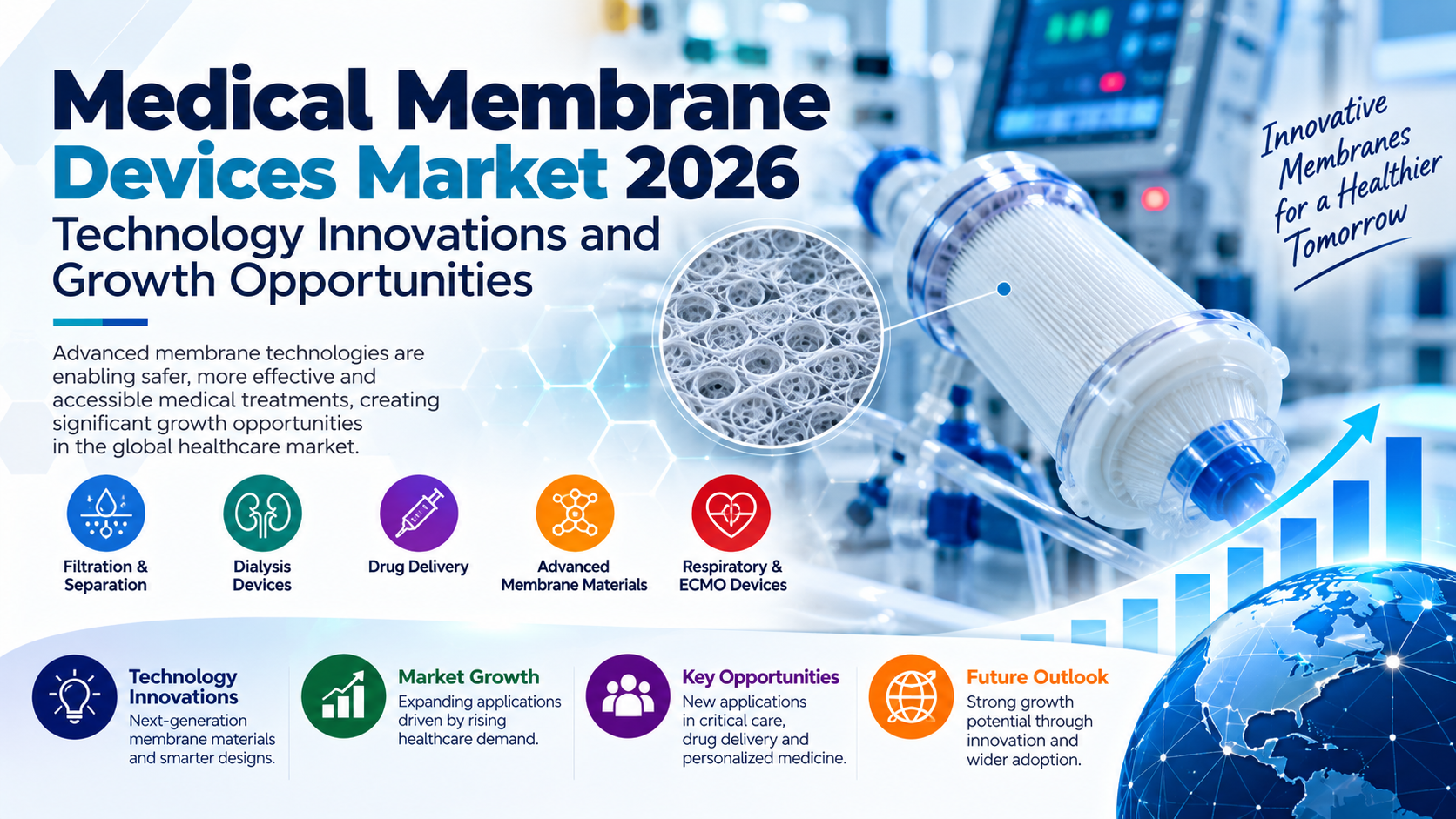
Medical membrane demand is forecast to grow about 7% to 9% a year. See the 2026 technology shifts, key segments, risks and growth opportunities.
Medical membrane demand is forecast to grow about 7% to 9% a year. See the 2026 technology shifts, key segments, risks and growth opportunities.
Introduction
Medical membranes sit inside some of healthcare’s most critical devices: the dialyzers that clean blood, the oxygenators that support failing lungs, and the sterile filters that make biologic drugs and intravenous fluids safe. Market research firms put the global medical membrane market at roughly $4.2 billion to $4.5 billion in 2025, with forecasts implying annual growth of about 7% to 9% over the coming years. Demand is rising as chronic kidney disease spreads, biologic drug output expands and regulators tighten sterility expectations. At the same time, new membrane chemistry, medium cut-off dialysis and single-use filtration are changing what buyers expect. This article reviews the current landscape, the forces behind growth, the technology shifts that matter most, the main risks, and what the evidence suggests comes next.
Market Structure and Regional Distribution
Medical membranes are thin polymer barriers, usually engineered as hollow fibers or flat sheets, that separate substances by size or charge. Their main uses are pharmaceutical filtration, hemodialysis, intravenous and sterile filtration, and membrane oxygenators. One estimate splits the 2025 market into about 36% pharmaceutical filtration, 29% hemodialysis, 19% IV and sterile filtration and 16% oxygenators, with polyethersulfone, polysulfone, PVDF and PTFE among the leading materials. North America held roughly 39% of revenue, followed by Europe at 28% and Asia-Pacific at 25%. Published figures vary because publishers define the market differently: 2025 estimates run from $4.2 billion to $4.5 billion, and forecasts for 2030 or 2034 range from $6.6 billion to $9.7 billion. Even the leading technology differs, with one report naming microfiltration and another ultrafiltration. All such numbers are best treated as directional rather than exact.
Key Drivers or Major Developments
Disease burden is the strongest driver. A Lancet analysis covering 204 countries estimated that about 788 million adults lived with chronic kidney disease in 2023, up from about 378 million in 1990, with roughly 1.48 million deaths. Dialysis overall is a $125.8 billion market in 2025 and is projected to reach $181.2 billion by 2034, and hemodialysis membranes capture part of that spending.
Biologics are the second driver. Growth in biologic drugs and vaccines, together with single-use bioprocessing, lifts demand for sterile and ultrafiltration membranes. Suppliers have responded with capacity and product moves, including Sartorius expanding biologics filtration production in 2024 and Cytiva launching sterile filtration technology for vaccine production the same year.
Regulation and infection control form the third driver. Stricter sterilization rules and concern about hospital-acquired infections favor validated membrane filtration.
Critical care is the fourth. Extracorporeal life support is widening oxygenator use, and extracorporeal CPR is the fastest-growing oxygenator application in one forecast.
What Trends Are Shaping Medical Membrane Technology?
Dialysis membranes are where innovation is most visible. Medium cut-off (MCO) membranes use polyarylethersulfone and polyvinylpyrrolidone with larger, more uniform pores that clear middle molecules of roughly 25 to 58 kDa while retaining more albumin than high-flux membranes. Because they run on standard dialysis machines, providers can adopt expanded hemodialysis without new equipment, a point Nipro stressed when it launched its Elisio-HX medium cut-off dialyzer in the United States after FDA 510(k) clearance. A meta-analysis of 18 prospective studies covering 853 patients found better reduction of beta-2 microglobulin and free light chains than high-flux membranes. The evidence has limits: it does not show a mortality benefit for MCO, and albumin loss of 1.2 to 3.5 grams per session remains a documented effect.
High-volume hemodiafiltration (HDF) is the performance benchmark. The CONVINCE trial of 1,360 patients reported all-cause mortality of 17.3% with HDF versus 21.9% with high-flux hemodialysis, a 23% reduction in the risk of death, although HDF is not used in the United States and is not suitable for every patient.
Elsewhere, oxygenators are moving toward long-duration hollow-fiber designs, about 60% of one oxygenator estimate, and antithrombotic or nitric oxide-releasing coatings are emerging as differentiators, though mostly still at research stage. Wearable and bioartificial kidneys remain early; a wearable dialysis system was tolerated for 24 hours before the trial stopped early over technical problems.
Challenges and Opportunities
Material regulation is a rising risk. The EU’s proposed PFAS restriction names fluoropolymers such as PTFE among materials used in devices, it is not yet known whether medical devices will receive derogations, and the restriction is now expected no earlier than 2029 to 2030. PTFE accounts for about 13% of material share, and a material change under the EU MDR may require a new conformity assessment. Other constraints include high polymer and sterile manufacturing costs, lengthy validation, and fouling that limits membrane life. Supplier concentration is a further concern, highlighted by a 2023 FDA communication on a Getinge oxygenator packaging issue.
Opportunities lie in biologics filtration, in Asia-Pacific, the fastest-growing region in portable dialysis and single-use systems, and in MCO products that fit existing machines.
What Comes Next?
Forecasts point to continued expansion. Publishers project the market reaching about $6.6 billion by 2030, or $8.5 billion to $9.7 billion by 2034, at annual rates of roughly 7% to 9%. Asia-Pacific is expected to grow fastest, led by China, India and Japan. Several variables could shift that path: whether MCO and HDF evidence translates into wider clinical adoption, how the PFAS restriction treats medical devices, and whether coatings and long-duration oxygenators move from research to routine use. Many forecasts come from commercial market-research firms whose methods are not fully disclosed, so they are best read as scenarios rather than guarantees. Clinical-trial results and regulatory decisions are the indicators to watch.
Conclusion
Medical membranes pair steady, health-driven demand with fast-moving materials and device engineering. Chronic disease, biologic drug production and critical-care needs provide a durable base, while MCO dialysis, hollow-fiber oxygenators and single-use filtration show where differentiation is happening. The evidence supports growth but not precision: market estimates diverge, some clinical benefits remain debated, and material rules such as PFAS could reshape supply chains. Companies that combine validated performance with compliant materials and reliable supply are best placed to turn demand into lasting advantage.