
Global 3D Cardiac Mapping System Market
 |
Pages:
240
|
Pages:
240
Global 3D Cardiac Mapping System Market Size, Share, and COVID-19 Impact Analysis, By Mapping Technique (Percutaneous, and Intra-cardiac), By Data Modality (High-Definition Mapping, and Non-High-Definition Mapping), By Application (Ventricular Arrhythmia Mapping, Supraventricular Arrhythmia Mapping, Electrophysiology Mapping, and Others), and By Region (North America, Europe, Asia-Pacific, Latin America, Middle East, and Africa), Analysis and Forecast 2025-2035
REPORT COVERAGE
Global
Global 3D Cardiac Mapping System Market Size Insights Forecasts to 2035
- The Global 3D Cardiac Mapping System Market Size Was Estimated at USD 1.95 Billion in 2024
- The Market Size is Expected to Grow at a CAGR of around 8.62 % from 2025 to 2035
- The Worldwide 3D Cardiac Mapping System Market Size is Expected to Reach USD 4.84 Billion by 2035
- North America is expected to grow the fastest during the forecast period.
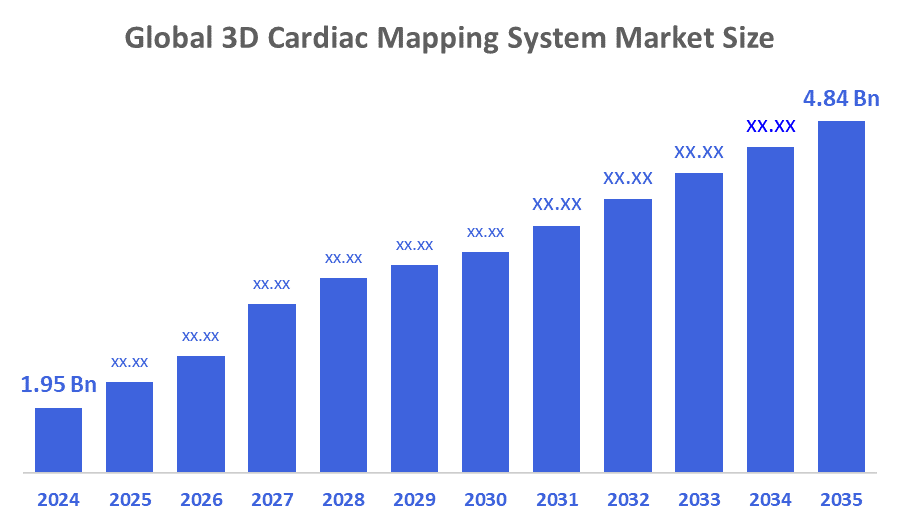
According to a research report published by Decisions Advisors and Consulting, The Global 3D Cardiac Mapping System Market Size Was Worth Around USD 1.95 Billion In 2024 And Is Predicted To Grow To Around USD 4.84 Billion By 2035 With A Compound Annual Growth Rate (CAGR) Of 8.62 % From 2025 To 2035. The market is expanding significantly due to the growing prevalence of heart conditions and the growing assistance of insurance companies. Market expansion is also being fueled by the increasing number of strategic partnerships between healthcare organisations and market participants.
Market Overview
A 3D cardiac mapping system is an advanced medical technology used in the diagnosis and treatment of cardiac arrhythmias. The system produces a three-dimensional anatomical and electrical map of the heart, which enables physicians to observe how electrical signals move throughout the different chambers of the heart. The systems use real-time electrophysiological data to create detailed anatomical models, which enable users to discover abnormal conduction pathways, discover arrhythmic foci, and direct catheter-based treatments, which include ablation procedures. 3D cardiac mapping provides essential benefits for modern electrophysiology because it decreases radiation exposure, boosts procedural efficiency, and leads to better patient results when compared to traditional fluoroscopy methods. The 3D cardiac mapping system market is experiencing robust growth, driven by several key factors. The worldwide rise in atrial fibrillation, ventricular tachycardia, and other arrhythmias has created strong demand for advanced diagnostic and therapeutic solutions that exist in the market today. The increasing rates of these conditions result from rising lifestyle-related and clinical risk factors, which include hypertension, diabetes and obesity and the growing number of elderly patient pool.
Catheter Precision, Inc. secured up to $36.5 million in strategic institutional financing to accelerate its growth and expand the commercialisation of its advanced cardiac ablation technologies. The funding will support the company’s flagship product, Vivo, a non-invasive mapping system that helps physicians identify arrhythmia sources before ablation procedures.
Report Coverage
This research report categorizes the 3D cardiac mapping system market based on various segments and regions, forecasts revenue growth, and analyzes trends in each submarket. The report analyses the key growth drivers, opportunities, and challenges influencing the 3D cardiac mapping system market. Recent market developments and competitive strategies, such as expansion, product launch, development, partnership, merger, and acquisition, have been included to draw the competitive landscape in the market. The report strategically identifies and profiles the key market players and analyzes their core competencies in each sub-segment of the 3D cardiac mapping system market.
Driving Factors
The 3D cardiac mapping system market is currently experiencing a transformative phase, driven by technological advancements and the growing need for accurate cardiac medical procedures. The combination of advanced imaging methods and instantaneous data processing capabilities, which enables cardiac mapping to achieve better precision, results in superior medical outcomes for patients. The market experiences growth as healthcare providers strive to implement advanced solutions that create straightforward systems that work efficiently with their current clinical operations. The process is developing new methods of conducting cardiac treatment, which create more effective procedures for patient care. Healthcare institutions are increasingly recognising the value of these technologies in diagnosing and treating complex arrhythmias. The market development process receives additional support from personalised medicine, which enables medical professionals to create customised treatment regimens through the use of comprehensive mapping techniques. The 3D cardiac mapping system market will continue to grow because the medical industry adopts new technologies while developing methods that focus on patient care.
San Diego-based Vektor Medical gained CE mark approval for its vMap AI-powered cardiac mapping system, a non-invasive technology that converts standard 12-lead ECGs into detailed 3D electro-anatomical maps of the heart. The vMap system, previously cleared by the FDA in 2021, can generate accurate maps for both focal and fibrillation-type arrhythmias in less than a minute, covering all four chambers of the heart.
Restraining Factors
The technical complexity of 3D cardiac mapping systems necessitates a uniform connection with the infrastructure of other institutions, including imaging systems, data archiving solutions, and catheter labs. The digital health preparedness required to support these technologies and guarantee IT compatibility is lacking in a number of older facilities. Furthermore, a steep learning curve is usually reported by doctors, especially when switching from 2D or fluoroscopy-guided methods to 3D mapping.
Market Segmentation
The 3D cardiac mapping system market share is classified into mapping technique, data modality and application.
- The intra-cardiac segment accounted for the largest share in 2024 and is anticipated to grow at a significant CAGR during the forecast period.
Based on the mapping technique, the 3D cardiac mapping system market is divided into percutaneous and intra-cardiac. Among these, the intra-cardiac segment accounted for the largest share in 2024 and is anticipated to grow at a significant CAGR during the forecast period. It enables tailored ablation operations by providing precise electrical mapping of heart structures and high-resolution imaging. Its efficacy and efficiency in treating complicated cardiac arrhythmias make it extremely valuable.
For instance, an in vitro study has explored the use of intracardiac echocardiography (ICE) via a transjugular approach for transcatheter tricuspid valve repair (TTVR). The research focused on how the imaging device moves within the heart to optimise leaflet detection during repair procedures.
- The high-definition mapping segment accounted for the highest market share in 2024 and is anticipated to grow at a substantial CAGR over the forecast period.
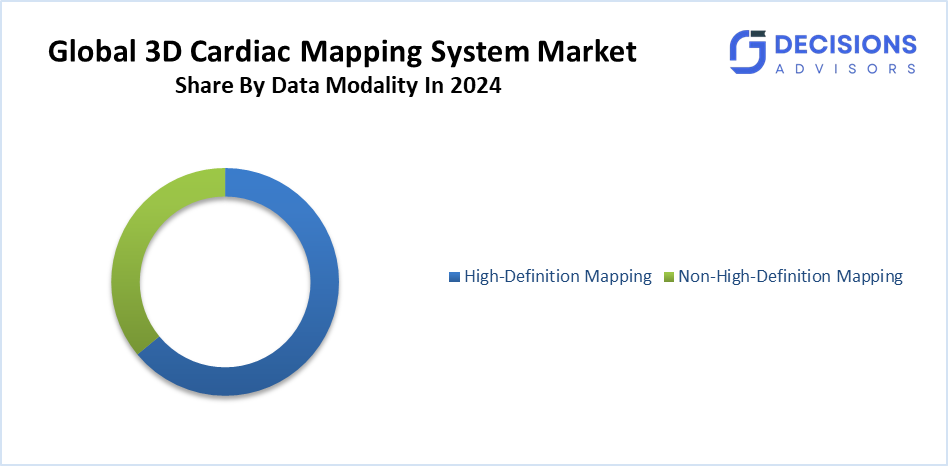
Based on the data modality, the 3D cardiac mapping system market is differentiated into high-definition mapping, and non-high-definition mapping. Among these, the high-definition mapping segment accounted for the highest market share in 2024 and is anticipated to grow at a substantial CAGR over the forecast period. This is because of its exceptional precision and thorough understanding of cardiac arrhythmias. Electrophysiologists choose it for complex operations where accuracy is crucial.
- The ventricular arrhythmia mapping segment accounted for the largest share in 2024 and is anticipated to grow at a significant CAGR during the forecast period.
Based on the application, the 3D cardiac mapping system market is segmented into ventricular arrhythmia mapping, supraventricular arrhythmia mapping, electrophysiology mapping, and others. Among these, the ventricular arrhythmia mapping segment accounted for the largest share in 2024 and is anticipated to grow at a significant CAGR during the forecast period. This is because of its vital function in identifying and treating cardiac problems that pose a hazard to life. Because of the sophisticated technology integration in this segment, arrhythmic foci can be identified with greater accuracy.
For instance, Vektor Medical announced the publication of new clinical results in EP Europace showing that its vMap™ AI-powered cardiac mapping system significantly improves outcomes in patients with unstable ventricular tachycardia (VT). vMap-guided ablation was associated with higher one-year arrhythmia-free survival rates compared to conventional approaches.
Regional Segment Analysis of the 3D Cardiac Mapping System Market
- North America (U.S., Canada, Mexico)
- Europe (Germany, France, U.K., Italy, Spain, Rest of Europe)
- Asia-Pacific (China, Japan, India, Rest of APAC)
- South America (Brazil and the Rest of South America)
- The Middle East and Africa (UAE, South Africa, Rest of MEA)
Asia Pacific is anticipated to hold the largest share of the 3D cardiac mapping system market over the predicted timeframe.
Asia Pacific is anticipated to hold the largest share of the 3D cardiac mapping system market over the predicted timeframe. The region experiences growth because healthcare expenses keep rising while more people develop heart diseases, and the number of elderly citizens increases. The healthcare systems in China and India are developing quickly because they need better infrastructure to support new medical technologies. The region's market is dominated by China and Japan because both countries receive substantial funding from their public and private sectors. The competitive landscape features a mix of local and international players, including Boston Scientific and GE Healthcare. The ongoing drive to enhance healthcare accessibility and service quality will increase demand for advanced cardiac mapping systems during the upcoming years.
For instance, Kauvery Hospital, Vadapalani, became the first in Tamil Nadu to introduce advanced 3D technology for cardiac care. This innovation enhances visualisation during minimally invasive procedures, allowing physicians to achieve greater precision in diagnosing and treating complex heart conditions. The hospital’s adoption of this cutting-edge imaging system reflects a broader trend in Indian healthcare toward integrating real-time 3D visualisation into interventional cardiology.
North America is expected to grow at a rapid CAGR in the 3D cardiac mapping system market during the forecast period. The region experiences growth because it has modern healthcare facilities, and more people develop cardiovascular diseases while medical technology receives major funding. The systems receive innovation support through FDA regulatory frameworks, which boost system implementation and result in better patient outcomes and improved operational efficiency. The United States serves as the dominant market in North America, with Biosense Webster, Abbott Laboratories and Medtronic as its primary industry players. Major companies in the market maintain their competitive position through ongoing technological development and partnership agreements. The active environment creates a strong system that enables the creation and distribution of advanced cardiac mapping technologies.
For instance, Abbott’s FDA approval of the Volt Pulsed Field Ablation (PFA) System is being seen as a major catalyst for its cardiology business in 2026. The Volt system, designed to treat both paroxysmal and persistent atrial fibrillation, delivers rapid, tissue-selective electrical pulses that isolate erratic signals while minimising collateral damage to surrounding structures. This approval positions Abbott alongside Medtronic, Boston Scientific, and Johnson & Johnson’s Biosense Webster in the competitive U.S. PFA market, which is expected to expand rapidly as physicians shift from radiofrequency and cryoablation toward pulsed field approaches.
Competitive Analysis:
The report offers the appropriate analysis of the key organizations/companies involved within the 3D cardiac mapping system market, along with a comparative evaluation primarily based on their product offering, business overviews, geographic presence, enterprise strategies, segment market share, and SWOT analysis. The report also provides an elaborative analysis focusing on the current news and developments of the companies, which includes product development, innovations, joint ventures, partnerships, mergers & acquisitions, strategic alliances, and others. This allows for the evaluation of the overall competition within the market.
List of Key Companies
- Abbott Laboratories
- Acutus Medical Inc.
- Axis Bio Solutions
- Biosense Webster Inc.
- Biotronik SE & Co. KG
- Boston Scientific Corporation
- CardioInsight Technologies Inc.
- Catheter Precision Inc.
- CoreMap Inc.
- Imricor Medical Systems Inc.
- Kardium Inc.
- Koninklijke Philips N.V.
- Lepu Medical Technology Co. Ltd.
- Medtronic plc
- MicroPort Scientific Corporation
- Others
Key Target Audience
- Market Players
- Investors
- End-users
- Government Authorities
- Consulting and Research Firm
- Venture capitalists
- Value-Added Resellers (VARs)
Recent Development
- In May 2025, Philips launched its real-time 3D intracardiac imaging technology in Europe, expanding access to minimally invasive heart procedures. This innovation provides clinicians with enhanced visualisation inside the heart during interventions, improving precision, safety, and efficiency in treating complex cardiac rhythm disorders. Philips aims to reduce procedure times, minimise complications, and broaden the adoption of minimally invasive therapies across European healthcare systems.
- In May 2024, Biosense Webster, a Johnson & Johnson MedTech company, launched a new version of its CARTO 3 Electro-Anatomical Mapping System, one of the most widely used platforms for cardiac ablation procedures. The updated CARTO 3 system enhances real-time 3D mapping, improves workflow efficiency, and integrates advanced visualisation tools to support physicians in treating complex arrhythmias such as atrial fibrillation.
Market Segment
This study forecasts revenue at global, regional, and country levels from 2020 to 2035. Decisions Advisors has segmented the 3D cardiac mapping system market based on the below-mentioned segments:
Global 3D Cardiac Mapping System Market, By Mapping Technique
- Percutaneous
- Intra-cardiac
Global 3D Cardiac Mapping System Market, By Modality
- High-Definition Mapping
- Non-High-Definition Mapping
Global 3D Cardiac Mapping System Market, By Application
- Ventricular Arrhythmia Mapping
- Supraventricular Arrhythmia Mapping
- Electrophysiology Mapping
- Others
Global 3D Cardiac Mapping System Market, By Regional Analysis
- North America
- US
- Canada
- Mexico
- Europe
- Germany
- UK
- France
- Italy
- Spain
- Russia
- Rest of Europe
- Asia Pacific
- China
- Japan
- India
- South Korea
- Australia
- Rest of Asia Pacific
- South America
- Brazil
- Argentina
- Rest of South America
- Middle East & Africa
- UAE
- Saudi Arabia
- Qatar
- South Africa
- Rest of the Middle East & Africa
Frequently Asked Questions (FAQ)
1. What are the primary cost components involved in implementing a 3D cardiac mapping system in hospitals?
The total cost includes capital equipment purchase, mapping software licenses, disposable catheters, integration with imaging systems, staff training, maintenance contracts, and periodic system upgrades. High upfront investment remains a key budgeting consideration for mid-sized healthcare facilities.
2. How does artificial intelligence enhance the performance of 3D cardiac mapping systems?
AI integration improves signal interpretation, automates arrhythmia source detection, enhances mapping accuracy, reduces procedure time, and supports predictive analytics for personalised treatment planning. Machine learning algorithms also assist in minimising operator dependency.
3. What regulatory challenges affect the commercialisation of 3D cardiac mapping systems globally?
Manufacturers must comply with strict regulatory frameworks such as FDA approval (U.S.), CE marking (Europe), and country-specific medical device regulations in the Asia-Pacific. Clinical validation, cybersecurity compliance, and post-market surveillance requirements can extend product launch timelines.
4. How are reimbursement policies influencing market adoption?
Favourable reimbursement for electrophysiology procedures in developed markets encourages adoption. However, inconsistent or limited reimbursement coverage in emerging economies may slow penetration, particularly in public healthcare institutions.
5. What role do ambulatory surgical centres (ASCs) play in the expansion of this market?
ASCs are increasingly performing minimally invasive cardiac procedures due to lower operational costs and shorter patient stays. As mapping systems become more compact and efficient, their adoption in outpatient settings is expected to increase.
6. How does interoperability impact purchasing decisions for 3D cardiac mapping systems?
Hospitals prioritise systems that integrate seamlessly with existing electronic health records (EHR), imaging platforms, catheter labs, and data management infrastructure. High interoperability reduces workflow disruption and enhances clinical efficiency.
7. What future innovations are expected to reshape the 3D cardiac mapping system industry?
Future developments may include cloud-based mapping platforms, robotic-assisted catheter navigation, fully non-invasive mapping solutions, enhanced real-time imaging fusion, and AI-driven automated ablation guidance systems designed to further improve precision and safety.
Check Licence
Choose the plan that fits you best: Single User, Multi-User, or Enterprise solutions tailored for your needs.
We Have You Covered
- 24/7 Analyst Support
- Clients Across the Globe
- Tailored Insights
- Technology Tracking
- Competitive Intelligence
- Custom Research
- Syndicated Market Studies
- Market Overview
- Market Segmentation
- Growth Drivers
- Market Opportunities
- Regulatory Insights
- Innovation & Sustainability
Report Details
| Scope | Global |
| Pages | 240 |
| Delivery | PDF & Excel via Email |
| Language | English |
| Release | Feb 2026 |
| Access | Download from this page |