
Global 3D Laparoscopy Imaging Market
 |
Pages:
240
|
Pages:
240
3D Laparoscopy Imaging Market Size, Share, By Product Type (3D Laparoscopes, 3D Camera Systems, Visualization & Display Systems, and Others), By Application (Gynecological Surgery, Bariatric Surgery, Urological Surgery, and Other Applications), By End User (Hospitals, Ambulatory Surgical Centers, and Others), and By Region (North America, Europe, Asia-Pacific, Latin America, Middle East & Africa), Analysis and Forecast 2026-2035.
CAGR
6.7%
REVENUE 2025
USD Billion 4.91
FORECAST 2035
USD Billion 9.39
REPORT COVERAGE
Global
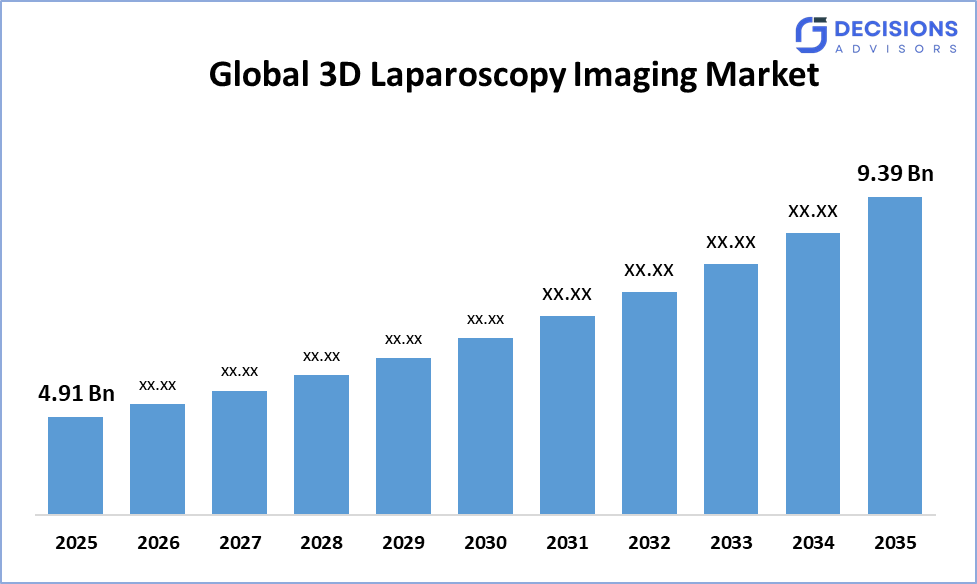
The 3D Laparoscopy Imaging Market Size is predicted to grow from USD 4.91 Billion in 2025 and is likely to reach around USD 9.39 Billion by 2035 with a CAGR of 6.70%. According to Decision Advisors, a detailed research report on the market reflects that the minimally invasive surgery adoption trend dominates the 3D Laparoscopy Imaging Market, accounting for approximately 41% of the total share worldwide. Olympus Corporation leads the market with a comprehensive 3D and 4K surgical visualization portfolio and holds approximately 15-18% global market share, making it the key contributor to global market development and growth dynamics.
Market Snapshot
- 3D Laparoscopy Imaging Market Size (2025): USD 4.91 Billion
- Projected 3D Laparoscopy Imaging Market Size (2035): USD 9.39 Billion
- 3D Laparoscopy Imaging Market Compound Annual Growth Rate (CAGR): 6.70%
- Largest Regional Market: North America
- 2nd Largest Region: Europe
- Fastest Growing Region: Asia Pacific
- Base Year: 2025
- Historical Period: 2021-2024
- Market Forecast Period: 2026-2035
Market Overview/ Introduction
The 3D laparoscopy imaging market refers to the industry that develops advanced stereoscopic visualization systems, including 3D laparoscopes, camera control units, monitors, and light sources, that provide surgeons with enhanced depth perception during minimally invasive procedures. The market is experiencing substantial growth because of the rising prevalence of chronic diseases requiring surgical intervention, increasing preference for minimally invasive surgery over open procedures, and continuous innovation in high-definition imaging technology. Government programs supporting medical device innovation, hospital infrastructure upgrades, and reimbursement reforms for minimally invasive procedures are creating better conditions for the adoption of 3D laparoscopic systems. Key companies, including Olympus Corporation, KARL STORZ SE & Co. KG, Stryker Corporation, Medtronic plc, and B. Braun Melsungen AG, are developing next-generation 3D and 4K fusion imaging platforms that improve surgical precision while reducing operative time. The market provides hospitals and surgical centers with products that combine high-resolution depth perception with ergonomic design, improved workflow integration, and compatibility with existing endoscopy towers. The global market will experience future expansion through the integration of artificial intelligence, robotic-assisted surgery platforms, fluorescence-guided imaging, and the expanding adoption of minimally invasive techniques across gynecological, urological, and bariatric procedures.
- The US FDA's Breakthrough Devices Program continues to support accelerated review pathways for advanced surgical visualization technologies, encouraging manufacturers to introduce next-generation 3D laparoscopic imaging systems into clinical practice.
- Japan's SAKIGAKE fast-track designation and national initiatives promoting minimally invasive surgery are driving the adoption of advanced 3D and 4K laparoscopic imaging systems, supporting improved surgical outcomes across the country's hospital networks.
Notable Insights: -
- North America is anticipated to hold approximately 36% share of the 3D Laparoscopy Imaging Market over the predicted timeframe.
- Asia Pacific is expected to grow at a rapid CAGR in the 3D Laparoscopy Imaging Market by holding approximately 22% of the share during the forecast period.
- By product type, the 3D camera systems segment dominated the market and holds approximately 41% share in 2025 and is projected to grow at a substantial CAGR during the forecast period.
- By application, the gynecological surgery segment dominated the market and holds approximately 33% share in 2025 and is projected to grow at a substantial CAGR during the forecast period.
- The compound annual growth rate of the 3D Laparoscopy Imaging Market is 6.70%.
- The market is likely to achieve a valuation of USD 9.39 Billion by 2035.
Market Drivers
The 3D laparoscopy imaging market experiences growth because more surgeons and hospitals adopt minimally invasive surgical techniques for gynecological, bariatric, urological, and general surgery procedures. The rising global prevalence of obesity, cancer, and gastrointestinal disorders drives increased demand for advanced surgical visualization during complex procedures. The shift toward outpatient and ambulatory surgical centers drives the adoption of compact, high-definition 3D imaging systems that reduce operative time and hospital stays. The integration of 4K resolution, fluorescence-guided imaging, and AI-assisted visualization drives demand for next-generation 3D laparoscopic platforms among leading hospitals. The market expands because training programs and surgical simulation centers increasingly incorporate 3D visualization to improve depth perception and reduce the learning curve for new surgeons. The global healthcare industry moves towards precision surgery and reduced complication rates, driving manufacturers to implement advanced 3D and 4K fusion imaging systems.
Restrain
The 3D laparoscopy imaging market is restrained by the high cost of advanced imaging systems, need for specialized surgeon training to adapt to stereoscopic visualization, eye strain and visual fatigue associated with earlier-generation 3D systems, and budget constraints in smaller hospitals and emerging economies.
Competitive Analysis:
The report offers the appropriate analysis of the key organizations/companies involved within the 3D laparoscopy imaging market along with a comparative evaluation primarily based on their product offerings, business overviews, geographic presence, enterprise strategies, segment market share, and SWOT analysis. The report also provides an elaborative analysis focusing on the current news and developments of the companies, which includes product development, innovations, joint ventures, partnerships, mergers & acquisitions, strategic alliances, and others. This allows for the evaluation of the overall competition within the market.
Top Companies in the 3D Laparoscopy Imaging Market
- Olympus Corporation
- KARL STORZ SE & Co. KG
- Stryker Corporation
- Medtronic plc
- B. Braun Melsungen AG
- CONMED Corporation
- Richard Wolf GmbH
- Fujifilm Holdings Corporation
- Siemens Healthineers AG
- Sometech Inc.
- Others
Government Initiatives
|
Country |
Key Government Initiatives |
|
US |
FDA Breakthrough Devices Program – Provides expedited development, assessment, and review pathways for eligible innovative medical devices, supporting faster access to advanced medical technologies. |
|
Japan |
SAKIGAKE Designation System – Promotes the early practical application of innovative medical products through priority consultation, assessment, and review, supporting the development and adoption of advanced medical-device technologies. |
|
Germany |
Hospital Future Act (KHZG) – Provides funding for hospital modernization, digital infrastructure, and IT security, supporting the integration of advanced technologies into Germany's hospital systems. The program provides up to €4.3 billion through the Hospital Future Fund. |
Market Segmentation
The 3D laparoscopy imaging market share is classified into product type, application and end user
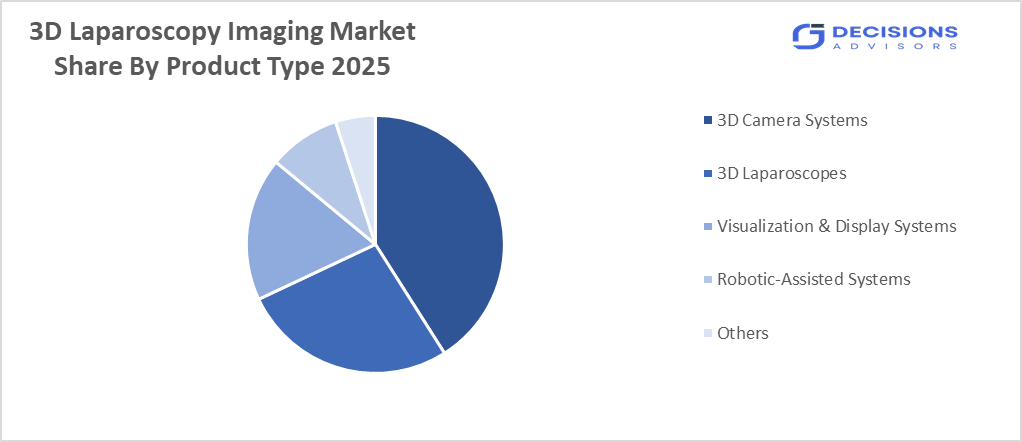
- The 3D Camera Systems segment dominated the market and holds approximately 41% share in 2025 and is projected to grow at a substantial CAGR during the forecast period.
Based on the product type, the 3D laparoscopy imaging market is divided into 3D laparoscopes, 3D camera systems, visualization & display systems, and others. Among these, the 3D camera systems segment dominates the market and holds approximately 41% share in 2025. This dominance is due to continuous advancements in dual-sensor and chip-on-tip camera technology that deliver high-resolution stereoscopic images with minimal latency. These systems are widely used in general surgery, gynecological procedures, and bariatric surgery, making them the most preferred choice across advanced minimally invasive surgical applications globally.
- The gynecological surgery segment accounted for the largest share of approximately 33% in 2025 and is anticipated to grow at a significant CAGR during the forecast period
Based on the application, the market is divided into gynecological surgery, bariatric surgery, urological surgery, and other applications. Among these, gynecological surgery accounted for the largest share and holds approximately 33% share in 2025. This dominance is due to the rising number of hysterectomy, myomectomy, and endometriosis procedures performed using minimally invasive techniques. Increasing adoption of 3D visualization to improve surgical precision in confined pelvic anatomy further supports segment growth, making gynecological surgery the primary revenue contributor in the 3D Laparoscopy Imaging Market.
- The hospitals segment accounted for the largest share of approximately 68% in 2025 and is anticipated to grow at a significant CAGR during the forecast period.
Based on end user, the market is divided into hospitals, ambulatory surgical centers, and others. Among these, hospitals dominate the market and hold approximately 68% share in 2025. This dominance is due to the availability of skilled surgical teams, higher patient volumes, and greater capital investment capacity for advanced 3D and 4K imaging towers. Their comprehensive surgical infrastructure and postoperative care capabilities make hospitals the primary adopters of 3D laparoscopic imaging systems across multiple end-use settings.
Regional Segment Analysis of the 3D Laparoscopy Imaging Market
- North America (U.S., Canada, Mexico)
- Europe (Germany, France, U.K., Italy, Spain, Rest of Europe)
- Asia-Pacific (China, Japan, India, Rest of APAC)
- South America (Brazil and the Rest of South America)
- The Middle East and Africa (UAE, South Africa, Rest of MEA)
North America is anticipated to hold approximately 36% share of the 3D laparoscopy imaging market over the predicted timeframe.
North America holds approximately 36% share of the 3D laparoscopy imaging market due to the high adoption of advanced surgical visualization technologies, well-established hospital infrastructure, and strong presence of leading medical device manufacturers. The region benefits from favorable reimbursement policies for minimally invasive procedures and continuous investment in next-generation 3D and 4K imaging platforms. High adoption of robotic-assisted surgery, growing surgical volumes, and rising awareness of the clinical benefits of 3D visualization further strengthen market growth. Additionally, the presence of major academic medical centers and surgical training programs supports sustained demand for advanced laparoscopic imaging systems 3D laparoscopy imaging market across the region.
Europe is expected to grow at a steady CAGR in the 3D laparoscopy imaging market, holding approximately 27% of the share during the forecast period.
Europe is expected to grow at a steady CAGR in the, holding approximately 27% share during the forecast period due to strong government support for hospital modernization and rising adoption of minimally invasive surgical techniques. The region benefits from the presence of leading endoscopy and surgical visualization companies, which drive continuous innovation in high-definition 3D imaging solutions. High adoption of advanced surgical training programs and increasing integration of fluorescence-guided imaging further supports market expansion. Additionally, growing investment in digital operating room infrastructure across Germany, France, and the UK is accelerating the adoption of 3D laparoscopic imaging solutions across multiple surgical specialties.
Asia Pacific is the fastest-growing region in the 3D laparoscopy imaging market during the period, holding approximately 22% share.
Asia Pacific is the fastest-growing region in the 3D laparoscopy imaging market during the forecast period, holding approximately 22% share due to rising healthcare expenditure, expanding hospital infrastructure, and growing awareness of minimally invasive surgical techniques. The region benefits from increasing medical tourism and rising investment by global manufacturers to expand their surgical visualization product portfolios across China, Japan, and India. Additionally, government initiatives supporting healthcare modernization and rising demand for advanced surgical training are encouraging the adoption of 3D and 4K laparoscopic imaging systems. Growing prevalence of chronic diseases requiring surgical intervention further supports market expansion across the region.
Future Market Trends in 3D Laparoscopy Imaging Market: -
- Integration of Artificial Intelligence in Surgical Visualization
AI integration in 3D laparoscopy imaging enables real-time tissue recognition, intraoperative guidance, and adaptive image enhancement. It helps reduce surgical errors, improves decision-making, and personalizes visualization settings across various procedures. This trend is driving more intuitive, precise, and efficient surgical workflows worldwide.
- Growth of 4K/3D Fusion and Fluorescence-Guided Imaging
Manufacturers are increasingly combining 4K resolution with 3D depth perception and near-infrared fluorescence imaging to improve tissue differentiation and vascular visualization. These fusion platforms offer better surgical accuracy, sleeker integration with existing towers, and improved patient outcomes. Rising demand for precision surgery is significantly boosting this trend globally.
- Expansion of Robotic-Assisted 3D Laparoscopic Platforms
3D visualization is increasingly integrated into robotic-assisted surgical consoles to enhance depth perception, dexterity, and surgical control. Their compatibility with robotic platforms, improved ergonomics, and reduced surgeon fatigue make them ideal for complex minimally invasive procedures. Growing robotic surgery adoption is accelerating market expansion globally.
- Rising Adoption in Ambulatory Surgical Centers
3D laparoscopy imaging systems are increasingly deployed in ambulatory surgical centers for gynecological, urological, and general surgery procedures due to their compact design and shorter recovery times. Their high responsiveness and cost efficiency make them ideal for outpatient surgical settings. Growing preference for same-day surgery is accelerating adoption globally.
Recent Development
- In March 2026, Olympus Corporation launched the VISERA ELITE III surgical imaging platform in the U.S., supporting rigid and flexible videoscopes along with 3D and 4K laparoscopic visualization for enhanced surgical precision across multiple specialties.
- In March 2024, KARL STORZ launched CollaboratOR 3D for Apple Vision Pro, enabling immersive stereoscopic visualization of laparoscopic procedures for surgical teams, remote collaboration, and training environments.
Market Segment
This study forecasts revenue at global, regional, and country levels from 2020 to 2035. Decision Advisors has segmented the 3D laparoscopy imaging market based on the below-mentioned segments:
3D Laparoscopy Imaging Market, By Product Type
- 3D Laparoscopes
- 3D Camera Systems
- Visualization & Display Systems
- Others
3D Laparoscopy Imaging Market, By Application
- Gynecological Surgery
- Bariatric Surgery
- Urological Surgery
- Other Applications
3D Laparoscopy Imaging Market, By End User
- Hospitals
- Ambulatory Surgical Centers
- Others
3D Laparoscopy Imaging Market, By Regional Analysis
- North America
- US
- Canada
- Mexico
- Europe
- Germany
- UK
- France
- Italy
- Spain
- Russia
- Rest of Europe
- Asia Pacific
- China
- Japan
- India
- South Korea
- Australia
- Rest of Asia Pacific
- South America
- Brazil
- Argentina
- Rest of South America
- Middle East & Africa
- UAE
- Saudi Arabia
- Qatar
- South Africa
- Rest of the Middle East & Africa
Frequently Asked Questions (FAQ)
Q. How does 3D laparoscopy imaging improve surgical outcomes compared to conventional 2D systems?
A. 3D laparoscopy provides surgeons with enhanced depth perception and spatial orientation, enabling more precise tissue handling, suturing, and dissection, which helps reduce operative time and lower the risk of intraoperative complications.
Q. Why are hospitals increasingly investing in 3D and 4K fusion imaging systems?
A. These systems combine high-resolution clarity with stereoscopic depth, improving surgical accuracy in complex procedures while supporting compatibility with fluorescence-guided imaging and existing endoscopy towers, offering long-term value for surgical departments.
Q. What role does 3D laparoscopy imaging play in robotic-assisted surgery?
A. It provides the high-fidelity stereoscopic visualization required for robotic consoles, allowing surgeons to operate with greater precision, control, and confidence during minimally invasive robotic procedures.
Q. How is surgeon training influencing the adoption of 3D laparoscopic imaging systems?
A. Growing use of 3D visualization in surgical training and simulation programs is helping new surgeons build depth perception and hand-eye coordination faster, encouraging broader clinical adoption of 3D systems across hospitals and surgical centers.
Check Licence
Choose the plan that fits you best: Single User, Multi-User, or Enterprise solutions tailored for your needs.
We Have You Covered
- 24/7 Analyst Support
- Clients Across the Globe
- Tailored Insights
- Technology Tracking
- Competitive Intelligence
- Custom Research
- Syndicated Market Studies
- Market Overview
- Market Segmentation
- Growth Drivers
- Market Opportunities
- Regulatory Insights
- Innovation & Sustainability
Report Details
| Scope | Global |
| Pages | 240 |
| Delivery | PDF & Excel via Email |
| Language | English |
| Release | Aug 2026 |
| Access | Download from this page |