
Global 3D Printed Electronics Market
 |
Author:
Achal E
|
Pages:
210
|
Author:
Achal E
|
Pages:
210
Global 3D Printed Electronics Market Size, Share By Printing Technology (Inkjet Printing, Aerosol Jet Printing, Screen Printing, Extrusion-based Printing, Others), By Material Type (Conductive Inks, Dielectric Materials, Substrates, Polymers, Nanomaterials), By Application (Consumer Electronics, Automotive, Healthcare, Aerospace & Defense, Industrial, Energy, Telecommunication), and By Region (North America, Europe, Asia-Pacific, Latin America, Middle East & Africa), Analysis and Forecast 2026-2035
CAGR
15.1%
REVENUE 2025
USD Billion 12.13
FORECAST 2035
USD Billion 49.5
REPORT COVERAGE
Global
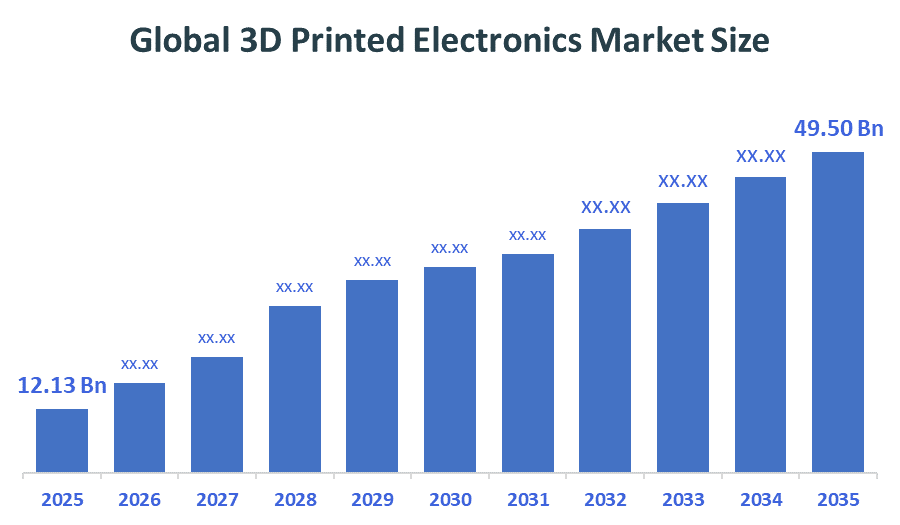
The Global 3D Printed Electronics Market Size is predicted to grow from USD 12.13 Billion in 2025 and is likely to reach around USD 49.50 Billion by 2035 with a CAGR of 15.1%. According to Decision Advisors, a detailed research report on the market reflects that the flexible electronics growth trend dominates the Global 3D Printed Electronics Market, accounting for approximately 46% of the total share worldwide. Nano Dimension leads the market with annual revenue of approximately USD 45-70 million and approx 21 - 22% global market share, making it the key contributor to global market development and growth dynamics.
Market Snapshot
- Global 3D Printed Electronics Market Size (2025): USD 12.13 Billion
- Projected Global 3D Printed Electronics Market Size (2035): USD 49.50 Billion
- Global 3D Printed Electronics Market Compound Annual Growth Rate (CAGR): 15.1%
- Largest Regional Market: North America
- 2nd Largest Region: Asia Pacific
- Fastest Growing Region: Europe
- Base Year: 2025
- Historical Period: 2021-2024
- Market Forecast Period: 2026-2035
Market Overview/ Introduction
The Global 3D Printed Electronics Market is an industry that produces electronic components using additive printing methods to create circuits, sensors, antennas, and flexible devices on various substrates. The market experiences strong expansion because consumers increasingly demand smaller electronics and wearable devices and IoT systems and affordable rapid prototyping methods. The industrial sector, together with the automotive sector and healthcare sector, and aerospace sector continues to drive growth through increased adoption of these technologies. The US CHIPS and Science Act, the EU Chips Act, and China's smart manufacturing programs provide government support that strengthens research and development, as well as semiconductor innovation and advanced manufacturing capabilities. Nano Dimension DuPont and Optomec lead their industry through their research on hybrid manufacturing systems which include their development of conductive inks and high-precision printing technologies that enhance production capacity and system efficiency. The market offers businesses its main benefits through decreased material waste and quicker design processes lightweight products, and extensive product personalization options. Future growth will be driven by flexible electronics, AI-integrated design tools, and nano-material advancements.
- India’s NSAM launched by MeitY aims to position India as a global 3D printing hub by developing 50+ indigenous technologies and establishing over 50 additive manufacturing technology centres nationwide.
- The Digital Garden City Nation Initiative promotes smart factories, automation, and advanced manufacturing, enabling adoption of 3D printing technologies and supporting development of flexible and conformal electronic systems.
Notable Insights: -
- North America is anticipated to hold approximately 32% share of the Global 3D Printed Electronics Market over the predicted timeframe.
- Asia Pacific is expected to grow at a rapid CAGR in the Global 3D Printed Electronics Market by holding approximately 30% of the share during the forecast period.
- By printing Technology, the Inkjet Printing segment dominated the market and holds approximately 32% share in 2025 and is projected to grow at a substantial CAGR during the forecast period.
- By material type, the conductive inks segment dominated the market and holds approximately 40% share in 2025 and is projected to grow at a substantial CAGR during the forecast period.
- The compound annual growth rate of the Global 3D Printed Electronics Market is 15.1%.
- The market is likely to achieve a valuation of USD 49.50 Billion by 2035.
What is the role of technology in grooming the market?
Technology plays a central role in driving the Global 3D Printed Electronics Market by enabling precise, scalable, and cost-effective manufacturing of electronic components. Inkjet and aerosol jet printing technologies allow high-resolution deposition of conductive and functional materials on flexible and rigid substrates. Advanced conductive inks based on silver nanoparticles, carbon nanotubes, and graphene improve electrical performance and mechanical flexibility. AI-driven design tools optimize circuit layouts and reduce material waste during printing processes. Hybrid manufacturing systems combine 3D printing with traditional lithography to enhance performance reliability. Flexible and stretchable electronics technologies are enabling new applications in wearable devices, medical sensors, and smart packaging. Additionally, automation and robotics integration in printing systems are improving production speed, consistency, and scalability across industrial applications.
Market Drivers
The Global 3D Printed Electronics Market exists because industries need electronic parts that are both tiny and light and function at high levels. Additive manufacturing technologies experience rising adoption because the demand for wearable devices and flexible consumer electronics continues to grow. The need for rapid prototyping in product development is further supporting market expansion by reducing design time and production costs. The rising use of IoT devices, together with smart sensors has created higher needs for embedded printed circuits. The automotive industry needs electrification, while the aerospace industry requires lightweight components, which results in more advanced printed electronics systems being integrated. The market develops over time because companies keep investing in semiconductor research and advanced manufacturing technologies.
Restrain
The market faces challenges such as high material costs for conductive inks and limited scalability for mass production. Technical constraints in achieving high conductivity and durability compared to traditional PCB manufacturing also restrict adoption.
Competitive Analysis:
The report offers the appropriate analysis of the key organizations/companies involved within the Global 3D Printed Electronics Market along with a comparative evaluation primarily based on their product offerings, business overviews, geographic presence, enterprise strategies, segment market share, and SWOT analysis. The report also provides an elaborative analysis focusing on the current news and developments of the companies, which includes product development, innovations, joint ventures, partnerships, mergers & acquisitions, strategic alliances, and others. This allows for the evaluation of the overall competition within the market.
Top Companies in the Global 3D Printed Electronics Market
- Nano Dimension
- Optomec
- Xerox Corporation
- Voxel8
- NovaCentrix
- DuPont
- BASF SE
- Markforged
- Siemens AG
- Dassault Systèmes
Government Initiatives
|
Country |
Key Government Initiatives |
|
India |
U.S. policies promoting clean energy and energy efficiency are driving manufacturers to adopt eco-friendly Class D amplifier solutions, enhancing power efficiency, reducing heat generation, and supporting sustainable audio technology development. |
|
Japan |
The National Centre for Additive Manufacturing (NCAM) in Hyderabad fosters India’s additive manufacturing ecosystem by supporting research, collaboration, and development of advanced 3D printing technologies across industries. |
|
China |
The focus on indigenous technology aims to reduce reliance on foreign systems by promoting local expertise, strengthening intellectual property rights, and establishing standardized frameworks for sustainable industrial development. |
Study on the Supply, Demand, Distribution, and Market Environment of the Global 3D Printed Electronics Market
The Global 3D Printed Electronics Market supply chain is supported by material suppliers, printing system manufacturers, and electronics OEMs that jointly enable production of advanced electronic components. Demand is rising across consumer electronics, healthcare devices, automotive electronics, aerospace systems, and industrial IoT applications due to increasing need for compact, flexible, and high-performance solutions. Distribution mainly occurs through direct B2B contracts, electronics manufacturing services (EMS), and specialized additive manufacturing providers that ensure efficient large-scale deployment. Growing collaboration between semiconductor companies and 3D printing technology firms is accelerating innovation and commercialization, while improving scalability, production efficiency, and global market accessibility for printed electronic solutions.
Price Analysis and Consumer Behaviour Analysis
Pricing in the Global 3D Printed Electronics Market is mainly influenced by material costs, printing technology complexity, and production scale. Conductive inks, often based on precious metals, remain the most expensive and sensitive input, impacting overall cost structures. Around 60% of manufacturers focus on cost-efficient prototyping rather than large-scale production due to current scalability limitations. Nearly 55% of developers prefer hybrid manufacturing methods that combine 3D printing with traditional fabrication to balance cost and performance. Demand is steadily increasing for flexible, lightweight, and customized electronic solutions, which is shaping purchasing behavior and encouraging investment in more efficient and scalable production technologies.
Market Segmentation
The Global 3D Printed Electronics Market share is classified into printing technology, material type and application.
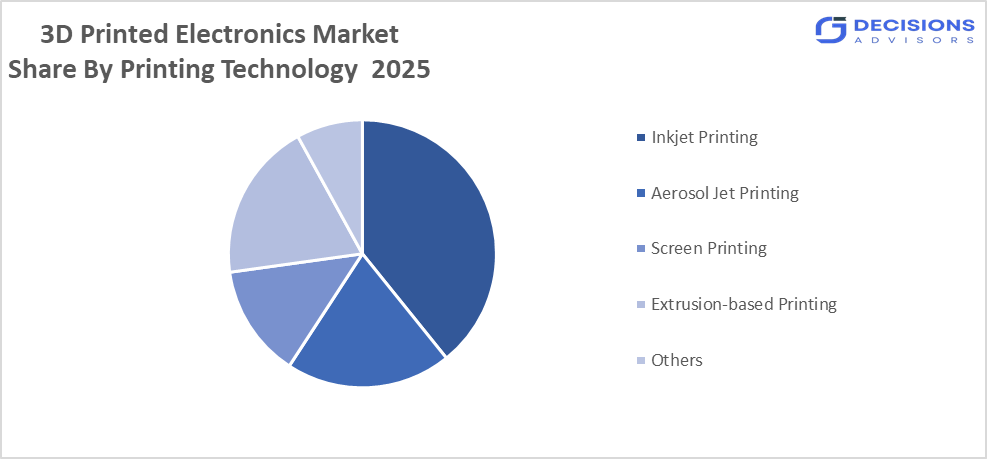
- The Inkjet Printing segment dominated the market and holds approximately 32% share in 2025 and is projected to grow at a substantial CAGR during the forecast period.
Based on printing technology, the Global 3D Printed Electronics Market is divided into Inkjet Printing, Aerosol Jet Printing, Screen Printing, Extrusion-based Printing, and Others. Among these, Inkjet Printing accounted for the largest share of approximately 32% in 2025. This dominance is due to its high precision, low material wastage, cost-effectiveness, and suitability for rapid prototyping and flexible circuit fabrication. Inkjet printing is widely used in consumer electronics and R&D applications, making it the most preferred technology for scalable and efficient printed electronics production globally.
The Conductive Inks segment accounted for the largest share of approximately 40% in 2025 and is anticipated to grow at a significant CAGR during the forecast period.
Based on material type, the market is divided into Conductive Inks, Dielectric Materials, Substrates, Polymers, and Nanomaterials. Among these, Conductive Inks dominated the market with approximately 40% share in 2025. This dominance is driven by their essential role in forming electrical pathways in printed circuits, along with strong demand for silver-based and carbon-based inks. Their wide applicability in flexible electronics, sensors, and wearable devices further strengthens their market position across industries.
- The Consumer Electronics segment accounted for the largest share of approximately 42% in 2025 and is anticipated to grow at a significant CAGR during the forecast period.
Based on application, the market is divided into Consumer Electronics, Automotive, Healthcare, Aerospace & Defense, Industrial, Energy, and Telecommunication. Among these, Consumer Electronics accounted for the largest share of approximately 42% in 2025. This dominance is driven by rising demand for wearable devices, smart gadgets, flexible displays, and compact electronic systems. Rapid digitalization and increasing adoption of connected devices further support strong segment growth, making consumer electronics the primary revenue contributor in the global Global 3D Printed Electronics Market.
Strategies to Implement for Growth of the Market in Non-Leading Regions
To accelerate growth in non-leading regions, companies should focus on improving awareness of 3D printed electronics and promoting its benefits in cost efficiency, flexibility, and rapid prototyping. Establishing local manufacturing facilities and strengthening partnerships with regional electronics OEMs can enhance market penetration and reduce supply chain costs. Offering affordable and scalable printing solutions tailored for small and medium enterprises will support wider adoption. Investment in workforce training, technical education, and R&D collaboration is essential to overcome skill gaps and technology barriers. Additionally, integrating cost-effective conductive materials and modular printing systems will help expand accessibility. Governments and private players should jointly support innovation clusters and incentive programs to encourage adoption in emerging markets, thereby ensuring balanced global market growth.
Regional Segment Analysis of the Global 3D Printed Electronics Market
- North America (U.S., Canada, Mexico)?
- Europe (Germany, France, U.K., Italy, Spain, Rest of Europe)
- Asia-Pacific (China, Japan, India, Rest of APAC)
- South America (Brazil and the Rest of South America)?
- The Middle East and Africa (UAE, South Africa, Rest of MEA)
North America is anticipated to hold approximately 32% share of the Global 3D Printed Electronics Market over the predicted timeframe.
North America is anticipated to hold approximately 32% share of the Global 3D Printed Electronics Market over the forecast period, driven by strong technological infrastructure and early adoption of advanced manufacturing solutions. The region benefits from the presence of leading semiconductor companies, well-established R&D facilities, and high investment in additive manufacturing technologies. Growing demand from consumer electronics, aerospace, automotive, and healthcare sectors is further strengthening market growth. Additionally, government initiatives supporting semiconductor innovation and advanced manufacturing are accelerating adoption. High usage of IoT devices, wearable electronics, and smart systems continues to drive demand for flexible and miniaturized electronic components across the region.
Asia Pacific is expected to grow at a rapid CAGR in the Global 3D Printed Electronics Market, holding approximately 30% of the share during the forecast period
Asia Pacific is expected to grow at a rapid CAGR in the Global 3D Printed Electronics Market, holding approximately 30% of the share during the forecast period. The region’s growth is driven by large-scale electronics manufacturing, strong semiconductor supply chains, and cost-efficient production capabilities. Increasing demand for smartphones, wearables, IoT devices, and smart consumer electronics is further accelerating market expansion. Countries such as China, India, Japan, and South Korea are key contributors due to rapid industrialization and digital transformation. Expanding automotive production and rising adoption of advanced infotainment systems also support regional demand. Additionally, favorable government policies and investments in smart manufacturing are strengthening Asia Pacific’s position in the global market.
Europe is the fastest-growing region in the Global 3D Printed Electronics Market during the period, holding approximately 25% share.
Europe is the fastest-growing region in the Global 3D Printed Electronics Market, holding approximately 25% share during the forecast period. Growth in the region is driven by strong investments in advanced manufacturing, flexible electronics, and sustainable production technologies. The automotive industry, especially electric vehicle development, is a key contributor to demand for lightweight and high-performance electronic components. Rising adoption of smart devices, IoT systems, and industrial automation is further supporting market expansion. Additionally, strict energy efficiency regulations and increasing semiconductor innovation initiatives across Germany, France, and the UK are accelerating the adoption of 3D printed electronics across multiple end-use industries.
Future Market Trends in Global Atomic Layer Deposition Equipment Market: -
Expansion of Flexible and Wearable Electronics (45 words)
Demand for flexible and wearable electronics is rising rapidly due to growing use in healthcare monitoring devices, fitness trackers, and smart textiles. These innovations enable lightweight, bendable, and highly integrated electronic systems, improving user comfort, functionality, and real-time health data tracking across multiple applications.
Growth of Hybrid Manufacturing Systems (45 words)
Hybrid manufacturing systems combining 3D printing with traditional semiconductor fabrication are improving performance, scalability, and production reliability. This approach enables faster prototyping, reduced manufacturing costs, and enhanced design flexibility, supporting efficient production of complex electronic components used across consumer, automotive, and industrial applications globally.
Rise of Nano-Material Based Printing (45 words)
Nano-material based printing using graphene, carbon nanotubes, and nano-silver inks is significantly enhancing electrical conductivity, mechanical strength, and durability of printed electronics. These advanced materials enable high-performance, miniaturized devices with improved efficiency, supporting next-generation applications in flexible circuits, sensors, and wearable electronic systems.
Expansion in Smart Packaging and IoT Integration (45 words)
Smart packaging and IoT integration are expanding rapidly with printed sensors and circuits embedded in packaging systems. These technologies enable real-time tracking, authentication, and condition monitoring of products. Growing adoption across logistics, retail, and healthcare industries is driving innovation in connected and intelligent packaging solutions.
Recent Development
- In November 2025, 3D Systems launched the SLA 825 Dual platform, at Formnext 2025, introducing an advanced stereolithography system designed to improve production efficiency, precision, and industrial manufacturing throughput in large-scale applications.
- In September 2025, the University of Maryland developed water-soluble 3D-printed circuits using polyvinyl alcohol (PVA), enabling recyclable electronics and reducing electronic waste through dissolvable circuit fabrication technology.
- In October 2022, Voltera launched NOVA, a direct-ink write printer designed for producing soft, stretchable, and flexible electronics, enabling advanced prototyping of wearable devices, sensors, and next-generation electronic components.
How is Recent Developments Helping the Market?
Recent developments are strengthening the Global Global 3D Printed Electronics Market by improving manufacturing efficiency, precision, and material performance. Advanced printing technologies enable faster fabrication of high-resolution circuits with better conductivity and design accuracy. The adoption of hybrid manufacturing systems is reducing reliance on traditional PCB processes while lowering production costs and increasing flexibility. Innovations in nano-material inks, such as graphene and silver-based formulations, are enhancing durability, electrical performance, and device reliability. Furthermore, growing collaborations between electronics manufacturers, semiconductor companies, and additive manufacturing firms are accelerating commercialization, expanding industrial adoption, and improving scalability across consumer, automotive, healthcare, and industrial applications worldwide.
Market Segment
This study forecasts revenue at global, regional, and country levels from 2020 to 2035. Decision Advisors has segmented the Global 3D Printed Electronics Market based on the below-mentioned segments:
Global 3D Printed Electronics Market, By Printing Technology
• Inkjet Printing
• Aerosol Jet Printing
• Screen Printing
• Extrusion-based Printing
• Others
Global 3D Printed Electronics Market, By Material Type
• Conductive Inks
• Dielectric Materials
• Polymers
• Nanomaterials
• Substrates
Global 3D Printed Electronics Market, By Application
• Consumer Electronics
• Automotive
• Healthcare
• Aerospace & Defense
• Industrial
• Energy
• Telecommunication
Global 3D Printed Electronics Market, By Regional Analysis
- North America
- US
- Canada
- Mexico
- Europe
- Germany
- UK
- France
- Italy
- Spain
- Russia
- Rest of Europe
- Asia Pacific
- China
- Japan
- India
- South Korea
- Australia
- Rest of Asia Pacific
- South America
- Brazil
- Argentina
- Rest of South America
- Middle East & Africa
- UAE
- Saudi Arabia
- Qatar
- South Africa
- Rest of the Middle East & Africa
Frequently Asked Questions (FAQ)
Q. What new business models are emerging in the 3D printed electronics industry?
A. Subscription-based manufacturing services and on-demand production platforms are emerging, allowing companies to access printed electronics without heavy upfront infrastructure investment
Q. How is design software influencing market adoption?
A. Advanced simulation and AI-driven design tools are reducing prototyping errors, optimizing circuit layouts, and significantly improving production efficiency and product reliability
Q. What role do startups play in this market?
A. Startups are driving innovation in materials science and compact printing systems, accelerating niche applications in wearables, medical devices, and smart sensors.
Q. How is supply chain localization impacting the industry?
A. Localization is reducing dependency on global semiconductor supply chains, improving production speed, and lowering logistics-related disruptions.
Q. How is intellectual property (IP) shaping competition in this market?
A. Strong IP protection is becoming critical as companies develop proprietary printing processes and conductive material formulations to maintain competitive advantage.
Check Licence
Choose the plan that fits you best: Single User, Multi-User, or Enterprise solutions tailored for your needs.
We Have You Covered
- 24/7 Analyst Support
- Clients Across the Globe
- Tailored Insights
- Technology Tracking
- Competitive Intelligence
- Custom Research
- Syndicated Market Studies
- Market Overview
- Market Segmentation
- Growth Drivers
- Market Opportunities
- Regulatory Insights
- Innovation & Sustainability
Report Details
| Scope | Global |
| Pages | 210 |
| Delivery | PDF & Excel via Email |
| Language | English |
| Release | Apr 2026 |
| Access | Download from this page |