
Global Ablation Devices Market
 |
Pages:
250
|
Pages:
250
Global Ablation Devices Market Size, Share, and COVID-19 Impact Analysis, By Type (Surgical Ablation Devices, Non-Surgical Ablation Devices, and Ablation Catheters), By Technology (Radiofrequency Ablation, Microwave Ablation, Laser Ablation, Cryoablation, and Ultrasound Ablation), By Application (Cardiology, Oncology, Gastroenterology, and Urology), and By Region (North America, Europe, Asia-Pacific, Latin America, Middle East, and Africa), Analysis and Forecast 2025-2035
REPORT COVERAGE
Global
Global Ablation Devices Market Size Insights Forecasts to 2035
- The Global Ablation Devices Market Size Was Estimated at USD 10.75 Billion in 2024
- The Market Size is Expected to Grow at a CAGR of around 8.57 % from 2025 to 2035
- The Worldwide Ablation Devices Market Size is Expected to Reach USD 26.55 Billion by 2035
- Europe is expected to grow the fastest during the forecast period.
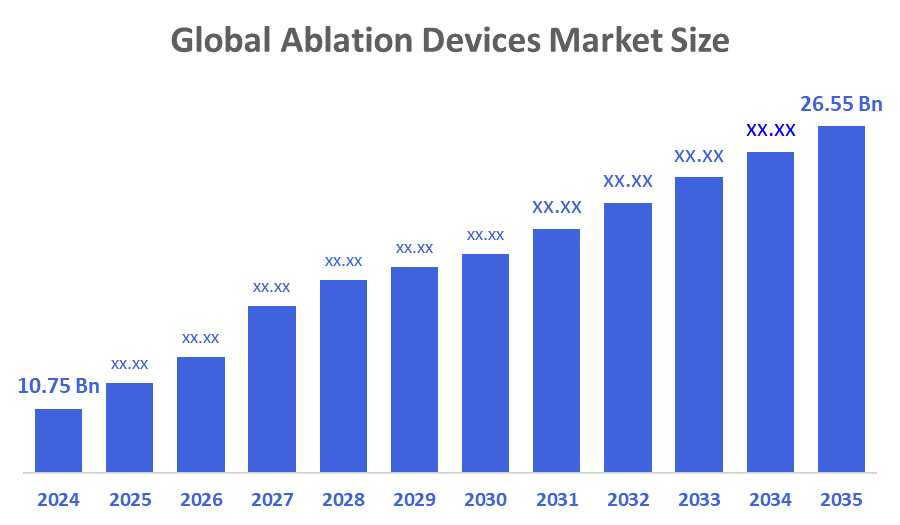
According to a research report published by Decisions Advisors and Consulting, The Global Ablation Devices Market Size Was Worth Around USD 10.75 Billion In 2024 And Is Predicted To Grow To Around USD 26.55 Billion By 2035 With A Compound Annual Growth Rate (CAGR) Of 8.57 % From 2025 To 2035. Chronic conditions, including cancer, orthopaedic issues, and especially cardiovascular disorders, are the main causes of the increase in demand for ablation procedures. The development of sophisticated imaging systems and robotically assisted operations are examples of recent advancements in ablation technology that are expected to improve accuracy and results.
Market Overview
The ablation devices market refers to the global industry focused on medical devices that remove or destroy abnormal tissue using minimally invasive techniques. Ablation devices are medical tools that eliminate or destroy aberrant bodily tissue using a variety of energy-based methods. Further, treating conditions like cancer, heart rhythms (such as atrial fibrillation), chronic pain, and even varicose veins, these devices are used in minimally invasive procedures. The devices find extensive application in medical treatments for cancer, cardiovascular diseases, pain disorders and ophthalmic issues. The market experiences growth because of increasing chronic disease rates and rising demand for less invasive treatments, together with technological advancements that enhance treatment accuracy and patient results.
Kardium Inc., a Vancouver-based medical device company, raised $250 million (CA$340 million) in a financing round to support the launch and expansion of its Globe Pulsed Field Ablation (PFA) System, designed to treat atrial fibrillation. The funding will be used to pursue regulatory approvals, expand manufacturing capabilities, and prepare for commercial rollout. Clinical trials have shown promising results, with the Globe system achieving rapid pulmonary vein isolation and high success rates without device-related complications.
Field Medical, a cardiac device startup based in California, has closed a $40 million Series A financing round to advance its pulsed field ablation (PFA) technology for treating ventricular tachycardia (VT). The round included $20 million in new capital and the conversion of $20 million in seed-round debt, with participation from leading strategics, venture capital firms, family offices, and reinvestment from seed investors showing strong confidence in the company’s direction.
Report Coverage
This research report categorizes the ablation devices market based on various segments and regions, forecasts revenue growth, and analyzes trends in each submarket. The report analyses the key growth drivers, opportunities, and challenges influencing the ablation devices market. Recent market developments and competitive strategies, such as expansion, product launch, development, partnership, merger, and acquisition, have been included to draw the competitive landscape in the market. The report strategically identifies and profiles the key market players and analyzes their core competencies in each sub-segment of the ablation devices market.
Driving Factors
The ablation devices market is currently undergoing a major transformation because emerging ablation device market trends combine with technological advancements and rising chronic disease rates. The combination of new techniques, which include radiofrequency and microwave ablation, shows better treatment results because these methods help doctors treat more patients. The increasing demand for minimally invasive treatments shows that patients now prefer medical options that provide shorter recovery durations and fewer chances of developing complications. The ablation system devices market will continue to expand because healthcare providers need to adjust their services to changing patient requirements. The combination of manufacturer partnerships with healthcare institutions leads to innovative developments that create advanced and efficient ablation technologies.
Baird Medical won the “Most Valuable Investment Award” for its groundbreaking AI Tumour Ablation Surgical Robot, marking a major milestone in the integration of artificial intelligence and robotics in healthcare. The award recognises the company’s innovation in combining advanced imaging, AI-driven decision support, and robotic precision to enhance minimally invasive tumour ablation procedures.
Restraining Factors
The market is limited by ablation devices because of their high costs, technical complexity, and necessity for expert operators. Adoption is hampered, particularly in institutions with limited resources, by limited reimbursement, regulatory barriers, and infrastructural requirements, which slow wider accessibility and mainstream expansion.
Market Segmentation
The ablation devices market share is classified into type, technology, and application.
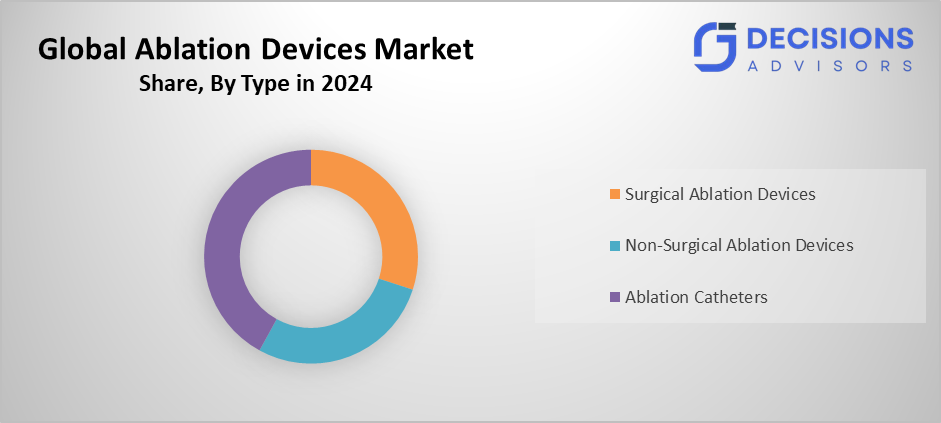
- The ablation catheters segment accounted for the largest share in 2024 and is anticipated to grow at a remarkable CAGR over the forecast period.
Based on the type, the ablation devices market is segmented into surgical ablation devices, non-surgical ablation devices, and ablation catheters. Among these, the ablation catheters segment accounted for the largest share in 2024 and is anticipated to grow at a remarkable CAGR over the forecast period. The system provides accurate energy delivery to specific tissue areas, which enables doctors to treat arrhythmias. The system has developed into a vital instrument that electrophysiologists use during catheter ablation procedures.
For instance, Stereotaxis designed the MAGiC cardiac ablation catheter to deliver consistent and safe tissue contact during procedures. The catheter integrates with the company’s magnetic navigation system, enabling physicians to precisely guide and position it inside the heart with minimal mechanical force. This approach reduces variability in lesion creation, enhances procedural safety, and improves outcomes for patients undergoing ablation therapy for arrhythmias.
- The radiofrequency ablation segment accounted for the largest share in 2024 and is anticipated to grow at a significant CAGR during the forecast period.
Based on the technology, the ablation devices market is differentiated into radiofrequency ablation, microwave ablation, laser ablation, cryoablation, and ultrasound ablation. Among these, the radiofrequency ablation segment accounted for the largest share in 2024 and is anticipated to grow at a significant CAGR during the forecast period. This is because of its widespread application in pain management and procedures such as catheter ablation for arrhythmias. Its leadership position has been cemented by its technological dependability and efficacy in delivering long-term relief.
For instance, Stratus Medical secured $10 million in funding to advance its portfolio of advanced pain relief technologies. The investment will accelerate the development and commercialisation of its Nimbus RF Multitined Expandable Electrode, a radiofrequency ablation system designed to provide long-lasting relief for patients suffering from chronic pain.
- The cardiology segment accounted for the highest market share in 2024 and is anticipated to grow at a substantial CAGR over the forecast period.
Based on the application, the ablation devices market is segmented into cardiology, oncology, gastroenterology, and urology. Among these, the cardiology segment accounted for the highest market share in 2024 and is anticipated to grow at a substantial CAGR over the forecast period. This segment expansion contributed to their vital function in the treatment of cardiac rhythm abnormalities. Although these devices are thought to be successful and less invasive than traditional surgery, the rising incidence of cardiovascular disorders has greatly increased demand for them.
For instance, Biotronik and CardioFocus entered into a strategic distribution agreement to expand access to pulsed field ablation (PFA) therapy in Europe. Under the deal, Biotronik will serve as the exclusive distributor of CardioFocus’s Centauri PFA System in selected European countries.
Regional Segment Analysis of the Ablation Devices Market
- North America (U.S., Canada, Mexico)
- Europe (Germany, France, U.K., Italy, Spain, Rest of Europe)
- Asia-Pacific (China, Japan, India, Rest of APAC)
- South America (Brazil and the Rest of South America)
- The Middle East and Africa (UAE, South Africa, Rest of MEA)
Asia Pacific is anticipated to hold the largest share of the ablation devices market over the predicted timeframe.
Asia Pacific is anticipated to hold the largest share of the ablation devices market over the predicted timeframe. The Asian market segment becomes a primary target for companies because there exists a large patient population and more investment in new medical technologies. Moreover, the regional market experiences growth because healthcare investments keep growing, while more people develop chronic diseases, and people start recognising new treatment solutions. The ablation devices market experiences strong growth in China and India because their healthcare systems improve, while their three billion citizens need medical services. The government programs that enhance healthcare access represent a crucial factor that drives the market development process. The competitive environment in this region consists of domestic companies and international organizations which compete with each other in China and Japan.
Baird Medical announced new strategic clinical education initiatives in Japan to accelerate its global commercial roadmap. The company is focusing on expanding physician training and awareness around its minimally invasive ablation technologies, aiming to strengthen adoption in key international markets. These initiatives are designed to support broader clinical use, enhance patient outcomes, and position Baird Medical for continued growth in the ablation devices sector.
Europe is expected to grow at a rapid CAGR in the ablation devices market during the forecast period. The regional market is growing because healthcare expenditures increase, the geriatric population expands, and medical technology progresses. Regulatory bodies like the European Medicines Agency (EMA) actively support medical device innovation, which will drive market development. The need for effective cardiovascular disease treatments creates strong market demand. The European market shows strength in Germany, France and the UK. The business environment consists of established enterprises and new startups, which create opportunities for innovative development. Industry stakeholders regularly form partnerships to improve their product ranges and increase their presence in the market.
Varian, a Siemens Healthineers company, launched its IntelliBlate microwave ablation system in Europe for the minimally invasive treatment of soft tissue tumours. The CE-marked device offers clinicians enhanced predictability and control, producing large, controlled spherical ablation zones. IntelliBlate integrates with Siemens Healthineers’ imaging and software solutions, enabling clinicians to plan, place, treat, monitor, and confirm ablation therapy in one environment.
Competitive Analysis:
The report offers the appropriate analysis of the key organizations/companies involved within the ablation devices market, along with a comparative evaluation primarily based on their product offering, business overviews, geographic presence, enterprise strategies, segment market share, and SWOT analysis. The report also provides an elaborative analysis focusing on the current news and developments of the companies, which includes product development, innovations, joint ventures, partnerships, mergers & acquisitions, strategic alliances, and others. This allows for the evaluation of the overall competition within the market.
List of Key Companies
- Abbott Laboratories
- Alcon Laboratories
- Angiodynamics
- Atricure
- Bausch & Lomb
- Biotronik
- Boston Scientific Corporation
- CONMED Corporation
- Elekta
- Ethicon
- Medtronic
- Olympus Corporation
- Varian
- Others
Key Target Audience
- Market Players
- Investors
- End-users
- Government Authorities
- Consulting and Research Firm
- Venture capitalists
- Value-Added Resellers (VARs)
Recent Development
- In February 2026, AngioDynamics expanded the indications for its NanoKnife System across Europe, strengthening its position as a multi-organ tumour ablation platform. The CE-marked system, which uses irreversible electroporation (IRE) technology, can now be applied to a broader range of soft tissue tumours beyond its earlier approvals. This expansion enhances treatment options for patients with cancers in organs such as the liver, pancreas, kidney, and prostate, offering a minimally invasive alternative where traditional ablation methods may be limited.
- In December 2025, Abbott received FDA approval for its Volt Pulsed Field Ablation (PFA) System to treat patients with atrial fibrillation (AFib). The catheter-based device delivers targeted, high-energy electrical pulses to isolate erratic heart signals, offering a minimally invasive alternative that is gentler on cardiac tissue.
- In October 2025, Techsomed Ltd., an Israel-based medical AI company, announced a pilot collaboration with Medtronic to advance AI-guided ablation therapy. The partnership integrates Techsomed’s BioTraceIO360 software with Medtronic’s Emprint microwave ablation system, creating a unified solution for image-guided tumour ablation.
- In September 2025, Boston Scientific announced the U.S. market launch of the FLEXView System, the first less-invasive unilateral visualisation system for cardiac surgical ablation. The FLEXView technology enables physicians to perform microwave cardiac surgical ablation procedures with improved visualisation and routing, reducing invasiveness compared to traditional approaches.
Market Segment
This study forecasts revenue at global, regional, and country levels from 2020 to 2035. Decisions Advisors has segmented the ablation devices market based on the below-mentioned segments:
Global Ablation Devices Market, By Type
- Surgical Ablation Devices
- Non-Surgical Ablation Devices
- Ablation Catheters
Global Ablation Devices Market, By Technology
- Radiofrequency Ablation
- Microwave Ablation
- Laser Ablation
- Cryoablation
- Ultrasound Ablation
Global Ablation Devices Market, By Application
- Cardiology
- Oncology
- Gastroenterology
- Urology
Global Ablation Devices Market, By Regional Analysis
- North America
- US
- Canada
- Mexico
- Europe
- Germany
- UK
- France
- Italy
- Spain
- Russia
- Rest of Europe
- Asia Pacific
- China
- Japan
- India
- South Korea
- Australia
- Rest of Asia Pacific
- South America
- Brazil
- Argentina
- Rest of South America
- Middle East & Africa
- UAE
- Saudi Arabia
- Qatar
- South Africa
- Rest of the Middle East & Africa
Frequently Asked Questions (FAQ)
1. How is pulsed field ablation (PFA) expected to influence the competitive landscape of the ablation devices market?
Pulsed Field Ablation (PFA) is emerging as a disruptive technology due to its tissue-selective mechanism, which minimises collateral damage compared to thermal ablation methods. Companies such as Abbott Laboratories are investing heavily in PFA platforms, positioning this technology as a next-generation solution in electrophysiology and potentially reshaping market share distribution.
2. What impact does the ageing global population have on demand for ablation devices?
The growing geriatric population significantly increases the prevalence of atrial fibrillation, cancer, and chronic pain conditions, thereby driving demand for minimally invasive ablation therapies. Regions with rapidly ageing populations, such as Japan, are expected to witness accelerated procedural volumes over the forecast period.
3. How are hospital infrastructure upgrades influencing ablation device adoption?
Expansion of hybrid operating rooms, catheterisation labs, and advanced imaging suites enhances the adoption of technologically sophisticated ablation systems. In countries like Germany, hospital modernisation initiatives are enabling greater integration of robotic and image-guided ablation procedures.
4. What role do clinical training programs play in expanding the ablation devices market?
Physician training and certification programs are critical to increasing procedural success rates and confidence in new technologies. Leading manufacturers such as Boston Scientific Corporation frequently conduct specialised electrophysiology and oncology training workshops to accelerate technology adoption.
5. How is artificial intelligence (AI) integration shaping the future of ablation therapies?
AI-driven treatment planning and real-time lesion assessment tools are improving precision and reducing procedural variability. Collaborations involving companies like Medtronic plc are focusing on AI-guided ablation platforms that enhance treatment accuracy and workflow efficiency.
6. What are the emerging opportunities for ablation devices in outpatient and ambulatory surgical centres?
With advancements in minimally invasive techniques, many ablation procedures are shifting from inpatient hospitals to outpatient settings. In markets such as the United States, ambulatory surgical centres are increasingly performing catheter-based ablations, improving accessibility and reducing healthcare costs.
7. How do supply chain dynamics affect the global distribution of ablation devices?
The ablation devices market relies on specialised components such as energy generators, catheters, and imaging systems. Global supply chain disruptions can impact device availability and pricing. Companies like Olympus Corporation are strengthening regional manufacturing and distribution networks to mitigate these risks.
Check Licence
Choose the plan that fits you best: Single User, Multi-User, or Enterprise solutions tailored for your needs.
We Have You Covered
- 24/7 Analyst Support
- Clients Across the Globe
- Tailored Insights
- Technology Tracking
- Competitive Intelligence
- Custom Research
- Syndicated Market Studies
- Market Overview
- Market Segmentation
- Growth Drivers
- Market Opportunities
- Regulatory Insights
- Innovation & Sustainability
Report Details
| Scope | Global |
| Pages | 250 |
| Delivery | PDF & Excel via Email |
| Language | English |
| Release | Feb 2026 |
| Access | Download from this page |