
Global Active Sensors Market
 |
Author:
Achal E
|
Pages:
245
|
Author:
Achal E
|
Pages:
245
Global Active Sensors Market Size, Share, By Product Type (Radar Sensors, LiDAR Sensors, Ultrasonic Sensors), By Application (Automotive Systems, Industrial Automation, Consumer Electronics), By End-Use Industry (Healthcare, Transportation, Smart Infrastructure, Manufacturing), and By Region (North America, Europe, Asia-Pacific, Latin America, Middle East & Africa), Analysis and Forecast 2026-2035
CAGR
10.56%
REVENUE 2025
USD Billion 21.3
FORECAST 2035
USD Billion 58.13
REPORT COVERAGE
Global
Market Snapshot
- Market Size (2025): USD 21.3 Billion
- Projected Market Size (2035): USD 58.13 Billion
- Compound Annual Growth Rate (CAGR): 10.56%
- Largest Regional Market: North America
- Fastest Growing Region: Asia Pacific
- 3rd Largest Region: Europe
- Base Year: 2025
- Historical Period: 2021–2024
- Forecast Period: 2026–2035
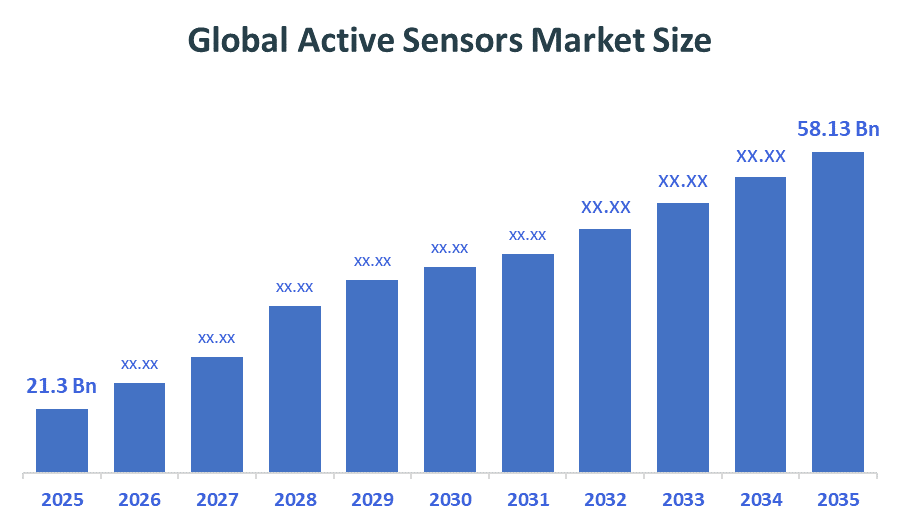
According to Decision Advisors, the Global Active Sensors Market Size is expected to grow from USD 21.3 Billion in 2025 to USD 58.13 billion by 2035, at a CAGR of 10.56% during the forecast period 2026-2035. The global active sensors market is projected to grow significantly over the next decade. The market is expanding due to increasing demand for automation, IoT integration, autonomous vehicles, industrial monitoring, and smart infrastructure, driven by need for real-time sensing, accuracy, and efficiency.
Market Overview/ Introduction
The Global Active Sensors Market refers to the industry that designs, manufactures and distributes active sensors which use energy transmission to detect physical and environmental changes and motion changes through their radar, LiDAR, ultrasonic and time-of-flight (ToF) sensor technology. The market is experiencing steady growth because automotive safety systems, autonomous vehicles, industrial automation, smart infrastructure, healthcare and consumer electronics are increasingly adopting these technologies. The market is expanding because North America, Europe and the Asia Pacific governments are funding advanced driver-assistance systems (ADAS) and IoT deployment and industrial digitalization through their technological development programs. Companies are focusing on innovations such as high-resolution radar and 4D LiDAR, AI-enabled sensors, ultra-wideband (UWB) sensors, and energy-efficient designs to meet evolving accuracy and performance and environmental requirements. The market provides customers with real-time monitoring capabilities that apply across multiple industries and connect with both AI and IoT systems, and support self-operating systems. The world will experience growth through increased implementation of autonomous vehicles, smart cities, AI-based automation and robotics and industrial IoT systems, which will extend to every region.
Notable Insights: -
- North America is anticipated to hold the largest share of 37% in the Active Sensors Market over the predicted timeframe.
- Asia Pacific is expected to grow at a rapid CAGR of approximately 12% in the Active Sensors Market during the forecast period.
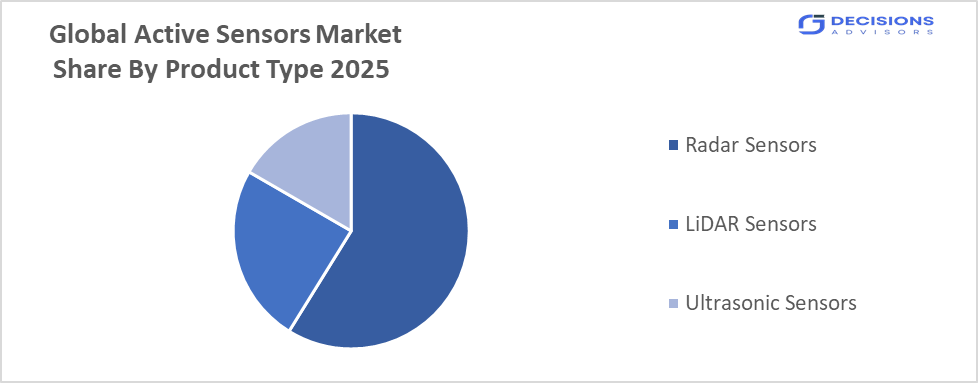
- By product type, the radar sensor segment dominated the market in 2025 with a share of 47% and is projected to grow at a substantial CAGR during the forecast period.
- By end-use industry, the transportation segment dominated the market in 2025 with a share of 52%, and is projected to grow at a substantial CAGR during the forecast period.
- The compound annual growth rate of the global Active Sensors market is 10.56%.
- The market is likely to achieve a valuation of USD 58.13 billion by 2035.
What is role of technology in grooming the market?
The global active sensors market is expanding because industrial sectors demand automated systems together with real-time monitoring and intelligent technology solutions. Active sensing technologies are now used by more than 60 % of smart devices that exist in the current market because of the rapid growth of Internet of Things and connected device systems. The market demand for autonomous vehicles, together with advanced driver-assistance systems, has increased because of this requirement. The industrial automation sector, together with smart infrastructure development projects, has achieved significant operational efficiency improvements and safety enhancements. The advancement of AI together with MEMS technologies has resulted in improved sensor performance, which includes better accuracy and energy efficiency that requires active sensors in modern automotive, healthcare, manufacturing and consumer electronics applications.
Market Drivers
The active sensors market exists because industries need automated systems that can monitor operations in real time and use intelligent technology. The automotive sector plays a major role, contributing nearly 50% of total demand, supported by increasing adoption of ADAS and autonomous vehicles. More than half of current electronic devices use active sensors, which has become a standard because of the fast growth of Internet of Things technology and its connected devices. Industrial automation and smart infrastructure projects enable organizations to improve their operations through increased efficiency combined with enhanced security measures. Advances in AI, MEMS technology, and sensor systems improve both performance and reliability of active sensors, also becomes necessary for automotive, healthcare, manufacturing, and consumer electronics industries.
Restrain
The market encounters difficulties because it needs to handle expensive production costs and implementation expenses, together with complicated system design and problems that arise during system integration. Advanced sensors require significant investment and technical expertise that prevents small enterprises from using them. The need for maintenance, together with the presence of system compatibility problems with current systems, will create obstacles that prevent organizations from expanding their operations resulting in decreased market development.
Competitive Analysis:
The report offers the appropriate analysis of the key organizations/companies involved within the active sensors market, along with a comparative evaluation primarily based on their product of offering, business overviews, geographic presence, enterprise strategies, segment market share, and SWOT analysis. The report also provides an elaborative analysis focusing on the current news and developments of the companies, which includes product development, innovations, joint ventures, partnerships, mergers & acquisitions, strategic alliances, and others. This allows for the evaluation of the overall competition within the market.
Top Companies in the Global Active Sensors Market
- Analog Devices Inc.
- Bosch Sensortec GmbH
- STMicroelectronics
- NXP Semiconductors
- Infineon Technologies AG
- Renesas Electronics Corporation
- Siemens AG
- Honeywell International Inc.
- Robert Bosch GmbH
- TE Connectivity
Government Initiatives
|
Country |
Key Government Initiatives |
|
India |
Under India’s Semicon India Programme with a ?76,000?crore outlay, fiscal support covers semiconductor fabs, compound semiconductors, and sensors (including MEMS) fabrication facilities, directly influencing the Global Active Sensors Market by expanding domestic sensor manufacturing capabilities. |
|
UK |
The UK government supports the sensor ecosystem via the Catapult network and a USD?1?billion semiconductor fund, promoting advanced sensor manufacturing, innovation, and adoption, positively impacting the global active sensors market. |
|
Japan |
Under the Green Growth Strategy, the government plans to invest over USD?50?billion in clean energy and infrastructure by 2030, driving demand for smart grid and energy-efficient sensors. |
Study on the Supply, Demand, Distribution, and Market Environment of the Global Active Sensors Market
The active sensors market demonstrates strong connections between its supply side and demand side, its distribution network and market environment. Supply exists because semiconductor manufacturers create advanced radar, LiDAR and ultrasonic sensors which deliver better performance. The various sectors that include automotive and industrial automation, healthcare and consumer electronics show increasing demand, with automotive applications accounting for approximately 50% of total market needs. The distribution network operates through partnerships with original equipment manufacturers and direct sales and international electronic supply chains. The market environment develops through fast IoT adoption, intelligent infrastructure creation and safety system regulations which receive government backing. The market faces global expansion challenges because high costs, supply chain limitations and technical integration problems maintain their influence.
Price Analysis and Consumer Behaviour Analysis
Pricing in the active sensors market varies based on technology, accuracy, and application. Advanced sensors such as LiDAR can cost significantly higher than ultrasonic sensors, contributing to hardware accounting for over 50% of total market revenue. Prices are influenced by miniaturization, integration capabilities, and performance efficiency. From a consumer behavior perspective, demand is driven by industries prioritizing accuracy, safety, and automation, with the automotive sector contributing nearly 50% of total demand. Over 55% of electronic devices integrate sensors, reflecting strong adoption. Buyers increasingly prefer energy-efficient, compact, and AI-enabled sensors, focusing on long-term reliability and system integration over initial cost.
Market Segmentation
The active sensors market share is classified into product type, application and end-use industry
- The radar sensors segment dominated the market in 2025 with a share of 47% and is projected to grow at a substantial CAGR during the forecast period
Based on the product type, the active sensors market is divided into radar sensors, lidar sensors, and ultrasonic sensors. Among these, the radar sensor segment dominated the market in 2025 with a share of 47% and is projected to grow at a substantial CAGR during the forecast period. This dominance is driven by strong adoption in automotive safety systems, reliable performance in adverse weather conditions, and lower cost compared to LiDAR technologies, making them widely preferred.
- The automotive systems segment accounted for the largest share in 2025, and is anticipated to grow at a significant CAGR during the forecast period.
Based on the application, the active sensors market is divided into automotive systems, industrial automation, and consumer electronics. Among these, the automotive systems segment accounted for the largest share in 2026, and is anticipated to grow at a significant CAGR during the forecast period. This dominance is because of the increasing adoption of ADAS and autonomous driving technologies, which require real-time sensing and high accuracy. Strict safety regulations, growing vehicle electrification, and demand for enhanced driver assistance features further drive strong integration of active sensors.
- The transportation segment dominated the market in 2025 with a share 52%, and is projected to grow at a substantial CAGR during the forecast period.
Based on end-use industry, the active sensors market is divided into healthcare, transportation, smart infrastructure, and manufacturing. Among these, the transportation segment dominated the market in 2026 with a share of 52%, and is projected to grow at a substantial CAGR during the forecast period. The dominance is due to widespread adoption in automotive safety systems, ADAS, and autonomous vehicles requiring real-time sensing and high accuracy. Increasing vehicle production, strict safety regulations, and growing demand for advanced driver assistance features are driving significant integration of active sensors across the transportation sector globally.
Strategies to Implement for Growth of the Market in Non-Leading Regions
Cost-effective solutions and localized manufacturing, together with strategic partnerships will drive growth in non-leading regions. Companies should introduce affordable, scalable active sensors to target price-sensitive markets. The company needs to expand its distribution network through partnerships with regional OEMs and system integrators to achieve better product accessibility. The technical training programs and awareness programs will help businesses across different sectors to adopt new technologies. The government can promote economic development through its support of smart infrastructure programs and industrial automation projects. The establishment of high-growth sectors that include transportation, manufacturing and smart cities will generate market demand. The establishment of local supply chains and service centers will enable companies to reduce expenses while delivering better customer assistance and achieving greater market reach in developing markets.
Regional Segment Analysis of the Active Sensors Market
- North America (U.S., Canada, Mexico)
- Europe (Germany, France, U.K., Italy, Spain, Rest of Europe)
- Asia-Pacific (China, Japan, India, Rest of APAC)
- South America (Brazil and the Rest of South America)
- The Middle East and Africa (UAE, South Africa, Rest of MEA)
North America is anticipated to hold the largest share of the active sensors market over the predicted timeframe.
North America is anticipated to hold the largest share of the active sensors market over the predicted timeframe, accounting for approximately 37% of the global market. The region’s dominance is driven by strong adoption of advanced driver-assistance systems (ADAS), autonomous vehicle technologies, and industrial automation. The United States leads the region, contributing over 80% of regional revenue, supported by the presence of major semiconductor and sensor manufacturers. Increasing investments in smart infrastructure, IoT, and healthcare technologies further boost demand. Additionally, strict safety regulations and early adoption of advanced technologies continue to strengthen North America’s leading position in the global market.
Asia Pacific is expected to grow at a rapid CAGR in the active sensors market during the forecast period.
Asia Pacific is expected to grow at a rapid CAGR of approximately 12% in the active sensors market during the forecast period. This growth is driven by expanding automotive production, increasing adoption of industrial automation, and rising demand for consumer electronics. Countries such as China, Japan, South Korea, and India are investing heavily in smart infrastructure and IoT technologies. Additionally, government initiatives supporting manufacturing and digitalization, along with the presence of major electronics manufacturers, are accelerating sensor adoption. The growing use of active sensors in electric vehicles and smart city projects further strengthens regional market expansion.
Europe is the 3rd largest region to grow in the active sensors market during the period.
Europe is the third largest region in the active sensors market, accounting for approximately 27% of the global share. Growth is driven by strong automotive manufacturing, increasing adoption of ADAS, and strict safety regulations across countries such as Germany, France, and the UK. The region also benefits from advancements in industrial automation and smart infrastructure projects. Additionally, rising investments in electric vehicles and IoT technologies are supporting steady demand for active sensors across transportation, manufacturing, and healthcare applications.
Future Market Trends in the Global Active Sensors Market: -
1.Integration with IoT and Connected Devices
Active sensors are increasingly integrated into IoT ecosystems, with over 55% of electronic and industrial devices now utilizing sensors for real-time monitoring and automation, driving demand across industries.
2.Advancements in Sensor Technologies
Innovations in radar, LiDAR, ultrasonic, and infrared sensors are improving sensitivity and efficiency, with nearly 45% of new sensors offering enhanced performance and lower power consumption.
3.Growth of Automation and Industry 4.0
Industrial automation is expanding rapidly, with close to 50% of companies embedding sensors to improve operational efficiency, safety, and productivity in manufacturing and industrial environments.
4.Rising Adoption in Automotive and Autonomous Systems
Active sensors are critical for ADAS and autonomous vehicles, enabling features like collision detection and navigation, supported by increasing global vehicle production and safety regulations.
Recent Development
- In February?2026, ams OSRAM launched the AS5173, a high-resolution magnetic position sensor with an integrated noise-reduction filter, enhancing automotive chassis position sensing and active damping in electric vehicles.
- In April?2025, ams OSRAM launched the TMF8806 dToF sensor, STMicroelectronics introduced the VL53L4ED for extreme temperatures, and Aeva released the Atlas 4D LiDAR, advancing active sensor applications.
- In March?2025, SICK AG launched the RMS2000 2D radar for harsh industrial environments, while NXP introduced the Trimension SR250 UWB chip, enhancing active sensor applications in IoT and automation.
- In October?2023, Niterra (formerly NGK/NTK) launched new MAP (Manifold Absolute Pressure) sensors, enhancing automotive engine monitoring and control systems, and contributing to growth in the Global Active Sensors Market.
How is Recent Developments Helping the Market?
Recent developments are accelerating the active sensors market through advancements in sensor performance, integration, and scalability. Improvements in radar and LiDAR technologies are enhancing detection accuracy and real-time sensing capabilities, with global radar sensor shipments exceeding 160 million units annually, reflecting strong automotive demand. Sensor fusion combining multiple sensing technologies is improving system reliability and safety. Additionally, miniaturization and cost optimization are increasing adoption across consumer electronics and industrial applications. Growing investments in smart infrastructure, automation, and IoT ecosystems are further expanding deployment, enabling wider use of active sensors across transportation, manufacturing, and urban development sectors.
Market Segment
This study forecasts revenue at global, regional, and country levels from 2020 to 2035. Decision Advisors has segmented the active sensors market based on the below-mentioned segments:
Global Active Sensors Market, By Product Type
- Radar Sensors
- LiDAR Sensors
- Ultrasonic Sensors
Global Active Sensors Market, By Application
- Automotive Systems
- Industrial Automation
- Consumer Electronics
Global Active Sensors Market, By End-Use Industry
- Healthcare
- Transportation
- Smart Infrastructure
- Manufacturing
Global Active Sensors Market, By Regional Analysis
- North America
- US
- Canada
- Mexico
- Europe
- Germany
- UK
- France
- Italy
- Spain
- Russia
- Rest of Europe
- Asia Pacific
- China
- Japan
- India
- South Korea
- Australia
- Rest of Asia Pacific
- South America
- Brazil
- Argentina
- Rest of South America
- Middle East & Africa
- UAE
- Saudi Arabia
- Qatar
- South Africa
- Rest of the Middle East & Africa
Frequently Asked Questions (FAQ)
Q. How do active sensors impact energy efficiency in smart systems?
A. Active sensors monitor real-time conditions and adjust system operations dynamically, minimizing wasted energy. In smart buildings, they control lighting, HVAC, and equipment usage. In industrial and transportation systems, adaptive sensing optimizes resource consumption, lowers operational costs, and reduces environmental impact.
Q. What role do active sensors play in predictive maintenance?
A. Active sensors track equipment performance continuously, detecting anomalies early and preventing failures. By providing real-time data on vibration, temperature, or pressure, they enable predictive maintenance schedules, minimize unplanned downtime, reduce repair costs, and extend machinery life, improving operational efficiency across industries.
Q. What is the importance of sensor fusion in active sensing systems?
A. Sensor fusion integrates data from multiple sensors, enhancing accuracy and reliability. It reduces false readings and improves environmental perception. This is critical in autonomous vehicles, robotics, and industrial automation, enabling better decision-making, improved safety, and optimized system performance in complex conditions.
Q. What is the role of AI in active sensor applications?
A. AI processes and analyzes sensor data to detect patterns, predict anomalies, and enable autonomous decision-making. In industries like automotive, manufacturing, and healthcare, AI enhances efficiency, optimizes operations, supports predictive maintenance, and improves safety, leveraging active sensor inputs for smarter, real-time actions.
Check Licence
Choose the plan that fits you best: Single User, Multi-User, or Enterprise solutions tailored for your needs.
We Have You Covered
- 24/7 Analyst Support
- Clients Across the Globe
- Tailored Insights
- Technology Tracking
- Competitive Intelligence
- Custom Research
- Syndicated Market Studies
- Market Overview
- Market Segmentation
- Growth Drivers
- Market Opportunities
- Regulatory Insights
- Innovation & Sustainability
Report Details
| Scope | Global |
| Pages | 245 |
| Delivery | PDF & Excel via Email |
| Language | English |
| Release | Apr 2026 |
| Access | Download from this page |