
Acute Bacterial Skin and Skin Structure Infections Market
 |
Author:
David J
|
Pages:
240
|
Author:
David J
|
Pages:
240
Global Acute Bacterial Skin and Skin Structure Infections Market Size, Share, and COVID-19 Impact Analysis, By Infection Type (Community-acquired ABSSSI, and Hospital-acquired ABSSSI), By Drug Class (Glycopeptides/lipoglycopeptides, Oxazolidinones, Beta-lactams, Lipopeptide, Tetracyclines, and Other drug classes), By Route of Administration (Parenteral, Oral, and Topical), and By Region (North America, Europe, Asia-Pacific, Latin America, Middle East, and Africa), Analysis and Forecast 2025 -2035
CAGR
5.41%
REVENUE 2024
USD Billion 7.15
FORECAST 2035
USD Billion 12.76
REPORT COVERAGE
Global
Global Acute Bacterial Skin and Skin Structure Infections Market Insights Forecasts to 2035
- The Global Acute Bacterial Skin and Skin Structure Infections Market Size Was Estimated at USD 7.15 Billion in 2024
- The Market Size is Expected to Grow at a CAGR of around 5.41 % from 2025 to 2035
- The Worldwide Acute Bacterial Skin and Skin Structure Infections Market Size is Expected to Reach USD 12.76 Billion by 2035
- Europe is expected to grow the fastest during the forecast period.
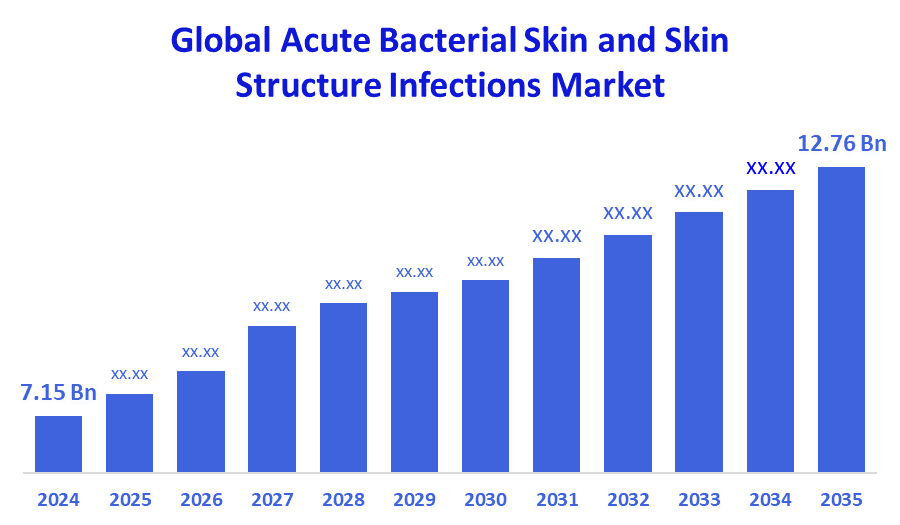
According to a research report published by Decisions Advisors and Consulting, the global acute bacterial skin and skin structure infections market size was worth around USD 7.15 billion in 2024 and is predicted to grow to around USD 12.76 billion by 2035 with a compound annual growth rate (CAGR) of 5.41 % from 2025 to 2035. The market’s picking up speed as more people recognise and diagnose acute bacterial skin and skin structure infections (ABSSSI). At the same time, pharmaceutical and biopharma companies are ramping up their research, pushing out new products and treatments. Antibiotic resistance is changing the game. The old antibiotics just don’t work like they used to, so there’s a stronger push to come up with new therapies and different ways to treat these infections.
Market Overview
The acute bacterial skin and skin structure infections market refers to the segment of the global pharmaceutical and healthcare industry that focuses on the diagnosis, treatment, and management of severe bacterial infections affecting the skin and underlying tissues. These infections include cellulitis, wound infections, abscesses, and major cutaneous infections, often caused by pathogens such as Staphylococcus aureus (including MRSA) and Streptococcus pyogenes. These infections can show up as cellulitis, erysipelas, wound infections, or big abscesses. Symptoms aren’t always the same, but you’ll often see redness, warmth, swelling, and pain in one spot. Some people also get a fever, chills, or notice their lymph nodes are swollen. Further, doctors look at your medical history and check you out in person, paying close attention to your symptoms. Sometimes they’ll take a sample from the infected area or do a wound culture to see exactly which bacteria are causing trouble. They need a better look at how deep the infection goes; they might order an ultrasound or MRI.
Report Coverage
This research report categorizes the acute bacterial skin and skin structure infections market based on various segments and regions, forecasts revenue growth, and analyzes trends in each submarket. The report analyses the key growth drivers, opportunities, and challenges influencing the acute bacterial skin and skin structure infections market. Recent market developments and competitive strategies, such as expansion, product launch, development, partnership, merger, and acquisition, have been included to draw the competitive landscape in the market. The report strategically identifies and profiles the key market players and analyzes their core competencies in each sub-segment of the acute bacterial skin and skin structure infections market.
Driving Factors
The acute bacterial skin and skin structure infection market is changing fast. More consumers are dealing with skin infections these days, and folks know a lot more about their treatment options than they used to. Healthcare providers need to rethink how they handle these cases. They’re after better management and newer therapies that actually work. Antibiotic resistance keeps getting worse, so there’s a real push for fresh treatment approaches. This reshapes the way these infections get treated. Companies and researchers are teaming up more than ever, chasing breakthroughs that can outsmart resistant bacteria. The next big thing, something that helps patients recover faster and makes treatment smoother. Telemedicine and digital health tools are making it easier to track patients and help them stick with their treatment plans. The market’s heading in a new direction. Innovation and teamwork sit right at the centre, driving progress for both providers and patients. These new treatments work better and help patients spend less time in the hospital, which cuts costs, too. More doctors and patients now understand how important it is to catch diseases early and start treatment right away, so targeted therapies are catching on fast. Advantageously, as governments boost healthcare funding and launch new programs, more people in developing countries can get the care they need, and the market keeps growing.
Restraining Factors
A few factors are holding back the ABSSSI market expansion. Antimicrobial resistance keeps climbing, hospital stays cost way too much, and new antibiotics just aren’t coming fast enough. Regulatory slowdowns and side effects don’t help either. All of this makes it harder for patients to get the treatments they need, slows down market growth, and really cranks up the pressure to find better options.
Market Segmentation
The acute bacterial skin and skin structure infections market share is classified into infection type, drug class, and route of administration.
- The community-acquired ABSSSI segment accounted for the largest market share in 2024 and is projected to grow at a substantial CAGR over the forecast period.
Based on the product type, the acute bacterial skin and skin structure infections market is divided into community-acquired ABSSSI, and hospital-acquired ABSSSI. Among these, the community-acquired ABSSSI segment accounted for the largest market share in 2024 and is projected to grow at a substantial CAGR over the forecast period. More high-risk patients are getting treated outside the hospital now, which means community-acquired ABSSSI cases keep climbing. Oral antibiotics that actually work make it easier for people to stick with their treatment. Plus, with fewer hospital stays, costs drop, and more patients can get care. All this pushes the growth of community-acquired infections and helps them grab a bigger share of the market.
- The glycopeptides/lipoglycopeptides segment accounted for the highest revenue share in 2024 and is projected to grow at a notable CAGR during the forecast period.
Based on the drug class, the acute bacterial skin and skin structure infections market is divided into glycopeptides/lipoglycopeptides, oxazolidinones, beta-lactams, lipopeptides, tetracyclines, and other drug classes. Among these, the glycopeptides/lipoglycopeptides segment accounted for the highest revenue share in 2024 and is projected to grow at a notable CAGR during the forecast period. Glycopeptides like vancomycin and lipoglycopeptides such as telavancin are key treatments for MRSA and resistant gram?positive pathogens. Their broad activity and proven effectiveness against severe ABSSSI cases sustain a strong market share amid rising global antibiotic resistance.
- The parenteral segment accounted for the highest market share in 2024 and is anticipated to grow at a significant CAGR during the forecast period.
Based on the route of administration, the acute bacterial skin and skin structure infections market is divided into parenteral, oral, and topical. Among these, the parenteral segment accounted for the highest market share in 2024 and is anticipated to grow at a significant CAGR during the forecast period. Parenteral antibiotics remain the established treatment route for severe and complicated ABSSSIs, including hospital-acquired and multidrug-resistant infections like MRSA. Their direct bloodstream delivery ensures rapid, effective therapy. Rising healthcare-associated infections further increase reliance on parenteral formulations, driving demand and reinforcing their indispensable role in critical care settings.
Regional Segment Analysis of the Acute Bacterial Skin and Skin Structure Infections Market
- North America (U.S., Canada, Mexico)
- Europe (Germany, France, U.K., Italy, Spain, Rest of Europe)
- Asia-Pacific (China, Japan, India, Rest of APAC)
- South America (Brazil and the Rest of South America)
- The Middle East and Africa (UAE, South Africa, Rest of MEA)
Asia Pacific is anticipated to hold the largest share of the acute bacterial skin and skin structure infections market over the predicted timeframe.
Asia Pacific is anticipated to hold the largest share of the acute bacterial skin and skin structure infections market over the predicted timeframe. Healthcare spending in the Asia-Pacific region just keeps climbing, fueled by booming populations and governments pushing to make essential medicines easier to get. China and India, both powerhouse manufacturers, deal with their own local challenges while juggling how they sell abroad. Southeast Asia and Oceania, their are using new treatments and point-of-care diagnostics, thanks to bigger public health budgets and shifting insurance rules.
Europe is expected to grow at a rapid CAGR in the acute bacterial skin and skin structure infections market during the forecast period. Germany’s healthcare system stands out as one of the best in the world. People here have easy access to everything they need—diagnostic tests, treatments, and hospitals that really focus on catching ABSSSIs early and treating them well. Folks are more aware of the symptoms these days, and better hygiene has pushed more care into outpatient settings. That means doctors catch problems sooner and patients have fewer complications, which opens up real chances for the market to grow. But there’s another side. More people are living with chronic diseases like diabetes and obesity, and these issues weaken the immune system. That leaves people wide open to serious skin infections. So, with chronic conditions on the rise, the demand for good ABSSSI treatments goes up, too.
Competitive Analysis:
The report offers the appropriate analysis of the key organizations/companies involved within the acute bacterial skin and skin structure infections market, along with a comparative evaluation primarily based on their product offering, business overviews, geographic presence, enterprise strategies, segment market share, and SWOT analysis. The report also provides an elaborative analysis focusing on the current news and developments of the companies, which includes product development, innovations, joint ventures, partnerships, mergers & acquisitions, strategic alliances, and others. This allows for the evaluation of the overall competition within the market.
List of Key Companies
- AbbVie
- Basilea Pharmaceutica
- Cypher Pharmaceuticals
- Endo Pharmaceuticals
- Glenmark Pharmaceuticals
- Melinta Therapeutics
- Menarini Group
- Merck
- Nabriva Therapeutics
- Paratek Pharmaceuticals
- Pfizer
- Sandoz
- Others
Key Target Audience
- Market Players
- Investors
- End-users
- Government Authorities
- Consulting and Research Firm
- Venture capitalists
- Value-Added Resellers (VARs)
Recent Development
- In June 2025, Cumberland Pharmaceuticals Inc., a speciality pharmaceutical company focused on delivering high-quality products to improve patient care, announced the availability of the Vibativ (telavancin) 4-Vial Starter Pak through a new contract with Vizient®, the nation's largest provider-driven healthcare performance improvement company. Vizient served more than 65% of the nation's acute care providers, including 97% of academic medical centres and 35% of the non-acute market.
- In August 2023, Mumbai-based BDR Pharmaceuticals International announced the launch of Dalbonova Injection, a revolutionary medication for the treatment of acute bacterial skin and skin structure infections caused by designated susceptible strains of Gram-positive microorganisms. This groundbreaking drug was available as a 500 mg injection and marked an important milestone in the field of anti-infective medicines in India.
- In July 2021, the U.S. Food and Drug Administration (FDA) approved Dalvance® (dalbavancin) for the treatment of acute bacterial skin and skin structure infections (ABSSSI) in pediatric patients, including newborns. This approval, announced by AbbVie, makes Dalvance the first single-dose intravenous (IV) therapy option for children with ABSSSI.
Market Segment
This study forecasts revenue at global, regional, and country levels from 2020 to 2035. Decisions Advisors has segmented the acute bacterial skin and skin structure infections market based on the below-mentioned segments:
Global Acute Bacterial Skin and Skin Structure Infections Market, By Infection Type
- Community-acquired ABSSSI
- Hospital-acquired ABSSSI
Global Acute Bacterial Skin and Skin Structure Infections Market, By Drug Class
- Glycopeptides/lipoglycopeptides
- Oxazolidinones
- Beta-lactams
- Lipopeptide
- Tetracyclines
- Other drug classes
Global Acute Bacterial Skin and Skin Structure Infections Market, By Route of Administration
- Parenteral
- Oral
- Topical
Global Acute Bacterial Skin and Skin Structure Infections Market, By Regional Analysis
- North America
- US
- Canada
- Mexico
- Europe
- Germany
- UK
- France
- Italy
- Spain
- Russia
- Rest of Europe
- Asia Pacific
- China
- Japan
- India
- South Korea
- Australia
- Rest of Asia Pacific
- South America
- Brazil
- Argentina
- Rest of South America
- Middle East & Africa
- UAE
- Saudi Arabia
- Qatar
- South Africa
- Rest of the Middle East & Africa
Frequently Asked Questions (FAQ)
- What is the projected size and growth rate of the global ABSSSI market?
The market was valued at USD 7.15 billion in 2024 and is expected to reach USD 12.76 billion by 2035, growing at a CAGR of 5.41% from 2025 to 2035.
- What are the main infection types in the ABSSSI market?
Segments include community-acquired ABSSSI (the largest share in 2024, driven by outpatient oral antibiotics and cost savings) and hospital-acquired ABSSSI, with community-acquired projected for substantial CAGR.
- Which drug class leads the market by revenue?
Glycopeptides/lipoglycopeptides held the highest share in 2024 (e.g., vancomycin, telavancin for MRSA), expected to grow at a notable CAGR due to efficacy against resistant gram-positive pathogens.
- What is the dominant route of administration?
Parenteral routes dominated market share in 2024 and are set for a significant CAGR, favoured for severe cases like MRSA via rapid bloodstream delivery in hospital settings.
- What drives growth in the ABSSSI market?
Rising prevalence, improved diagnosis/awareness, antibiotic resistance spurring novel therapies, pharma R&D/product launches, collaborations, telemedicine, early intervention, and government healthcare funding boost expansion.
- What are the key restraining factors?
Escalating antimicrobial resistance, high hospitalisation costs, slow new antibiotic development, regulatory hurdles, and side effects limit access and innovation.
- Which region holds the largest share and which grows fastest?
Asia-Pacific leads overall due to population growth, healthcare spending, manufacturing hubs (China/India), and diagnostics adoption; Europe is expected to have the fastest CAGR via advanced systems and chronic disease links.
- Who are the key players and recent developments?
Companies include AbbVie, Pfizer, Merck, Melinta Therapeutics, and Glenmark. Highlights: Cumberland's Vibativ 4-Vial Starter Pak with Vizient (June 2025), BDR Pharma's Dalbonova launch in India (Aug 2023), AbbVie's pediatric Dalvance approval (July 2021).
Check Licence
Choose the plan that fits you best: Single User, Multi-User, or Enterprise solutions tailored for your needs.
We Have You Covered
- 24/7 Analyst Support
- Clients Across the Globe
- Tailored Insights
- Technology Tracking
- Competitive Intelligence
- Custom Research
- Syndicated Market Studies
- Market Overview
- Market Segmentation
- Growth Drivers
- Market Opportunities
- Regulatory Insights
- Innovation & Sustainability
Report Details
| Scope | Global |
| Pages | 240 |
| Delivery | PDF & Excel via Email |
| Language | English |
| Release | Feb 2026 |
| Access | Download from this page |