
Global Acute Coronary Syndrome Market
 |
Pages:
250
|
Pages:
250
Global Acute Coronary Syndrome Market Size, Share, and COVID-19 Impact Analysis, By Type (Non-St-Elevation Myocardial Infarction, St-Elevation Myocardial Infarction, and Unstable Angina), By Diagnosis (Stress Test, Blood Tests, Imaging and Others), Treatment (Medication and Surgery) and By Region (North America, Europe, Asia-Pacific, Latin America, Middle East, and Africa), Analysis and Forecast 2025-2035
REPORT COVERAGE
Global
Global Acute Coronary Syndrome Market Size Insights Forecasts to 2035
- The Global Acute Coronary Syndrome Market Size Was valued at USD 12.27 Billion in 2024
- The Global Acute Coronary Syndrome Market Size is Expected to Grow at a CAGR of around 6.77% from 2025 to 2035
- The Worldwide Acute Coronary Syndrome Market Size is Expected to Reach USD 25.22 Billion by 2035
- Asia-Pacific is expected to grow the fastest during the forecast period.
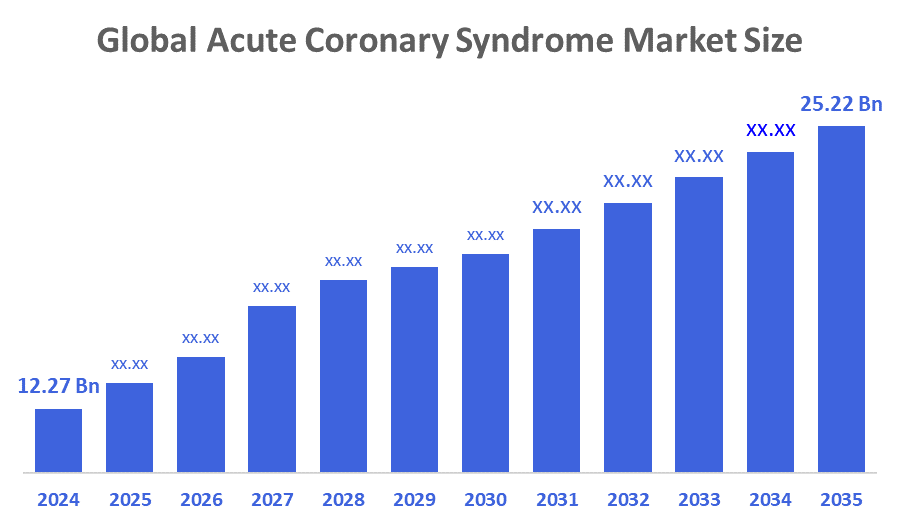
According to a research report published by Decisions Advisors and Consulting, The Global Acute Coronary Syndrome Market Size Was Worth Around USD 12.27 Billion In 2024 And Is Predicted To Grow To Around USD 25.22 Billion By 2035 With A Compound Annual Growth Rate (CAGR) Of 6.77% From 2025 To 2035. The global acute coronary syndrome treatment and monitoring market will benefit from multiple growth drivers that include expanded cardiac intervention techniques, AI-based diagnostic tools, telemedicine services, healthcare funding in developing countries, preventive health screening initiatives, and customized medical treatments.
Market Overview
The Global Acute Coronary Syndrome Market Size refers to the worldwide industry which develops diagnostics and treatments and patient management solutions for emergency situations when blood flow to the heart suddenly decreases. The market includes all medical products which treat acute cardiac events that result in heart attacks. Additionally, Tele-cardiology provides fast evaluation support to frontline units through its connection to distant specialists. The ambulance teams transmit ECG data which helps them create treatment plans before reaching the hospital. The mobile care units provide their services to high-density areas at a faster rate. Emergency networks use cloud-based communication systems to manage increased call volumes. Digital review tools enable physicians to analyze intricate clinical signs. Remote decision support systems provide important assistance to rural clinics. Urban networks improve their service capacity through the establishment of mobile hubs and quick triage stations. The Acute Coronary Syndrome Market advances with wider use of hybrid emergency frameworks. For instance, GE Healthcare’s MUSE ECG system enables transmission of 12-lead ECGs within seconds, supporting pre-hospital triage across more than 12,000 global facilities.
Report Coverage
This research report categorizes the acute coronary syndrome market based on various segments and regions, forecasts revenue growth, and analyzes trends in each submarket. The report analyses the key growth drivers, opportunities, and challenges influencing the acute coronary syndrome market. Recent market developments and competitive strategies such as expansion, type launch, development, partnership, merger, and acquisition, have been included to draw the competitive landscape in the market. The report strategically identifies and profiles the key market players and analyses their core competencies in each sub-segment of the acute coronary syndrome market.
Driving Factors
The Global Acute Coronary Syndrome Market Size Industry experiences growth because multiple countries spend more money on healthcare services. The government and private sector health facilities have expanded their healthcare system investments, which results in improved access to acute coronary syndrome diagnostic and therapeutic services. Countries spend large amounts of money on cardiovascular health initiatives, which include both screening programs and public awareness campaigns. The increased funding will enable the implementation of modern medical treatments, which will lead to a 6.97% compound annual growth rate from 2025 to 2035 as the market develops solutions to meet rising demand for cardiovascular treatment.
Restraining Factors
The advanced sophistication of cardiology equipment together with its expensive price and necessary financial backing requirements results in increased medical costs. The elevated expenses lead to patient treatment delays which occur at both hospitals and clinics. The strict and lengthy regulatory approval procedures together with non-compliant products that fail to obtain clearance create obstacles that restrict market expansion. For instance, advanced cardiac imaging or interventional devices often require extensive clinical validation and regulatory documentation, increasing development timelines and costs, ultimately limiting their accessibility and delaying their adoption in routine clinical practice.
Market Segmentation
The acute coronary syndrome market share is classified into type, diagnosis, and treatment.
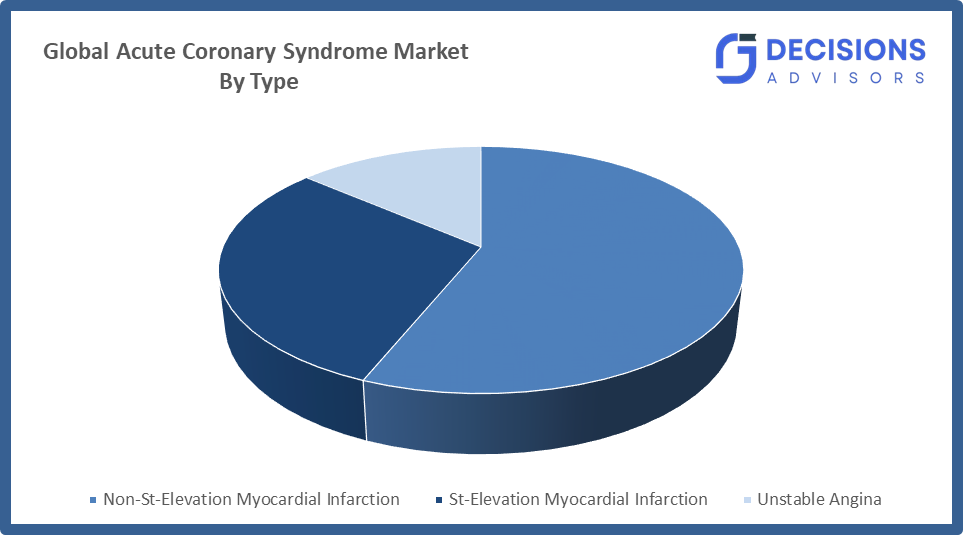
- The non-St-elevation myocardial infarction segment dominated the market in 2024, approximately 45% and is projected to grow at a substantial CAGR during the forecast period.
Based on the type, the acute coronary syndrome market is divided into non-St-elevation myocardial infarction, St-elevation myocardial infarction, and unstable angina. Among these, the non-St-elevation myocardial infarction segment dominated the market in 2024, approximately 45% and is projected to grow at a substantial CAGR during the forecast period. The system includes data training up to the month of October in the year 2023. The NSTEMI cases increase because more people with partial blockages caused by their way of living and their metabolic health conditions. Hospitals use improved triage systems which enable them to identify different diseases more quickly. The health care professionals develop better treatment procedures to decrease risks of complications which affect their most vulnerable patients. The system shows enhanced performance through upgraded diagnostic methods which enable better initial identification of patients. The Acute Coronary Syndrome Market benefits from strong adoption across all three categories. For instance, Siemens Healthineers’ Atellica IM High-Sensitivity Troponin I assay supports rule-in and rule-out pathways within 60 minutes, improving early differentiation of STEMI vs NSTEMI.
- The blood tests segment accounted for the largest share in 2024, approximately 52% and is anticipated to grow at a significant CAGR during the forecast period.
Based on the diagnosis, the acute coronary syndrome market is divided into stress test, blood tests, imaging and others. Among these, the blood tests segment accounted for the largest share in 2024, approximately 52% and is anticipated to grow at a significant CAGR during the forecast period. The essential function of cardiac biomarker testing enables medical professionals to diagnose acute coronary syndrome with high speed and precise results. The widespread use of cardiac biomarker testing together with its fast test results and affordable pricing and its standard application in emergency departments, enables healthcare providers to maintain clinical trust in the test, which leads to better patient outcomes through early disease detection and treatment selection, thus creating constant market demand for the product.
- The medication segment accounted for the highest market revenue in 2024, approximately 58% and is anticipated to grow at a significant CAGR during the forecast period.
Based on the treatment, the acute coronary syndrome market is divided into medication and surgery. Among these, the medication segment accounted for the highest market revenue in 2024, approximately 58% and is anticipated to grow at a significant CAGR during the forecast period. The drug functions as first-line treatment because it remains affordable and emergency departments can provide it to patients without delay. The process of developing new drugs leads to better patient outcomes and increased treatment compliance. For instance, antiplatelet and anticoagulant therapies are routinely administered immediately after diagnosis, stabilizing patients and reducing complications, which sustains strong clinical demand and market growth.
Regional Segment Analysis of the Acute Coronary Syndrome Market
- North America (U.S., Canada, Mexico)
- Europe (Germany, France, U.K., Italy, Spain, Rest of Europe)
- Asia-Pacific (China, Japan, India, Rest of APAC)
- South America (Brazil and the Rest of South America)
- The Middle East and Africa (UAE, South Africa, Rest of MEA)
North America is anticipated to hold the largest share of the acute coronary syndrome market over the predicted timeframe.
North America is anticipated to hold the largest share of the acute coronary syndrome market over the predicted timeframe. North America holds 38.47% of the market because its broad insurance coverage and quick EMS response times and more than 1800 PCI-certified laboratories support this market share. The United States spends nearly four times Japan’s outlay on catheter hardware which leads to faster adoption of bioresorbable scaffolds and AI-driven lesion assessment tools. The single-payer model in Canada ensures consistent procedure volumes while the public-private partnerships in Mexico make affordable stent programs available to secondary cities.
Asia-Pacific is expected to grow at a rapid CAGR in the acute coronary syndrome market during the forecast period. The phenomenon of urban hospital growth together with rising diabetes rates and changes in human lifestyle patterns drives the current situation. Cardiac centers receive government funding because of increasing patient demand which requires new facilities to be built. The diagnostic system receives better performance through the fast implementation of high-sensitivity biomarkers. Interventional cardiology develops through two main factors which include increased patient knowledge and the growth of treatment facilities in major urban areas. Regional healthcare providers are making efforts to create better access to medical treatment throughout their different healthcare systems. The market expands because more people acquire health insurance while the need for ongoing cardiac treatment increases.
Competitive Analysis:
The report offers the appropriate analysis of the key organizations/companies involved within the acute coronary syndrome market, along with a comparative evaluation primarily based on their type of offering, business overviews, geographic presence, enterprise strategies, segment market share, and SWOT analysis. The report also provides an elaborative analysis focusing on the current news and developments of the companies, which includes type development, innovations, joint ventures, partnerships, mergers & acquisitions, strategic alliances, and others. This allows for the evaluation of the overall competition within the market.
List of Key Companies
- Pfizer Inc.
- Johnson and Johnson Limited
- Siemens AG
- F. Hoffmann-La Roche Ltd.
- Merck & Co. Inc.
- Bayer AG
- Novartis AG
- Sanofi-Aventis LLC.
- Bristol-Myers Squibb Company
- Thermo Fisher Scientific Inc.
- Others
Key Target Audience
- Market Players
- Investors
- End-users
- Government Authorities
- Consulting and Research Firm
- Venture capitalists
- Value-Added Resellers (VARs)
Recent Development
- In September 2025, a new review highlighted evolving acute coronary syndrome (ACS) care trends, including reconsideration of fasting before catheterization, refinement of antithrombotic strategies, personalization of dual-antiplatelet therapy duration, and mixed results from inflammation-targeting trials that influenced future clinical practice
Market Segment
This study forecasts revenue at global, regional, and country levels from 2020 to 2035. Decisions Advisors has segmented the acute coronary syndrome market based on the below-mentioned segments:
Global Acute Coronary Syndrome Market, By Type
- Non-St-Elevation Myocardial Infarction
- St-Elevation Myocardial Infarction
- Unstable Angina
Global Acute Coronary Syndrome Market, By Diagnosis
- Stress Test
- Blood Tests
- Imaging
- Others
Global Acute Coronary Syndrome Market, By Treatment
- Medication
- Surgery
Global Acute Coronary Syndrome Market, By Regional Analysis
- North America
- US
- Canada
- Mexico
- Europe
- Germany
- UK
- France
- Italy
- Spain
- Russia
- Rest of Europe
- Asia Pacific
- China
- Japan
- India
- South Korea
- Australia
- Rest of Asia Pacific
- South America
- Brazil
- Argentina
- Rest of South America
- Middle East & Africa
- UAE
- Saudi Arabia
- Qatar
- South Africa
- Rest of the Middle East & Africa
Frequently Asked Questions (FAQ)
Q1. What growth outlook is projected for the global acute coronary syndrome market?
A: According to Decisions Advisors and Consulting, the market grows from USD 12.27 billion in 2024 to USD 25.22 billion by 2035, driven by innovation, funding, telemedicine, and expanding cardiac care access globally.
Q2. How do hybrid emergency technologies support acute cardiac care?
A: Hybrid emergency cardiology uses cloud communication, remote ECG transmission, and mobile triage hubs, exemplified by GE Healthcare’s MUSE system, enabling faster pre-hospital decisions, improved coordination, reduced delays, and better survival.
Q3. Why does healthcare investment accelerate market expansion?
A: Healthcare investment increases screening, diagnostics, and treatment capacity, improving accessibility, awareness, and early intervention for cardiac emergencies, thereby accelerating adoption of advanced therapies, supporting sustained market expansion, innovation, service delivery.
Q4. What barriers restrain growth in this market?
A: High equipment costs, regulatory complexity, and lengthy validation processes delay product approvals, restrict hospital adoption, increase treatment expenses, and limit patient access, slowing innovation cycles, commercialization, competitive entry, infrastructure modernization.
Q5. What technological trends shape acute coronary syndrome management?
A: The market integrates AI-based diagnostics, tele-cardiology, remote decision support, and customized therapies to enhance rapid assessment, precision treatment, workflow efficiency, rural connectivity, data-driven planning, emergency responsiveness, clinician collaboration, scalability, outcomes.
Check Licence
Choose the plan that fits you best: Single User, Multi-User, or Enterprise solutions tailored for your needs.
We Have You Covered
- 24/7 Analyst Support
- Clients Across the Globe
- Tailored Insights
- Technology Tracking
- Competitive Intelligence
- Custom Research
- Syndicated Market Studies
- Market Overview
- Market Segmentation
- Growth Drivers
- Market Opportunities
- Regulatory Insights
- Innovation & Sustainability
Report Details
| Scope | Global |
| Pages | 250 |
| Delivery | PDF & Excel via Email |
| Language | English |
| Release | Feb 2026 |
| Access | Download from this page |