
Global Acute Hospital Care Market
 |
Pages:
220
|
Pages:
220
Global Acute Hospital Care Market Size, Share, By Technology (Bioinformatics, Big Data Analytics, Drug Discovery, Gene Sequencing, Companion Diagnostics, Others), By Application (CNS, Immunology, Oncology, Respiratory, Others), By End-Use (Diagnostic Companies, Pharmaceutical Companies, Healthcare IT companies, Others), and By Region (North America, Europe, Asia-Pacific, Latin America, Middle East, and Africa), Analysis and Forecast 2025 ? 2035.
REPORT COVERAGE
Global
Market Snapshot
- Market Size (2025): USD 3.61 Billion
- Projected Market Size (2035): USD 6.8 Billion
- Compound Annual Growth Rate (CAGR): 6.54%
- Largest Regional Market: North America
- Fastest Growing Region: Asia-Pacific
- 3rd Largest Region: Europe
- Base Year: 2025
- Historical Period: 2021–2024
- Forecast Period: 2025–2035
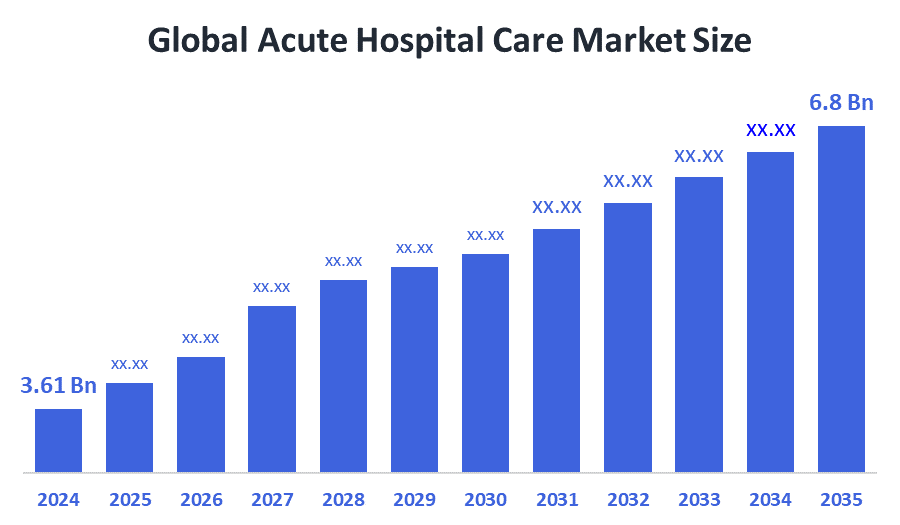
According to Decision Advisors, the Global Acute Hospital Care Market Size is expected to grow from USD 3.61 billion in 2025 to USD 6.8 billion by 2035, at a CAGR of 6.54% during the forecast period 2025-2035. It is propelled by a swiftly aging worldwide demographic, the growing incidence of chronic illnesses, and heightened need for emergency, trauma, and intensive care services. Market expansion is also significantly driven by technological advancements (such as AI and telemedicine), increased investment in healthcare infrastructure, and expanded insurance coverage.
Market Overview/ Introduction
Acute hospital care denotes the active, short-term medical treatment administered in hospitals to patients facing severe, urgent, or life-threatening health crises, as well as those in the immediate aftermath of complex surgical procedures. This encompasses, but is not limited to, emergency services, intensive care units (ICU), surgical care, and specialized diagnostic services. The demand for complex, long-term acute care (LTAC) and emergency services is being fueled by the rise in patient volumes, especially among individuals aged 65 and over. Smart hospital infrastructure leverages IoT and data analytics to enable real-time patient monitoring, optimize workflows, and enhance resource utilization. Telemedicine and virtual care expand access by supporting remote consultations, chronic disease management, and continuous post-acute care, improving outcomes and reducing hospital burden.
- In the United States, Medicare and Medicaid cover over 140 million people, significantly driving acute hospital demand. Affordable Care Act (ACA) expansion increased insured rates to approx. 92%, boosting emergency and inpatient visits, while HHS initiatives via HealthCare.gov further enhance access and acute care utilization.
- Ayushman Bharat PM-JAY, the world’s largest government-funded scheme, provides 5 lakh coverage per family to over 55 crore beneficiaries, enabling free secondary and tertiary hospitalization. This significantly boosts hospital admissions and acute care utilization, driving growth in the global acute hospital care market.
- The UK’s “Fit for the Future” 10-year National Health Service plan (2025) promotes 250-300 neighbourhood health hubs and expanded AI-driven digital tools, including the NHS App. It enhances triaging and shifts care to community settings, improving efficiency and optimizing acute hospital care demand globally.
Notable Insights: -
- North America holds the largest regional market share approximately 55% in the Acute Hospital Care.
- Asia-Pacific is the fastest growing region in the Acute Hospital Care Market the share of 34.8%.
- By technology, big data analytics segment is the dominating accounting for over 49% of the global market share in 2025.
- The compound annual growth rate of the acute hospital care is 6.54%.
- The market is likely to achieve a valuation of USD 6.8 billion by 2035.
What is role of technology in grooming the market?
Technology plays a pivotal role in advancing the acute hospital care market by improving efficiency, accuracy, and patient outcomes. Integration of AI, IoT, and electronic health records enables real-time patient monitoring and faster clinical decision-making, reducing hospital stays by nearly 15–20% in some settings. Telemedicine and remote monitoring support the nearly 40% of patients requiring post-acute care, ensuring continuity and lowering readmission rates. Robotic-assisted and minimally invasive procedures enhance precision and recovery time. Additionally, predictive analytics helps optimize resource utilization, especially in intensive care units, which account for about 58% of acute care services. Overall, digital transformation reduces operational costs, improves care quality, and expands access to healthcare services, particularly in underserved regions.
How is Recent Developments Helping the Market?
Recent developments are greatly boosting growth in the acute hospital care market by enhancing accessibility, efficiency, and patient outcomes. With digital check-ins, virtual visits, and remote monitoring, the emergence of smart hospitals guarantees ongoing patient involvement and minimizes readmissions. Improvements in telemedicine boost emergency response effectiveness, shorten diagnostic periods, and decrease healthcare expenses. Moreover, the remote patient monitoring market surpassed 26.9 billion in 2024, indicating robust uptake. Furthermore, innovations like hospital-at-home models and AI-driven care are alleviating the burden on hospitals and enhancing efficiency by conserving bed capacity and facilitating real-time ICU monitoring. These innovations are changing acute care into a healthcare system that is more interconnected, focused on patients, and scalable.
Market Drivers
Key driving factors for the acute hospital care market, supported with the statistics, include the rising prevalence of chronic diseases such as cardiovascular diseases, diabetes, and cancer, which require frequent hospitalization and drive demand. The growing geriatric population further increases hospital admissions due to higher susceptibility to acute conditions. Emergency care dominates the market with 52.9% share, driven by trauma, accidents, and critical illnesses, with over 5 million deaths annually from injuries worldwide. Intensive care demand is also significant, with approximately 56% of acute care services linked to ICU usage, highlighting the need for advanced critical care infrastructure. Additionally, nearly 40% of patients require post-acute or continued care, boosting the need for integrated and continuous care services globally.
Restrain
Access to acute hospital care is restricted by the high costs of treatment and hospitalization, particularly in low- and middle-income areas. The lack of qualified healthcare workers, especially in emergency and ICU settings, affects the quality and capacity of services. In developing regions, limited infrastructure restricts timely access to acute care services. Moreover, insufficient insurance coverage and reimbursement problems diminish the affordability for patients.
Competitive Analysis:
The report offers the appropriate analysis of the key organizations/companies involved within the acute hospital care market, along with a comparative evaluation primarily based on their product of offering, business overviews, geographic presence, enterprise strategies, segment market share, and SWOT analysis. The report also provides an elaborative analysis focusing on the current news and developments of the companies, which includes product development, innovations, joint ventures, partnerships, mergers & acquisitions, strategic alliances, and others. This allows for the evaluation of the overall competition within the market.
Top Companies in Global Acute Hospital Care Market
- HCA Healthcare
- Tenet Healthcare
- Universal Health Services
- Community Health Systems
- Ascension
- Ramsay Health Care
- IHH Healthcare
- Fresenius Medical Care
- Apollo Hospitals
- LifePoint Health
- Max Healthcare
- Mayo Clinic
- Cleveland Clinic
- Kaiser Permanente
- Fortis Healthcare.
Government Initiatives
|
Country |
Key Government Initiatives |
|
India |
The WHO Global Emergency and Trauma Care Initiative (GETI) focuses on strengthening emergency care systems by increasing capacity and supporting policy development, reaching over 100 countries. With emergency conditions causing more than 50% of global deaths, the initiative drives improvements in acute hospital care delivery and system standardization globally. |
|
US |
The CMS Acute Hospital Care at Home (AHCAH) waiver, launched in November 2020, enables approved hospitals to provide inpatient-level care at home by waiving certain facility requirements. The program has been extended through 2030, with increasing emphasis on expanding access to rural and underserved populations. |
|
China |
The National Healthcare Security Administration has driven payment and insurance reforms in China, promoting cost control through global budget and DRG-based models while expanding coverage to over 95% of the population, strengthening acute hospital care access. |
Market Segmentation
The acute hospital care market share is classified into technology, application, and end use.
- The big data analytics segment dominated the market in 2025, and is projected to grow at a substantial CAGR of approximately 49% during the forecast period.
Based on the technology, the acute hospital care market is divided into bioinformatics, big data analytics, drug discovery, gene sequencing, companion diagnostics, others. Among these, the big data analytics segment dominated the market in 2025, and is projected to grow at a substantial CAGR of approximately 49% during the forecast period. Hospitals are utilizing analytics to handle large volumes of data for improved clinical decision-making, leading to quicker diagnoses and lower treatment expenses. It facilitates proactive care by recognizing patient risks prior to their escalation, transitioning from a reactive to a preventative approach, which is essential in ICU and emergency contexts.
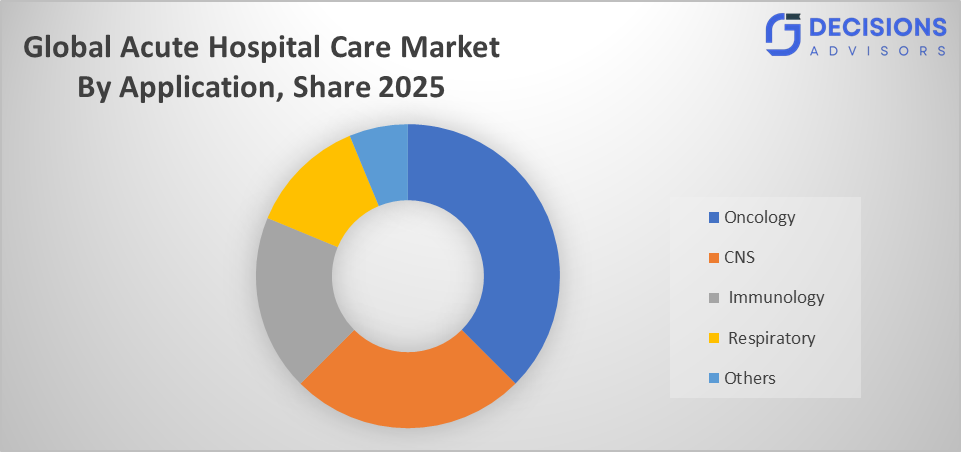
- The oncology segment accounted for the largest share in 2025, and is anticipated to grow at a significant CAGR of approximately 61% during the forecast period.
Based on the application, the acute hospital care market is divided into CNS, immunology, oncology, respiratory, others. Among these, the oncology segment accounted for the largest share in 2025, and is anticipated to grow at a significant CAGR of approximately 61% during the forecast period. This segment is motivated by the growing intricacy of cancer care and climbing occurrence rates. Although emergency services usually manage the greatest workload, oncology is becoming a vital specialty with high revenue potential because of the demand for specialized acute care, sophisticated diagnostics, and intricate therapeutic procedures.
- The pharmaceutical companies segment dominated the market in 2025, and is projected to grow at a substantial CAGR of approximately 43% during the forecast period.
Based on the end use, the acute hospital care market is divided into diagnostic companies, pharmaceutical companies, healthcare it companies, others. Among these, the pharmaceutical companies segment dominated the market in 2025, and is projected to grow at a substantial CAGR of approximately 43% during the forecast period. Pharmaceutical companies hold a dominant position due to their provision of essential therapeutic agents like antibiotics, antivirals, anesthetics, and critical care medications that are vital for the immediate and short-term management of acute illnesses, injuries, and surgical procedures.
Strategies to Implement for Growth of the Market in Non-Leading Regions
Growth in the global acute hospital care market in non-leading regions can be driven by expanding healthcare infrastructure and ICU capacity, particularly as large hospitals hold around 37% share, while focusing on high-growth regions like Asia-Pacific with nearly 9% CAGR. Strengthening emergency and critical care services is essential since they account for over 50% of demand, alongside increasing public-private partnerships where private players are growing at over 8% CAGR. Adoption of digital health and telemedicine is crucial to support the nearly 40% of patients requiring post-acute care, while improving insurance coverage enhances affordability and access. Additionally, investing in workforce training, smart hospital technologies, and rural healthcare expansion will help address rising patient volumes and unlock untapped market potential.
Regional Segment Analysis of the Acute Hospital Care Market
- North America (U.S., Canada, Mexico)
- Europe (Germany, France, U.K., Italy, Spain, Rest of Europe)
- Asia-Pacific (China, Japan, India, Rest of APAC)
- South America (Brazil and the Rest of South America)
- The Middle East and Africa (UAE, South Africa, Rest of MEA)
North America is anticipated to hold the largest share of approximately 55% of the acute hospital care market over the predicted timeframe. It is attributed because of the to the U.S., which has the highest healthcare expenditure per capita and a developed infrastructure. Major factors comprise a swiftly expanding elderly demographic that is susceptible to chronic illnesses necessitating high-acuity treatment, including cardiovascular diseases. Moreover, the region’s pre-eminence is bolstered by the extensive use of robotic surgeries, AI-based diagnostics, and advantageous reimbursement practices.
Asia Pacific is expected to grow at a rapid CAGR in the acute hospital care market during the forecast period. The region is propelled by the rapidly aging demographics especially in Japan, South Korea, and China are leading to elevated rates of admissions for complex ailments such as cancer, diabetes, and cardiovascular diseases. Currently, approximately 52% of acute care episodes are associated with the management of worsening chronic conditions. New facilities are seeing significant investment from both governments and private entities. For example, India intends to incorporate 50,000 private-sector beds by 2027, and China is making substantial investments in ICUs and general hospitals.
Europe is the 3rd largest region to grow in the acute hospital care market during the region. The market is mainly driven by the growing elderly demographic and the increasing incidence of chronic and non-communicable diseases (such as cardiovascular issues and diabetes). A significant emphasis is placed on the expansion of emergency departments and intensive care units (ICUs), as well as on the integration of advanced diagnostic and therapeutic technologies. Europe is experiencing consistent growth, bolstered by universal health coverage and the necessity of managing increasing patient volumes through enhanced specialized services
Future Market Trends in Acute Hospital Care Market: -
- Technological Transformation (AI & Robotics):
More than 58% of hospitals are putting resources into AI diagnostics, real-time monitoring systems, and robotic surgery to improve operational efficiency and patient outcomes.
- Hospital-at-Home and Remote Care:
The "hospital-at-home" model is experiencing significant growth (approximately 7.56% CAGR) as a means of reducing costs and improving accessibility, using tele-monitoring and remote diagnostics for acute care.
- Transition to Micro-Hospitals:
Models with smaller facilities (fewer than 25 beds) are emerging, developing at a CAGR of 8.69%, and offering quicker emergency access while requiring less capital investment.
Recent Development
- In May 2025, the Acute Care Transformation initiative by the World Health Organization Foundation and Laerdal Global Health committed US$12.5 million to scale Basic Emergency Care training across 400 African hospitals, aiming to expand to 1,000 hospitals and strengthen global acute hospital care systems.
- In February 2025, Teladoc Health launched AcuteConnect, an AI-powered tele-ICU system leveraging predictive analytics to detect patient deterioration in real time, enhancing critical care monitoring and driving digital transformation in the global acute hospital care market.
- In February 2025, Johnson & Johnson MedTech launched the CEREGLIDE 92 Catheter System in the U.S. to support neurovascular procedures for acute ischemic stroke, enhancing emergency stroke treatment and advancing innovation in the global acute hospital care market.
- In January 2025, SOC Telemed expanded its emergency tele-neurology services through a Midwest U.S. partnership, covering over 100 hospitals and enhancing access to critical neurological care, supporting the growth of telemedicine in the global acute hospital care market.
Market Segment
This study forecasts revenue at global, regional, and country levels from 2020 to 2035. Decision Advisor has segmented the acute hospital care market based on the below-mentioned segments:
Global Acute Hospital Care Market, By Technology
- Bioinformatics
- Big Data Analytics
- Drug Discovery
- Gene Sequencing
- Companion Diagnostics
- Others
Global Acute Hospital Care Market, By Application
- CNS
- Immunology
- Oncology
- Respiratory
- Others
Global Acute Hospital Care Market, By End Use
- Diagnostic Companies
- Pharmaceutical Companies
- Healthcare IT companies
- Others
Global Acute Hospital Care Market, By Regional Analysis
- North America
- US
- Canada
- Mexico
- Europe
- Germany
- UK
- France
- Italy
- Spain
- Russia
- Rest of Europe
- Asia Pacific
- China
- Japan
- India
- South Korea
- Australia
- Rest of Asia Pacific
- South America
- Brazil
- Argentina
- Rest of South America
- Middle East & Africa
- UAE
- Saudi Arabia
- Qatar
- South Africa
- Rest of the Middle East & Africa
Frequently Asked Questions (FAQ)
1. How is the shift toward value-based healthcare models influencing the acute hospital care market?
The transition from fee-for-service to value-based care is significantly reshaping acute hospital services by prioritizing patient outcomes, cost efficiency, and reduced hospital readmissions. Hospitals are increasingly adopting integrated care pathways, real-time monitoring, and post-acute follow-ups, as nearly 40% of patients require continued care. This shift encourages the use of data analytics and coordinated care models, improving clinical outcomes while optimizing operational costs.
2. What role does digital transformation play in optimizing acute hospital workflows and patient outcomes?
Digital transformation, including AI, IoT, and electronic health records, enables real-time patient monitoring and predictive decision-making. These technologies reduce hospital stays by approximately 15–20% and enhance ICU efficiency, which accounts for nearly 56% of acute care services. Automation of administrative tasks and improved data interoperability also streamline workflows and reduce clinician burden.
3. How are demographic trends shaping demand patterns in the acute hospital care market?
The rapidly growing geriatric population is a key demand driver, as elderly individuals are more prone to chronic conditions such as cardiovascular diseases, diabetes, and cancer. This demographic shift leads to increased hospital admissions, longer stays, and higher demand for emergency and intensive care services, particularly in developed regions with aging populations.
4. In what ways are emerging economies contributing to the expansion of the acute hospital care market?
Emerging economies, particularly in Asia-Pacific, are driving market growth through expanding healthcare infrastructure, rising healthcare expenditure, and increasing insurance coverage. Government initiatives such as India’s Ayushman Bharat scheme and China’s healthcare reforms are improving access to acute care services. Additionally, investments in hospital capacity and ICU expansion are addressing unmet medical needs in these regions.
5. How do technological advancements in critical care impact clinical efficiency and patient survival rates?
Technologies such as AI-enabled monitoring systems, robotic-assisted surgeries, and tele-ICU platforms improve diagnostic accuracy and enable early intervention in critical conditions. These advancements enhance patient survival rates, reduce complications, and optimize ICU resource utilization, which is crucial given the high demand for critical care services globally.
Check Licence
Choose the plan that fits you best: Single User, Multi-User, or Enterprise solutions tailored for your needs.
We Have You Covered
- 24/7 Analyst Support
- Clients Across the Globe
- Tailored Insights
- Technology Tracking
- Competitive Intelligence
- Custom Research
- Syndicated Market Studies
- Market Overview
- Market Segmentation
- Growth Drivers
- Market Opportunities
- Regulatory Insights
- Innovation & Sustainability
Report Details
| Scope | Global |
| Pages | 220 |
| Delivery | PDF & Excel via Email |
| Language | English |
| Release | Mar 2026 |
| Access | Download from this page |