
Global Adiabatic Cooler Market
 |
Author:
Pranali P
|
Pages:
245
|
Author:
Pranali P
|
Pages:
245
Global adiabatic Cooler Market Size, Share, By Product Type (Dry-Air Adiabatic Coolers, and Liquid Adiabatic Coolers), By Orientation & Configuration (V-Type Orientation, Horizontal Orientation and Flatbed / Table Type), By Application (Data Centers, Industrial Process Cooling, Commercial HVAC, and Power Generation) By Capacity (Small (<100 kW), Medium (100?500 kW), Large (>500 kW)), and By Region (North America, Europe, Asia-Pacific, Latin America, Middle East, and Africa), Analysis and Forecast 2026-2035
CAGR
6.14%
REVENUE 2025
USD Billion 2.02
FORECAST 2035
USD Billion 3.66
REPORT COVERAGE
Global
Market Snapshot
- Global Adiabatic Cooler Market Size (2025): USD 2.016 Billion
- Projected Global Adiabatic Cooler Market Size (2035): USD 3.66 Billion
- Global Adiabatic Cooler Compound Annual Growth Rate (CAGR): 6.14%
- Largest Regional Market: Asia Pacific
- Fastest Growing Region: North America
- 3rd Largest Region: Europe
- Base Year: 2025
- Historical Period: 2021–2024
- Forecast Period: 2026–2035
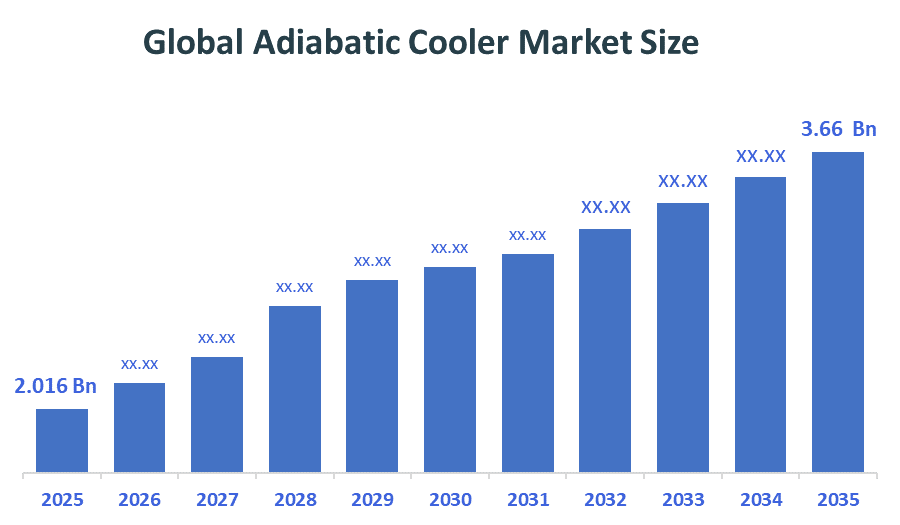
According to Decision Advisors, the Global adiabatic cooler Market Size is expected to grow from USD 2.016 Billion in 2025 to USD 3.66 Billion by 2035, at a CAGR of 6.14% during the forecast period 2026-2035. Global adiabatic cooler market is expected to drive by the rapid expansion of global data centres and water-saving directives. The adiabatic cooling technology saves about 95% more water than the regular tower-based cooling. The high-power cost and "Net-Zero" directives encourage the use of energy-efficient technology.
Market Overview/ Introduction
The market for adiabatic coolers encompasses the worldwide industry dealing with the manufacture, delivery, and implementation of cooling equipment designed based on the concept of evaporative cooling for lowering air temperatures in an efficient manner. Adiabatic coolers are devices used for cooling which utilize the process of evaporation in order to cool down air before it is passed to a heat exchanger. Such equipment helps in temperature reduction using minimal water and energy consumption. Adiabatic coolers find application in different industries, such as HVAC systems, data centres, power plants, food and beverages production, as well as in the chemical industry. Among the main drivers of market growth are industrialization, increasing global temperatures, and the need for water and energy-efficient equipment. The introduction of strict rules on environmental protection and sustainability contributes to the implementation of innovative cooling technologies. Developments of the market include the implementation of smart sensors, Internet of Things-based systems, hybrid solutions, and corrosion-resistant materials. Modularity, improved intelligent control systems, and innovations in humidification technology are some other technological developments in this field. Moreover, governments are implementing various programs and initiatives related to the promotion of energy efficiency, carbon reduction, and industrial growth, especially in the manufacturing industry sector.
- In March 2026: EU funding programs including Horizon Europe, InvestEU, and the Recovery and Resilience Facility continue to support green cooling and energy-efficient technologies, backed by over €372 billion investment via InvestEU and €650+ billion under RRF, with approximately 42% allocated to green transition projects.
- In February 2026: The U.S. Environmental Protection Agency and U.S. Department of Energy continue advancing efficiency standards and incentives, with cooling accounting for up to 15% of building energy use, accelerating adoption of energy-efficient and low-emission cooling technologies.
- In January 2025: The U.S. Department of Energy and Internal Revenue Service continue offering tax incentives of up to 30% for energy-efficient installations, while U.S. General Services Administration mandates sustainable systems in federal facilities, boosting advanced cooling adoption.
Notable Insights: -
- Asia-Pacific holds the largest regional market share approximately 39% in the global Adiabatic cooler market.
- North America is the fastest growing region market share approximately 40% in the global Adiabatic cooler market.
- By product type, the Dry-Air Adiabatic Cooler segment held a dominant position with 57% in terms of market share in 2025.
- By Orientation & Configuration, V-Type Orientation segment is the dominating accounting for market is approximately 62%.
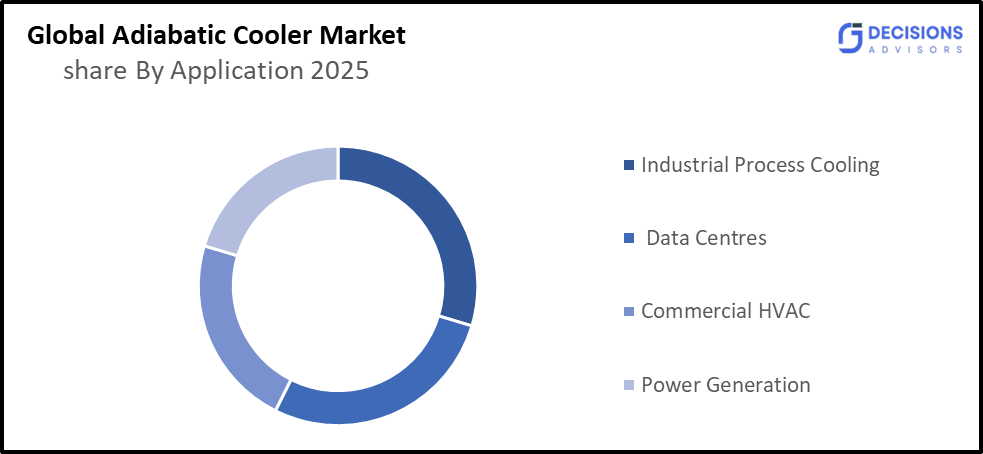
- By application, Industrial Process Cooling segment held a dominant position market is approximately 29%.
- By capacity, Large (>500 kW) segment held a dominant position market is approximately 51%.
- The market is likely to achieve a valuation of USD 3.66 Billion by 2035.
What is role of technology in grooming the market?
Technology has an essential part to play in moulding the market for adiabatic coolers, considering that innovations like IoT-integrated monitoring systems, sensors, and controls can enable performance optimization and preventive maintenance through real-time monitoring to lower costs. The creation of hybrid technologies improves system performance during fluctuating climates without consuming large amounts of energy and water. Corrosion resistance materials and efficient heat exchanger designs extend the life of adiabatic cooling systems, making digitalization and energy management more effective for green practices.
How is Recent Developments Helping the Market?
Emerging technologies are rejuvenating the industry using AI-adaptive control systems and IoT technologies. In today's advanced cooling systems, the system uses sensor-based real-time switches to either go into dry mode or evaporative mode based on moisture content, saving up to 48% energy consumption. With the development of hybrid and modulating cooling systems, retrofitting of existing older industrial facilities is much easier. Meanwhile, the development of corrosion-resistant material technologies increases the longevity of the system in severe environments.
Market Drivers
The market for adiabatic coolers is expected to grow owing to the rising demand for sustainable and energy-efficient cooling solutions from various sectors. The increase in global temperature levels and the rise in heat load requirements for applications, such as data centres, power generation plants, and manufacturing facilities, have led to an increase in the demand for cooling solutions. The rapid rate of industrialization, especially in developing countries, is likely to drive the market's growth rate even further. The tightening of environmental regulations regarding carbon emission and energy efficiency is motivating companies to install environmentally friendly cooling solutions. The problem of water scarcity, on the other hand, is also compelling firms to install cooling solutions that optimize their use of water resources compared to conventional cooling methods. The cost-efficiency associated with using adiabatic coolers, such as lower maintenance costs, is another factor fuelling the growth of the market. Innovations, such as smart sensors, control, and hybrid cooling systems, are further propelling the market's expansion.
Restrain
The adiabatic cooler market faces restraints such as high initial installation costs and complexity in system design, which can limit adoption among small and medium enterprises. Dependence on water availability and quality is another challenge, especially in regions facing water scarcity or strict regulations. Additionally, maintenance requirements, including scaling and microbial control, can increase operational efforts. Limited awareness in developing markets may also hinder widespread adoption.
Competitive Analysis:
The report offers the appropriate analysis of the key organizations/companies involved within the adiabatic cooler market, along with a comparative evaluation primarily based on their Product of offering, business overviews, geographic presence, enterprise strategies, segment market share, and SWOT analysis. The report also provides an elaborative analysis focusing on the current news and developments of the companies, which includes Product development, innovations, joint ventures, partnerships, mergers & acquisitions, strategic alliances, and others. This allows for the evaluation of the overall competition within the market.
Top Companies in Global Adiabatic Cooler Market
- Baltimore Aircoil Company (BAC)
- EVAPCO, Inc.
- Güntner Group
- Alfa Laval
- SPX Technologies (Marley)
- Trane Technologies
- Vertiv Group Corp
- Schneider Electric
- Frigel Firenze S.p.A.
- MITA Group
- Thermax Global
- Johnson Controls
Government Initiatives
|
Country |
Key Government Initiatives |
|
|
European Union
|
In January 2026: The Energy Efficiency Directive continues to drive data centre sustainability, requiring facilities ≥500 kW to report KPIs like PUE and WUE, while the EU prepares a Data Centre Energy Efficiency Package by 2026 to support carbon-neutral operations by 2030. |
|
|
India |
In January 2026: India's data centre capacity is projected to triple, reaching 4 GW by 2030, fuelled by AI and cloud demand. This surge drives a massive market for adiabatic cooling as operators prioritize water-saving technologies under the India Cooling Action Plan (ICAP). |
|
|
U.S. |
In December 2025: The U.S. Environmental Protection Agency launched a Clean Air Act resource hub to streamline data centre permitting, while federal initiatives and incentives promote energy-efficient infrastructure, indirectly accelerating adoption of advanced cooling solutions like adiabatic systems. |
|
Study on the Supply, Demand, Distribution, and Market Environment of Adiabatic Cooler Market
The Adiabatic Cooler Market is shaped by growing demand for energy?efficient, water?saving cooling solutions across industrial, commercial, data centre, and HVAC sectors. Global supply includes dry and liquid adiabatic coolers from OEMs distributed through direct sales, dealer networks, and engineering partners to reach end users worldwide. Market demand is driven by industrial expansion, sustainability mandates, and water scarcity concerns, particularly in North America, Europe, and Asia Pacific, with overall market value expected to grow at approximately 6.1?%–7.0?% CAGR through 2030. Regulatory pressure on water use reduction and rising adoption in high?thermal applications create a supportive environment for expansion.
Price Analysis and Consumer Behaviour Analysis
Price Analysis: Systems with an adiabatic approach have an added value because their starting capital cost is normally 23%-38% higher compared to traditional air-cooled equipment. The reasons include using quality material like copper and aluminium, as well as advanced control mechanisms that leverage IoT technology. But despite its sensitivity to price, the system's advantage includes saving on water consumption (95%) and lowering energy expenses (48%).
Consumer Behaviour Analysis: The consumer mindset changes from focusing on low cost to lifecycle value considerations. Industries and data centres value the reliability and regulatory compliance of equipment rather than cost, making the adiabatic system an essential solution in the context of "Net-Zero." Moreover, there is an increased interest in modular design solutions to make installation faster and more convenient.
Market Segmentation
The Adiabatic cooler market share is classified into product type, orientation & configuration, and application
- The product type segment dominated the market in 2025, and is projected to grow at a substantial CAGR of approximately 57% during the forecast period.
Based on the product type, the Adiabatic cooler market is divided into Dry-Air Adiabatic Coolers, and Liquid Adiabatic Coolers. Among these, The Dry-Air Adiabatic Cooler segment dominates the market, currently holding approximately 57% share as of 2026. This leadership is driven by its exceptional water efficiency, as these units rely on ambient air for primary heat rejection and only activate wetted pads during peak temperatures. Consequently, they offer 70%–90% water savings compared to traditional towers. This makes them the preferred choice for hyperscale data centres and water-scarce industrial zones seeking low maintenance and "Net-Zero" compliance.
- The oorientation & configuration segment accounted for the largest share in 2025, and is anticipated to grow at a significant CAGR of approximately 62% during the forecast period.
Based on the orientation & configuration, the adiabatic cooler market is divided into V-Type Orientation, Horizontal Orientation and Flatbed / Table Type. Among these, The V-type orientation holds the largest revenue share estimated approximately 55–65%, while horizontal systems account for a smaller share but are growing steadily. The dominance of V-type coolers is mainly due to their superior heat exchange efficiency and optimized airflow design, which enhances cooling performance. Their compact footprint and space-saving structure make them ideal for industrial plants, data centres, and commercial HVAC systems. Additionally, V-type systems reduce energy consumption and improve operational efficiency, aligning with sustainability goals.
- The application segment dominated the market in 2025, and is projected to grow at a substantial CAGR of approximately 29% during the forecast period.
Based on the application, the Adiabatic cooler market is divided into Data Centres, Industrial Process Cooling, Commercial HVAC, and Power Generation. Among these, industrial process cooling is the dominant segment in the adiabatic cooler market. Industrial applications account for the largest share, estimated around 58–70% of total installations, driven by continuous cooling needs in manufacturing, chemical and food industries.
These sectors require reliable, 24/7 temperature control, making adiabatic coolers ideal due to energy efficiency and reduced water consumption. While data centres hold approximately 25–30% share and are the fastest-growing segment, increasing digitalization and cloud demand are boosting adoption.
- The capacity segment dominated the market in 2025, and is projected to grow at a substantial CAGR of approximately 51% during the forecast period.
Based on the capacity, the adiabatic cooler market is divided into Small (<100 kW), Medium (100–500 kW), Large (>500 kW). Among these, the large capacity segment (>500 kW) is dominating the adiabatic cooler market. Large systems hold the highest share estimated approximately 45–55%, driven by strong demand from power generation, heavy industries, and large data centres requiring continuous high-load cooling.
These units offer higher efficiency, centralized cooling, and reduced operational downtime, making them ideal for large-scale operations.
Strategies to Implement for Growth of the Market in Non-Leading Regions
To drive growth of the adiabatic cooler market in non-leading regions, companies should focus on cost-effective and localized solutions tailored to regional climate and industrial needs. Increasing awareness through technical workshops, partnerships with local distributors, and demonstration projects can help overcome knowledge gaps. Expanding distribution networks and strengthening after-sales service are essential to build customer trust. Collaborating with governments and industry bodies to align with energy efficiency and sustainability initiatives can accelerate adoption. Additionally, offering financing options and modular systems can make solutions more accessible to small and medium enterprises. Investing in training programs and digital monitoring technologies will further enhance adoption and long-term market growth.
Regional Segment Analysis of the Adiabatic cooler Market
- North America (U.S., Canada, Mexico)
- Europe (Germany, France, U.K., Italy, Spain, Rest of Europe)
- Asia-Pacific (China, Japan, India, Rest of APAC)
- South America (Brazil and the Rest of South America)
- The Middle East and Africa (UAE, South Africa, Rest of MEA)
Asia Pacific is anticipated to hold the largest share of the Adiabatic cooler market over the predicted timeframe.
Asia-Pacific is the leading region in the global adiabatic cooler market, capturing a projected approximately 37%–40% revenue share. This dominance is driven by the region's massive expansion in hyperscale data centres and industrial clusters across China and India. With ambient temperatures rising and water scarcity reaching critical levels, governments have introduced strict "Water Usage Effectiveness" (WUE) mandates, forcing a shift away from traditional cooling towers toward water-efficient adiabatic systems. By 2026, the global market is valued at approximately $723.6 million, with Asia-Pacific generating significant momentum toward a forecasted $1.5 billion global valuation by 2035. The region’s rapid 5G rollout and AI-driven computational loads are accelerating a robust CAGR of 8.6%, making it the primary hub for advanced thermal management investment.
North America is expected to grow at a rapid CAGR in the Adiabatic cooler market during the forecast period. North America is expected to grow at a rapid CAGR of approximately 8.6% during the forecast period (2026–2035). This acceleration is primarily fuelled by the presence of over 5,000 data centres in the United States, where rising computational densities from AI and cloud computing have increased thermal loads by approximately 22%–44%. The region’s growth is further supported by stringent energy-efficiency mandates, such as California’s Title 24, and the U.S. refrigerant phasedown, which Favor water-saving adiabatic systems over traditional cooling towers. With more than 41,000 operational units already installed, North America is a critical hub for high-capacity industrial retrofits. By 2035, the region’s focus on "Net-Zero" goals and sustainable manufacturing is projected to maintain its position as a dominant revenue contributor in the global market.
Europe is the 3rd largest region to grow in the Adiabatic cooler market during the region. Europe is the third-largest region in the global adiabatic cooler market, accounting for a 28% revenue share in 2026. Growth is primarily fuelled by the EU Energy Efficiency Directive and strict F-Gas regulations, which mandate a transition toward low-carbon cooling. Mature markets like Germany and the UK lead in industrial retrofitting, while Southern Europe increasingly adopts adiabatic systems to handle rising summer temperatures without the excessive water waste of traditional cooling towers.
Future Market Trends in Global Adiabatic Cooler Market: -
1. Adoption of Smart and IoT-Enabled Cooling Systems
The integration of IoT and smart technologies is transforming adiabatic coolers into intelligent systems capable of real-time monitoring, predictive maintenance, and automated control. These systems optimize energy and water consumption while improving operational efficiency. Advanced analytics help detect faults early, reducing downtime and maintenance costs. As industries move toward digitalization and Industry 4.0, demand for connected cooling solutions is expected to rise significantly, especially in data centres and large industrial facilities.
2. Shift Toward Hybrid and Energy-Efficient Cooling Solutions
There is a growing trend toward hybrid cooling systems that combine adiabatic and dry cooling technologies to enhance performance under varying climatic conditions. These systems reduce energy consumption and water usage compared to traditional cooling methods. Industries are increasingly adopting such solutions to meet sustainability goals and comply with environmental regulations. This trend is further supported by rising energy costs and the need for cost-effective cooling systems, driving innovation in high-efficiency heat exchangers and system designs.
3. Focus on Sustainability and Water Conservation
Sustainability and water conservation are becoming central to market growth, especially in regions facing water scarcity. Manufacturers are developing advanced systems that minimize water usage while maintaining cooling efficiency. Innovations such as improved evaporative media, closed-loop systems, and water treatment technologies are gaining traction. Governments and regulatory bodies are also promoting eco-friendly cooling solutions through policies and incentives. This trend is expected to drive widespread adoption of adiabatic coolers across industries aiming to reduce environmental impact.
Recent Development
- In January 2025: Baltimore Aircoil Company showcased sustainable cooling innovations at the AHR Expo 2025 in Orlando, including the TrilliumSeries adiabatic cooler, emphasizing energy-efficient and water-saving solutions to support rising demand for eco-friendly industrial and commercial cooling technologies.
- In September 2024: Kaltra GmbH announced the Q4 2024 launch of its redesigned Mistral W hybrid adiabatic cooler, featuring a gravity-fed wetting system, reduced water usage, and automatic switching between dry and adiabatic cooling modes.
- In March 2024: Frigel Firenze S.p.A. introduced its extended Hybrid Adiabatic Cooler Platform, featuring next-generation Ecodry 4DK and LDK models designed to reduce water consumption and improve energy efficiency for data center and industrial cooling applications.
Market Segment
This study forecasts revenue at global, regional, and country levels from 2021 to 2035. Decision Advisors has segmented the Adiabatic cooler market based on the below-mentioned segments:
Global Adiabatic Cooler Market, By Product Type
- Dry-Air Adiabatic Coolers
- Liquid Adiabatic Coolers
Global Adiabatic Cooler Market, By Orientation & Configuration
- V-Type Orientation
- Horizontal Orientation
- Flatbed / Table Type
Global Adiabatic Cooler Market, By Application
- Data Centres
- Industrial Process Cooling
- Commercial HVAC
- Power Generation
Global Adiabatic Cooler Market, By Capacity
- Small (<100 kW)
- Medium (100–500 kW)
- Large (>500 kW)
Global Adiabatic Cooler Market, By Regional Analysis
- North America
- US
- Canada
- Mexico
- Europe
- Germany
- UK
- France
- Italy
- Spain
- Russia
- Rest of Europe
- Asia Pacific
- China
- Japan
- India
- South Korea
- Australia
- Rest of Asia Pacific
- South America
- Brazil
- Argentina
- Rest of South America
- Middle East & Africa
- UAE
- Saudi Arabia
- Qatar
- South Africa
- Rest of the Middle East & Africa
Frequently Asked Questions (FAQ)
1. What are the key challenges in the adoption of adiabatic coolers across different climatic regions?
Adiabatic coolers face performance variability depending on climatic conditions, particularly in regions with high humidity where evaporative efficiency declines. Additionally, extremely cold climates may limit operation during winter months. These regional constraints require customized system designs and hybrid configurations to ensure consistent performance, which can increase overall system complexity and cost.
2. How do adiabatic coolers compare with traditional cooling towers in terms of lifecycle cost?
Although adiabatic coolers have higher initial installation costs, they offer lower lifecycle costs due to reduced energy consumption, minimized water usage, and lower chemical treatment requirements. Over time, these savings can offset capital investment, making them a cost-effective solution for industries focusing on long-term operational efficiency and sustainability.
3. What role does digitalization play in improving the performance of adiabatic cooling systems?
Digitalization enhances adiabatic cooling performance through advanced monitoring, automation, and predictive maintenance. Technologies such as AI-driven analytics and IoT-enabled systems allow real-time adjustments based on environmental conditions, improving efficiency, reducing downtime, and extending equipment lifespan while ensuring compliance with energy and environmental standards.
4. Which end-user industries are expected to create new growth opportunities in the future?
Beyond traditional sectors, emerging industries such as semiconductor manufacturing, pharmaceuticals, and electric vehicle battery production are expected to generate new demand. These sectors require precise thermal management and energy-efficient solutions, positioning adiabatic coolers as a suitable option for advanced industrial applications.
5. How is sustainability influencing purchasing decisions in the adiabatic cooler market?
Sustainability has become a critical factor in purchasing decisions, with companies prioritizing solutions that reduce carbon emissions and water consumption. Regulatory compliance, corporate ESG goals, and long-term cost savings are driving industries to adopt environmentally friendly cooling technologies, thereby increasing the preference for adiabatic cooling systems over conventional alternatives.
- Introduction
- Objectives of the Study
- Market Definition
- Research Scope
- Research Methodology and Assumptions
- Executive Summary
- Premium Insights
- Porter’s Five Forces Analysis
- Value Chain Analysis
- Top Investment Pockets
- Market Attractiveness Analysis By Product Type
- Market Attractiveness Analysis By Orientation & Configuration
- Market Attractiveness Analysis By Application
- Market Attractiveness Analysis By Capacity
- Market Attractiveness Analysis By Region
- Industry Trends
- Market Dynamics
- Market Evaluation
- Drivers
- Rising need for energy-efficient and water-saving cooling systems.
- Restraints
- High initial installation cost and maintenance complexity limit adoption.
- Opportunities
- Growing adoption in data centers, industrial automation, and sustainable HVAC systems creates strong expansion opportunities.
- Challenges
5.5.1. Limited awareness and performance issues in extreme humidity conditions restrict market growth.
- Global Adiabatic Cooler Market Analysis and Projection, By Product Type
- Segment Overview
- Dry-Air Adiabatic Coolers
- Liquid Adiabatic Coolers
- Global Adiabatic Cooler Market Analysis and Projection, By Orientation & Configuration
- Segment Overview
- V-Type Orientation
- Horizontal Orientation
- Flatbed / Table Type
- Global Adiabatic Cooler Market Analysis and Projection, By Application
- Segment Overview
- Data Centers
- Industrial Process Cooling
- Commercial HVAC
- Power Generation
- Global Adiabatic Cooler Market Analysis and Projection, By Capacity
- Segment Overview
- Small (<100 kW)
- Medium (100–500 kW)
- Large (>500 kW)
- Global Adiabatic Cooler Market Analysis and Projection, By Regional Analysis
- Segment Overview
- North America
- U.S.
- Canada
- Mexico
- Europe
- Germany
- France
- U.K.
- Italy
- Spain
- Asia-Pacific
- Japan
- China
- India
- South America
- Brazil
- Middle East and Africa
- UAE
- South Africa
- Global Adiabatic Cooler Market-Competitive Landscape
- Overview
- Market Share of Key Players in the Adiabatic Cooler Market
- Global Company Market Share
- North America Company Market Share
- Europe Company Market Share
- APAC Company Market Share
- Competitive Situations and Trends
- Coverage Launches and Developments
- Partnerships, Collaborations, and Agreements
- Mergers & Acquisitions
- Expansions
- Company Profiles
- Baltimore Aircoil Company (BAC)
- Business Overview
- Company Snapshot
- Company Market Share Analysis
- Company Coverage Portfolio
- Recent Developments
- SWOT Analysis
- EVAPCO, Inc.
- Business Overview
- Company Snapshot
- Company Market Share Analysis
- Company Coverage Portfolio
- Recent Developments
- SWOT Analysis
- Güntner Group
- Business Overview
- Company Snapshot
- Company Market Share Analysis
- Company Coverage Portfolio
- Recent Developments
- SWOT Analysis
- Alfa Laval
- Business Overview
- Company Snapshot
- Company Market Share Analysis
- Company Coverage Portfolio
- Recent Developments
- SWOT Analysis
- SPX Technologies (Marley)
- Business Overview
- Company Snapshot
- Company Market Share Analysis
- Company Coverage Portfolio
- Recent Developments
- SWOT Analysis
- Trane Technologies
- Business Overview
- Company Snapshot
- Company Market Share Analysis
- Company Coverage Portfolio
- Recent Developments
- SWOT Analysis
- Vertiv Group Corp
- Business Overview
- Company Snapshot
- Company Market Share Analysis
- Company Coverage Portfolio
- Recent Developments
- SWOT Analysis
- Schneider Electric
- Business Overview
- Company Snapshot
- Company Market Share Analysis
- Company Coverage Portfolio
- Recent Developments
- SWOT Analysis
- Frigel Firenze S.p.A.
- Business Overview
- Company Snapshot
- Company Market Share Analysis
- Company Coverage Portfolio
- Recent Developments
- SWOT Analysis
- MITA Group
- Business Overview
- Company Snapshot
- Company Market Share Analysis
- Company Coverage Portfolio
- Recent Developments
- SWOT Analysis
- Thermax Global
- Business Overview
- Company Snapshot
- Company Market Share Analysis
- Company Coverage Portfolio
- Recent Developments
- SWOT Analysis
- Johnson Controls
- Business Overview
- Company Snapshot
- Company Market Share Analysis
- Company Coverage Portfolio
- Recent Developments
- SWOT Analysis
- Baltimore Aircoil Company (BAC)
List of Table
- Global Adiabatic Cooler Market, By Product Type, 2024-2035(USD Billion)
- Global Dry-Air Adiabatic Coolers, Adiabatic Cooler Market, By Region, 2024-2035(USD Billion)
- Global Liquid Adiabatic Coolers, Adiabatic Cooler Market, By Region, 2024-2035(USD Billion)
- Global Adiabatic Cooler Market, By Orientation & Configuration, 2024-2035(USD Billion)
- Global V-Type Orientation, Adiabatic Cooler Market, By Region, 2024-2035(USD Billion)
- Global Horizontal Orientation, Adiabatic Cooler Market, By Region, 2024-2035(USD Billion)
- Global Flatbed / Table Type, Adiabatic Cooler Market, By Region, 2024-2035(USD Billion)
- Global Adiabatic Cooler Market, By Application, 2024-2035(USD Billion)
- Global Data Centers, Adiabatic Cooler Market, By Region, 2024-2035(USD Billion)
- Global Industrial Process Cooling, Adiabatic Cooler Market, By Region, 2024-2035(USD Billion)
- Global Commercial HVAC, Adiabatic Cooler Market, By Region, 2024-2035(USD Billion)
- Global Power Generation, Adiabatic Cooler Market, By Region, 2024-2035(USD Billion)
- Global Adiabatic Cooler Market, By Capacity, 2024-2035(USD Billion)
- Global Small (<100 kW), Adiabatic Cooler Market, By Region, 2024-2035(USD Billion)
- Global Medium (100–500 kW), Adiabatic Cooler Market, By Region, 2024-2035(USD Billion)
- Global Large (>500 kW), Adiabatic Cooler Market, By Region, 2024-2035(USD Billion)
- North America Adiabatic Cooler Market, By Product Type, 2024-2035(USD Billion)
- North America Adiabatic Cooler Market, By Orientation & Configuration, 2024-2035(USD Billion)
- North America Adiabatic Cooler Market, By Application, 2024-2035(USD Billion)
- North America Adiabatic Cooler Market, By Capacity, 2024-2035(USD Billion)
- U.S. Adiabatic Cooler Market, By Product Type, 2024-2035(USD Billion)
- U.S. Adiabatic Cooler Market, By Orientation & Configuration, 2024-2035(USD Billion)
- U.S. Adiabatic Cooler Market, By Application, 2024-2035(USD Billion)
- U.S. Adiabatic Cooler Market, By Capacity, 2024-2035(USD Billion)
- Canada Adiabatic Cooler Market, By Product Type, 2024-2035(USD Billion)
- Canada Adiabatic Cooler Market, By Orientation & Configuration, 2024-2035(USD Billion)
- Canada Adiabatic Cooler Market, By Application, 2024-2035(USD Billion)
- Canada Adiabatic Cooler Market, By Capacity, 2024-2035(USD Billion)
- Mexico Adiabatic Cooler Market, By Product Type, 2024-2035(USD Billion)
- Mexico Adiabatic Cooler Market, By Orientation & Configuration, 2024-2035(USD Billion)
- Mexico Adiabatic Cooler Market, By Application, 2024-2035(USD Billion)
- Mexico Adiabatic Cooler Market, By Capacity, 2024-2035(USD Billion)
- Europe Adiabatic Cooler Market, By Product Type, 2024-2035(USD Billion)
- Europe Adiabatic Cooler Market, By Orientation & Configuration, 2024-2035(USD Billion)
- Europe Adiabatic Cooler Market, By Application, 2024-2035(USD Billion)
- Europe Adiabatic Cooler Market, By Capacity, 2024-2035(USD Billion)
- Germany Adiabatic Cooler Market, By Product Type, 2024-2035(USD Billion)
- Germany Adiabatic Cooler Market, By Orientation & Configuration, 2024-2035(USD Billion)
- Germany Adiabatic Cooler Market, By Application, 2024-2035(USD Billion)
- Germany Adiabatic Cooler Market, By Capacity, 2024-2035(USD Billion)
- France Adiabatic Cooler Market, By Product Type, 2024-2035(USD Billion)
- France Adiabatic Cooler Market, By Orientation & Configuration, 2024-2035(USD Billion)
- France Adiabatic Cooler Market, By Application, 2024-2035(USD Billion)
- France Adiabatic Cooler Market, By Capacity, 2024-2035(USD Billion)
- U.K. Adiabatic Cooler Market, By Product Type, 2024-2035(USD Billion)
- U.K. Adiabatic Cooler Market, By Orientation & Configuration, 2024-2035(USD Billion)
- U.K. Adiabatic Cooler Market, By Application, 2024-2035(USD Billion)
- U.K. Adiabatic Cooler Market, By Capacity, 2024-2035(USD Billion)
- Italy Adiabatic Cooler Market, By Product Type, 2024-2035(USD Billion)
- Italy Adiabatic Cooler Market, By Orientation & Configuration, 2024-2035(USD Billion)
- Italy Adiabatic Cooler Market, By Application, 2024-2035(USD Billion)
- Italy Adiabatic Cooler Market, By Capacity, 2024-2035(USD Billion)
- Spain Adiabatic Cooler Market, By Product Type, 2024-2035(USD Billion)
- Spain Adiabatic Cooler Market, By Orientation & Configuration, 2024-2035(USD Billion)
- Spain Adiabatic Cooler Market, By Application, 2024-2035(USD Billion)
- Spain Adiabatic Cooler Market, By Capacity, 2024-2035(USD Billion)
- Asia Pacific Adiabatic Cooler Market, By Product Type, 2024-2035(USD Billion)
- Asia Pacific Adiabatic Cooler Market, By Orientation & Configuration, 2024-2035(USD Billion)
- Asia Pacific Adiabatic Cooler Market, By Application, 2024-2035(USD Billion)
- Asia Pacific Adiabatic Cooler Market, By Capacity, 2024-2035(USD Billion)
- Japan Adiabatic Cooler Market, By Product Type, 2024-2035(USD Billion)
- Japan Adiabatic Cooler Market, By Orientation & Configuration, 2024-2035(USD Billion)
- Japan Adiabatic Cooler Market, By Application, 2024-2035(USD Billion)
- Japan Adiabatic Cooler Market, By Capacity, 2024-2035(USD Billion)
- China Adiabatic Cooler Market, By Product Type, 2024-2035(USD Billion)
- China Adiabatic Cooler Market, By Orientation & Configuration, 2024-2035(USD Billion)
- China Adiabatic Cooler Market, By Application, 2024-2035(USD Billion)
- China Adiabatic Cooler Market, By Capacity, 2024-2035(USD Billion)
- India Adiabatic Cooler Market, By Product Type, 2024-2035(USD Billion)
- India Adiabatic Cooler Market, By Orientation & Configuration, 2024-2035(USD Billion)
- India Adiabatic Cooler Market, By Application, 2024-2035(USD Billion)
- India Adiabatic Cooler Market, By Capacity, 2024-2035(USD Billion)
- South America Adiabatic Cooler Market, By Product Type, 2024-2035(USD Billion)
- South America Adiabatic Cooler Market, By Orientation & Configuration, 2024-2035(USD Billion)
- South America Adiabatic Cooler Market, By Application, 2024-2035(USD Billion)
- South America Adiabatic Cooler Market, By Capacity, 2024-2035(USD Billion)
- Brazil Adiabatic Cooler Market, By Product Type, 2024-2035(USD Billion)
- Brazil Adiabatic Cooler Market, By Orientation & Configuration, 2024-2035(USD Billion)
- Brazil Adiabatic Cooler Market, By Application, 2024-2035(USD Billion)
- Brazil Adiabatic Cooler Market, By Capacity, 2024-2035(USD Billion)
- The Middle East and Africa Adiabatic Cooler Market, By Product Type, 2024-2035(USD Billion)
- The Middle East and Africa Adiabatic Cooler Market, By Orientation & Configuration, 2024-2035(USD Billion)
- The Middle East and Africa Adiabatic Cooler Market, By Application, 2024-2035(USD Billion)
- The Middle East and Africa Adiabatic Cooler Market, By Capacity, 2024-2035(USD Billion)
- UAE Adiabatic Cooler Market, By Product Type, 2024-2035(USD Billion)
- UAE Adiabatic Cooler Market, By Orientation & Configuration, 2024-2035(USD Billion)
- UAE Adiabatic Cooler Market, By Application, 2024-2035(USD Billion)
- UAE Adiabatic Cooler Market, By Capacity, 2024-2035(USD Billion)
- South Africa Adiabatic Cooler Market, By Product Type, 2024-2035(USD Billion)
- South Africa Adiabatic Cooler Market, By Orientation & Configuration, 2024-2035(USD Billion)
- South Africa Adiabatic Cooler Market, By Application, 2024-2035(USD Billion)
- South Africa Adiabatic Cooler Market, By Capacity, 2024-2035(USD Billion)
List of Figures
- Global Adiabatic Cooler Market Segmentation
- Adiabatic Cooler Market: Research Methodology
- Market Size Estimation Methodology: Bottom-Up Approach
- Market Size Estimation Methodology: Top-down Approach
- Data Triangulation
- Porter’s Five Forces Analysis
- Value Chain Analysis
- Top investment pocket in the Adiabatic Cooler Market
- Top Winning Strategies, 2024-2035
- Top Winning Strategies, By Development, 2024-2035(%)
- Top Winning Strategies, By Company, 2024-2035
- Moderate Bargaining power of Buyers
- Moderate Bargaining power of Suppliers
- Moderate Bargaining power of New Entrants
- Low threat of Substitution
- High Competitive Rivalry
- Top Player Positioning, 2024
- Market Share Analysis, 2024
- Restraint and Drivers: Adiabatic Cooler Market
- Adiabatic Cooler Market Segmentation, By Product Type
- Adiabatic Cooler Market For Dry-Air Adiabatic Coolers, By Region, 2024-2035 ($ Billion)
- Adiabatic Cooler Market For Liquid Adiabatic Coolers, By Region, 2024-2035 ($ Billion)
- Adiabatic Cooler Market Segmentation, By Orientation & Configuration
- Adiabatic Cooler Market For V-Type Orientation, By Region, 2024-2035 ($ Billion)
- Adiabatic Cooler Market For Horizontal Orientation, By Region, 2024-2035 ($ Billion)
- Adiabatic Cooler Market For Flatbed / Table Type, By Region, 2024-2035 ($ Billion)
- Adiabatic Cooler Market Segmentation, By Application
- Adiabatic Cooler Market For Data Centers, By Region, 2024-2035 ($ Billion)
- Adiabatic Cooler Market For Industrial Process Cooling, By Region, 2024-2035 ($ Billion)
- Adiabatic Cooler Market For Commercial HVAC, By Region, 2024-2035 ($ Billion)
- Adiabatic Cooler Market For Power Generation, By Region, 2024-2035 ($ Billion)
- Adiabatic Cooler Market Segmentation, By Capacity
- Adiabatic Cooler Market For Small (<100 kW), By Region, 2024-2035 ($ Billion)
- Adiabatic Cooler Market For Medium (100–500 kW), By Region, 2024-2035 ($ Billion)
- Adiabatic Cooler Market For Large (>500 kW), By Region, 2024-2035 ($ Billion)
- Baltimore Aircoil Company (BAC): Net Sales, 2024-2035 ($ Billion)
- Baltimore Aircoil Company (BAC): Revenue Share, By Segment, 2024 (%)
- Baltimore Aircoil Company (BAC): Revenue Share, By Region, 2024 (%)
- EVAPCO, Inc.: Net Sales, 2024-2035 ($ Billion)
- EVAPCO, Inc.: Revenue Share, By Segment, 2024 (%)
- EVAPCO, Inc.: Revenue Share, By Region, 2024 (%)
- Güntner Group: Net Sales, 2024-2035 ($ Billion)
- Güntner Group: Revenue Share, By Segment, 2024 (%)
- Güntner Group: Revenue Share, By Region, 2024 (%)
- Alfa Laval: Net Sales, 2024-2035 ($ Billion)
- Alfa Laval: Revenue Share, By Segment, 2024 (%)
- Alfa Laval: Revenue Share, By Region, 2024 (%)
- SPX Technologies (Marley): Net Sales, 2024-2035 ($ Billion)
- SPX Technologies (Marley): Revenue Share, By Segment, 2024 (%)
- SPX Technologies (Marley): Revenue Share, By Region, 2024 (%)
- Trane Technologies: Net Sales, 2024-2035 ($ Billion)
- Trane Technologies: Revenue Share, By Segment, 2024 (%)
- Trane Technologies: Revenue Share, By Region, 2024 (%)
- Vertiv Group Corp: Net Sales, 2024-2035 ($ Billion)
- Vertiv Group Corp: Revenue Share, By Segment, 2024 (%)
- Vertiv Group Corp: Revenue Share, By Region, 2024 (%)
- Schneider Electric: Net Sales, 2024-2035 ($ Billion)
- Schneider Electric: Revenue Share, By Segment, 2024 (%)
- Schneider Electric: Revenue Share, By Region, 2024 (%)
- Frigel Firenze S.p.A..: Net Sales, 2024-2035 ($ Billion)
- Frigel Firenze S.p.A..: Revenue Share, By Segment, 2024 (%)
- Frigel Firenze S.p.A..: Revenue Share, By Region, 2024 (%)
- MITA Group: Net Sales, 2024-2035 ($ Billion)
- MITA Group: Revenue Share, By Segment, 2024 (%)
- MITA Group: Revenue Share, By Region, 2024 (%)
- Thermax Global: Net Sales, 2024-2035 ($ Billion)
- Thermax Global: Revenue Share, By Segment, 2024 (%)
- Thermax Global: Revenue Share, By Region, 2024 (%)
- Johnson Controls: Net Sales, 2024-2035 ($ Billion)
- Johnson Controls: Revenue Share, By Segment, 2024 (%)
- Johnson Controls: Revenue Share, By Region, 2024 (%
Check Licence
Choose the plan that fits you best: Single User, Multi-User, or Enterprise solutions tailored for your needs.
We Have You Covered
- 24/7 Analyst Support
- Clients Across the Globe
- Tailored Insights
- Technology Tracking
- Competitive Intelligence
- Custom Research
- Syndicated Market Studies
- Market Overview
- Market Segmentation
- Growth Drivers
- Market Opportunities
- Regulatory Insights
- Innovation & Sustainability
Report Details
| Scope | Global |
| Pages | 245 |
| Delivery | PDF & Excel via Email |
| Language | English |
| Release | Apr 2026 |
| Access | Download from this page |