
Global Advanced Utility Boilers Market
 |
Author:
Mayuri S
|
Pages:
210
|
Author:
Mayuri S
|
Pages:
210
Global Advanced Utility Boilers Market Size, Share By Type (Pulverized Coal Boilers, Circulating Fluidized Bed Boilers, Stoker Fired Boilers, Waste Heat Recovery Boilers, and Others), By Application (Power Generation, Industrial Steam Supply, Oil & Gas, Chemical Processing, and Others), By Technology (Subcritical Boilers, Supercritical Boilers, Ultra-Supercritical Boilers), and By Region (North America, Europe, Asia-Pacific, Latin America, Middle East & Africa), Analysis and Forecast 2026-2035
CAGR
2.75%
REVENUE 2025
USD Billion 26.16
FORECAST 2035
USD Billion 34.32
REPORT COVERAGE
Global
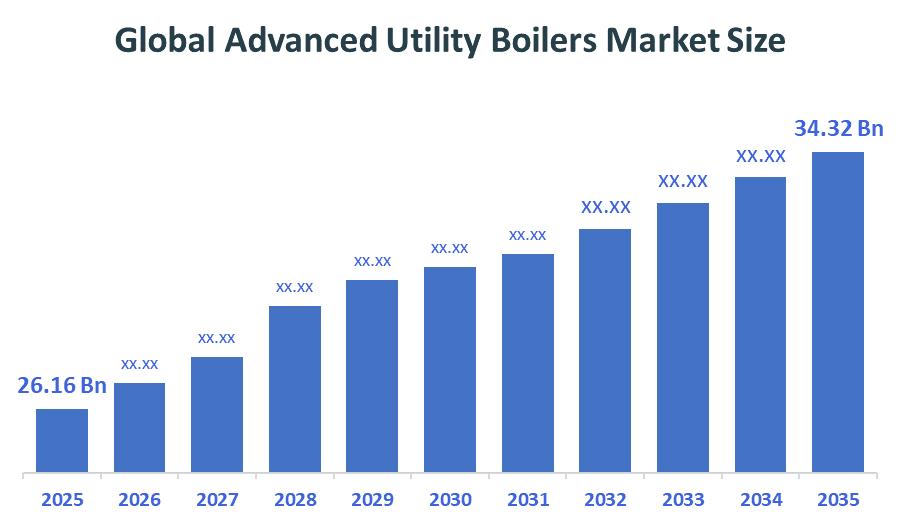
The Global Advanced Utility Boilers Market Size is predicted to grow from USD 26.16 Billion in 2025 and is likely to reach around USD 34.32 Billion by 2035 with a CAGR of 2.75%. According to Decision Advisors, a detailed research report on the market reflects that the Ultra-Supercritical Adoption trend dominates the Global Advanced Utility Boilers Market, accounting for of the total share worldwide. General Electric leads the market with annual revenue of approximately USD 68.4 billion and approx 10 - 15% global market share, making it the key contributor to global market development and growth dynamics.
Market Snapshot
- Global Advanced Utility Boilers Market Size (2025): USD 26.16 Billion
- Projected Global Advanced Utility Boilers Market Size (2035): USD 34.32 Billion
- Global Advanced Utility Boilers Market Compound Annual Growth Rate (CAGR): 2.75%
- Largest Regional Market: Asia Pacific
- 2nd Largest Region: North America
- Fastest Growing Region: Europe
- Base Year: 2025
- Historical Period: 2021-2024
- Market Forecast Period: 2026-2035
Market Overview/ Introduction
The Global Advanced Utility Boilers Market refers to high-capacity boiler systems that power large electricity generation plants and industrial steam operations. The market experiences steady growth because electricity demand increases while industrial activities expand, and old thermal power facilities require replacement. The US and EU Green Deal and China's dual-carbon strategy, government carbon reduction policies, emissions trading systems and clean energy transition programs, are driving companies to adopt ultra-supercritical technologies. Major companies such as GE and Siemens Energy, and Mitsubishi Power, are developing advanced materials and digital twin systems and AI-based predictive maintenance to boost their operational efficiency and system reliability. The market advantage exists because organizations achieve high thermal efficiency, which leads to reduced fuel consumption, and they meet emission standards. The upcoming growth of the market will result from businesses implementing decarbonization strategies, factories using automated systems and plants developing hybrid energy systems in all parts of the world.
Notable Insights: -
- Asia Pacific is anticipated to hold approximately 40% share of the Global Advanced Utility Boilers Market over the predicted timeframe.
- North America is expected to grow at a rapid CAGR in the Global Advanced Utility Boilers Market by holding approximately 27% of the share during the forecast period.
- By type, the pulverized coal boilers, segment dominated the market and holds approximately 45% share in 2025 and is projected to grow at a substantial CAGR during the forecast period.
- By application, the power generation segment dominated the market and holds approximately 52% share in 2025 and is projected to grow at a substantial CAGR during the forecast period.
- The compound annual growth rate of the Global Advanced Utility Boilers Market is 2.75%.
- The market is likely to achieve a valuation of USD 34.32 Billion by 2035.
What is the role of technology in grooming the market?
Technology plays a critical role in the Global Advanced Utility Boilers Market by improving efficiency, safety, and environmental performance. Supercritical and ultra-supercritical technologies enable higher steam temperatures and pressures, resulting in improved thermal efficiency and reduced fuel consumption. Advanced combustion systems optimize fuel-air ratios, reducing emissions and improving heat output. Digital twin technology and AI-based predictive maintenance systems help monitor boiler performance in real time, reducing downtime and operational risks. Automation and control systems enhance operational stability and safety in large-scale power plants. Additionally, advanced materials such as high-strength alloys improve durability under extreme temperature and pressure conditions, extending equipment lifespan and reducing maintenance costs.
Market Drivers
Emerging economies experience market growth due to increased electricity consumption and industrial development, and their growing power generation capacity. The market expansion benefits from ongoing investments in thermal power facilities and the updating of their outdated systems. Environmental regulations compel organizations to use efficiently operating systems which produce low emissions, particularly ultra-supercritical boiler systems. The chemical, oil and gas, and manufacturing sectors drive the need for dependable steam production systems. The combination of digital monitoring with automation systems and predictive maintenance technologies results in better operational performance while decreasing equipment downtime, which leads to more efficient plant operations and higher global market growth and sustained business development.
Restrain
The market faces challenges such as high initial capital investment and long installation cycles for advanced boiler systems. Environmental concerns related to coal-based power generation and strict regulatory frameworks also limit market expansion in certain regions.
Competitive Analysis:
The report offers the appropriate analysis of the key organizations/companies involved within the Global Advanced Utility Boilers Market along with a comparative evaluation primarily based on their product offerings, business overviews, geographic presence, enterprise strategies, segment market share, and SWOT analysis. The report also provides an elaborative analysis focusing on the current news and developments of the companies, which includes product development, innovations, joint ventures, partnerships, mergers & acquisitions, strategic alliances, and others. This allows for the evaluation of the overall competition within the market.
Top Companies in the Global Advanced Utility Boilers Market
- General Electric
- Siemens Energy
- Mitsubishi Power
- Babcock & Wilcox
- Doosan Enerbility
- Thermax Limited
- IHI Corporation
- Shanghai Electric
- Andritz AG
- John Wood Group
Government Initiatives
|
Country |
Key Government Initiatives |
|
UK |
The UK Boiler Upgrade Scheme provides £7,500 grants to replace gas boilers with heat pumps, supporting low-carbon heating adoption, with increased funding of £295 million allocated for 2025–26. |
|
Japan |
Japan’s 6th Strategic Energy Plan targets carbon neutrality by 2050 and a 46% greenhouse gas reduction by FY2030 compared to 2013 levels, strengthening long-term national decarbonization efforts. |
|
India |
Governments provide subsidies and financial incentives to promote energy-efficient technologies, lowering upfront investment costs and encouraging industries to adopt sustainable systems, improving efficiency and supporting long-term environmental goals globally. |
Study on the Supply, Demand, Distribution, and Market Environment of the Global Advanced Utility Boilers Market
Supply in the Global Advanced Utility Boilers Market is supported by heavy engineering manufacturers producing high-capacity pressure vessels, steam generators, and thermal systems designed for large-scale power plants. Demand is driven by utilities, independent power producers, and industrial sectors seeking efficient and reliable steam generation solutions. Distribution occurs mainly through EPC contractors, direct OEM agreements, and industrial equipment suppliers, ensuring customized deployment across projects. High demand is concentrated in rapidly industrializing regions with expanding energy infrastructure. Continuous advancements in materials, automation, and digital monitoring are improving supply chain efficiency, reducing maintenance requirements, and optimizing lifecycle performance across global installations.
Price Analysis and Consumer Behaviour Analysis
Pricing in the Global Advanced Utility Boilers Market is influenced by capacity, technology type, pressure rating, and efficiency level. Ultra-supercritical boilers are priced higher due to complex engineering, advanced materials, and higher performance standards. Despite elevated costs, most buyers prefer high-efficiency systems because they deliver long-term fuel savings and reduced emissions. A majority of utilities prioritize lifecycle cost optimization over initial investment, shaping procurement decisions globally. Industrial buyers focus on reliability, regulatory compliance, and operational efficiency. Increasing emphasis on decarbonization and energy efficiency is further driving demand for advanced systems, even at premium pricing levels across power generation markets.
Market Segmentation
The Global Advanced Utility Boilers Market share is classified into type, application and technology
- The Pulverized Coal Boilers segment dominated the market and holds approximately 45% share in 2025 and is projected to grow at a substantial CAGR during the forecast period.
Based on the type, the Global Advanced Utility Boilers Market is divided into Pulverized Coal Boilers, Circulating Fluidized Bed Boilers, Stoker Fired Boilers, Waste Heat Recovery Boilers, and Others. Among these, Pulverized Coal Boilers dominate the market due to their superior thermal efficiency, reduced fuel consumption, and lower emissions. These systems operate at extremely high pressure and temperature, making them highly suitable for modern power plants focused on sustainability and efficiency improvements. Their widespread adoption in large-scale electricity generation projects further strengthens their leading position globally.
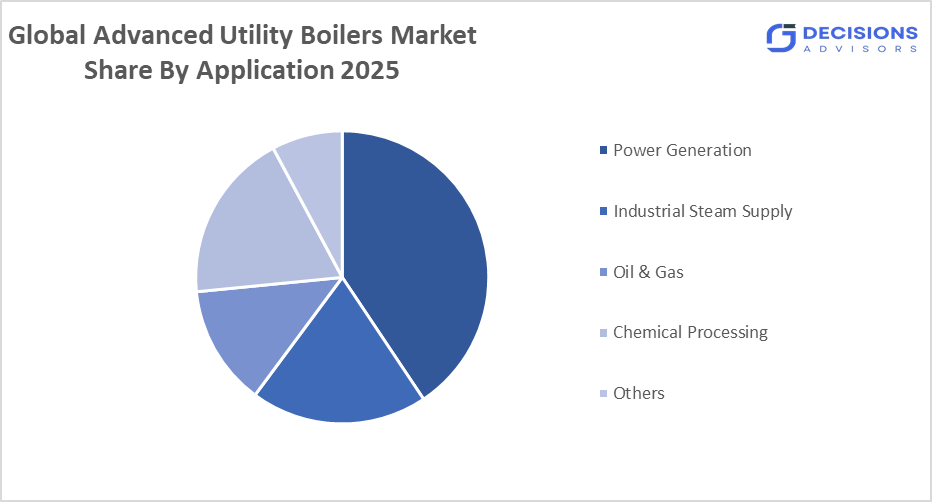
- The Power Generation segment accounted for the largest share of approximately 52% in 2025 and is anticipated to grow at a significant CAGR during the forecast period.
Based on the application, the Global Advanced Utility Boilers Market is divided into Power Generation, Industrial Steam Supply, Oil & Gas, Chemical Processing, and Others. Among these, Power Generation dominates the market due to increasing global electricity demand, expansion of thermal power infrastructure, and modernization of aging plants. Utility-scale boilers are widely used in coal, gas, and hybrid power plants to ensure efficient steam production. Rising investments in energy security and grid reliability further reinforce the dominance of this segment across global markets.
- The Ultra-Supercritical Boilers segment accounted for the largest share of approximately 45% in 2025 and is anticipated to grow at a significant CAGR during the forecast period.
Based on technology, the Global Advanced Utility Boilers Market is divided into Subcritical Boilers, Supercritical Boilers, and Ultra-Supercritical Boilers. Among these, Ultra-Supercritical Boilers lead the market due to their highest efficiency levels and ability to significantly reduce greenhouse gas emissions compared to conventional technologies. Their ability to operate under extreme conditions enables maximum energy output with lower fuel usage. Increasing environmental regulations and global decarbonization goals are further accelerating adoption of ultra-supercritical technology across modern power generation facilities.
Strategies to Implement for Growth of the Market in Non-Leading Regions
Strategies to implement for growth in non-leading regions focus on improving affordability, accessibility, and localization of advanced utility boiler systems. Companies should develop cost-efficient and modular boiler solutions suited for mid-sized industrial plants in emerging economies. Establishing regional manufacturing and assembly facilities can significantly reduce logistics costs and improve delivery timelines. Strong collaboration with local EPC contractors, utilities, and government bodies will enhance project execution and market penetration. Investment in cleaner combustion technologies and hybrid energy systems will ensure compliance with environmental regulations. Additionally, integrating digital monitoring, automation, and predictive maintenance services will improve operational efficiency, reduce downtime, and strengthen long-term customer relationships globally.
Regional Segment Analysis of the Global Advanced Utility Boilers Market
- North America (U.S., Canada, Mexico)?
- Europe (Germany, France, U.K., Italy, Spain, Rest of Europe)
- Asia-Pacific (China, Japan, India, Rest of APAC)
- South America (Brazil and the Rest of South America)?
- The Middle East and Africa (UAE, South Africa, Rest of MEA)
Asia Pacific is anticipated to hold approximately 40% share of the Global Advanced Utility Boilers Market over the predicted timeframe.
Asia Pacific holds approximately 40% share of the Global Advanced Utility Boilers Market due to rapid industrialization, large-scale urbanization, and expanding power generation capacity across emerging economies. Countries such as China and India dominate regional demand, driven by continuous investments in coal, gas, and hybrid power plants. Strong presence of manufacturing industries and heavy energy consumption further supports market expansion. Government-backed infrastructure development programs and energy security initiatives are accelerating adoption of advanced boiler technologies. Additionally, increasing focus on high-efficiency ultra-supercritical systems and modernization of aging thermal plants is strengthening the region’s leadership position in global energy infrastructure development and deployment.
North America is expected to grow at a rapid CAGR in the Global Advanced Utility Boilers Market, holding approximately 27% of the share during the forecast period
North America accounts for approximately 27% share of the Global Advanced Utility Boilers Market, driven by modernization of aging power infrastructure and increasing adoption of advanced emission control technologies. The region focuses on upgrading existing thermal power plants to improve efficiency and reduce carbon emissions. Strong investments in digitalization, automation, and predictive maintenance systems are enhancing operational performance. The United States leads regional demand due to its large-scale industrial base and energy consumption needs. Additionally, growing integration of ultra-supercritical and high-efficiency boiler systems supports long-term sustainability goals, while regulatory frameworks encourage cleaner and more efficient power generation across utilities and industries.
Europe is the fastest-growing region in the Global Advanced Utility Boilers Market during the period, holding approximately 24% share.
Europe holds approximately 24% share of the Global Advanced Utility Boilers Market and is recognized as the fastest-growing region due to strict environmental regulations and strong decarbonization targets. The region is rapidly transitioning toward high-efficiency and low-emission boiler technologies, particularly ultra-supercritical systems. Countries such as Germany, the UK, and France are investing heavily in modernizing power infrastructure and replacing outdated thermal plants. Growing adoption of renewable-integrated hybrid energy systems is also supporting demand for advanced boilers. Additionally, strong policy frameworks such as the EU Green Deal are accelerating investments in cleaner, more efficient, and digitally optimized power generation technologies across Europe.
Future Market Trends in Global Atomic Layer Deposition Equipment Market: -
Shift Toward Ultra-Supercritical Technologies
Ultra-supercritical technologies are increasingly adopted due to their ability to operate at extremely high pressure and temperature, improving thermal efficiency and reducing fuel consumption. They significantly lower emissions and enhance power plant performance, making them the preferred choice for modern large-scale electricity generation systems globally.
Integration of AI-Based Predictive Maintenance
AI-based predictive maintenance helps monitor boiler performance in real time, identifying potential failures before they occur. It reduces unplanned downtime, improves operational efficiency, and lowers maintenance costs. By analyzing sensor data, it enhances equipment reliability and ensures smoother, safer, and more efficient power plant operations.
???????Growth in Waste Heat Recovery Systems
Waste heat recovery systems capture and reuse excess heat from industrial processes and power plants, improving overall energy efficiency. These systems reduce fuel consumption and emissions while maximizing energy output. Increasing focus on sustainability and cost savings is driving their adoption across industries worldwide.
???????Digital Twin Adoption in Power Plants
Digital twin technology creates a virtual model of boiler systems for real-time monitoring and simulation. It enables performance optimization, predictive maintenance, and operational planning. Power plants use it to improve efficiency, reduce risks, and enhance decision-making, leading to smarter and more reliable energy production systems.
???????Hybrid Energy System Integration with Boilers
Hybrid energy systems integrate boilers with renewable sources like solar and biomass to improve efficiency and reduce carbon emissions. This combination enhances energy flexibility and reliability while supporting decarbonization goals. It is increasingly adopted in modern power plants to balance sustainability and continuous energy demand.
Recent Development
- In February 2025, AtmosZero launched the Electric Boiler 2.0 for zero-emission industrial heat, enabling electrified steam generation and improved energy efficiency.
- In September 2024, Thermax expanded its biomass-flexible and solid-fuel boiler portfolio focusing on fuel flexibility, lower emissions, and enhanced industrial decarbonization across steam generation systems.
How is Recent Developments Helping the Market?
Recent developments are significantly strengthening the Global Advanced Utility Boilers Market by improving efficiency, sustainability, and operational reliability. Innovations in ultra-supercritical and supercritical technologies are enhancing thermal performance while reducing fuel consumption and greenhouse gas emissions. Digital solutions such as AI-driven monitoring, IoT-based sensors, and predictive maintenance systems enable real-time performance tracking, minimizing downtime and maintenance costs. Advanced high-temperature resistant materials are increasing system durability under extreme operating conditions. Additionally, integration of automation and smart control systems is improving plant safety and efficiency. These advancements collectively support global decarbonization efforts and are accelerating adoption across power generation and industrial sectors worldwide.
Market Segment
This study forecasts revenue at global, regional, and country levels from 2020 to 2035. Decision Advisors has segmented the Global Advanced Utility Boilers Market based on the below-mentioned segments:
Global Advanced Utility Boilers Market, By Type
• Pulverized Coal Boilers
• Circulating Fluidized Bed Boilers
• Stoker Fired Boilers
• Waste Heat Recovery Boilers
• Others
Global Advanced Utility Boilers Market, By Application
• Power Generation
• Industrial Steam Supply
• Oil & Gas
• Chemical Processing
• Others
Global Advanced Utility Boilers Market, By Technology
• Subcritical Boilers
• Supercritical Boilers
• Ultra-Supercritical Boilers
Global Advanced Utility Boilers Market, By Regional Analysis
- North America
- US
- Canada
- Mexico
- Europe
- Germany
- UK
- France
- Italy
- Spain
- Russia
- Rest of Europe
- Asia Pacific
- China
- Japan
- India
- South Korea
- Australia
- Rest of Asia Pacific
- South America
- Brazil
- Argentina
- Rest of South America
- Middle East & Africa
- UAE
- Saudi Arabia
- Qatar
- South Africa
- Rest of the Middle East & Africa
Frequently Asked Questions (FAQ)
Q. How are global energy transition goals affecting boiler system design?
A. Energy transition goals are pushing manufacturers to design boilers with higher efficiency, lower emissions, and compatibility with alternative fuels, ensuring alignment with decarbonization targets and future grid requirements.
Q. Why is operational flexibility important in modern utility boilers?
A. Operational flexibility allows boilers to adjust quickly to fluctuating energy demand, integrate with renewable sources, and maintain stable output, making them essential for modern hybrid power systems.
Q. How does workforce expertise influence market adoption?
A. Skilled workforce availability impacts installation efficiency, system optimization, and maintenance quality. Lack of trained personnel can slow adoption of advanced boiler technologies in developing regions.
Q. What role do retrofit projects play in market expansion?
A. Retrofit projects extend the lifespan of existing power plants by upgrading efficiency and emission performance, reducing the need for full replacement and supporting gradual modernization of infrastructure.
Q. How are supply chain dynamics shaping project timelines?
A. Global supply chain efficiency affects equipment delivery, project execution speed, and cost stability. Delays in critical components can significantly impact commissioning timelines for large-scale boiler installations.
Check Licence
Choose the plan that fits you best: Single User, Multi-User, or Enterprise solutions tailored for your needs.
We Have You Covered
- 24/7 Analyst Support
- Clients Across the Globe
- Tailored Insights
- Technology Tracking
- Competitive Intelligence
- Custom Research
- Syndicated Market Studies
- Market Overview
- Market Segmentation
- Growth Drivers
- Market Opportunities
- Regulatory Insights
- Innovation & Sustainability
Report Details
| Scope | Global |
| Pages | 210 |
| Delivery | PDF & Excel via Email |
| Language | English |
| Release | Apr 2026 |
| Access | Download from this page |