
Global Advanced Welding Helmets Market
 |
Pages:
195
|
Pages:
195
Global Advanced Welding Helmets Market Size, Share, By Product Type (Auto-Darkening Welding Helmet, Fixed Shade Welding Helmet, and Variable Shade Welding Helmet), By Power Source Type (Passive, Battery Powered, and Solar-Powered), By Application (Shipbuilding and Marine, Energy and Utility, Automotive, General Industries, and Construction), and By Region (North America, Europe, Asia-Pacific, Latin America, Middle East, and Africa), Analysis and Forecast 2025-2035.
REPORT COVERAGE
Global
Market Snapshot
- Market Size (2025): USD 1.2 Billion
- Projected Market Size (2035): USD 2.13 Billion
- Compound Annual Growth Rate (CAGR): 5.91%
- Largest Regional Market: Asia-Pacific
- Fastest Growing Region: North America
- 3rd Largest Region: Europe
- Base Year: 2025
- Historical Period: 2021–2024
- Forecast Period: 2025–2035
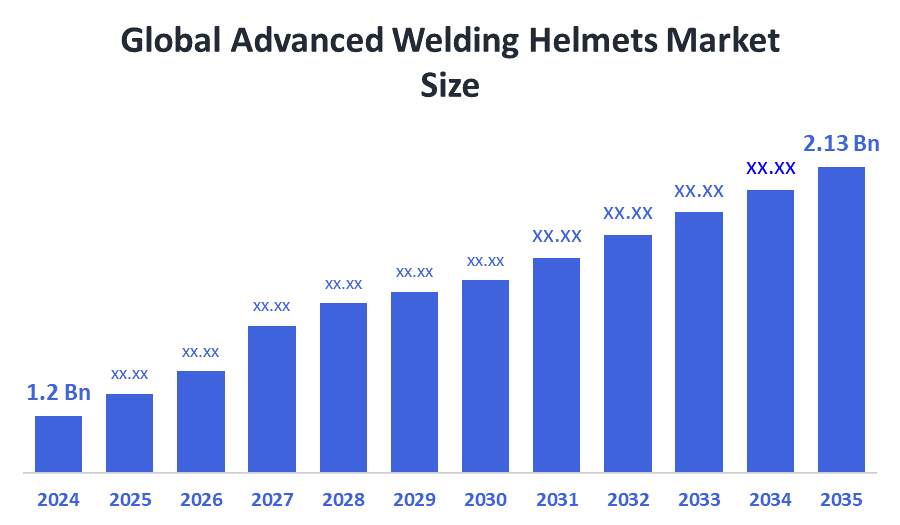
According to Decision Advisors, the Global Advanced Welding Helmets Market Size is expected to grow from USD 1.2 Billion in 2025 to USD 2.13 Billion by 2035, at a CAGR of 5.91% during the forecast period 2025-2035. The market has emerged because of the stringent occupational safety regulations, rapid adoption of ADF technology, infrastructure & industrial growth, demand for ergonomic and lightweight designs, and technological integration (smart helmets).
Market Overview/ Introduction
An Advanced Welding Helmet is a piece of personal protective equipment (PPE) that uses sophisticated, electronic Auto-Darkening Filters (ADF) to instantly protect a welder’s face and eyes from intense ultraviolet (UV) and infrared (IR) light. Unlike traditional helmets, advanced models allow the welder to keep the hood in place throughout the process, automatically darkening within milliseconds when an arc is struck. The market for these high-tech helmets is moving toward smart technology, featuring integrated heads-up displays (HUDs) that display welding parameters such as amperage and wire feed speed. Prominent manufacturers are ESAB, 3M Speedglas, Lincoln Electric, Optrel, and Miller Electric. The rise of industrialization and manufacturing in areas such as India, China, Southeast Asia, and Nigeria is generating significant growth potential through the adoption of professional safety gear.
- Enforcement of China’s GB 2811 standards by the government, alongside EN?379 and ANSI Z87.1, promotes adoption of high-quality welding helmets, ensuring worker safety, regulatory compliance, and increased demand for advanced protective equipment in industrial sectors.
- India’s PLI schemes under the “Make in India” initiative encourage local production of high-quality welding helmets, boosting accessibility, safety compliance, and adoption of advanced protective gear while reducing reliance on imports in growing industrial sectors.
- The U.S. government, through OSHA mandates, requires employers to provide PPE, including welding helmets, to protect workers from UV/IR radiation, sparks, and molten metal, driving adoption of high-quality helmets across industrial and manufacturing sectors.
Notable Insights: -
- Asia-Pacific holds the largest regional market share approximately 54% in the Advanced Welding Helmets.
- North America is the fastest growing region in the advanced welding helmets.
- By product type, the auto-darkening welding helmet segment dominated the market in 2025, and is projected to grow at a substantial CAGR of approximately 65.3% during the forecast period.
- The compound annual growth rate of the Advanced Welding Helmets is 5.91%.
- The market is likely to achieve a valuation of USD 2.13 billion by 2035.
What is role of technology in grooming the market?
Technology is crucial in influencing the global advanced welding helmets market by improving safety, comfort, and productivity. With innovations like auto-darkening filters, digital controls, true-color optics, IoT/sensor integration, and lightweight ergonomic designs, visibility is enhanced, eye strain is minimized, and welders can work longer with increased precision. These developments comply with rigorous workplace safety standards, promoting their extensive use in industries such as construction, automotive, aerospace, and shipbuilding. Moreover, advanced features like connectivity and real-time monitoring are turning helmets into integrated tools that facilitate improved performance tracking and predictive maintenance. Technology is key to market growth, enhancing user experience, operational efficiency, and the overall safety of welding professionals globally. Modern helmets, such as the ESAB Sentinel A60 and 3M Speedglas G5-03, offer 1/1/1/1 optical clarity and faster switching speeds (often under 0.1 ms), significantly reducing eye strain.
How is Recent Developments Helping the Market?
Innovation, increased safety adoption, and market expansion are significantly bolstering the global advanced welding helmets market due to recent developments. Producers are introducing products that are rich in technology, helmets that darken automatically and have better viewing areas, solar-powered elements, ergonomic designs, and built-in communication systems, all of which improve comfort and efficiency. Adaptive shade filters are now used in about 43% of new helmets, while 29% provide Bluetooth connectivity, enhancing precision and integration with digital workflows. The market growth and adoption of advanced welding helmets are being further accelerated by stricter occupational safety standards and rising industrialization across the Asia Pacific and North America. With these advancements, companies are able to meet changing customer demands and regulatory requirements while increasing their global market penetration.
Market Drivers
Stringent workplace safety regulations and increasing awareness of worker health hazards are the main drivers of the global advanced welding helmets market. Protective equipment is mandated by governments and organizations, leading to its increased adoption in various sectors such as construction, automotive, and shipbuilding. Furthermore, the swift pace of industrialization and infrastructure advancement is propelling welding activities around the world, with the construction industry representing almost 29.5% of the market share. Another crucial factor is technological progress, with auto-darkening helmets comprising roughly 64% of the total market share and enhancing productivity and precision. Moreover, the Asia Pacific region holds a leading position with a share exceeding 37%, propelled by extensive manufacturing and urban development, which persistently boosts the global demand for advanced welding helmets.
Restrain
High product costs are restricting the adoption of global advanced welding helmets among small-scale welders, creating limitations for the market. The absence of awareness in developing areas and the presence of inexpensive conventional helmets impede growth. Moreover, problems with maintenance and the sensitivity of electronic components can diminish durability, which in turn affects long-term user preference and slows down market penetration.
Competitive Analysis:
The report offers the appropriate analysis of the key organizations/companies involved within the Advanced Welding Helmets market, along with a comparative evaluation primarily based on their product of offering, business overviews, geographic presence, enterprise strategies, segment market share, and SWOT analysis. The report also provides an elaborative analysis focusing on the current news and developments of the companies, which includes product development, innovations, joint ventures, partnerships, mergers & acquisitions, strategic alliances, and others. This allows for the evaluation of the overall competition within the market.
Top Companies in Global Advanced Welding Helmets Market
- Jackson Safety (SureWerx)
- 3M (Speedglas)
- Lincoln Electric
- YesWelder
- ESAB, Miller Electric (ITW Welding)
- Optrel AG
- Honeywell (Uvex)
- Hobart Welders
- GYS
- ArcOne
- Fronius International
Government Initiatives
|
Country |
Key Government Initiatives |
|
UK |
Strict enforcement of UK occupational safety regulations drives industries to adopt high-quality welding helmets, ensuring compliance and worker protection. With over 561,000 workplace injuries reported in 2022–23, investment in PPE remains crucial for safety. |
|
US |
Government regulations are strengthening safety requirements for welding helmets, with standards like ANSI Z87.1, CSA Z94.3, and EN?379 ensuring proper UV/IR protection, impact resistance, and optical clarity, driving adoption of compliant helmets in global markets. |
|
China |
The “Made in China 2025” initiative drives industrial upgrading in sectors like automotive, aerospace, and shipbuilding, increasing automation and precision welding, which in turn boosts demand for high-quality welding helmets and advanced protective equipment. |
Market Segmentation
The advanced welding helmets market share is classified into product type, power source type, and application.
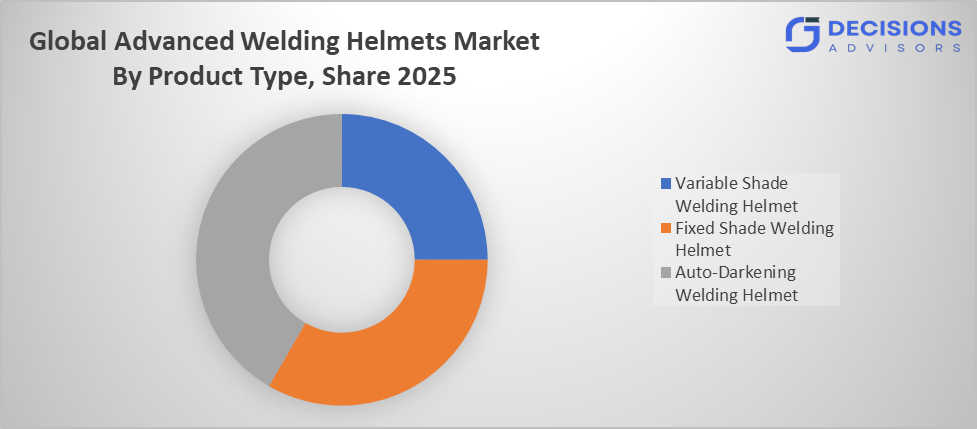
- The auto-darkening welding helmet segment dominated the market in 2025, and is projected to grow at a substantial CAGR of approximately 65.3% during the forecast period.
Based on the product type, the advanced welding helmets market is divided into auto-darkening welding helmet, fixed shade welding helmet, and variable shade welding helmet. Among these, the auto-darkening welding helmet segment dominated the market in 2025, and is projected to grow at a substantial CAGR of approximately 65.3% during the forecast period. It is due to their enhanced convenience, greater security, and elevated efficiency via automatic lens shading. They are favored for improving comfort for welders and minimizing eye strain during extended, high-intensity industrial tasks in the automotive and manufacturing industries.
- The solar-powered segment accounted for the largest share in 2025, and is anticipated to grow at a significant CAGR of approximately 46 % during the forecast period.
Based on the power source type, the advanced welding helmets market is divided into passive, battery powered, and solar-powered. Among these, the solar-powered segment accounted for the largest share in 2025, and is anticipated to grow at a significant CAGR of approximately 46 % during the forecast period. It is propelled because they are viewed as eco-friendlier and provide a reduced total cost of ownership over time, which contributes to their uptake in heavy industrial environments. Helmets that run on solar energy lessen the need for battery replacements and offer great reliability for prolonged, uninterrupted industrial welding work.
- The construction segment dominated the market in 2025, and is projected to grow at a substantial CAGR of approximately 28.3%during the forecast period.
Based on the application, the advanced welding helmets market is divided into shipbuilding and marine, energy and utility, automotive, general industries, and construction. Among these, the construction segment dominated the market in 2025, and is projected to grow at a substantial CAGR of approximately 28.3% during the forecast period. In structural steel fabrication, the necessity of safeguarding workers from sparks, intense light, radiation, and fumes renders advanced helmets essential. The increasing urbanization and government-driven initiatives for infrastructure, smart cities, and transportation networks globally are propelling a high intensity of welding in this sector.
Strategies to Implement for Growth of the Market in Non-Leading Regions
In order to foster growth in the welding helmet market within non-leading regions, companies need to implement strategies that tackle the market's challenges and leverage its opportunities. Highlighting inexpensive auto-darkening and passive helmet models can boost uptake in areas sensitive to cost. Working together with local distributors, OEMs, and training providers broadens market reach and fosters technical awareness among welders. Building trust and ensuring helmets are used correctly can be achieved by expanding after-sales support, workshops, and safety education programs. Showcasing technological benefits like enhanced clarity lenses, ergonomic designs, built-in LED lighting, and intelligent features can appeal to contemporary welders in search of better performance and safety. Moreover, focusing on industrial projects, vocational centers, and government initiatives can foster significant visibility and adoption in emerging and non-leading markets.
Regional Segment Analysis of the Advanced Welding Helmets Market
- North America (U.S., Canada, Mexico)
- Europe (Germany, France, U.K., Italy, Spain, Rest of Europe)
- Asia-Pacific (China, Japan, India, Rest of APAC)
- South America (Brazil and the Rest of South America)
- The Middle East and Africa (UAE, South Africa, Rest of MEA)
Asia Pacific is anticipated to hold the largest share of the advanced welding helmets market over the predicted timeframe. The advanced welding helmets market is expected to be dominated by the Asia Pacific region, which will account for 36.7% of global revenue in 2024, with forecasts suggesting it will retain this leadership position through 2033. The main drivers of this growth are the swift industrialisation and extensive infrastructure development in China, India, and Southeast Asia. This has led to a substantial rise in welding intensity within the construction and transportation sectors. The region's status as a global manufacturing powerhouse, especially in steel production, shipbuilding, and automotive manufacturing, along with the rise in high-performance aircraft and passenger vehicle production, generates a strong and steady demand for high-quality protective gear. The shift to Industry 4.0 is speeding up the use of “smart” helmets with auto-darkening filters, IoT connectivity, and augmented reality to improve safety and operational efficiency.
North America is expected to grow at a rapid CAGR in the advanced welding helmets market during the forecast period. North America is expected to witness rapid growth in the advanced welding helmets market due to stringent government safety regulations, such as OSHA mandates, high adoption of automated and industrial welding technologies, and growing awareness of worker safety and PPE compliance. The increasing use of auto-darkening helmets, ergonomic designs, and smart lens technologies further drives demand across construction, automotive, shipbuilding, and manufacturing sectors. Rising investments in industrial automation and focus on reducing workplace injuries contribute to market expansion.
Europe is the 3rd largest region to grow in the advanced welding helmets market during the region. Europe occupies a notable place in the global advanced welding helmets market, with approximately 28% of the global market share, ranking it as the third-largest region due to its robust industrial foundation in automotive, aerospace, and heavy machinery production. The stringent workplace safety regulations and compliance standards throughout the European Union create a steady demand for top-quality protective gear. Moreover, the rise of automation in welding processes and the presence of established manufacturers facilitate a consistent adoption.
Future Market Trends in Advanced Welding Helmets: -
- Smart & Connected Helmets:
By incorporating IoT, AI, and Bluetooth technologies, these helmets can link to smartphones or weld monitors for real-time diagnostics, data tracking, and automatic safety adjustments.
- Advanced ADF Technology:
Auto-darkening filters are being developed to include 4–5 sensor zones for quicker arc detection, wider DIN ranges (5-13), and enhanced optical clarity to reduce eye strain.
- Design that is ergonomic and light:
A robust transition to lighter materials and an improved distribution of weight in order to lessen the strain on workers’ necks while they perform complicated tasks over extended periods.
Recent Development
- In September 2025, Optrel launched the Sphere X Series welding helmets, featuring Crystal Lens Technology for over 30% increased field of vision and a five-sensor auto-darkening system, enhancing precision, safety, and innovation in the welding helmet market.
- In Jan 2025, 3M expanded its Speedglas lineup with the G5?03 Pro welding helmet, featuring advanced auto?darkening filters that deliver superior UV/IR protection and customizable settings, strengthening its position in the professional welding helmet market.
- In October 2024, ESAB launched the Savage A50 welding helmet, featuring an integrated 50-lumen dual LED work light, a redesigned shell, and a glove-friendly digital interface, enhancing usability, visibility, and safety in the welding helmet market.
- In October 2024, Miller Electric introduced ClearLight?4x Lens Technology for welding helmets, providing up to four times greater clarity than standard lenses, enhancing visibility, precision, and safety for welders in the professional welding helmet market.
Market Segment
This study forecasts revenue at global, regional, and country levels from 2020 to 2035. Decision Advisor has segmented the advanced welding helmets market based on the below-mentioned segments:
Global Advanced Welding Helmets Market, By Product Type
- Auto-Darkening Welding Helmet
- Fixed Shade Welding Helmet
- Variable Shade Welding Helmet
Global Advanced Welding Helmets Market, By Power Source Type
- Passive
- Battery Powered
- Solar-Powered
Global Advanced Welding Helmets Market, By Application
- Shipbuilding and Marine
- Energy and Utility
- Automotive, General Industries
- Construction
Global Advanced Welding Helmets Market, By Regional Analysis
- North America
- US
- Canada
- Mexico
- Europe
- Germany
- UK
- France
- Italy
- Spain
- Russia
- Rest of Europe
- Asia Pacific
- China
- Japan
- India
- South Korea
- Australia
- Rest of Asia Pacific
- South America
- Brazil
- Argentina
- Rest of South America
- Middle East & Africa
- UAE
- Saudi Arabia
- Qatar
- South Africa
- Rest of the Middle East & Africa
FAQ
Q. How are energy-efficient solutions influencing product innovation in welding helmets?
A. Energy-efficient solutions, particularly solar-powered helmets, are transforming innovation trends. The segment holds a strong position with around 46% growth potential, driven by reduced battery dependency and lower operational costs, making them ideal for continuous industrial welding applications.
Q. How do regulatory frameworks impact product standardization and innovation?
A. Regulations such as ANSI Z87.1 and EN 379 drive standardization while encouraging innovation. Manufacturers are investing in high-performance lenses and faster response times (often below 0.1 ms) to meet compliance, enhancing both safety and technological advancement.
Q. How is user comfort influencing product development in advanced welding helmets?
A. User comfort is becoming a key focus, with manufacturers designing lightweight helmets, better headgear systems, and improved weight distribution. This reduces fatigue during long working hours and enhances overall productivity, especially in industrial environments.
Q. How is industrial automation influencing helmet design trends?
A. Automation is driving demand for helmets with better precision, real-time data display, and compatibility with automated welding systems, leading to smarter and more adaptive protective equipment.
Check Licence
Choose the plan that fits you best: Single User, Multi-User, or Enterprise solutions tailored for your needs.
We Have You Covered
- 24/7 Analyst Support
- Clients Across the Globe
- Tailored Insights
- Technology Tracking
- Competitive Intelligence
- Custom Research
- Syndicated Market Studies
- Market Overview
- Market Segmentation
- Growth Drivers
- Market Opportunities
- Regulatory Insights
- Innovation & Sustainability
Report Details
| Scope | Global |
| Pages | 195 |
| Delivery | PDF & Excel via Email |
| Language | English |
| Release | Mar 2026 |
| Access | Download from this page |