
Global Aftercoolers Market
 |
Author:
Pranali P
|
Pages:
240
|
Author:
Pranali P
|
Pages:
240
Global aftercoolers Market Size, Share, By Type (Air-Cooled Aftercoolers, Water-Cooled Aftercoolers, Hybrid Aftercoolers), By Application (Compressors, Engines & Turbines, Specialized Aftercoolers, and Power Generation) By End User (Manufacturing & Industrial Plants, Oil & Gas, Power Generation, Automotive, Food & Beverage and Pharmaceuticals), and By Region (North America, Europe, Asia-Pacific, Latin America, Middle East, and Africa), Analysis and Forecast 2026-2035.
CAGR
11.64%
REVENUE 2025
USD Billion 1.67
FORECAST 2035
USD Billion 5.01
REPORT COVERAGE
Global
Market Snapshot
- Global Aftercoolers Market Size (2025): USD 1.666 Billion
- Projected Global Aftercoolers Market Size (2035): USD 5.01 Billion
- Global Aftercoolers Compound Annual Growth Rate (CAGR): 11.64%
- Largest Regional Market: North America
- Fastest Growing Region: Asia Pacific
- 3rd Largest Region: Europe
- Base Year: 2025
- Historical Period: 2021–2024
- Forecast Period: 2026–2035
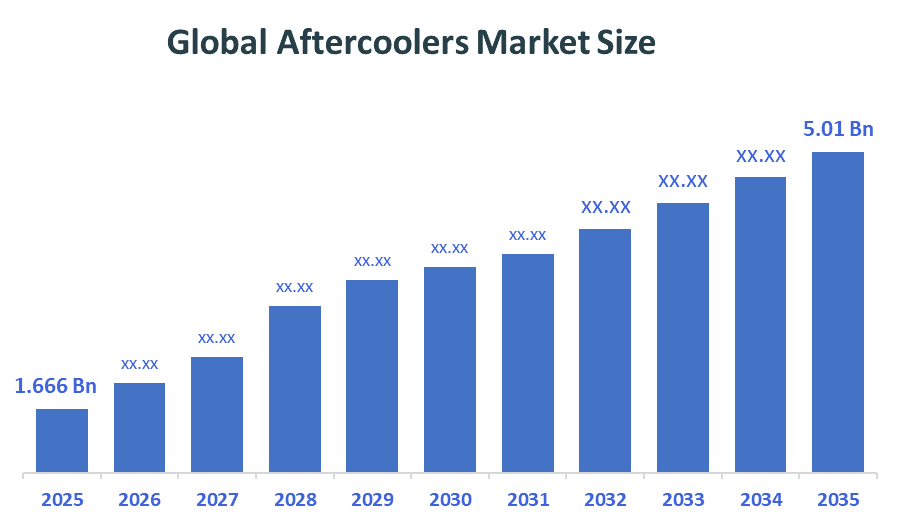
According to Decision Advisors, the Global aftercoolers Market Size is expected to grow from USD 1.666 Billion in 2025 to USD 5.01 Billion by 2035, at a CAGR of 11.64% during the forecast period 2026-2035. The Global Aftercoolers Market would be driven by the growing requirement for compressed air and gas systems. Increasing growth in the manufacturing industry, oil & gas industry, power generation industry, and automotive industry would contribute to the rising acceptance of aftercoolers due to their performance improvement features, energy efficiency, and avoidance of moisture damage. Industrial automation, environmental concerns, and the need for high-quality air have led to further growth in the market.
Market Overview/ Introduction
The Global Aftercoolers Market consists of various industrial tools that facilitate air cooling or air conditioning by reducing the temperature and eliminating moisture from compressed air or gases after compression. In the manufacturing and process industry, aftercoolers find applications in industries including manufacturing, energy generation, oil and gas, automotive, food processing, and pharmaceuticals. The key factors contributing to the market's growth include the fast pace at which industries are growing and the rise in stringent regulations on energy consumption. With increased focus on energy efficiency and production of efficient manufacturing lines that need efficient compressed air systems, there is a growing demand for aftercoolers. The development of technologies such as advanced heat-exchange methods, internet-of-things (IoT)-enabled monitoring systems, hybrid and modular air/water-cooled solutions, and predictive maintenance systems is changing the landscape of this market. Moreover, the implementation of durable materials and innovative design in this market increases the efficiency of the system. Government policies encouraging industries to adopt sustainable solutions for efficient production and energy conservation contribute to the growth of the global aftercoolers market.
- India’s MSME Champions Scheme merges ZED, Lean, Digital, and Innovation programs, helping aftercooler manufacturers upgrade technology, improve quality, adopt lean practices, and enhance competitiveness in domestic and global markets.
- India’s PAT Scheme for energy-intensive sectors like steel, power, and chemicals promotes energy efficiency. Aftercoolers improve compressed air performance, aiding compliance, reducing costs, and enabling trading of energy savings certificates.
Notable Insights: -
- Asia-Pacific holds the largest regional market share approximately 39% in the global Aftercoolers market.
- North America is the fastest growing region market share approximately 40% in the global Aftercoolers market.
- By type, the air-cooled aftercoolers segment held a dominant position with 57% in terms of market share in 2025.
- By application, compressors segment is the dominating accounting for market is approximately 52%.
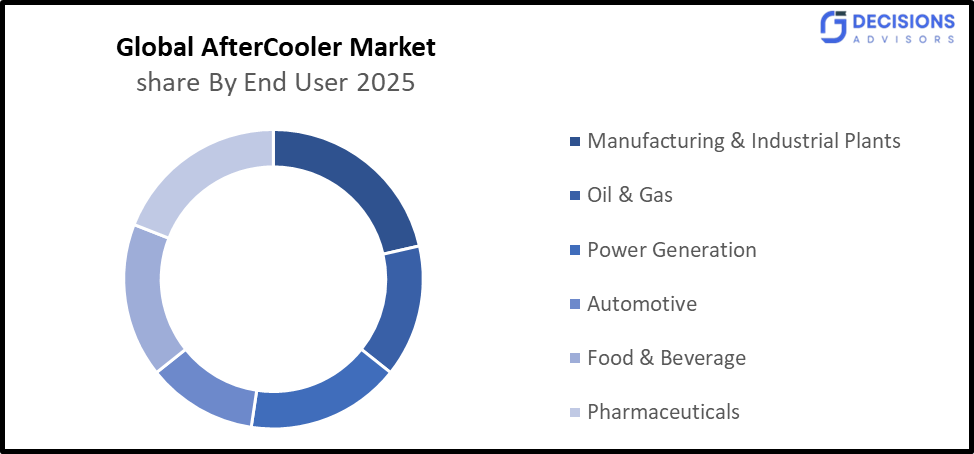
- By end user, manufacturing & industrial plants segment held a dominant position market is approximately 42%.
- The market is likely to achieve a valuation of USD 5.01 Billion by 2035.
What is role of technology in grooming the market?
Technological advancement is the major force shaping the present-day aftercooler market through the conversion of conventional machinery into precise, data-centric equipment. Through the incorporation of IoT sensors and automated control technology, suppliers have been able to achieve timely diagnosis and proactive repair, thus minimizing downtime in industries. In addition, advances in materials science, such as the application of highly durable alloying compounds and anticorrosive treatments, have enhanced equipment longevity under tough conditions. Better engineering techniques, like optimizing the arrangement of fins in heat exchangers, have also improved thermal efficiency, enabling machines to optimize energy usage while meeting international sustainability criteria.
How is Recent Developments Helping the Market?
Current advancements are propelling the Global Aftercoolers Market through efficiency enhancement, better reliability, and enhanced industrial applications. The incorporation of Internet of Things (IoT) sensors and predictive maintenance systems makes it possible to monitor performance in real time, thereby ensuring minimum downtime. The use of heat exchangers with new designs and robust material improves efficiency and durability. Product development and partnerships can help deliver solutions that provide better air quality. Stringent energy efficiency standards and increasing automation in industries such as pharmaceutical and food processing will boost market growth.
Market Drivers
A primary driver is the rapid expansion of industrial automation, where aftercoolers serve as essential components by removing up to 70% of moisture from compressed air, thereby protecting downstream equipment and reducing maintenance costs. This demand is further intensified by the shift toward Industry 4.0, leading to the adoption of "smart" aftercoolers equipped with IoT sensors for real-time performance monitoring. Geographically, the Asia-Pacific region dominates the landscape, accounting for approximately 37% to 41% of the global market share due to massive infrastructure projects and high-end manufacturing initiatives. Additionally, as global industrial energy consumption is expected to rise by 30% by 2030, stringent environmental regulations like ISO 8573-1 Class 0 are compelling industries to adopt high-efficiency cooling solutions to meet carbon reduction targets and optimize operational energy loads.
Restrain
The Global Aftercoolers Market faces restraints from high initial investment and installation costs, limiting adoption among smaller industries. Maintenance complexity, especially for water-cooled and hybrid systems, increases operational expenses. Growth is also challenged by alternative cooling solutions, fluctuating raw material prices, and strict regulatory compliance in certain regions, which can restrict deployment and slow market expansion.
Competitive Analysis:
The report offers the appropriate analysis of the key organizations/companies involved within the aftercoolers market, along with a comparative evaluation primarily based on their Product of offering, business overviews, geographic presence, enterprise strategies, segment market share, and SWOT analysis. The report also provides an elaborative analysis focusing on the current news and developments of the companies, which includes Product development, innovations, joint ventures, partnerships, mergers & acquisitions, strategic alliances, and others. This allows for the evaluation of the overall competition within the market.
Top Companies in Global Aftercoolers Market
- Atlas Copco AB
- Ingersoll Rand Inc.
- Parker?Hannifin Corporation
- Kaeser Kompressoren SE
- Sullair LLC
- Hitachi Industrial Equipment Systems Co., Ltd.
- BOGE Kompressoren GmbH & Co. KG
- Quincy Compressor LLC
- FS?Elliott Company LLC
- Sullivan?Palatek Inc.
- Others
Government Initiatives
|
Country |
Key Government Initiatives |
|
India
|
In January?2026, India’s PLI Scheme for White Goods supports 85 companies investing approximately ?11,198?crore in AC components like compressors and heat exchangers. The initiative strengthens domestic supply chains, boosting thermal management technologies and creating opportunities for aftercooler suppliers. |
|
U.S. |
In January?2025 – The U.S. DOE implemented new energy conservation standards for oil-flooded rotary air compressors (35–1,250?cfm). Aftercoolers play a key role in meeting efficiency targets, reducing heat and moisture, and contributing to an estimated 0.16 quadrillion BTU long-term energy savings. |
|
U.S. |
In 2025, U.S. federal incentives and “Buy American” policies promote domestic production of industrial components, including aftercoolers, supporting supply-chain reshoring and boosting adoption in government and industrial projects. |
Study on the Supply, Demand, Distribution, and Market Environment of Aftercoolers Market
The Aftercoolers Market operates within a dynamic supply and demand framework, driven by rising industrialization, manufacturing automation, and the need for energy-efficient compressed air systems. Suppliers offer a range of air-, water-, and hybrid-cooled aftercoolers through direct sales, distributors, and OEM partnerships, ensuring broad availability. Demand is strongest in manufacturing, oil & gas, power generation, and automotive sectors, where reliable air and gas cooling is critical. The market environment is shaped by technological innovations, regulatory standards, and sustainability initiatives, encouraging adoption of advanced solutions. Strategic expansions, regional infrastructure growth, and industrial modernization further strengthen the global aftercoolers ecosystem.
Price Analysis and Consumer Behaviour Analysis
Price variation in the Global Aftercoolers Market is observed on account of many factors such as type, method of cooling, capacity, brand name, and technology. Air cooled after coolers usually come at a lower cost than water-cooled after coolers because of better performance and durability. Consumers in the industrial sector concentrate on long-term operational efficiency, robustness, and maintenance expenses, rather than making an initial purchase decision on the basis of upfront capital cost alone. Consumer preferences are shifting towards energy efficient, robust, and technologically superior after coolers, especially in industries such as manufacturing, oil & gas, and pharmaceuticals.
Market Segmentation
The Aftercoolers market share is classified into type, application, and end user
- The type segment dominated the market in 2025, and is projected to grow at a substantial CAGR of approximately 57% during the forecast period.
Based on the type, the aftercoolers market is divided into air-cooled aftercoolers, hybrid aftercoolers, and water-cooled aftercoolers. Among these, Air-Cooled Aftercoolers dominate the Global Aftercoolers Market, holding approximately 55–57?% of the market share in 2025. Their dominance is driven by lower installation and maintenance costs, simpler design, and suitability across diverse industrial applications. Air-cooled units are preferred in regions with limited water availability and for industries seeking cost-effective, energy-efficient solutions. While water-cooled and hybrid aftercoolers offer higher performance, their complexity, higher operational costs, and water dependency limit widespread adoption, reinforcing air-cooled systems as the most widely used type globally.
- The application segment accounted for the largest share in 2025, and is anticipated to grow at a significant CAGR of approximately 52% during the forecast period.
Based on the applications, the aftercoolers market is divided into compressors, engines & turbines, specialized aftercoolers, and power generation. Among these, compressors dominate the application segment, accounting for approximately 50–52?% of the market share in 2025. This is because compressors are widely used across manufacturing, automotive, oil & gas, and pharmaceutical industries, where compressed air quality is critical for operational efficiency and equipment longevity. Aftercoolers for compressors effectively reduce temperature and moisture, preventing corrosion and system failures. While engines, turbines, and specialized applications are growing, the sheer volume of industrial compressor use globally ensures it remains the largest and most consistent aftercooler application segment.
- The end user segment dominated the market in 2025, and is projected to grow at a substantial CAGR of approximately 41% during the forecast period.
Based on the end user, the aftercoolers market is divided into manufacturing & industrial plants, oil & gas, power generation, automotive, food & beverage and pharmaceuticals. Among these, manufacturing & industrial plants dominate the end-user segment, holding approximately 40–42?% of the market share in 2025. This dominance is driven by the extensive use of compressed air systems in metal fabrication, machinery, electronics, and general industrial processes, where aftercoolers are critical for removing moisture, ensuring consistent air quality, and preventing equipment corrosion. While sectors like oil & gas and automotive are growing, the sheer scale and diversity of industrial manufacturing globally ensure it remains the largest consumer of aftercoolers, supporting steady market demand.
Strategies to Implement for Growth of the Market in Non-Leading Regions
Growth of the Aftercoolers Market in underdeveloped regions, companies must consider local strategies that would involve creating awareness regarding the market, cost-effectiveness, and infrastructure. The development of cost-efficient air and hybrid cooling technologies specifically designed for small businesses is key. Creating effective distribution channels and maintenance centres is vital for ensuring success and credibility. Collaborating with local manufacturers and energy experts is another strategy for increasing market penetration. Companies should also conduct training seminars and product demonstration sessions in order to create awareness regarding energy-saving regulations.
Regional Segment Analysis of the Aftercoolers Market
- North America (U.S., Canada, Mexico)
- Europe (Germany, France, U.K., Italy, Spain, Rest of Europe)
- Asia-Pacific (China, Japan, India, Rest of APAC)
- South America (Brazil and the Rest of South America)
- The Middle East and Africa (UAE, South Africa, Rest of MEA)
North America is anticipated to hold the largest share of the Aftercoolers market over the predicted timeframe.
The North America Aftercoolers Market is anticipated to hold the largest share globally over the forecast period, accounting for approximately 42?% of the global market in 2025. The region is expected to grow at a CAGR of around 6.5?% from 2026 to 2035. This dominance is driven by well-established industrial and manufacturing sectors, widespread adoption of energy-efficient compressed air systems, and stringent regulatory standards. High demand in the automotive, power generation, and oil & gas industries, along with technological advancements in air- and water-cooled aftercoolers, supports sustained market growth in North America throughout the forecast period.
Asia pacific is expected to grow at a rapid CAGR in the Aftercoolers market during the forecast period. The Asia Pacific region is expected to register rapid growth in the Global Aftercoolers Market during the forecast period, driven by strong industrial expansion and infrastructure development in countries such as China and India. Asia Pacific held approximately 38.1?% of global market share in 2025 and is projected to grow at approximately 12.95?% CAGR through 2031, outperforming other regions. This growth is supported by rising demand for energy?efficient compressed?air systems across manufacturing, automotive, and power generation sectors, along with supportive government initiatives promoting industrial modernization and sustainability. As industrial automation increases, the need for advanced aftercoolers also accelerates, making Asia Pacific the fastest?growing regional market globally.
Europe is the 3rd largest region to grow in the Aftercoolers market during the region. Europe is projected to be the third-largest region in the Global Aftercoolers Market during the forecast period. The market growth is driven by industrial modernization, energy-efficiency regulations, and increasing demand from the manufacturing, automotive, and power generation sectors. In 2025, Europe accounted for around 20–22?% of the global market share. The adoption of advanced air- and water-cooled aftercoolers, technological innovations, and sustainable industrial practices supports steady growth. Strong infrastructure, government incentives for green technologies, and emphasis on operational efficiency in industrial processes further contribute to Europe’s consistent but moderate market expansion.
Future Market Trends in Global Aftercoolers Market: -
1. Adoption of Smart and IoT-Enabled Aftercoolers
The integration of IoT and smart sensors in aftercoolers allows real-time monitoring of temperature, pressure, and moisture levels. Predictive maintenance reduces unplanned downtime and improves system efficiency. Industrial users are increasingly adopting data-driven solutions to optimize energy consumption, reduce operational costs, and enhance reliability. This trend is particularly strong in automated manufacturing, pharmaceuticals, and oil & gas sectors, where system performance and compliance with quality standards are critical.
2. Growth of Energy-Efficient Cooling Solutions
Rising energy costs and regulatory pressure are driving demand for energy-efficient aftercoolers. Modern air- and water-cooled units use advanced heat exchanger designs, high-performance materials, and hybrid configurations to minimize energy consumption while maximizing cooling efficiency. Industries are prioritizing equipment that reduces operational costs and carbon footprint, supporting sustainability goals. This trend is expected to boost adoption in emerging regions where industrial modernization and environmental compliance are increasingly important.
3. Expansion in Emerging Markets
Rapid industrialization in Asia Pacific, Latin America, and the Middle East is creating new growth opportunities. Local infrastructure development, government incentives, and increasing awareness of compressed air quality and operational efficiency drive aftercooler adoption. Manufacturers are targeting these regions with cost-effective, modular, and compact solutions suitable for small- and medium-sized industries. Strategic partnerships, distribution networks, and localized after-sales support further enhance market penetration and accelerate growth in non-leading regions.
Recent Development
- In July 2025, Atlas Copco’s Optimizer?4.0 integrated with aftercoolers at a European food & beverage facility achieved annual energy savings of €5,000, optimizing compressor performance, reducing carbon emissions, and demonstrating digital efficiency in industrial cooling systems.
- In March?2025, Tsunami Compressed Air Solutions launched the Tsunami Aftercooler, designed to pre-cool compressed air and maximize moisture removal, enhancing efficiency and reliability for downstream equipment like dryers in industrial and body shop applications.
Market Segment
This study forecasts revenue at global, regional, and country levels from 2021 to 2035. Decision Advisors has segmented the Aftercoolers market based on the below-mentioned segments:
Global Aftercoolers Market, By Type
- Air-Cooled Aftercoolers
- Water-Cooled Aftercoolers
- Hybrid Aftercoolers
Global Aftercoolers Market, By Application
- Compressors
- Engines & Turbines
- Specialized Aftercoolers
- Power Generation
Global Aftercoolers Market, By End User
- Manufacturing & Industrial Plants
- Oil & Gas
- Power Generation
- Automotive
- Food & Beverage
- Pharmaceuticals
Global Aftercoolers Market, By Regional Analysis
- North America
- US
- Canada
- Mexico
- Europe
- Germany
- UK
- France
- Italy
- Spain
- Russia
- Rest of Europe
- Asia Pacific
- China
- Japan
- India
- South Korea
- Australia
- Rest of Asia Pacific
- South America
- Brazil
- Argentina
- Rest of South America
- Middle East & Africa
- UAE
- Saudi Arabia
- Qatar
- South Africa
- Rest of the Middle East & Africa
Frequently Asked Questions (FAQ)
1.Q: What is the typical lifespan of an industrial aftercooler?
A: The lifespan of an industrial aftercooler typically ranges from 10 to 20 years, depending on factors such as operating conditions, maintenance practices, type of cooling system (air, water, hybrid), and quality of materials used. Regular preventive maintenance can significantly extend operational life.
2.Q: How do aftercoolers impact overall energy efficiency in compressed air systems?
A: Aftercoolers reduce the temperature and moisture content of compressed air, minimizing energy losses in downstream equipment such as dryers and compressors. Efficient aftercoolers reduce maintenance needs, prevent corrosion, and lower operational energy consumption by up to 15–20% in optimized systems.
3.Q: Are aftercoolers compatible with renewable energy-powered industrial systems?
A: Yes, aftercoolers can be integrated with renewable energy-powered compressed air systems, such as solar or wind-powered plants, since they primarily rely on heat exchange principles rather than fossil-fuel inputs. This enhances system sustainability and reduces carbon footprint.
4.Q: What are the primary maintenance challenges for aftercoolers?
A: Key challenges include corrosion in water-cooled systems, fouling or scaling in heat exchangers, and clogging of fins in air-cooled units. Predictive maintenance, IoT monitoring, and regular cleaning schedules are critical to ensuring reliability and performance.
5.Q: Can aftercoolers be retrofitted to existing compressed air systems?
A: Yes, most modern aftercoolers, especially modular air- and water-cooled units, can be retrofitted to existing industrial compressed air systems. Retrofitting improves energy efficiency, moisture control, and equipment longevity without requiring full system replacement.
Check Licence
Choose the plan that fits you best: Single User, Multi-User, or Enterprise solutions tailored for your needs.
We Have You Covered
- 24/7 Analyst Support
- Clients Across the Globe
- Tailored Insights
- Technology Tracking
- Competitive Intelligence
- Custom Research
- Syndicated Market Studies
- Market Overview
- Market Segmentation
- Growth Drivers
- Market Opportunities
- Regulatory Insights
- Innovation & Sustainability
Report Details
| Scope | Global |
| Pages | 240 |
| Delivery | PDF & Excel via Email |
| Language | English |
| Release | Apr 2026 |
| Access | Download from this page |