
Global AI In Diagnostic Market
 |
Author:
David J
|
Pages:
245
|
Author:
David J
|
Pages:
245
Global AI In Diagnostic Market Size, Share, By Component (Software, Hardware, Services), By Application (Medical Imaging, Pathology, Radiology, Cardiology, Oncology, Others), By End User (Hospitals, Diagnostic Centers, Research Institutes), and By Region (North America, Europe, Asia-Pacific, Latin America, Middle East & Africa), Analysis and Forecast 2025-2035
REPORT COVERAGE
Global
Market Snapshot
- Market Size (2025): USD 1.99 Billion
- Projected Market Size (2035): USD 17.3 Billion
- Compound Annual Growth Rate (CAGR): 21.3%
- Largest Regional Market: North America
- Fastest Growing Region: Asia Pacific
- 3rd Largest Region: Europe
- Base Year: 2025
- Historical Period: 2021–2025
- Forecast Period: 2025–2035
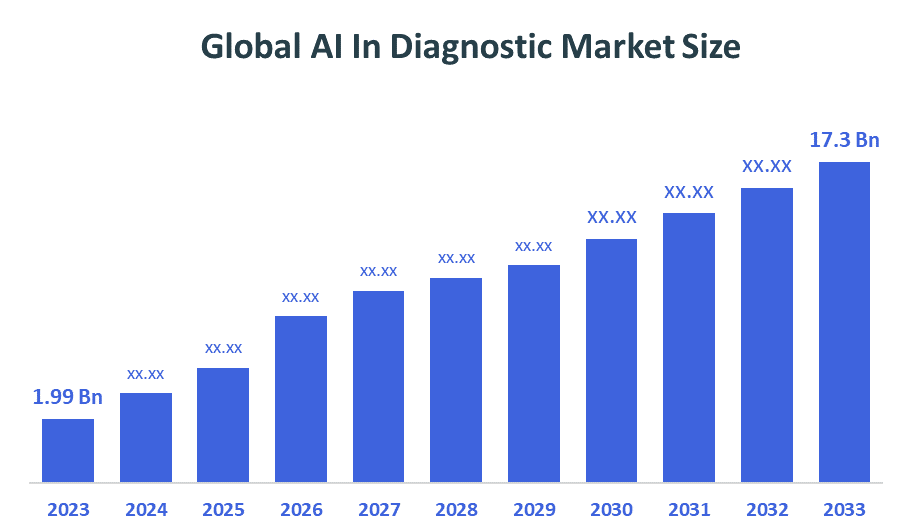
According to Decision Advisors, the global AI in diagnostic market Size is expected to grow from USD 1.99 billion in 2024 to USD 17.3 billion by 2035, at a CAGR of 21.3% during the forecast period 2025-2035. The global AI in diagnostic market is projected to expand significantly over the next decade, driven by the increasing adoption of AI-powered medical imaging, the rising prevalence of chronic diseases, and growing demand for early and accurate diagnosis. Advancements in deep learning algorithms, computer vision, and natural language processing are enhancing diagnostic precision across applications such as radiology, pathology, cardiology, and oncology. Additionally, the integration of AI with electronic health records (EHRs), the expansion of cloud-based healthcare platforms, the increasing use of predictive analytics, and rising healthcare expenditure are further accelerating market growth.
Market Overview/ Introduction
The AI in diagnostic market is referred to as a specialized branch of healthcare technology that uses digital brains. algorithms trained on millions of medical images and data points to help clinicians spot diseases like cancer, heart conditions, or neurological disorders earlier and more accurately than ever before. Rather than replacing doctors, this technology acts as a tireless, high-speed partner that can scan a massive MRI or a complex blood report in seconds, flagging tiny abnormalities that a human eye might miss during a long shift bur this technology resolves this problem. This market is driven by a massive advantage in AI’s ability to solve the data overload problem in modern medicine, reducing patient wait times and cutting down on diagnostic errors that can lead to costly, unnecessary treatments. Governments and industry giants are already laying the groundwork for this transformation. Public initiatives like the U.S. FDA’s streamlined clearance for AI devices and India’s AI mission are building the regulatory highways needed for these tools to reach hospitals safely. Meanwhile, tech leaders like Microsoft, NVIDIA, and GE HealthCare are moving beyond just making gadgets; they are creating entire AI ecosystems, where diagnostic software is built directly into hospital cloud systems and imaging machines. The scope of AI in diagnostics is moving from just identifying a disease to predicting it. The next frontier is multimodal AI systems that can look at your genetics, your lifestyle data from a wearable, and your clinical scans all at once to catch a health issue years before symptoms even appear. As we move toward this future, the goal remains deeply human, giving doctors more time to focus on their patients while the AI handles the heavy lifting of data analysis.
- In India, Ayushman Bharat Pradhan Mantri Jan Arogya Yojana supports the adoption of digital healthcare and AI-enabled diagnostic services by providing up to ?5 lakh annual health coverage for secondary and tertiary care at empanelled hospitals.
- China is investing heavily in AI healthcare under its national AI strategy, aiming to become a global leader in AI-powered diagnostics.
Notable Insights: -
- North America is anticipated to hold the largest share of the AI in diagnostic market over the predicted timeframe.
- Asia Pacific is expected to grow at a rapid CAGR in the AI in diagnostic market during the forecast period.
- By component, the software segment dominated the market in 2025 and is projected to grow at a substantial CAGR during the forecast period.
- By end user, the hospitals segment dominated the market in 2025, and is projected to grow at a substantial CAGR during the forecast period.
- The compound annual growth rate of the global spirit market is 21.3%.
- The market is likely to achieve a valuation of USD 17.3 billion by 2035.
What is role of technology in grooming the market?
Technology plays a transformative role in the metastatic NSCLC market by enabling precision diagnostics, personalized treatment, and improved patient outcomes. Advanced technologies such as next-generation sequencing (NGS) allow comprehensive genomic profiling, helping clinicians identify actionable mutations. Liquid biopsy techniques are gaining traction due to their non-invasive nature and ability to monitor tumor progression in real time. Artificial intelligence (AI) and machine learning are increasingly used in drug discovery, clinical trial optimization, and treatment planning, improving efficiency and reducing development timelines. Additionally, digital health platforms and telemedicine are enhancing patient monitoring and treatment adherence. These innovations collectively contribute to faster diagnosis, targeted treatment, and improved survival rates, driving overall market growth.
Market Drivers
The global AI in diagnostic market is driven by the rising prevalence of chronic diseases such as cancer, cardiovascular disorders, and neurological conditions, which have significantly increased the demand for early and accurate diagnosis. AI-powered diagnostic tools are increasingly being adopted across healthcare systems to improve clinical outcomes, reduce diagnostic errors, and enhance workflow efficiency. Technological advancements in machine learning, deep learning, and computer vision are enabling highly accurate image analysis in radiology, pathology, and cardiology. The growing integration of AI with electronic health records (EHRs) and cloud-based platforms is further supporting real-time data analysis and clinical decision-making. Major technology companies such as Google Health, Microsoft, and Siemens Healthineers are investing heavily in AI-driven diagnostic innovations, accelerating market growth.
Restrain
The AI in diagnostic market is restrained due to it faces several challenges that may hinder its expansion. One of the primary restraints is the high cost associated with the implementation and integration of AI technologies into existing healthcare systems, particularly in developing regions. Data privacy and security concerns also pose major challenges, as AI systems rely on large volumes of sensitive patient data.
Competitive Analysis:
The report offers the appropriate analysis of the key organizations/companies involved within the AI in diagnostic market, along with a comparative evaluation primarily based on their product of offering, business overviews, geographic presence, enterprise strategies, segment market share, and SWOT analysis. The report also provides an elaborative analysis focusing on the current news and developments of the companies, which includes product development, innovations, joint ventures, partnerships, mergers & acquisitions, strategic alliances, and others. This allows for the evaluation of the overall competition within the market.
Top Companies in Global AI In Diagnostic Market
- Siemens Healthineers
- GE Healthcare
- Philips Healthcare
- IBM Watson Health
- Aidoc
- PathAI
- Qure.ai
- Tempus
- Viz.ai
- AliveCor
Government Initiatives
|
Country |
Key Government Initiatives |
|
UK |
NHS AI Deployment Strategy: The UK has pioneered the adoption of circulating tumor DNA “blood-first” testing supported by the National Health Service. By integrating AI to accelerate mutation detection, the NHS reduces biopsy delays and drives demand for precision diagnostics, aiming to diagnose 75% of cancers at stage 1 or 2 by 2028. |
|
India |
IndiaAI Mission & ABDM: Launched with a budget of over $1.2 billion, this mission focuses on building high-quality healthcare datasets. By early 2026, the Ayushman Bharat Digital Mission (ABDM) will have enabled AI-driven diagnostic tools to be deployed in rural health centers, specifically targeting tuberculosis and diabetic retinopathy screening to bridge the doctor-patient gap |
|
Europe |
|
Market Segmentation
The AI in diagnostic market share is classified into component, application, and end user
- The software segment dominated the market in 2025 and is projected to grow at a substantial CAGR during the forecast period.
Based on the component, the AI in diagnostics market is divided into software, hardware, and services. Among these, the software segment dominated the market in 2025 and is projected to grow at a substantial CAGR during the forecast period. This dominance is attributed to the widespread adoption of AI-based algorithms and platforms used for medical imaging analysis, clinical decision support, and workflow optimisation. The increasing deployment of cloud-based AI solutions and continuous advancements in machine learning models have significantly driven demand, positioning software as the core component of AI in diagnostic systems.
- The medical imaging segment accounted for the largest share in 2025 and is anticipated to grow at a significant CAGR during the forecast period.
Based on the application, the AI in diagnostic market is divided into medical imaging, radiology, pathology, cardiology, oncology and others. Among these, the medical imaging segment accounted for the largest share in 2025, and is anticipated to grow at a significant CAGR during the forecast period. This is primarily due to the extensive use of AI in analysing CT scans, MRIs, and X-rays for early and accurate disease detection. AI-powered imaging solutions enhance diagnostic precision, reduce interpretation time, and support clinicians in identifying complex conditions such as cancer, neurological disorders, and cardiovascular diseases.
- The hospitals segment dominated the market in 2025, and is projected to grow at a substantial CAGR during the forecast period.
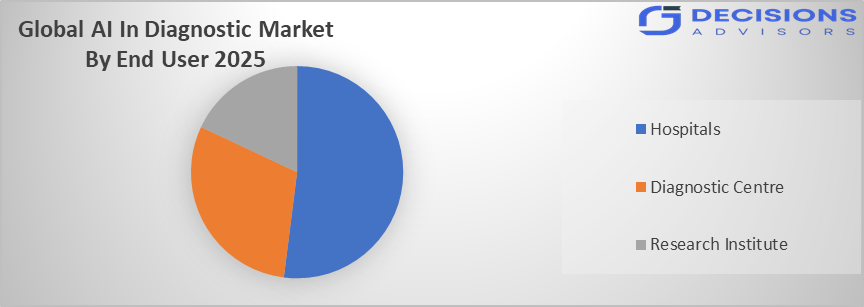
Based on the end user, the AI in diagnostic market is divided into hospitals, diagnostic centers and research institutes. Among these, the hospitals segment dominated the market in 2025, and is projected to grow at a substantial CAGR during the forecast period. This dominance is driven by the availability of advanced healthcare infrastructure, higher adoption of AI-integrated diagnostic tools, and access to large patient datasets required for AI model training and deployment. Hospitals serve as primary centers for implementing AI solutions across radiology, pathology, and clinical workflows, thereby driving higher utilization and supporting sustained market growth.
Strategies to Implement for Growth of the Market in Non-Leading Regions
Growth in non-leading regions can be accelerated through strategic investments in healthcare infrastructure, improved access to diagnostic technologies, and expansion of AI-enabled healthcare services. Companies can enhance market penetration by introducing cost-effective and cloud-based AI solutions, making advanced diagnostics more accessible in emerging markets. Strengthening digital health infrastructure, including electronic health records (EHRs) and data interoperability systems, is critical to support AI integration. Expanding diagnostic centres, hospitals, and telemedicine services can further improve patient access to AI-powered diagnostics. Additionally, collaborations with local governments, healthcare providers, and research institutions can support awareness programs, early disease detection initiatives, and faster adoption of AI technologies. Strategic partnerships can also help streamline regulatory approvals and reimbursement frameworks, accelerating market growth in developing regions.
Regional Segment Analysis of the AI In Diagnostic Market
- North America (U.S., Canada, Mexico)
- Europe (Germany, France, U.K., Italy, Spain, Rest of Europe)
- Asia-Pacific (China, Japan, India, Rest of APAC)
- South America (Brazil and the Rest of South America)
- The Middle East and Africa (UAE, South Africa, Rest of MEA)
North America is anticipated to hold the largest share of the AI in diagnostic market over the predicted timeframe.
North America is anticipated to hold the largest share of the AI in diagnostic market over the predicted timeframe. The dominance of this region is primarily driven by the strong presence of advanced healthcare infrastructure, high adoption of artificial intelligence technologies, and significant investments in digital health. The region benefits from the presence of leading technology and healthcare companies such as Google Health, Microsoft, and GE HealthCare, which are continuously innovating AI-based diagnostic solutions. Additionally, regulatory support from the U.S. Food and Drug Administration, which has approved a growing number of AI-enabled medical devices, is accelerating adoption. Rising prevalence of chronic diseases, increasing demand for early diagnosis, and widespread integration of AI in radiology and clinical workflows are further supporting regional market growth.
Asia Pacific is expected to grow at a rapid CAGR in the AI in diagnostic market during the forecast period.
Asia Pacific is expected to grow at a rapid CAGR in the AI in diagnostic market during the forecast period. This growth is driven by the expanding healthcare infrastructure, large patient population, and increasing government initiatives supporting digital health transformation in countries such as China, India, and Japan. The rising burden of chronic diseases, including cancer and cardiovascular disorders, is creating strong demand for AI-powered diagnostic solutions. Governments are actively promoting AI adoption through national strategies and investments, while the growing penetration of cloud computing and digital health platforms is enabling scalable deployment of AI in diagnostic tools. Additionally, increasing collaborations between local healthcare providers and global technology firms are accelerating innovation and market expansion across the region.
Europe is the 3rd largest region to grow in the AI in diagnostic market during the region.
Europe is the third-largest region in the AI in diagnostic market, supported by well-established healthcare systems and strong research capabilities in artificial intelligence and medical technologies. Key countries such as Germany, France, and the United Kingdom play a significant role in driving regional growth. The region is witnessing increasing adoption of AI in medical imaging, pathology, and clinical decision support systems. Regulatory support from organizations such as the European Medicines Agency and growing investments in digital healthcare infrastructure are further contributing to market expansion. Additionally, rising focus on early disease detection and precision medicine is enhancing the adoption of AI-based diagnostic solutions across Europe.
Future Market Trends in Global AI in the Diagnostic Market: -
1. Rapid Growth of AI-Powered Medical Imaging and Automation
AI-driven medical imaging is emerging as the most dominant trend in the AI in diagnostic market. Advanced deep learning algorithms are increasingly being used to analyze X-rays, CT scans, MRIs, and pathology slides with high accuracy and speed. These solutions significantly reduce diagnostic time and human error while improving clinical outcomes. The growing adoption of AI in radiology and imaging workflows is expected to remain a key driver, as healthcare providers seek to enhance efficiency and address the shortage of skilled professionals.
2. Shift Toward Predictive, Preventive, and Personalized Diagnostics
The market is witnessing a strong transition from reactive diagnosis to predictive and preventive healthcare. AI technologies are enabling early disease detection by analyzing large datasets and identifying patterns before symptoms appear. This shift supports personalized treatment planning and improves patient outcomes. Additionally, AI is increasingly being used for risk prediction, disease progression monitoring, and precision medicine, making healthcare more proactive and patient-centric.
3. Integration of AI with Cloud, Telemedicine, and Digital Health Ecosystems
The integration of AI in diagnostic with cloud computing, telemedicine platforms, and electronic health records (EHRs) is transforming healthcare delivery. Cloud-based AI solutions enable real-time diagnostics, remote patient monitoring, and scalable deployment across healthcare systems. The growing adoption of telehealth and digital platforms is further expanding access to AI-powered diagnostics, particularly in remote and underserved areas. This trend is supported by increasing investments, startup innovations, and the expansion of digital health infrastructure globally.
Recent Development
In March 2026, Perimeter Medical Imaging AI received approval from the U.S. Food and Drug Administration for its AI-enabled imaging device “Claire,” designed for breast cancer surgery, which demonstrated improved detection of residual tumors and enhanced surgical outcomes.
In February 2026, the FDA launched the Technology-Enabled Meaningful Patient Outcomes (TEMPO) pilot program to accelerate access to digital health and AI-based diagnostic devices while ensuring safety and regulatory compliance.
In December 2025, the U.S. Food and Drug Administration reported a significant rise in AI-enabled medical device approvals, with over 295 AI/ML-based devices cleared in a single year, highlighting rapid adoption of AI in diagnostics and medical imaging.
How is Recent Developments Helping the Market?
Recent developments are significantly accelerating the growth of AI in diagnostic market by enhancing accuracy, efficiency, and accessibility of healthcare services. The increasing number of regulatory approvals for AI-enabled medical devices is validating the clinical reliability of AI technologies and encouraging wider adoption among healthcare providers. The fact that hundreds of AI devices are now approved and widely used indicates a shift from experimental use to real-world clinical implementation. Advancements in AI-powered imaging and diagnostic tools are improving early disease detection and reducing diagnostic errors, which directly contributes to better patient outcomes. For instance, AI systems are now capable of identifying complex conditions with higher precision and speed, supporting clinicians in making informed decisions and reducing workload pressure. Government initiatives and pilot programs, such as those introduced by the U.S. Food and Drug Administration, are streamlining regulatory pathways and promoting innovation while ensuring patient safety. These initiatives are also encouraging investments from both public and private sectors, further strengthening the market ecosystem.
Market Segment
This study forecasts revenue at global, regional, and country levels from 2020 to 2035. Decision Advisors has segmented the AI in the diagnostic market based on the below-mentioned segments:
Global AI In Diagnostic Market, By Component
- Software
- Hardware
- Services
Global AI In Diagnostic Market, By Application
- Medical Imaging
- Pathology
- Radiology
- Cardiology
- Oncology
- Others
Global AI In Diagnostic Market, By End User
- Hospitals
- Diagnostic Centers
- Research Institutes
Global AI In Diagnostic Market, By Regional Analysis
- North America
- US
- Canada
- Mexico
- Europe
- Germany
- UK
- France
- Italy
- Spain
- Russia
- Rest of Europe
- Asia Pacific
- China
- Japan
- India
- South Korea
- Australia
- Rest of Asia Pacific
- South America
- Brazil
- Argentina
- Rest of South America
- Middle East & Africa
- UAE
- Saudi Arabia
- Qatar
- South Africa
- Rest of the Middle East & Africa
Frequently Asked Questions (FAQ)
Q. How does AI in diagnostics handle data bias and ensure fair outcomes across different patient populations?
A.AI models can sometimes reflect biases present in training data. To address this, companies and healthcare providers are focusing on diverse datasets, continuous model validation, and regulatory guidelines to ensure fair and unbiased diagnostic outcomes across different demographics.
Q. What role does explainable AI (XAI) play in diagnostic decision-making?
A.Explainable AI helps clinicians understand how AI models arrive at specific conclusions, increasing transparency and trust. This is crucial in healthcare settings where accountability and interpretability are essential for clinical adoption.
Q3. How is AI in diagnostics integrated into existing hospital IT systems?
A.AI in diagnostic solutions are integrated with hospital systems such as electronic health records (EHRs) and Picture Archiving and Communication Systems (PACS), enabling seamless data flow, real-time analysis, and improved clinical workflow efficiency.
Q4. What are the reimbursement challenges for AI-based diagnostic solutions?
A.Reimbursement policies for AI diagnostics are still evolving. In many regions, a lack of standardised reimbursement frameworks can limit adoption, although governments and insurers are gradually introducing coverage for AI-assisted procedures.
Q5. How will generative AI impact the future of diagnostics?
A.Generative AI is expected to enhance diagnostics by summarizing patient data, generating clinical reports, and assisting in complex case analysis. It can improve efficiency, reduce administrative burden, and support faster clinical decision-making.
- Introduction
- Objectives of the Study
- Market Definition
- Research Scope
- Research Methodology and Assumptions
- Executive Summary
- Premium Insights
- Porter’s Five Forces Analysis
- Value Chain Analysis
- Top Investment Pockets
- Market Attractiveness Analysis By Component
- Market Attractiveness Analysis By Application
- Market Attractiveness Analysis By End User
- Market Attractiveness Analysis By Region
- Industry Trends
- Market Dynamics
- Market Evaluation
- Drivers
- Rising demand for accurate and early disease diagnosis
- Restraints
- Strict regulatory and data privacy concerns
- Opportunities
- Expansion of precision medicine and telemedicine
- Challenges
5.5.1. Integration and trust issues in healthcare systems
- Global AI In Diagnostic Market Analysis and Projection, By Component
- Segment Overview
- Software
- Hardware
- Services
- Global AI In Diagnostic Market Analysis and Projection, By Application
- Segment Overview
- Medical Imaging
- Pathology
- Radiology
- Cardiology
- Oncology
- Others
- Global AI In Diagnostic Market Analysis and Projection, By End User
- Segment Overview
- Hospitals
- Diagnostic Centers
- Research Institutes
- Global AI In Diagnostic Market Analysis and Projection, By Regional Analysis
- Segment Overview
- North America
- U.S.
- Canada
- Mexico
- Europe
- Germany
- France
- U.K.
- Italy
- Spain
- Asia-Pacific
- Japan
- China
- India
- South America
- Brazil
- Middle East and Africa
- UAE
- South Africa
- Global AI In Diagnostic Market-Competitive Landscape
- Overview
- Market Share of Key Players in the AI In Diagnostic Market
- Global Company Market Share
- North America Company Market Share
- Europe Company Market Share
- APAC Company Market Share
- Competitive Situations and Trends
- Coverage Launches and Developments
- Partnerships, Collaborations, and Agreements
- Mergers & Acquisitions
- Expansions
- Company Profiles
- Siemens Healthineers
- Business Overview
- Company Snapshot
- Company Market Share Analysis
- Company Coverage Portfolio
- Recent Developments
- SWOT Analysis
- GE Healthcare
- Business Overview
- Company Snapshot
- Company Market Share Analysis
- Company Coverage Portfolio
- Recent Developments
- SWOT Analysis
- Philips Healthcare
- Business Overview
- Company Snapshot
- Company Market Share Analysis
- Company Coverage Portfolio
- Recent Developments
- SWOT Analysis
- IBM Watson Health
- Business Overview
- Company Snapshot
- Company Market Share Analysis
- Company Coverage Portfolio
- Recent Developments
- SWOT Analysis
- Aidoc
- Business Overview
- Company Snapshot
- Company Market Share Analysis
- Company Coverage Portfolio
- Recent Developments
- SWOT Analysis
- PathAI
- Business Overview
- Company Snapshot
- Company Market Share Analysis
- Company Coverage Portfolio
- Recent Developments
- SWOT Analysis
- Qure.ai
- Business Overview
- Company Snapshot
- Company Market Share Analysis
- Company Coverage Portfolio
- Recent Developments
- SWOT Analysis
- Tempus
- Business Overview
- Company Snapshot
- Company Market Share Analysis
- Company Coverage Portfolio
- Recent Developments
- SWOT Analysis
- Viz.ai
- Business Overview
- Company Snapshot
- Company Market Share Analysis
- Company Coverage Portfolio
- Recent Developments
- SWOT Analysis
- AliveCor
- Business Overview
- Company Snapshot
- Company Market Share Analysis
- Company Coverage Portfolio
- Recent Developments
- SWOT Analysis
- Siemens Healthineers
List of Table
- Global AI In Diagnostic Market, By Component, 2024-2035(USD Billion)
- Global Software, AI In Diagnostic Market, By Region, 2024-2035(USD Billion)
- Global Hardware, AI In Diagnostic Market, By Region, 2024-2035(USD Billion)
- Global Services, AI In Diagnostic Market, By Region, 2024-2035(USD Billion)
- Global AI In Diagnostic Market, By Application, 2024-2035(USD Billion)
- Global Medical Imaging, AI In Diagnostic Market, By Region, 2024-2035(USD Billion)
- Global Pathology, AI In Diagnostic Market, By Region, 2024-2035(USD Billion)
- Global Radiology, AI In Diagnostic Market, By Region, 2024-2035(USD Billion)
- Global Cardiology, AI In Diagnostic Market, By Region, 2024-2035(USD Billion)
- Global Oncology, AI In Diagnostic Market, By Region, 2024-2035(USD Billion)
- Global AI In Diagnostic Market, By End User, 2024-2035(USD Billion)
- Global Hospitals, AI In Diagnostic Market, By Region, 2024-2035(USD Billion)
- Global Diagnostic Centers, AI In Diagnostic Market, By Region, 2024-2035(USD Billion)
- Global Research Institutes, AI In Diagnostic Market, By Region, 2024-2035(USD Billion)
- North America AI In Diagnostic Market, By Component, 2024-2035(USD Billion)
- North America AI In Diagnostic Market, By Application, 2024-2035(USD Billion)
- North America AI In Diagnostic Market, By End User, 2024-2035(USD Billion)
- U.S. AI In Diagnostic Market, By Component, 2024-2035(USD Billion)
- U.S. AI In Diagnostic Market, By Application, 2024-2035(USD Billion)
- U.S. AI In Diagnostic Market, By End User, 2024-2035(USD Billion)
- Canada AI In Diagnostic Market, By Component, 2024-2035(USD Billion)
- Canada AI In Diagnostic Market, By Application, 2024-2035(USD Billion)
- Canada AI In Diagnostic Market, By End User, 2024-2035(USD Billion)
- Mexico AI In Diagnostic Market, By Component, 2024-2035(USD Billion)
- Mexico AI In Diagnostic Market, By Application, 2024-2035(USD Billion)
- Mexico AI In Diagnostic Market, By End User, 2024-2035(USD Billion)
- Europe AI In Diagnostic Market, By Component, 2024-2035(USD Billion)
- Europe AI In Diagnostic Market, By Application, 2024-2035(USD Billion)
- Europe AI In Diagnostic Market, By End User, 2024-2035(USD Billion)
- Germany AI In Diagnostic Market, By Component, 2024-2035(USD Billion)
- Germany AI In Diagnostic Market, By Application, 2024-2035(USD Billion)
- Germany AI In Diagnostic Market, By End User, 2024-2035(USD Billion)
- France AI In Diagnostic Market, By Component, 2024-2035(USD Billion)
- France AI In Diagnostic Market, By Application, 2024-2035(USD Billion)
- France AI In Diagnostic Market, By End User, 2024-2035(USD Billion)
- U.K. AI In Diagnostic Market, By Component, 2024-2035(USD Billion)
- U.K. AI In Diagnostic Market, By Application, 2024-2035(USD Billion)
- U.K. AI In Diagnostic Market, By End User, 2024-2035(USD Billion)
- Italy AI In Diagnostic Market, By Component, 2024-2035(USD Billion)
- Italy AI In Diagnostic Market, By Application, 2024-2035(USD Billion)
- Italy AI In Diagnostic Market, By End User, 2024-2035(USD Billion)
- Spain AI In Diagnostic Market, By Component, 2024-2035(USD Billion)
- Spain AI In Diagnostic Market, By Application, 2024-2035(USD Billion)
- Spain AI In Diagnostic Market, By End User, 2024-2035(USD Billion)
- Asia Pacific AI In Diagnostic Market, By Component, 2024-2035(USD Billion)
- Asia Pacific AI In Diagnostic Market, By Application, 2024-2035(USD Billion)
- Asia Pacific AI In Diagnostic Market, By End User, 2024-2035(USD Billion)
- Japan AI In Diagnostic Market, By Component, 2024-2035(USD Billion)
- Japan AI In Diagnostic Market, By Application, 2024-2035(USD Billion)
- Japan AI In Diagnostic Market, By End User, 2024-2035(USD Billion)
- China AI In Diagnostic Market, By Component, 2024-2035(USD Billion)
- China AI In Diagnostic Market, By Application, 2024-2035(USD Billion)
- China AI In Diagnostic Market, By End User, 2024-2035(USD Billion)
- India AI In Diagnostic Market, By Component, 2024-2035(USD Billion)
- India AI In Diagnostic Market, By Application, 2024-2035(USD Billion)
- India AI In Diagnostic Market, By End User, 2024-2035(USD Billion)
- South America AI In Diagnostic Market, By Component, 2024-2035(USD Billion)
- South America AI In Diagnostic Market, By Application, 2024-2035(USD Billion)
- South America AI In Diagnostic Market, By End User, 2024-2035(USD Billion)
- Brazil AI In Diagnostic Market, By Component, 2024-2035(USD Billion)
- Brazil AI In Diagnostic Market, By Application, 2024-2035(USD Billion)
- Brazil AI In Diagnostic Market, By End User, 2024-2035(USD Billion)
- The Middle East and Africa AI In Diagnostic Market, By Component, 2024-2035(USD Billion)
- The Middle East and Africa AI In Diagnostic Market, By Application, 2024-2035(USD Billion)
- The Middle East and Africa AI In Diagnostic Market, By End User, 2024-2035(USD Billion)
- UAE AI In Diagnostic Market, By Component, 2024-2035(USD Billion)
- UAE AI In Diagnostic Market, By Application, 2024-2035(USD Billion)
- UAE AI In Diagnostic Market, By End User, 2024-2035(USD Billion)
- South Africa AI In Diagnostic Market, By Component, 2024-2035(USD Billion)
- South Africa AI In Diagnostic Market, By Application, 2024-2035(USD Billion)
- South Africa AI In Diagnostic Market, By End User, 2024-2035(USD Billion)
List of Figures
- Global AI In Diagnostic Market Segmentation
- AI In Diagnostic Market: Research Methodology
- Market Size Estimation Methodology: Bottom-Up Approach
- Market Size Estimation Methodology: Top-down Approach
- Data Triangulation
- Porter’s Five Forces Analysis
- Value Chain Analysis
- Top investment pocket in the AI In Diagnostic Market
- Top Winning Strategies, 2024-2035
- Top Winning Strategies, By Development, 2024-2035(%)
- Top Winning Strategies, By Company, 2024-2035
- Moderate Bargaining power of Buyers
- Moderate Bargaining power of Suppliers
- Moderate Bargaining power of New Entrants
- Low threat of Substitution
- High Competitive Rivalry
- Top Player Positioning, 2024
- Market Share Analysis, 2024
- Restraint and Drivers: AI In Diagnostic Market
- AI In Diagnostic Market Segmentation, By Component
- AI In Diagnostic Market For Software, By Region, 2024-2035 ($ Billion)
- AI In Diagnostic Market For Hardware, By Region, 2024-2035 ($ Billion)
- AI In Diagnostic Market For Services, By Region, 2024-2035 ($ Billion)
- AI In Diagnostic Market Segmentation, By Application
- AI In Diagnostic Market For Medical Imaging, By Region, 2024-2035 ($ Billion)
- AI In Diagnostic Market For Pathology, By Region, 2024-2035 ($ Billion)
- AI In Diagnostic Market For Radiology, By Region, 2024-2035 ($ Billion)
- AI In Diagnostic Market For Cardiology, By Region, 2024-2035 ($ Billion)
- AI In Diagnostic Market For Oncology, By Region, 2024-2035 ($ Billion)
- AI In Diagnostic Market Segmentation, By End User
- AI In Diagnostic Market For Hospitals, By Region, 2024-2035 ($ Billion)
- AI In Diagnostic Market For Diagnostic Centers, By Region, 2024-2035 ($ Billion)
- AI In Diagnostic Market For Research Institutes, By Region, 2024-2035 ($ Billion)
- Siemens Healthineers: Net Sales, 2024-2035 ($ Billion)
- Siemens Healthineers: Revenue Share, By Segment, 2024 (%)
- Siemens Healthineers: Revenue Share, By Region, 2024 (%)
- GE Healthcare: Net Sales, 2024-2035 ($ Billion)
- GE Healthcare: Revenue Share, By Segment, 2024 (%)
- GE Healthcare: Revenue Share, By Region, 2024 (%)
- Philips Healthcare: Net Sales, 2024-2035 ($ Billion)
- Philips Healthcare: Revenue Share, By Segment, 2024 (%)
- Philips Healthcare: Revenue Share, By Region, 2024 (%)
- IBM Watson Health: Net Sales, 2024-2035 ($ Billion)
- IBM Watson Health: Revenue Share, By Segment, 2024 (%)
- IBM Watson Health: Revenue Share, By Region, 2024 (%)
- Aidoc: Net Sales, 2024-2035 ($ Billion)
- Aidoc: Revenue Share, By Segment, 2024 (%)
- Aidoc: Revenue Share, By Region, 2024 (%)
- PathAI: Net Sales, 2024-2035 ($ Billion)
- PathAI: Revenue Share, By Segment, 2024 (%)
- PathAI: Revenue Share, By Region, 2024 (%)
- Qure.ai: Net Sales, 2024-2035 ($ Billion)
- Qure.ai: Revenue Share, By Segment, 2024 (%)
- Qure.ai: Revenue Share, By Region, 2024 (%)
- Tempus: Net Sales, 2024-2035 ($ Billion)
- Tempus: Revenue Share, By Segment, 2024 (%)
- Tempus: Revenue Share, By Region, 2024 (%)
- Viz.ai.: Net Sales, 2024-2035 ($ Billion)
- Viz.ai.: Revenue Share, By Segment, 2024 (%)
- Viz.ai.: Revenue Share, By Region, 2024 (%)
- AliveCor: Net Sales, 2024-2035 ($ Billion)
- AliveCor: Revenue Share, By Segment, 2024 (%)
- AliveCor: Revenue Share, By Region, 2024 (%)
Check Licence
Choose the plan that fits you best: Single User, Multi-User, or Enterprise solutions tailored for your needs.
We Have You Covered
- 24/7 Analyst Support
- Clients Across the Globe
- Tailored Insights
- Technology Tracking
- Competitive Intelligence
- Custom Research
- Syndicated Market Studies
- Market Overview
- Market Segmentation
- Growth Drivers
- Market Opportunities
- Regulatory Insights
- Innovation & Sustainability
Report Details
| Scope | Global |
| Pages | 245 |
| Delivery | PDF & Excel via Email |
| Language | English |
| Release | Mar 2026 |
| Access | Download from this page |