
Global Air Circuit Breaker Market
 |
Author:
Mayuri S
|
Pages:
245
|
Author:
Mayuri S
|
Pages:
245
Global Air Circuit Breaker Market Size, Share By Type (Air Blast Circuit Breaker and Plain Air Circuit Breaker), By Voltage (Low Voltage and Medium Voltage), By End User (Utility, Industrial, Commercial, and Others) and By Region (North America, Europe, Asia-Pacific, Latin America, Middle East & Africa), Analysis and Forecast 2026-2035
CAGR
6.74%
REVENUE 2025
USD Billion 3.72
FORECAST 2035
USD Billion 7.14
REPORT COVERAGE
Global
Market Snapshot
- Global Air Circuit Breaker Market Size (2025): USD 3.72 Billion
- Projected Global Air Circuit Breaker Market Size (2035): USD 7.14 Billion
- Global Air Circuit Breaker Market Compound Annual Growth Rate (CAGR): 6.74%
- Largest Regional Market: Asia Pacific
- 2nd Largest Region: North America
- Fastest Growing Region: Europe
- Base Year: 2025
- Historical Period: 2021–2024
- Market Forecast Period: 2026–2035
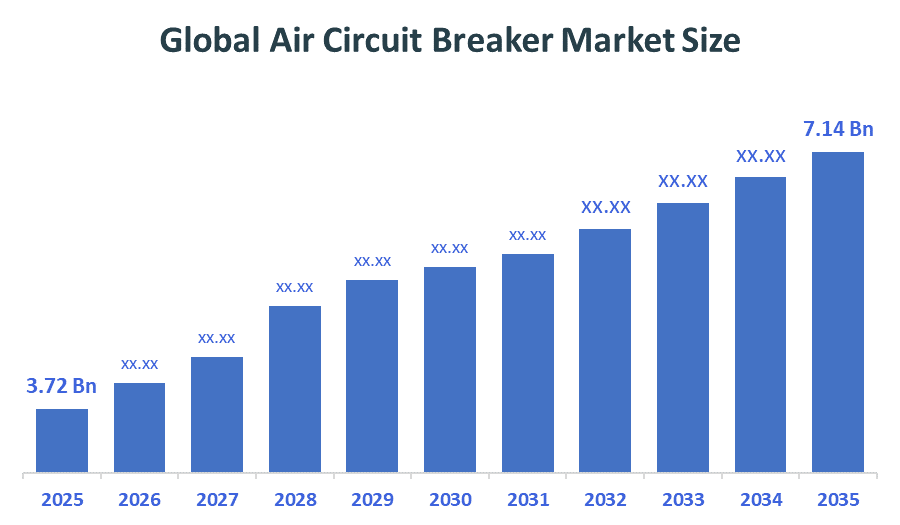
According to Decision Advisors, the Global Air Circuit Breaker Market Size is expected to grow from USD 3.72 Billion in 2025 to USD 7.14 Billion by 2035, at a CAGR of 6.74% during the forecast period 2026-2035. The Global Air Circuit Breaker Market growth is driven by increasing electricity demand, expansion of power distribution infrastructure, industrialization, and rising investments in grid modernization and renewable energy integration.
Market Overview/ Introduction
The Global Air Circuit Breaker Market includes electrical protection devices that serve to break and isolate electrical circuits during fault incidents, which include overloads, short circuits, and ground faults. Air circuit breakers (ACBs) serve as the main equipment for low- and medium-voltage power distribution networks, which industrial plants, commercial buildings, utility companies, and infrastructure projects use. The market experiences consistent growth because of rising electrification rates, fast urban development, and global industrial and commercial facility expansion. The demand for advanced circuit protection solutions is increasing because governments and utilities are making large investments in smart grids and renewable energy integration and constructing dependable power distribution networks. ACB adoption is increasing because organizations are moving toward energy-efficient systems which use digital monitoring technologies.
Notable Insights: -
- Asia Pacific is anticipated to hold approximately 32% share of the global air circuit breaker market over the predicted timeframe.
- North America is expected to grow at a rapid CAGR in the air circuit breaker market by holding approximately 34% of the share during the forecast period.
- By type, the plain air circuit breaker segment dominated the market and holds approximately 68% share in 2025 and is projected to grow at a substantial CAGR during the forecast period.
- By voltage, the low voltage segment dominated the market and holds approximately 64% share in 2025 and is projected to grow at a substantial CAGR during the forecast period.
- The compound annual growth rate of the Global Air Circuit Breaker Market is 6.74%.
- The market is likely to achieve a valuation of USD 7.14 Billion by 2035.
What is the role of technology in grooming the market?
The Global Air Circuit Breaker market is experiencing steady growth, driven by rising electricity demand, rapid industrialization, and increasing investments in power distribution infrastructure. Air circuit breakers are essential for protecting electrical systems in industrial, commercial, and utility applications, particularly in low-voltage networks. The growing adoption of smart grids and renewable energy sources is further accelerating demand for advanced, intelligent circuit protection systems. Technological advancements such as IoT-enabled monitoring, predictive maintenance, and digital trip units are enhancing operational efficiency and reliability. Additionally, expanding urban infrastructure and stricter safety regulations are supporting market expansion across both developed and emerging economies.
Market Drivers
The Global Air Circuit Breaker Market experiences growth because worldwide electricity usage increases and power grid development projects receive greater financial backing. The electricity demand of the entire world has been increasing at a rate of 3-4% each year which creates a requirement for dependable systems that protect circuits. The Asia-Pacific region experiences rising demand for low-voltage distribution systems because industrialization and urbanization occur at a rapid pace. The deployment of renewable energy sources which includes solar and wind energy requires advanced protection systems to handle changing power demands. The growing use of smart grids together with digital substations drives an increased need for intelligent ACBs.
Restrain
The global air circuit breaker market faces challenges due to high installation and maintenance costs, particularly for advanced and smart ACB systems. Retrofitting existing electrical infrastructure requires significant capital investment, limiting adoption in cost-sensitive regions. Additionally, competition from alternative technologies such as vacuum circuit breakers and molded case circuit breakers restricts market penetration in certain applications. Technical complexity, along with the need for skilled personnel for installation and maintenance, further acts as a barrier to widespread adoption.
Competitive Analysis:
The report offers the appropriate analysis of the key organizations/companies involved within the global air circuit breaker market, along with a comparative evaluation primarily based on their product of offering, business overviews, geographic presence, enterprise strategies, segment market share, and SWOT analysis. The report also provides an elaborative analysis focusing on the current news and developments of the companies, which includes product development, innovations, joint ventures, partnerships, mergers & acquisitions, strategic alliances, and others. This allows for the evaluation of the overall competition within the market.
Top Companies in the Global Air Circuit Breaker Market
- Schneider Electric
- Siemens AG
- ABB Ltd.
- Eaton Corporation
- Mitsubishi Electric
- General Electric
- Fuji Electric
- Larsen & Toubro
- Legrand
- Hyundai Electric
Government Initiatives
|
Country |
Key Government Initiatives |
|
US |
Data center and industrial expansion are increasing electricity demand, driving the need for reliable circuit protection systems. In 2024, the U.S. Department of Energy announced $2.2 billion to strengthen grid infrastructure. |
|
UK |
Net-zero mandates in the UK are accelerating grid modernization and renewable energy integration, increasing the need for advanced electrical infrastructure and reliable circuit protection systems, thereby supporting growth in the air circuit breaker market. |
|
China |
China’s investments in smart grid infrastructure under its new infrastructure strategy are accelerating demand for advanced electrical equipment. The transition toward digital, automated power systems requires intelligent circuit protection solutions to support efficient and reliable grid operations. |
Study on the Supply, Demand, Distribution, and Market Environment of the Air Circuit Breaker Market
Demand for air circuit breakers is driven by expanding industrial infrastructure, rapid commercial real estate development, and ongoing upgrades in power distribution networks. Increasing electricity consumption and the need for reliable circuit protection further support demand across utilities and industrial sectors. Supply is led by global electrical equipment manufacturers focusing on technologically advanced, energy-efficient, and smart-enabled products. Distribution channels include direct sales, EPC contractors, and authorized distributors, ensuring wide market reach. The growing adoption of smart grids, digital substations, and automation technologies is strengthening the overall market environment, particularly across emerging economies and developing infrastructure markets.
Price Analysis and Consumer Behaviour Analysis
Air circuit breaker pricing varies significantly depending on voltage rating, current capacity, and technological features such as digital trip units and remote monitoring. Industrial air circuit breakers typically range from ?22,000 to over ?5,00,000 in India, while globally prices can exceed $9,000 for high-capacity units. Low-voltage ACBs dominate adoption due to cost-efficiency and widespread use in commercial and industrial systems. End-users prioritize reliability, lifecycle cost, and compliance with safety standards. Despite higher upfront costs, smart ACBs with IoT-based monitoring are increasingly preferred, as they can reduce maintenance costs by 10–20% over the lifecycle through predictive maintenance and improved operational efficiency.
Market Segmentation
The Global Air Circuit Breaker Market share is classified into type, application and propulsion.
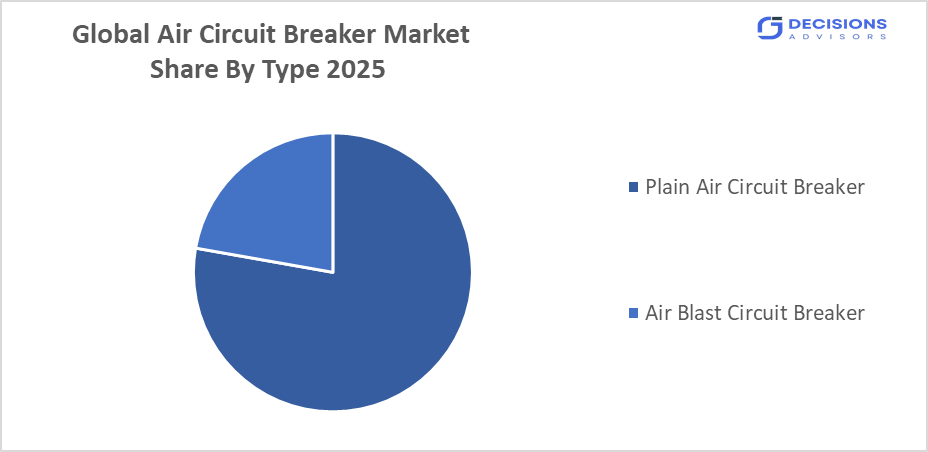
- The plain air circuit breaker segment dominated the market and holds approximately 68% share in 2025 and is projected to grow at a substantial CAGR during the forecast period.
Based on the type, the global air circuit breaker market is divided into air blast circuit breaker and plain air circuit breaker. Among these, the plain air circuit breaker segment dominated the market and holds approximately 68% share in 2025 and is projected to grow at a substantial CAGR during the forecast period. This dominance is due to their widespread use in low-voltage industrial and commercial power distribution systems, which account for the largest demand globally. They are cost-effective, easy to maintain, and highly reliable. In contrast, air blast circuit breakers are limited to high-voltage applications and are increasingly replaced by advanced technologies.
- The low voltage segment accounted for the largest share of approximately 64% in 2025 and is anticipated to grow at a significant CAGR during the forecast period.
Based on the voltage, the global air circuit breaker market is divided into low voltage and medium voltage. Among these, the low voltage segment accounted for the largest share of approximately 64% in 2025 and is anticipated to grow at a significant CAGR during the forecast period. This dominance is driven by widespread deployment in industrial facilities, commercial buildings, data centers, and infrastructure, where low-voltage power distribution systems are most common. Medium voltage ACBs have comparatively limited applications and lower installation volumes.
- The industrial segment accounted for the largest share of approximately 44% in 2025 and is anticipated to grow at a significant CAGR during the forecast period.
Based on the end user, the global air circuit breaker market is divided into utility, industrial, commercial, and others. Among these, the industrial segment accounted for the largest share of approximately 44% in 2025 and is anticipated to grow at a significant CAGR during the forecast period. This dominance is driven by high power consumption across manufacturing, oil & gas, mining, and heavy industries, where reliable circuit protection is critical. Continuous operations, safety requirements, and increasing automation further boost demand for air circuit breakers in industrial applications compared to utility and commercial sectors.
Strategies to Implement for Growth of the Market in Non-Leading Regions
Growth in non-leading regions can be driven by investing in cost-effective power distribution infrastructure and promoting localized manufacturing to reduce equipment costs. Governments should implement supportive policies, subsidies, and incentives to encourage adoption of advanced electrical protection systems. Expanding rural electrification and industrialization initiatives will further increase demand. Strategic partnerships with EPC contractors and utilities can improve market penetration. Additionally, training programs to develop skilled technical workforce and awareness campaigns on electrical safety and efficiency will support adoption. Integrating smart grid technologies and digital monitoring solutions can enhance reliability, attracting investments and accelerating market growth in emerging regions.
Regional Segment Analysis of the Air Circuit Breaker Market
- North America (U.S., Canada, Mexico)?
- Europe (Germany, France, U.K., Italy, Spain, Rest of Europe)
- Asia-Pacific (China, Japan, India, Rest of APAC)
- South America (Brazil and the Rest of South America)?
- The Middle East and Africa (UAE, South Africa, Rest of MEA)
Asia Pacific is anticipated to hold approximately 32% share of the global air circuit breaker market over the predicted timeframe.
Asia Pacific is anticipated to account for approximately 32% of the global air circuit breaker (ACB) market over the forecast period, driven by rapid industrialization, urban infrastructure expansion, and rising electricity demand. Countries such as China, India, and Japan are investing heavily in power generation, smart grid development, and industrial automation, significantly boosting ACB adoption. Additionally, increasing renewable energy integration and government initiatives for grid modernization further support market growth. The presence of major electrical equipment manufacturers and ongoing expansion of commercial and residential construction projects also contribute to the region’s strong market position.
North America is expected to grow at a rapid CAGR in the air circuit breaker market by holding approximately 34% of the share during the forecast period
North America is expected to grow at a rapid CAGR in the air circuit breaker (ACB) market, accounting for approximately 34% share during the forecast period. Growth is driven by strong investments in grid modernization, aging electrical infrastructure replacement, and increasing adoption of smart grid technologies. The United States and Canada are focusing on enhancing power reliability and integrating renewable energy sources, which increases demand for advanced ACB systems. Additionally, expansion of data centers, commercial facilities, and industrial automation further accelerates market growth. Strict safety regulations and the presence of established electrical equipment manufacturers also support sustained regional demand.
Europe is the fastest-growing region in the air circuit breaker market during the period, holding approximately 28% share.
Europe is the fastest-growing region in the air circuit breaker (ACB) market, holding approximately 28% share during the forecast period. Growth is driven by strong emphasis on energy efficiency, grid modernization, and rapid integration of renewable energy sources across countries such as Germany, France, and the UK. Increasing investments in smart grid infrastructure, electrification of industrial processes, and stringent regulatory standards for electrical safety are accelerating ACB adoption. Additionally, expansion of electric vehicle charging infrastructure and modernization of aging power distribution systems further contribute to sustained market growth across the region.
Future Market Trends in Global Pod Taxi Market: -
-
- Advancement in Autonomous Driving (Level 4 & 5)
Rapid progress in AI, machine learning, and sensor technologies is enabling higher levels of automation, improving safety, navigation accuracy, and operational efficiency. Level-4 autonomous systems are already leading deployments in controlled environments such as airports and urban corridors.
-
- Integration with Mobility-as-a-Service (MaaS)
Pod taxis are increasingly integrated with multimodal transport systems such as buses, metros, and micro-mobility solutions, enabling seamless door-to-door connectivity and improving urban mobility efficiency.
-
- Electrification and Sustainability Focus
Growing emphasis on zero-emission transport is driving adoption of electric pod taxis, supporting global carbon reduction goals and sustainable urban mobility initiatives.
-
- Smart Infrastructure and 5G Connectivity
Deployment of 5G networks and smart traffic systems is enhancing real-time communication, route optimization, and system efficiency, enabling faster and more reliable operations.
Recent Development
- In July 2025, ABB launched the SACE Emax 3 air circuit breaker (ACB), targeting data centers and industrial applications, with advanced monitoring and predictive maintenance to enhance energy reliability and operational efficiency
- In May 2025, Schneider Electric launched the EasyPact?NW air circuit breaker, offering up to 66?kA capacity with LED status bars and NFC connectivity, directly targeting the air circuit breaker market for industrial and IoT?enabled applications.
- In July?2023, Siemens expanded its Sentron?3WA Series of air circuit breakers (ACBs) with additional models (3WA2 and 3WA3) covering both IEC and UL standards for global critical?infrastructure applications. This makes it directly part of the air circuit breaker market.
How is Recent Developments Helping the Market?
Recent developments are significantly enhancing the growth of the global air circuit breaker market by improving efficiency, safety, and operational reliability. Innovations such as IoT-enabled monitoring, digital trip units, and AI-based fault detection are enabling real-time diagnostics and predictive maintenance, reducing downtime and operational costs. Additionally, new product launches and investments in smart grid technologies are accelerating adoption across industrial and commercial sectors. The modernization of aging electrical infrastructure and integration of renewable energy systems are further increasing demand, making advanced ACBs essential for efficient and reliable power distribution networks.
Market Segment
This study forecasts revenue at global, regional, and country levels from 2020 to 2035. Decision Advisors has segmented the Global Air Circuit Breaker Market based on the below-mentioned segments:
Global Air Circuit BreakerMarket, By Type
- Air Blast Circuit Breaker
- Plain Air Circuit Breaker
Global Air Circuit Breaker Market, By Voltage
- Low Voltage
- Medium Voltage
Global Air Circuit Breaker Market, By End User
- Utility, Industrial
- Commercial
- Others
Global Air Circuit Breaker Market, By Regional Analysis
- North America
- US
- Canada
- Mexico
- Europe
- Germany
- UK
- France
- Italy
- Spain
- Russia
- Rest of Europe
- Asia Pacific
- China
- Japan
- India
- South Korea
- Australia
- Rest of Asia Pacific
- South America
- Brazil
- Argentina
- Rest of South America
- Middle East & Africa
- UAE
- Saudi Arabia
- Qatar
- South Africa
- Rest of the Middle East & Africa
Frequently Asked Questions (FAQ)
Q. What is the typical lifespan of an air circuit breaker?
Air circuit breakers generally have a lifespan of 15–25 years, depending on operating conditions, maintenance practices, and load cycles. Regular servicing and timely component replacement can significantly extend their operational life.
Q. Are air circuit breakers suitable for renewable energy systems?
Yes, ACBs are widely used in solar and wind power installations for protection and control, especially in low-voltage distribution networks.
Q. What industries are emerging as new adopters of air circuit breakers?
Sectors such as data centers, renewable energy plants, electric vehicle infrastructure, and smart buildings are increasingly adopting ACBs due to rising power reliability requirements.
Q. What is the difference between air circuit breakers and molded case circuit breakers (MCCBs)?
Air circuit breakers are typically used for higher current ratings (above 630A) and offer advanced features like adjustable trip settings and remote operation, whereas MCCBs are compact and used for lower current applications.
Check Licence
Choose the plan that fits you best: Single User, Multi-User, or Enterprise solutions tailored for your needs.
We Have You Covered
- 24/7 Analyst Support
- Clients Across the Globe
- Tailored Insights
- Technology Tracking
- Competitive Intelligence
- Custom Research
- Syndicated Market Studies
- Market Overview
- Market Segmentation
- Growth Drivers
- Market Opportunities
- Regulatory Insights
- Innovation & Sustainability
Report Details
| Scope | Global |
| Pages | 245 |
| Delivery | PDF & Excel via Email |
| Language | English |
| Release | Apr 2026 |
| Access | Download from this page |