
Global Air Heating Appliance Market
 |
Author:
Mayuri S
|
Pages:
210
|
Author:
Mayuri S
|
Pages:
210
Global Air Heating Appliance Market Size, Share, By Product Type (Electric Heaters, Gas Heaters, Oil-Filled Heaters, Infrared Heaters, and Heat Pumps), By Application (Residential, Commercial, and Industrial), By Distribution Channel (Online Retail, Specialty Stores, Supermarkets and Hypermarkets, and Direct Sales), and By Region (North America, Europe, Asia-Pacific, Latin America, Middle East, and Africa), Analysis and Forecast 2026 ? 2035
CAGR
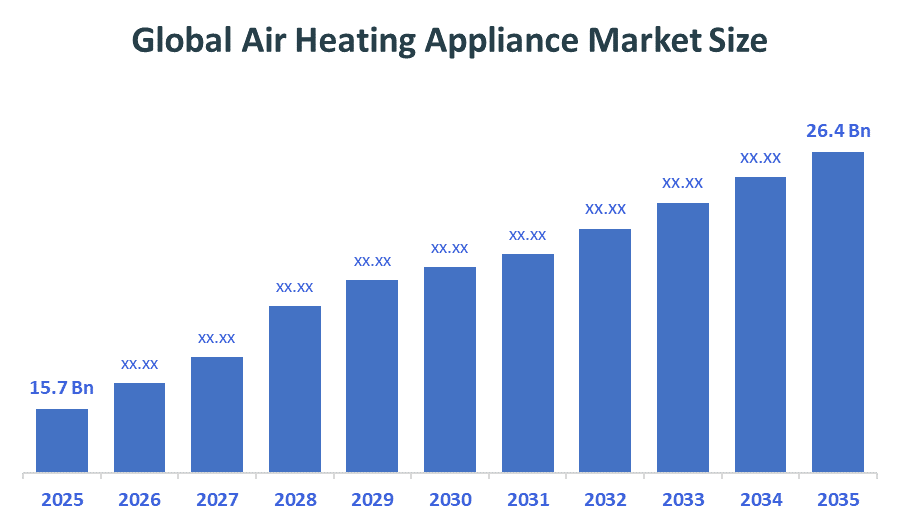
5.33%
REVENUE 2025
USD Billion 15.7
FORECAST 2035
USD Billion 26.4
REPORT COVERAGE
Global
Market Snapshot
- Global Air Heating Appliance Market Size (2025): USD 15.7 Billion
- Global Air Heating Appliance Projected Market Size (2035): USD 26.4 Billion
- Global Air Heating Appliance Compound Annual Growth Rate (CAGR): 5.33%
- Largest Regional Market: North America
- Fastest Growing Region: Asia-Pacific
- 3rd Largest Region: Europe
- Base Year: 2025
- Historical Period: 2021–2024
- Forecast Period: 2026–2035
The air heating appliances provide a vital set of climate control mechanisms that are aimed at ensuring the maintenance of an ideal temperature through the circulation of heated air across residential and industrial premises. The devices serve as an important link between furnace-based systems and individual heaters, employing innovative heat transfer mechanisms and highly efficient fans to achieve efficient heating operations. The modern appliances possess a number of innovations, including the use of variable speed compressors and intelligent sensors to facilitate continuous operation with minimal power consumption. Having been invented as simple resistors for the generation of heat, the appliances have now become highly sophisticated self-contained systems that boast of Energy Star ratings, fast heating, and compatibility with home automation systems. One of the major elements contributing to the growth of the global air heating appliance market is the increasing requirement for eco-friendly buildings and energy management systems, in modern as well as rural constructions. Air heating appliances are necessary to guarantee effective operations and air quality indoors, especially since there is a need for continuous environmental controls without depending on conventional sources of power that are costlier and emit greenhouse gases.
- The residential and light commercial sectors account for almost 65% of the application-based market share due to the growing need for energy-efficient renovations in homes, multi-family homes, and indoor climate control systems.
- Smart heating technology in the commercial sector is experiencing substantial growth, with a CAGR forecasted to surpass 9% on account of the increasing adoption of IoT-enabled building management systems as part of the advanced generation of green infrastructure for providing optimised thermal comfort to large-scale office complexes and retail hubs.
Notable Insights: -
- Electric air source heat pumps currently hold a dominant market share of approximately 70.2% within the air heating sector. This leading position is attributed to their dual capability of providing both high-efficiency heating and cooling from a single unit.
- Approximately 89.4% of air heating appliance installations are concentrated in residential applications. The high number is attributable to the boom in housing construction globally and the extensive upgrading of old heating devices used in single-family houses. Consumers are choosing to install these gadgets not only for improving their indoor air quality but also for regulating the temperature of individual rooms.
- The Asia-Pacific region accounts for nearly 50% of the overall global market value as of 2026. Fast-growing urbanisation in developing nations such as China and India has led to the enormous requirement for a standard air heater in modern residential buildings.
What is the role of technology in shaping the market?
Technology is making ground-breaking developments in the realm of air heating equipment manufacture by way of the enhancement in energy efficiency, heat distribution accuracy, and automation in terms of operational efficiency. Modern air heating devices are not only air heaters anymore but rather climate control systems that can run autonomously for a very long period of time, owing to the incorporation of efficient inverter compressors, variable speed motors, and smart home multi-zones.
How are Recent Developments Helping the Market?
Innovations like the deployment of AI-enabled climate control devices, installation of high-capacity thermal heat exchange units, and intelligent energy optimisation software are some of the factors that have offered immense support for enhancing market growth. Companies have manufactured advanced air heating systems that allow for multiple filter systems, such as HEPA and UV-C sanitisers, to be installed within them, operating round-the-clock during their heating seasons without any direct interference from individuals. Using AI-driven analytics, these machines will be capable of adjusting temperatures depending on the occupancy status to ensure comfort conditions, as well as avoid unnecessary electricity wastage. This attribute is anticipated to simplify the administration of large housing communities and business organisations. Furthermore, cloud-assisted diagnostics will offer fast fault detection capabilities and assist in predictive maintenance processes.
Market Drivers
Air heating appliances are seeing positive growth due to the rising spending by both residential construction companies and business organisations on green and efficient indoor infrastructural systems as per new environmental standards. Modern air heating systems have gained widespread popularity due to their ability to combine various functionalities, including air purification, humidification, and thermostat scheduling in one system, which can be reused and maintained easily. Another driving factor behind the rapid growth of the air heating appliances market is the trend towards achieving carbon neutrality, as there is an increasing need for more cost-effective electric-based solutions to replace conventional fossil fuel boilers, especially in urban areas where natural gas lines cannot be used anymore.
Restraints
There are some difficulties in the process of the international air heater appliance market development because of the problems with providing reliability of heat exchanger parts in harsh conditions outside, because of the high level of humidity and corrosion of the air near the sea coast. Additionally, there are some costs that may become obstacles for the fast introduction of such technology, such as special compressors and installation costs and costs related to the storage of the refrigerants.
Competitive Analysis:
The report offers the appropriate analysis of the key organisations/companies involved within the air heating appliance market, along with a comparative evaluation primarily based on their product offerings, business overviews, geographic presence, enterprise strategies, segment market share, and SWOT analysis. The report also provides an elaborate analysis focusing on the current news and developments of the companies, which includes product development, innovations, joint ventures, partnerships, mergers & acquisitions, strategic alliances, and others. This allows for the evaluation of the overall competition within the market.
Top 10 Companies in the Global Air Heating Appliance Market
- Daikin Industries, Ltd.
- Mitsubishi Electric Corporation
- Carrier Global Corporation
- Trane Technologies plc
- Johnson Controls International plc
- Lennox International Inc.
- Rheem Manufacturing Company
- Bosch Thermotechnology (Robert Bosch GmbH)
- Panasonic Holdings Corporation
- Fujitsu General Limited
Government Initiatives
|
Country |
Key Government Initiatives |
|
US |
After the enactment of the Inflation Reduction Act, the Home Energy Rebates of the U.S. Department of Energy offer USD 8,000 per household for heat pumps and a maximum of USD 14,000 for household electrification rebates, in conjunction with tax credits for 30% of eligible upgrades to minimise household costs. |
|
India |
The Bureau of Energy Efficiency extended its Standards and Labelling Programme in March 2026 to include more residential air heaters through compulsory star rating, aiming for an efficiency improvement of approximately 30%. Furthermore, the Make in India programme provides an incentive of approximately 20% to encourage domestic production, considering the increased housing requirement in tier II cities expanding at over 8% per year. |
|
UK |
The UK has been speeding up its progress through the introduction of the Clean Heat Market Mechanism. The UK government is giving out grants worth up to £7,500 through the Boiler Upgrade Scheme to enable people to switch from their old gas boilers to air-source heat pumps. |
Study on the Supply, Demand, Distribution, and Market Environment
The viability of the air heating appliances business lies in balancing the capacity to work at maximum levels of energy efficiency with the ever-increasing demand for intelligent, uninterrupted regulation of internal climatic conditions. Supply of air heating appliances is dependent on the ability to manufacture efficient inverters and thermal heat exchangers that are capable of providing uninterrupted heating in an energy-efficient manner without wastage due to inefficiency that existed in earlier models. Demand will arise out of the move to full electrification of the domestic energy ecosystem, usage of high-definition sensors in the thermostat machinery, which are used to track occupancy and ambient air quality, and the necessity for thermal monitoring in locations that have severe climatic conditions during winters.
Price Analysis and Consumer Behaviour Analysis
Costs of air heating devices vary according to the BTU rating, Energy Star, and the smartness of the products. Products incorporating advanced technologies such as variable refrigerant flow with advanced prediction maintenance features, together with multi-stage filters, are relatively expensive. Portable air heaters and small wall-mounted heaters, on the other hand, can be purchased cheaply and are very useful for providing temporary heating in compact spaces. It has been shown that customers value cost-effectiveness and durability. Therefore, firms would prefer products that offer operational independence, easy system integration, and accurate temperature control. There has been a growing trend toward designing modular filtering loads in order to update equipment in response to changing standards.
Market Segmentation
The Global Air Heating Appliance Market share is classified into product type, application, distribution channel, and energy source.
- Heat Pumps segment holds the largest share, contributing approximately 36% of the market in 2025.
Based on the Product Type, the global air heating appliance market is divided into electric heaters, gas heaters, oil-filled heaters, infrared heaters, and heat pumps. Among these, Heat Pumps segment holds the largest share, contributing approximately 36% of the market in 2025. The superiority of these types of heaters lies in their increased energy efficiency, along with their ability to heat and cool the space through the use of the same unit. The other main categories include gas heaters and electric space heaters, and they are still relevant owing to their relatively inexpensive installation costs.
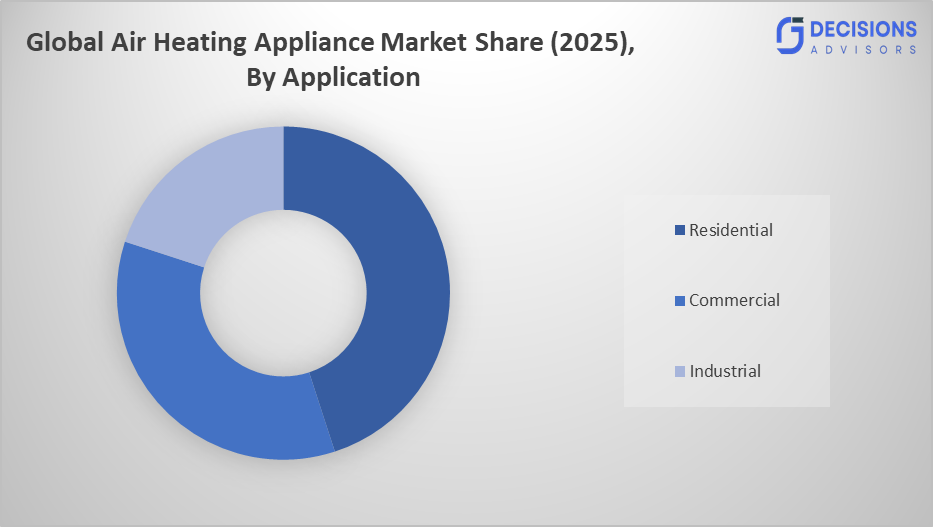
- Residential segment accounts for the largest share, representing over 45% of the global market in 2025.
Based on the Application, the global air heating appliance market is divided into residential, commercial, and industrial sectors. Among these, Residential segment accounts for the largest share, representing over 45% of the global market in 2025. Such implementations become essential to ensure proper heating and cooling inside and to minimise the electricity bills by using highly efficient devices. However, the Commercial section has recently gained prominence and has become one of the most rapidly developing sectors due to the building of green-certified office spaces and renovation of old HVAC systems in hospitality and healthcare organisations.
Retail Stores and speciality dealer networks dominate the global market, accounting for approximately 40.5% of the total revenue in 2025.
Based on the Distribution Channel, the global air heating appliance market is divided into online retail, speciality stores, supermarkets and hypermarkets, and direct sales. Among these, the Retail Stores and speciality dealer networks dominate the global market, accounting for approximately 40.5% of the total revenue in 2025. The chosen section is favoured by people who demand personalised consultation along with professional installation for heating systems. The Online Retail industry is experiencing a rise in its usage, especially from individuals and small organisations that prefer transparent pricing along with door-to-door delivery of the equipment.
Strategies to Implement for Growth of the Market in Non-Leading Regions
The opportunities for growth in the air heating appliances market in new markets could be enhanced by using efficient modular heating systems designed for use by the local residential developers as well as the local organizations involved in managing urban infrastructure. Carbon-neutral programs initiated by the government along with the development of high-efficient electrical grids plays a crucial role in generating demand in regions where conventional homes make it difficult to lay gas pipes on the ground. Additionally, investing more money in training local HVAC technicians along with establishing regional service centers can further aid in the process.
Regional Segment Analysis of the Global Air Heating Appliance Market
- North America (U.S., Canada, Mexico)
- Europe (Germany, France, U.K., Italy, Spain, Rest of Europe)
- Asia-Pacific (China, Japan, India, South Korea, Rest of APAC)
- Latin America (Brazil and the Rest of Latin America)
- The Middle East and Africa (UAE, South Africa, Rest of MEA)
North America is expected to hold a significant share of the air heating appliance market during the forecast period. This region holds approximately 32% share of global revenue, its highly sophisticated infrastructure related to residential construction, along with the extensive adoption of energy-efficient technology in both national climate goals and housing security applications. Majority of the revenue in this region is derived from the US, owing to significant expenditure within the government in heat pump uptake through tax credits, as well as regional studies on cold weather inverters. Long-term building code improvements and early deployment of smart-connected systems during retrofits have been critical factors in this regard.
Asia-Pacific is projected to be the fastest-growing region over the forecast period. This region is anticipated to witness a growth rate of around 10.6% CAGR. The reason for this lies in the rapid expansion of urban residential infrastructure alongside the increasing need for comfortable indoor living conditions in countries like China, India, and Southeast Asia. Some other factors contributing to this include the increase in government spending on sustainable urban planning, indigenous innovation and development of inexpensive electric heating appliances, and extensive use of inverters for regulating temperature.
Europe is anticipated to hold a substantial share, contributing approximately 27% of the global market share. The region also enjoys a competitive advantage due to innovative clusters on thermal technology and investments in sustainable heating of the environment as well as energy efficiency studies. Also, the comparative advantage that this region enjoys against other nations such as Germany, France, and the United Kingdom is the expertise that they possess when it comes to precision engineering of high-efficiency heat pumps. In addition to that, the strict regulation that they impose concerning electrification of buildings has provided them with another comparative advantage. The presence of large industrial companies combined with enhanced environmental consciousness system has allowed gradual introduction of air heaters.
Recent Developments
- In March 2026, according to the European Heat Pump Association, heat pump sales in Europe increased by 10.3% to about 2.62 million units in 2025 due to government incentives designed to decrease the use of traditional fossil fuels for heating purposes.
- In February 2026, the Bureau of Energy Efficiency extended its compulsory labelling scheme for star rating to cover other heating equipment in residential settings, with the aim of raising efficiency levels to up to 30% and promoting energy-efficient devices among urban homes.
- In January 2026, the International Energy Agency revealed that around 40% of global residential energy usage is due to space heating, resulting in growing policies to boost the use of efficient heat pumps and electrical heating equipment, which offer up to 25% energy savings.
- In September 2025, the European Commission upgraded Ecodesign requirements on heaters, mandating more efficient seasonal energy performance, resulting in reduced carbon dioxide emissions from heating systems by up to 20% among EU member countries.
Market Segmentation
This study forecasts revenue at global, regional, and country levels from 2020 to 2035. The global air heating appliance market is segmented based on the following categories:
Global Air Heating Appliance Market, By Product Type
- Electric Heaters
- Gas Heaters
- Oil-Filled Heaters
- Infrared Heaters
- Heat Pumps
Global Air Heating Appliance Market, By Application
- Residential
- Commercial
- Industrial
Global Air Heating Appliance Market, By Distribution Channel
- Online Retail
- Speciality Stores
- Supermarkets and Hypermarkets
- Direct Sales
Global Air Heating Appliance Market, By Regional Analysis
- North America
- United States
- Canada
- Mexico
- Europe
- Germany
- United Kingdom
- France
- Italy
- Spain
- Russia
- Rest of Europe
- Asia Pacific
- China
- Japan
- India
- South Korea
- Australia
- Rest of Asia Pacific
- Latin America
- Brazil
- Argentina
- Rest of Latin America
- Middle East & Africa
- United Arab Emirates
- Saudi Arabia
- Qatar
- South Africa
- Rest of Middle East & Africa
Frequently Asked Questions (FAQ)
- What is an air heating appliance, and why is it important?
Air heater units are specific types of climatic control mechanisms that serve to regulate room temperatures through the creation or transfer of heat to rooms. Air heaters are vital for ensuring that people remain healthy and comfortable during winter periods while protecting buildings against freezing and providing suitable operating conditions within industries.
- What factors are driving the growth of the air heating appliance market?
This growth is due to the considerable amount of investments that have been made into energy-efficient retrofits, increased demands for climate-control systems in smart homes, and the extensive use of highly efficient heat pumps.
- Which product type dominates the air heating appliance market?
Heat pumps are by far the most prominent and impactful category in the market owing to their high energy efficiency, ability to run on renewable sources of electricity, and flexibility in offering heating and cooling functionalities. Heat pumps have immense possibilities if applied to long-term urban development initiatives and areas seeking to achieve full electrification of buildings.
- Which applications are widely used in this market?
The application in residential buildings and office spaces is quite prominent owing to the pressing need to ensure that there are constant temperatures indoors and that comfort levels are guaranteed. This has been facilitated by the rising use of building management systems in order to make sure that there is efficient use of energy on a daily basis.
Check Licence
Choose the plan that fits you best: Single User, Multi-User, or Enterprise solutions tailored for your needs.
We Have You Covered
- 24/7 Analyst Support
- Clients Across the Globe
- Tailored Insights
- Technology Tracking
- Competitive Intelligence
- Custom Research
- Syndicated Market Studies
- Market Overview
- Market Segmentation
- Growth Drivers
- Market Opportunities
- Regulatory Insights
- Innovation & Sustainability
Report Details
| Scope | Global |
| Pages | 210 |
| Delivery | PDF & Excel via Email |
| Language | English |
| Release | Apr 2026 |
| Access | Download from this page |