
Global Air Motor Market
 |
Author:
Pranali P
|
Pages:
240
|
Author:
Pranali P
|
Pages:
240
Global Air Motor Market Size, Share, By Type (Vane air motors, Piston air motors, Gear air motors, Turbine air motors), By Application (Industrial tools, Material handling, Mixing & pumping, and Chemical & petrochemical) By End User (Oil & gas, Chemical & petrochemical, Automotive, Food & Beverage, Mining, and Manufacturing & metalworking), and By Region (North America, Europe, Asia-Pacific, Latin America, Middle East, and Africa), Analysis and Forecast 2026-2035.
CAGR
2.74%
REVENUE 2025
USD Billion 4.72
FORECAST 2035
USD Billion 5.59
REPORT COVERAGE
Global
Market Snapshot
- Global Air Motor Market Size (2025): USD 2.74 Billion
- Projected Global Air Motor Market Size (2035): USD 4.72 Billion
- Global Air Motor Compound Annual Growth Rate (CAGR): 5.59%
- Largest Regional Market: Asia pacific
- Fastest Growing Region: North America
- 3rd Largest Region: Europe
- Base Year: 2025
- Historical Period: 2021–2024
- Forecast Period: 2026–2035
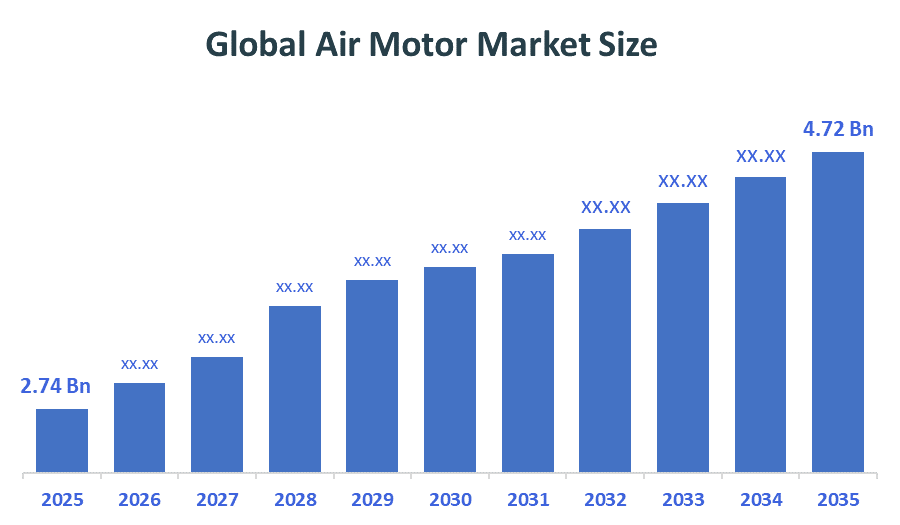
The Global Air Motor Market would be driven by the growing requirement for compressed air and gas systems. Increasing growth in the manufacturing industry, oil & gas industry, Chemical & petrochemical industry, and automotive industry would contribute to the rising acceptance of Air Motor due to their performance improvement features, energy efficiency, and avoidance of moisture damage. Industrial automation, environmental concerns, and the need for high-quality air have led to further growth in the market.
Market Overview/ Introduction
The Global Air Motor Market consists of various industrial tools that facilitate air cooling or air conditioning by reducing the temperature and eliminating moisture from compressed air or gases after compression. In the manufacturing and process industry, Air Motor find applications in industries including manufacturing, energy generation, oil and gas, automotive, food processing, and Mining. The key factors contributing to the market's growth include the fast pace at which industries are growing and the rise in stringent regulations on energy consumption. With increased focus on energy efficiency and production of efficient manufacturing lines that need efficient compressed air systems, there is a growing demand for Air Motor. The development of technologies such as advanced heat-exchange methods, internet-of-things (IoT)-enabled monitoring systems, hybrid and modular air/water-cooled solutions, and predictive maintenance systems is changing the landscape of this market. Moreover, the implementation of durable materials and innovative design in this market increases the efficiency of the system. Government policies encouraging industries to adopt sustainable solutions for efficient production and energy conservation contribute to the growth of the global Air Motor market.
- April 2026 – Governments across Europe, United States, and India are enforcing strict emissions and safety regulations, boosting adoption of explosion-proof, low-maintenance air motors in chemical, mining, oil & gas, and food/pharma industries.
- April 2026 – In Europe, China, and India, Industry 4.0 policies are accelerating automation and robotics adoption, driving demand for reliable air motors used in smart manufacturing, assembly systems, and hazardous industrial environments.
Notable Insights: -
- Asia-Pacific holds the largest regional market share approximately 45% in the global Air Motor market.
- North America is the fastest growing region market share approximately 29% in the global Air Motor market.
- By type, the vane air motors segment held a dominant position with 52% in terms of market share in 2025.
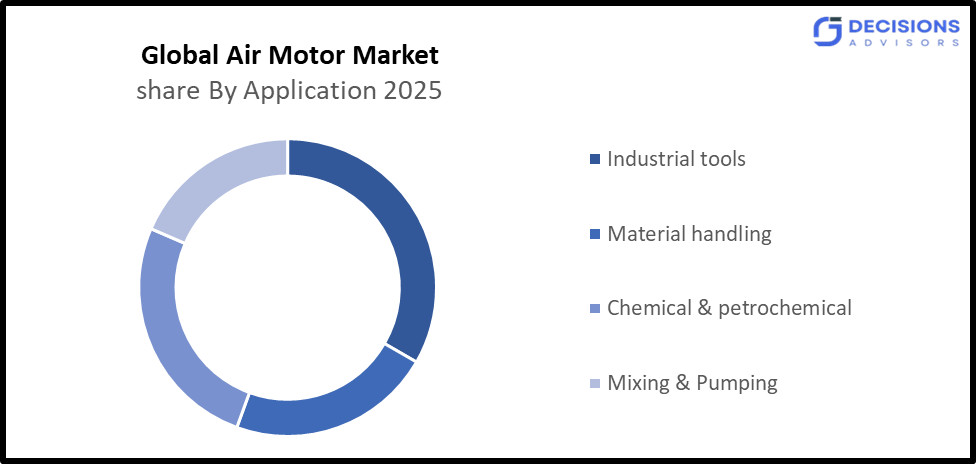
- By application, industrial tools segment is the dominating accounting for market is approximately 40%.
- By end user, oil & gas segment held a dominant position market is approximately 35%.
- The market is likely to achieve a valuation of USD 4.72 Billion by 2035.
What is role of technology in grooming the market?
The field of technology is making waves within the market for air motors as far as efficiency and applicability is concerned. For instance, the use of precision manufacturing enables manufacturers to produce motors with lower friction, making it more efficient in terms of power-to-weight ratios. IoT and smart sensor technologies have been at the centre of technological advancement within the industry, allowing machines to undergo predictive maintenance to eliminate vibrations and ensure air pressure within an assembly line setting. Innovations within materials technology have enabled the production of "lubricant-free" air motors required in highly sterile environments such as pharma products.
How is Recent Developments Helping the Market?
Latest trends have made considerable contributions to the growth of the Air Motor Market through improved efficiency, enhanced safety, and digitalization. New models and designs are being introduced by manufacturers that have low air consumption along with highly efficient models including vane, piston, and gear motors that provide better performance in terms of torque. With the help of IoT technologies, sensors, and predictive maintenance techniques, it has become possible to monitor equipment performance efficiently and prevent downtime in industrial operations. Moreover, automation, robotics, and the emergence of Industry 4.0 are expected to boost the need for intelligent and compact pneumatic equipment in manufacturing, automotive, and chemicals industry. In this regard, advancements related to explosion-proof and light-weight motors will contribute towards the growth of the air motor market by providing expanded applications in the oil & gas sector.
Market Drivers
Air Motor market will be fuelled by increasing demand for safe, robust, and explosion-proof power supply systems in various hazardous industrial sectors, such as oil and gas, chemical, petrochemical, and mining. These products can work without any electric input, making them perfect for usage in cases when a spark might cause an explosion. Another significant driver for the Air Motor market will be growing levels of industrial automation and increased usage of pneumatic equipment in manufacturing processes. These products are valued for their durability and easy maintenance requirements; they can function at extremely high temperatures, humidity levels, and dust environment. Furthermore, expanding application of air motors in such end-user industries as food and beverage and pharmaceutical, which require aseptic conditions in production facilities, will drive market growth as well. Investment in industrial safety measures, infrastructure development, and cost-efficiency will add to the growth dynamics of this market.
Restrain
The Air Motor market faces restraints such as lower energy efficiency compared to electric motors, leading to higher operating costs due to continuous compressed air requirements. Limited torque and speed control also restrict adoption in precision applications. Additionally, high installation costs of compressed air systems and energy losses during air compression reduce overall efficiency. Growing preference for electric and hybrid alternatives further challenges market expansion globally.
Competitive Analysis:
The report offers the appropriate analysis of the key organizations/companies involved within the air motor market, along with a comparative evaluation primarily based on their Product of offering, business overviews, geographic presence, enterprise strategies, segment market share, and SWOT analysis. The report also provides an elaborative analysis focusing on the current news and developments of the companies, which includes Product development, innovations, joint ventures, partnerships, mergers & acquisitions, strategic alliances, and others. This allows for the evaluation of the overall competition within the market.
Top Companies in Global Air Motor Market
- Atlas Copco
- Ingersoll Rand
- Parker Hannifin
- Deprag Schulz GmbH u. Co.
- Gast Manufacturing
- Desoutter Industrial Tools
- Fiam Utensili Pneumatici
- Globe Airmotors B.V.
- SPX FLOW
- BIAX Schmid & Wezel GmbH
- Others
Government Initiatives
|
Country |
Key Government Initiatives |
|
America
|
In April 2026 – In the Americas, the air motor market is witnessing increased focus on MRO services and smart pneumatic actuators, as industries adopt sensor-enabled tools to enhance maintenance efficiency, reduce downtime, and support advanced industrial automation practices. |
|
India |
April 2026 – In India, sustainability initiatives are boosting demand for air motors, as industries adopt spark-free pneumatic solutions. With compressed air systems consuming 10–30% of plant electricity and efficiency upgrades reducing energy use by 10–15%, adoption is rising across manufacturing sectors. |
|
U.S. |
In In April 2026 – In United States and Europe, stricter enforcement of ATEX and OSHA safety standards is boosting demand for explosion-proof air motors, as industries adopt spark-free pneumatic solutions to enhance safety in hazardous environments like oil and chemical facilities. |
Study on the Supply, Demand, Distribution, and Market Environment of Air Motor Market
Air Motor Market Analysis in terms of market structure, it is quite balanced yet supply constrained because the manufacturing is limited to only a handful of large engineering companies around the world. In terms of sourcing, air motor supply comes from Europe and North America and is becoming more common in Asia Pacific due to reduced production costs. From a demand standpoint, it is mainly fuelled by the need for explosion-proof power in oil & gas, chemical, mining, and manufacturing sectors. Distribution takes place through OEM sales, industrial distributors, and online B2B websites. Some of the factors that impact the industry include industrial safety laws, increased automation, and rising energy efficiency standards. At the same time, reliance on compressed air systems and competition from electric motors can affect pricing strategies and customer adoption.
Price Analysis and Consumer Behaviour Analysis
The pricing pattern in the Air Motor industry is subject to the type of motor, torque capability, material construction, and applications. The pricing for advanced types of vane and piston air motors that are used in the oil and gas and chemical sectors remains high due to the explosion-proof feature required in their manufacture. Nevertheless, the lifespan and low maintenance costs make them economically sound for demanding applications. In terms of consumer behaviour, price does not form the priority criterion. Instead, consumers value safety, reliability, and suitability in extreme conditions more than any other criteria when making purchase decisions. Industrial customers opt for branded products with after-sales service and global availability features. More and more customers look for energy-saving air motors that consume less compressed air. Purchases are mainly project-driven, with OEMs and industrial customers buying in bulk.
Market Segmentation
The Air Motor market share is classified into type, application, and end user
- The type segment dominated the market in 2025, and is projected to grow at a substantial CAGR of approximately 8% during the forecast period.
Based on the type, the Air Motor market is divided into vane air motors, turbine air motors, gear air motors, and piston air motors. Among these, Vane air motors dominate the Global Air Motor Market, currently holding a 52% share of the global market. Its dominance is fueled by its compact footprint and high power-to-weight ratio, making it the primary choice for industrial automation and handheld tools. The global air motor market is projected to grow at a CAGR of approximately 6.5% to 8.2% (depending on the industrial sector) from 2026 through 2034. This growth is driven by rising demand for spark-free, safe power in hazardous "ATEX" environments and the rapid expansion of automated manufacturing in the Asia-Pacific region.
- The application segment accounted for the largest share in 2025, and is anticipated to grow at a significant CAGR of approximately 7% during the forecast period.
Based on the applications, the Air Motor market is divided into industrial tools, material handling, mixing & pumping, and chemical & petrochemical. Among these, industrial tools segment dominates the Air Motor market due to widespread use in manufacturing, automotive, and maintenance operations where spark-free and durable pneumatic tools are preferred. It holds the largest market share of around 38–42% and is expected to grow at a CAGR of approximately 5–6% during the forecast period. Material handling, mixing & pumping, and chemical & petrochemical applications follow with comparatively lower shares but steady demand from process industries and hazardous environments requiring reliable pneumatic power solutions. Overall demand is driven by safety and efficiency requirements across industries.
- The end user segment dominated the market in 2025, and is projected to grow at a substantial CAGR of approximately 5.5% during the forecast period.
Based on the end user, the Air Motor market is divided into oil & gas, chemical & petrochemical, automotive, food & beverage, manufacturing & metalworking, and mining. Among these, oil & gas dominate the the Air Motor market due to extensive use in hazardous environments where spark-free and explosion-proof operation is critical for drilling, refining, and upstream applications. It accounts for nearly 32–36% market share and is projected to grow at a CAGR of around 5–6% during the forecast period driven by safety regulations and automation. Other segments like manufacturing, chemical, automotive, and food industries follow, supported by demand for reliable pneumatic systems in harsh and continuous industrial operations ensuring efficiency safety and operational reliability across industries worldwide operations
Strategies to Implement for Growth of the Market in Non-Leading Regions
For the growth of the Air Motor market in non-leading regions such as portions of the Asia-Pacific region, Latin America, and Africa, a number of strategic recommendations should be considered. Firstly, the implementation of regional production and assembly plants may prove to be efficient for reducing expenses related to transportation, importation, etc. Secondly, the improvement of distribution networks, particularly via local industrial distributors, OEMs and so forth can enhance the market presence and service availability in the area. Moreover, the implementation of programs of awareness among the potential customers is recommended, with the emphasis on benefits such as the explosion-proof feature, durability and adaptability to harsh conditions. Also, the supply of cost-effective and modular solutions may facilitate the penetration of the market by promoting Air Motors among smaller and medium-sized businesses. Moreover, ensuring excellent after sales service, supply of spare parts, maintenance and repairs, etc., will create positive consumer experience and foster client loyalty in the long term. Collaboration with governmental and industrial infrastructure projects may unlock numerous opportunities. Finally, the application of marketing online and other digital means, including the use of B2B online platforms, is highly recommended.
Regional Segment Analysis of the Air Motor Market
- North America (U.S., Canada, Mexico)
- Europe (Germany, France, U.K., Italy, Spain, Rest of Europe)
- Asia-Pacific (China, Japan, India, Rest of APAC)
- South America (Brazil and the Rest of South America)
- The Middle East and Africa (UAE, South Africa, Rest of MEA)
Asia pacific is anticipated to hold the largest share of the Air Motor market over the predicted timeframe.
The Asia-Pacific region is projected to dominate the global air motor market through 2034, currently holding a leading share of approximately 42% to 47%. This regional dominance is primarily fuelled by rapid industrialization and the aggressive expansion of manufacturing hubs in China and India. A key driver is the region’s massive transition toward Industry 4.0 and factory automation. As manufacturing becomes more sophisticated, there is an increased demand for the high power-to-weight ratio and "spark-free" safety that air motors provide, especially in the thriving automotive, electronics, and chemical sectors. Furthermore, government initiatives like "Make in India" and China’s focus on high-end equipment manufacturing are accelerating the adoption of pneumatic systems. With a projected CAGR of over 8.2%, Asia-Pacific benefits from cost-competitive production and a robust supply chain, ensuring it remains the primary engine for global market growth and innovation in the pneumatic sector.
North America is expected to grow at a rapid CAGR in the Air Motor market during the forecast period. The North American air motor market is entering a phase of rapid expansion, with a projected value expected to contribute significantly to the global $3.54 billion total by the end of 2026. Currently, the region holds a substantial market share of approximately 28% to 30%, driven largely by the high-tech industrial base in the United States and Canada. The market is anticipated to grow at a CAGR of 7.2% to 8.5% through 2034. This acceleration is fuelled by the region's rigid ATEX and OSHA safety mandates, which require spark-free pneumatic power in the aerospace, oil and gas, and pharmaceutical sectors. Furthermore, the aggressive integration of Industry 4.0 and the domestic "Battery Belt" expansion for electric vehicle manufacturing have created a surge in demand for high-precision, lubricant-free air motors in automated assembly lines, positioning North America as a primary hub for high-value pneumatic innovation.
Europe is the 3rd largest region to grow in the Air Motor market during the region. Europe maintains its position as the third-largest region in the global air motor market, currently holding a steady market share of approximately 18% to 22%. The region’s growth is characterized by high-value, specialized applications rather than sheer volume. Growth is driven by stringent EU workplace safety and energy-efficiency directives, which compel industries like pharmaceuticals, food processing, and chemicals to adopt hygienic and spark-free pneumatic drives. Germany remains the primary contributor, leveraging its world-class automotive and machinery manufacturing base. With a projected CAGR of 6.1% to 6.5% through 2034, Europe remains a critical hub for high-performance, precision-engineered air motors tailored for sustainable and "smart" factory environments.
Future Market Trends in Global Air Motor Market: -
1. Increasing Adoption of Energy-Efficient Air Motors
A major future trend in the global Air Motor market is the shift toward energy-efficient designs that reduce compressed air consumption and operating costs. Manufacturers are developing advanced vane and piston motors with optimized airflow, improved sealing, and reduced leakage. This helps industries lower energy expenses while maintaining performance. As sustainability becomes a priority, companies are focusing on eco-friendly solutions and compliance with energy regulations, driving the adoption of high-efficiency air motors across manufacturing, chemical, and process industries worldwide.
2. Integration with Automation and Smart Technologies
The integration of air motors with automation and smart monitoring systems is gaining momentum. With the rise of Industry 4.0, companies are incorporating IoT-enabled sensors and predictive maintenance features into pneumatic systems. This allows real-time performance tracking, fault detection, and reduced downtime. Smart air motors improve operational efficiency and reliability in automated production lines. Industries such as automotive, packaging, and food processing are increasingly adopting these advanced solutions to enhance productivity and streamline operations.
3. Growing Demand in Hazardous and Specialized Environments
Air motors are increasingly being used in hazardous and specialized environments where electric motors are not suitable. Their explosion-proof nature makes them ideal for oil & gas, mining, and chemical industries. Future demand will rise as safety regulations become stricter globally. Additionally, industries such as pharmaceuticals and food processing are adopting air motors for clean and contamination-free operations. This expanding application scope in niche and high-risk environments is expected to significantly drive market growth in the coming years.
Recent Development
- January 2026, Chicago Pneumatic expanded its industrial tool portfolio with advanced grinders and sanders powered by durable air motors, enhancing performance and reliability in demanding manufacturing and maintenance applications.
- June 2025, Deprag Schulz GmbH u. Co. highlighted its ADVANCED LINE stainless steel air motors for hygienic industries at Automatic 2025, reinforcing demand for oil-free, corrosion-resistant solutions in food, pharmaceutical, and medical applications.
Market Segment
This study forecasts revenue at global, regional, and country levels from 2021 to 2035. Decision Advisors has segmented the Air Motor market based on the below-mentioned segments:
Global Air Motor Market, By Type
- Vane air motors
- Piston air motors
- Gear air motors
- Turbine Air Motor
Global Air Motor Market, By Application
- Industrial tools
- Material handling
- Chemical & petrochemical
- Mixing & Pumping
Global Air Motor Market, By End User
- Oil & Gas
- Chemical & petrochemical
- Automotive
- Food & Beverage
- Mining
- Manufacturing & Metalworking
Global Air Motor Market, By Regional Analysis
- North America
- US
- Canada
- Mexico
- Europe
- Germany
- UK
- France
- Italy
- Spain
- Russia
- Rest of Europe
- Asia Pacific
- China
- Japan
- India
- South Korea
- Australia
- Rest of Asia Pacific
- South America
- Brazil
- Argentina
- Rest of South America
- Middle East & Africa
- UAE
- Saudi Arabia
- Qatar
- South Africa
- Rest of the Middle East & Africa
Frequently Asked Questions (FAQ)
Q1. What are the key technological advancements influencing the air motor industry?
A. Advancements such as precision engineering, lightweight composite materials, and improved air flow efficiency designs are significantly enhancing performance, durability, and energy efficiency of modern air motors.
Q2. How does compressed air availability impact air motor adoption?
A. The adoption of air motors is highly dependent on stable and cost-efficient compressed air infrastructure, as industries with optimized air systems achieve better operational efficiency and lower lifecycle costs.
Q3. What role do sustainability initiatives play in the air motor market?
A. Sustainability initiatives encourage industries to adopt energy-efficient pneumatic systems that reduce carbon emissions and optimize energy consumption, thereby supporting greener manufacturing processes.
Q4. What are the key challenges faced by manufacturers in this market?
A. Manufacturers face challenges such as high energy consumption of compressed air systems, competition from electric alternatives, and the need for continuous innovation to meet industry-specific requirements.
Q5. How is demand for customization shaping the air motor market?
A. Increasing demand for application-specific solutions is driving manufacturers to offer customized air motors with varied torque, size, and material configurations to meet diverse industrial requirements.
Check Licence
Choose the plan that fits you best: Single User, Multi-User, or Enterprise solutions tailored for your needs.
We Have You Covered
- 24/7 Analyst Support
- Clients Across the Globe
- Tailored Insights
- Technology Tracking
- Competitive Intelligence
- Custom Research
- Syndicated Market Studies
- Market Overview
- Market Segmentation
- Growth Drivers
- Market Opportunities
- Regulatory Insights
- Innovation & Sustainability
Report Details
| Scope | Global |
| Pages | 240 |
| Delivery | PDF & Excel via Email |
| Language | English |
| Release | Apr 2026 |
| Access | Download from this page |