
Global Airport Baggage Handling Systems Market
 |
Author:
Pranali P
|
Pages:
200
|
Author:
Pranali P
|
Pages:
200
Global Airport Baggage Handling Systems Market Size, Share By Type (Conveyor Systems, Destination Coded Vehicles, Others), By Technology (Barcode, RFID, Others), By Airport Class (Class A, Class B, Class C), and By Region (North America, Europe, Asia-Pacific, Latin America, Middle East & Africa), Analysis and Forecast 2026-2035
CAGR
8.41%
REVENUE 2025
USD Billion 9.15
FORECAST 2035
USD Billion 20.52
REPORT COVERAGE
Global
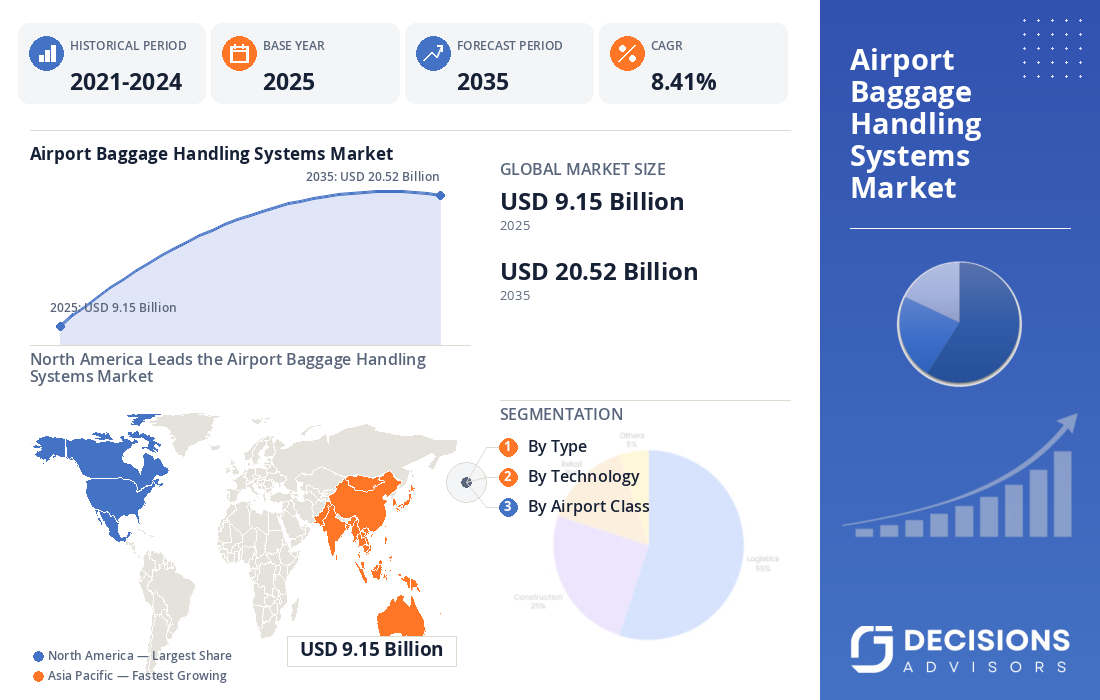
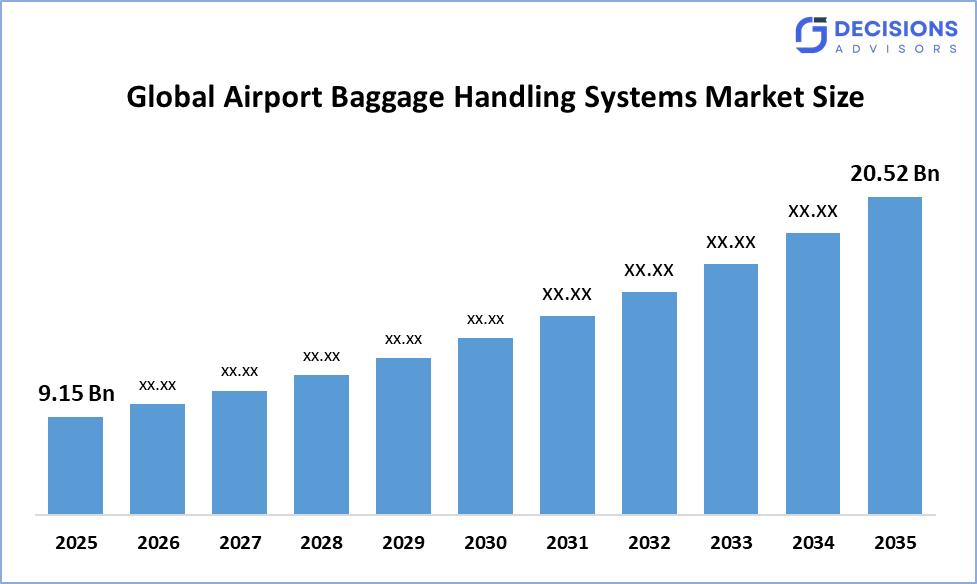
The Global Airport Baggage Handling Systems Market Size is predicted to grow from USD 9.15 Billion in 2025 and is likely to reach around USD 20.52 Billion by 2035 with a CAGR of 8.41%. According to Decision Advisors, a comprehensive research report on the market indicates that automated baggage handling system is the major trend in the Global Airport Baggage Handling Systems Market, holding about 77.55% market share. The major trends include sorting by using artificial intelligence, robotics, RFID, Internet of Things, predictive maintenance, and real-time baggage monitoring. The major companies dominating the market include BEUMER Group, Alstef Group, and Leonardo S.p.A., together holding more than 18.9% global market share.
Market Snapshot
- Global Airport Baggage Handling Systems Market Size (2025): USD 9.15 Billion
- Projected Global Airport Baggage Handling Systems Market Size (2035): USD 20.52 Billion
- Global Airport Baggage Handling Systems Market Compound Annual Growth Rate (CAGR): 8.41%
- Largest Regional Market: North America
- 2nd Largest Region: Europe
- Fastest Growing Region: Asia Pacific
- Base Year: 2025
- Historical Period: 2021-2024
- Market Forecast Period: 2026-2035
Market Overview/ Introduction
The Global Airport Baggage Handling Systems Market represents the range of automated and manual technologies that help move, sort, screen, monitor, and retrieve passengers' baggage at airports. Various government projects and initiatives, such as airport modernization and development programs, have encouraged investments in automated baggage handling systems, smart airports, and security screening infrastructure. Some of the latest trends in the industry are the use of AI, RFID, IoT, robots, machine learning, and real-time monitoring of the baggage. For instance, in December 2024, SITA partnered with IDEMIA Public Security to develop technologies of computer vision and digital technologies for airport operations. Some of the factors that have been driving the market development include the rise in air passenger traffic, the expansion and modernization of airports, labor shortage, and automation need.
- The Federal Aviation Administration continues distributing hundreds of millions in Bipartisan Infrastructure Law grants to modernize aging airport terminals, replacing legacy systems with energy-efficient, automated baggage handling technology.
- The European Commission implemented standardized ground handling regulations within the EASA framework, driving mandatory European airport upgrades toward highly compliant, automated, and secure baggage sorting technologies.
Notable Insights: -
- North America is anticipated to hold approximately 34.9% share of the Global Airport Baggage Handling Systems Market over the predicted timeframe.
- Asia Pacific is expected to grow at a rapid CAGR in the Global Airport Baggage Handling Systems Market by holding approximately 27.7% of the share during the forecast period.
- By type, the Conveyor Systems, segment dominated the market and holds approximately 43.87% share in 2025 and is projected to grow at a substantial CAGR during the forecast period.
- By technology, the Barcode segment dominated the market and holds approximately 34.73% share in 2025 and is projected to grow at a substantial CAGR during the forecast period.
- The compound annual growth rate of the Global Airport Baggage Handling Systems Market is 8.41%.
- The market is likely to achieve a valuation of USD 20.52 Billion by 2035.
Market Drivers
The Global Airport Baggage Handling Systems Market witness’s growth owing to the increase in air passengers, which leads to an increase in baggage that needs to be handled efficiently. The development of airports is one of the major factors that drives the demand for conveyor systems, automated sorting systems, and baggage handling solutions. The trend toward airport automation has made airlines more inclined towards minimizing manual operations and ensuring operational efficiency, which ultimately leads to the avoidance of baggage mishandling. The use of radio frequency identification technology, bar-code scanning, Internet of Things, artificial intelligence, and other real-time tracking technologies contributes greatly to the growth of the market. Moreover, the need for a better passenger experience and reduced waiting time makes airports install faster baggage processing systems. Besides, labor shortage, increasing airport operational complexities, increased security needs in aviation, and investments in smart airports are other major factors driving the market.
Restrain
High installation costs, complicated system integration, maintenance needs, and operational disruptions are some of the difficulties facing the global airport baggage handling systems market. Modern baggage systems necessitate large capital expenditures for infrastructure improvements, equipment, and integration.
Competitive Analysis:
The report offers the appropriate analysis of the key organizations/companies involved within the Global Airport Baggage Handling Systems Market along with a comparative evaluation primarily based on their product offerings, business overviews, geographic presence, enterprise strategies, segment market share, and SWOT analysis. The report also provides an elaborative analysis focusing on the current news and developments of the companies, which includes product development, innovations, joint ventures, partnerships, mergers & acquisitions, strategic alliances, and others. This allows for the evaluation of the overall competition within the market.
Top Companies in the Global Airport Baggage Handling Systems Market
- Vanderlande
- Beumer Group
- Daifuku
- Siemens Logistics
- Alstef Group
- Leonardo
- Fives Group
- Honeywell International
- Pteris Global
- G&S Airport Conveyor
Government Initiatives
|
Country |
Key Government Initiatives |
|
Canada |
Transport Canada strictly enforces civil aviation security regulations that require CATSA-operated airports to continuously fund and upgrade checkpoint and hold-baggage screening infrastructure |
|
Poland |
The government is investing $10 billion into the new Warsaw Solidarity Airport greenfield megaproject, integrating fully automated, high-capacity baggage handling technology linked with rail networks. |
|
United States |
The TSA's strategic modernization plans mandate advanced baggage screening technologies, driving massive nationwide airport investments into automated sorting, AI security layers, and RFID tracking infrastructure. |
Market Segmentation
The Global Airport Baggage Handling Systems Market share is classified into Type, Technology and Airport Class
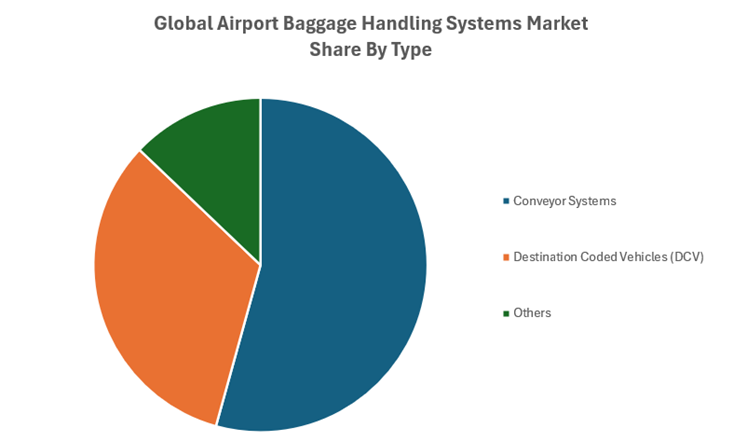
- The Conveyor Systems segment dominated the market and holds approximately 43.87% share in 2025 and is projected to grow at a substantial CAGR during the forecast period.
Based on the type, the Global Airport Baggage Handling Systems Market is categorized as Conveyor Systems, Destination Coded Vehicles, and Others. Out of these, the Conveyor Systems account for the largest share of the market with around 43.87% in 2026. Such market position can be attributed to their reliable nature, scalability, continuous operation, and ability to efficiently transport luggage. Conveyor Systems are extensively used in airports for the transportation of luggage from check-in counters, screening, sorting, and loading to flights.
- The Barcode segment accounted for the largest share of approximately 34.73% in 2025 and is anticipated to grow at a significant CAGR during the forecast period.
Based on the technology, the Global Airport Baggage Handling Systems Market is segmented into Barcode, RFID, and Others. Out of all these segments, the Barcode segment holds the maximum market share of around 34.73%. The reason behind the high market share of this segment includes the usage of the segment, cost-effectiveness, infrastructure and compatibility with the current baggage handling system. Barcode is extensively used for the purposes of identification, sorting, tracking and processing of baggage at airports globally. On the other hand, the RFID segment is expected to register significant growth owing to tracking accuracy and real-time visibility.
- The Class A segment accounted for the largest share of approximately 48% in 2025 and is anticipated to grow at a significant CAGR during the forecast period.
Based on airport class, the Global Airport Baggage Handling Systems Market is categorized into Class A, Class B, and Class C. From these segments, the Class A category leads the market and accounts for about 48% share in 2025. Such dominance in the class is mainly due to increased passenger traffic, advanced infrastructure, and widespread use of automated baggage handling systems. The Class A airports need advanced conveyor systems, sorting, and RFID system tracking, and therefore, generate the highest revenue contribution in the global market.
Regional Segment Analysis of the Global Airport Baggage Handling Systems Market
- Asia-Pacific (China, India, Japan, South Korea, Australia, and Rest of Asia-Pacific)?
- North America (United States and Canada)
- Europe (Germany, UK, France, Italy, Spain, and Rest of Europe)
- Latin America (Brazil, Mexico, Argentina, Colombia, and Rest of Latin America)?
- The Middle East and Africa (UAE, Saudi Arabia, South Africa, Qatar, and Rest of MEA)
North America is anticipated to hold approximately 34.9% share of the Global Airport Baggage Handling Systems Market over the predicted timeframe.
The North America segment has a share of about 34.9% in the Global Airport Baggage Handling Systems Market because of the presence of well-developed airport infrastructure, high air passenger traffic, airport modernization projects, and increased automation in baggage handling processes. This segment enjoys investments in advanced screening systems, RFID technology, sorting, and other efficient baggage handling systems. The US is one of the biggest markets in North America due to the presence of well-developed international airports in this country.
Asia Pacific is expected to grow at a rapid CAGR in the Global Airport Baggage Handling Systems Market, holding approximately 27.7% of the share during the forecast period
The Asia Pacific region accounts for 27.7% of the Global Airport Baggage Handling Systems Market, due to the growing air passenger numbers, fast airport expansions, and investments in the infrastructure development of airports in the region. The increasing demand for baggage handling solutions comes from large scale constructions of airports in China, India, Japan, South Korea, and Southeast Asia, as well as the use of advanced baggage handling technologies such as automation, tracking with the help of radio frequency identification technology, and use of artificial intelligence and robotics. The growing number of international tourists and investments in infrastructure development of airports in the region are stimulating the demand for baggage handling solutions. The presence of airports and the development of smart-airport facilities in the region contribute to its strong market position.
Middle East & Africa is the fastest-growing region in the Global Airport Baggage Handling Systems Market during the period, holding approximately 5.70% share.
The Middle East & Africa is among the fastest-growing regions in the Global Airport Baggage Handling Systems Market and holds a market share of around 5.70% in the global market. Growth is attributed to significant expansion of airports, high volume of air passengers, growth in tourism, modernization of airports, and investment in baggage handling system automation. The region is increasingly adopting technologies such as RFID tracking, sorting, artificial intelligence, and efficient baggage management systems.
Future Market Trends in Global Airport Baggage Handling Systems Market: -
-
- Expansion of Automated Baggage Handling Systems
Baggage handling systems have started using automated processes to become more efficient, shorten the time involved, and decrease the chances of errors. The use of conveyors, automated sorting, and destination-coded vehicles make it possible to handle bags quicker. The increasing number of passengers, expansion of the airports, and their modernization programs have increased this trend.
-
- AI-Enabled Baggage Tracking and Sorting
AI has revolutionized the way baggage handling works using advanced techniques like intelligent sorting, prediction, automatic decision making, and continuous monitoring. AI-based systems can identify potential problems within baggage handling processes. The growing need for efficient operation of airports has made them implement AI technology in their next-generation baggage handling systems.
-
- Growth in RFID-Based Baggage Tracking
The use of RFID technology has become important as airports look for ways to track their bags accurately and in real time through the entire process of passenger transit. The technology makes automatic identification possible; increases visibility of bags; minimizes errors associated with handling and improves the process of reconciliation.
-
- Rising Adoption of Robotics and IoT
Robotics and IoT technology are gradually being introduced in the airport baggage handling processes to enhance automation, monitoring, and efficiency. The IoT technology ensures that the equipment is monitored in real time using sensors, while the robotics ensure that the baggage is transported and sorted out.
Recent Development
- In January 2024, using integrated CrisBag carrier systems and high-speed automation, the BEUMER Group completed an early overhaul of the baggage handling system at Singapore Changi Airport Terminal
- In July 2024, The Alstef Group won a contract to install new baggage handling equipment at Montreal Metropolitan Airport, including cutting-edge check-in lines and screening technologies
- In March 2024, early equipment failure detection was made possible by IoT sensors incorporated into luggage conveyors and sorting systems, which decreased downtime and enhanced airport baggage operations.
Market Segment
This study forecasts revenue at global, regional, and country levels from 2020 to 2035. Decision Advisors has segmented the Global Airport Baggage Handling Systems Market based on the below-mentioned segments:
Global Airport Baggage Handling Systems Market, By Type
- Conveyor Systems
- Destination Coded Vehicles
- Others
Global Airport Baggage Handling Systems Market, By Technology
- Barcode
- RFID
- Others
Global Airport Baggage Handling Systems Market, By Airport Class
- Class A
- Class B
- Class C
Global Airport Baggage Handling Systems Market, By Regional Analysis
- Asia-Pacific
- China
- India
- Japan
- South Korea
- Australia
- Rest of Asia-Pacific
- North America
- United States
- Canada
- Europe
- Germany
- UK
- France
- Italy
- Spain
- Rest of Europe
- Latin America
- Brazil
- Mexico
- Argentina
- Colombia
- Rest of Latin America
- Middle East & Africa
- UAE
- Saudi Arabia
- South Africa
- Qatar
- Rest of MEA
Frequently Asked Questions (FAQ)
Q. How are airport baggage handling systems improving airport operations?
A. Automated baggage handling systems facilitate quicker luggage circulation around airport facilities, increase efficiency, decrease processing times, and minimize baggage mishandling.
Q. Why are RFID technologies increasingly preferred for baggage tracking?
A. RFID improves visibility, decreases lost baggage, and facilitates effective baggage reconciliation procedures by offering precise, real-time baggage identification and tracking.
Q. What role does artificial intelligence play in baggage handling systems?
A. AI helps airports increase dependability and decrease system downtime by enabling automated luggage sorting, predictive maintenance, real-time monitoring, and operational optimization.
Q. How is automation influencing the Global Airport Baggage Handling Systems Market?
A. Conveyors, automatic sorters, destination-coded cars, robotics, and intelligent monitoring systems are being adopted to effectively manage increasing passenger and baggage numbers.
Check Licence
Choose the plan that fits you best: Single User, Multi-User, or Enterprise solutions tailored for your needs.
We Have You Covered
- 24/7 Analyst Support
- Clients Across the Globe
- Tailored Insights
- Technology Tracking
- Competitive Intelligence
- Custom Research
- Syndicated Market Studies
- Market Overview
- Market Segmentation
- Growth Drivers
- Market Opportunities
- Regulatory Insights
- Innovation & Sustainability
Report Details
| Scope | Global |
| Pages | 200 |
| Delivery | PDF & Excel via Email |
| Language | English |
| Release | Sep 2026 |
| Access | Download from this page |