
Global Allergic Rhinoconjunctivitis Market
 |
Pages:
240
|
Pages:
240
Global Allergic Rhinoconjunctivitis Market Size, Share, By Drug Type (Antihistamines, Corticosteroids, Decongestants, Mast Cell Stabilizers, and Non-steroidal Anti-Inflammatory Drugs), By Product Type (Tablets, Eye Drops, Nasal Sprays, and Gels & Creams), By Dosage Form (Solid, Liquid, and Semi-Solid), and By Region (North America, Europe, Asia-Pacific, Latin America, Middle East, and Africa), Analysis and Forecast 2025-2035
REPORT COVERAGE
Global
Market Snapshot
- Market Size (2025): USD 6.72Billion
- Projected Market Size (2035): USD 15.4 Billion
- Compound Annual Growth Rate (CAGR): 8.65%
- Largest Regional Market: North America
- Fastest Growing Region: Asia Pacific
- 2nd Largest Region: Europe
- Base Year: 2025
- Historical Period: 2021–2024
- Forecast Period: 2025–2035
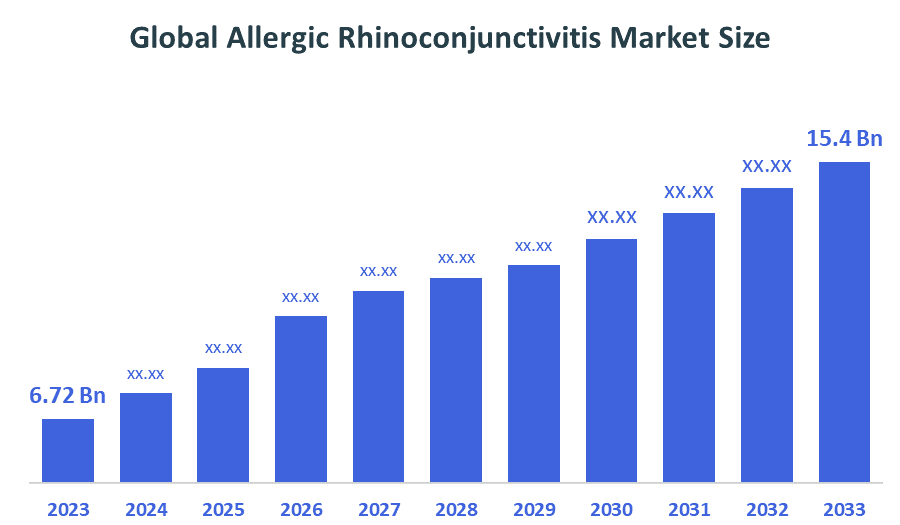
According to Decision Advisors, the Global Allergic Rhinoconjunctivitis Market Size is expected to grow from USD 6.72billion in 2025 to USD 15.4 billion by 2035, at a CAGR of 8.65% during the forecast period 2025-2035. The global allergic rhinoconjunctivitis market is projected to grow significantly over the next decade due to increasing patient population, environmental changes, and advancements in treatment options. The global allergy cases have increased because of urbanization and environmental pollution, which has resulted in more people needing medical treatment. Better healthcare access, with enhanced patient education, leads to improved patient outcomes.
Market Overview/ Introduction
The market for pharmaceutical treatments and biologic medicines, which include immunotherapies and supportive care products, exists to diagnose and treat allergic rhinitis and allergic conjunctivitis, both separately and when combined. The condition known as allergic rhinoconjunctivitis (ARC) occurs when a person experiences allergic reactions that cause nasal inflammation and conjunctival inflammation. The market shows consistent growth because urbanization and, pollution, and climate change lead to more people developing the disease. The demand for healthcare services across the world will continue to grow because people become more aware of health issues, doctors can better diagnose diseases, and hospitals provide more medical services between now and the following 10 years, with a compound annual growth rate between 5 and 8%.
The development of advanced biologics testing and allergen immunotherapy expansion, with increasing demand in India and China's emerging markets create key business opportunities. Digital health tools combined with personalized treatment methods will improve patient results while opening up new opportunities for business expansion.
- Allergy portfolios contribute 2–10% of total revenue for large pharma companies.
- In February 2025, ALK announced that the US Food and Drug Administration (FDA) had approved ALK’s ODACTRA tablet for use in young children with house dust mite (HDM) allergy. ODACTRA now serves as a treatment option for children aged five to 11 and for patients aged 12 to 65 who suffer from HDM-induced allergic rhinitis with or without conjunctivitis.
- Glenmark’s Ryaltris nasal spray is now approved in Europe for the first-line treatment of allergic rhinitis in patients over 12 years of age
Notable Insights: -
- North America holds the largest regional market share, approximately 39.5% in the global Allergic Rhino Conjunctivitis market.
- Asia Pacific is the fastest-growing region in the global allergic rhinoconjunctivitis market.
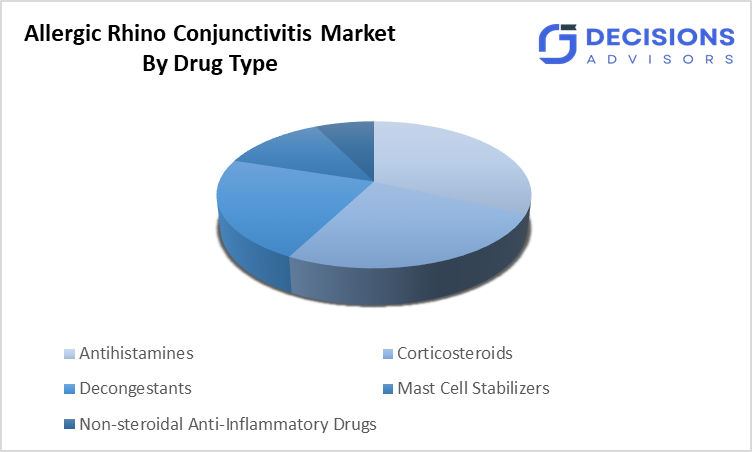
- By drug type, the antihistamines segment held a dominant position of over 40% in terms of market share in 2025.
- By dosage form, the solid segment is the dominating one, accounting for over 62% of the global market share in 2025.
- The compound annual growth rate of the global allergic rhinoconjunctivitis market is 8.65%.
- The market is likely to achieve a valuation of USD 15.4 billion by 2035.
What is role of technology in grooming the market?
Technology plays a critical role in shaping the global allergic rhinoconjunctivitis market, as the process of achieving better patient outcomes depends on three core areas that require enhancement. The ARIA guidelines show how digital health tools and AI platforms enable doctors to monitor patient symptoms while providing customized treatment solutions. The use of mobile applications together with wearable technology enables people to track their pollen exposure, which results in a 30 to 40% increase in treatment compliance. The progress of biotechnology has enabled researchers to create precise treatment methods for specific diseases. The biologic products that Sanofi and Regeneron Pharmaceuticals developed represent the most rapidly expanding category, which will continue to grow at a rate exceeding 10% each year. The market share for sublingual tablets in immunotherapy technologies has reached almost 30%. Telemedicine platforms enable doctors to reach more patients in developing countries which has resulted in an annual market growth rate between 8 and 9% while they enhance disease management systems and lead to market expansion.
Market Drivers
The global allergic rhinoconjunctivitis market is propelled by the rising rates of diseases, which affect 20 to 40% of people, and increasing levels of urban air pollution serve as the main market drivers. The market drivers include three factors, which are climate change, extended pollen seasons and growing public knowledge that leads to increased medical diagnoses. The market for effective treatments which include antihistamines and immunotherapy, shows increasing demand as the market expects to grow at a rate of 8 to 9% CAGR. Product innovation is also accelerating growth. Glenmark Pharmaceuticals introduced Ryaltris nasal spray, which combines antihistamine and steroid treatment to provide better symptom relief. Combination products provide better treatment results because they improve patient convenience while increasing treatment success rates, which leads to a worldwide market.
Restrain
The main restraints on the global allergic rhinoconjunctivitis market include the high costs associated with new medical treatments, which use thrombopoietin receptor agonists and biologics as their basis create difficulties for patients who live in low- and middle-income areas. The combination of corticosteroid treatment and immunosuppressive medication leads to severe side effects, which include both infections and osteoporosis, while also causing weight gain that makes it harder for patients to stay with their treatment.
Competitive Analysis:
The report offers the appropriate analysis of the key organizations/companies involved within the allergic rhinoconjunctivitis market, along with a comparative evaluation primarily based on their product of offering, business overviews, geographic presence, enterprise strategies, segment market share, and SWOT analysis. The report also provides an elaborative analysis focusing on the current news and developments of the companies, which includes product development, innovations, joint ventures, partnerships, mergers & acquisitions, strategic alliances, and others. This allows for the evaluation of the overall competition within the market.
Top Companies in Global Allergic Rhinoconjunctivitis Market
- GlaxoSmithKline
- Sanofi
- Merck & Co.
- Bayer AG
- Johnson & Johnson
- AstraZeneca
- Teva Pharmaceutical Industries
- ALK-Abelló
- Boehringer Ingelheim
- Novartis
Government Initiatives
|
Country |
Key Government Initiatives |
|
UK |
Adoption of ARIA-based clinical guidelines through NHS frameworks. Focus on primary care-based allergy diagnosis, Integration of digital tools (e.g., symptom tracking apps). |
|
US |
Guidelines led by: American Academy of Allergy, Asthma & Immunology, NIH-supported clinical recommendations. Key initiatives include the evidence-based treatment protocols, increased access to OTC antihistamines & biologics, and public awareness programs on seasonal allergies. |
Market Segmentation
The allergic rhinoconjunctivitis market share is classified into drug type, product type, and dosage form.
- The antihistamines segment dominated the market in 2025, and is projected to grow at a substantial CAGR of approximately 40% during the forecast period.
Based on the drug type, the allergic rhinoconjunctivitis market is divided into antihistamines, corticosteroids, decongestants, mast cell stabilizers, and non-steroidal anti-inflammatory drugs. Among these, the antihistamines segment dominated the market in 2025 and is projected to grow at a substantial CAGR of approximately 40% during the forecast period. The growth of the segment is driven by the fact that the first-line treatment for this condition uses antihistamines as the primary option, which provides fast symptom relief through its availability at stores and exhibits high safety standards. The first-line treatment for this condition uses antihistamines as the primary option, which provides fast symptom relief through its availability at stores and exhibits high safety standards.
- The non-surgical treatments segment accounted for the largest share in 2025, and is anticipated to grow at a significant CAGR of approximately 70% during the forecast period.
Based on the product type, the allergic rhinoconjunctivitis market is divided into tablets, eye drops, nasal sprays, and gels & creams. Among these, the non-surgical treatments segment accounted for the largest share in 2025, and is anticipated to grow at a significant CAGR of approximately 70% during the forecast period. The treatment works because it directly addresses three eye symptoms, which include itching, redness and watering of the eyes. The treatment provides fast relief to patients who prefer it because they can obtain it more easily than they can access tablets and nasal sprays that treat systemic or nasal symptoms.
- The solid segment dominated the market in 2025, and is projected to grow at a substantial CAGR of approximately 62% during the forecast period.
Based on the dosage form, the allergic rhinoconjunctivitis market is divided into solid, liquid, and semi-solid. Among these, the solid segment dominated the market in 2025 and is projected to grow at a substantial CAGR of approximately 62% during the forecast period. The widespread use of nasal sprays and eye drops has created a preference for these products because they deliver fast results, their use is simple, and patients show higher treatment compliance. People prefer nasal sprays because these products provide instant relief, while solid tablets, semi-solid gels and ointments take longer to deliver their effects.
Regional Segment Analysis of the Allergic Rhinoconjunctivitis Market
- North America (U.S., Canada, Mexico)
- Europe (Germany, France, U.K., Italy, Spain, Rest of Europe)
- Asia-Pacific (China, Japan, India, Rest of APAC)
- South America (Brazil and the Rest of South America)
- The Middle East and Africa (UAE, South Africa, Rest of MEA)
North America is anticipated to hold the largest share of the allergic rhinoconjunctivitis market over the predicted timeframe.
North America is anticipated to hold the largest share of the allergic rhinoconjunctivitis market over the predicted timeframe. This market is accounting about approximately 39.5% of the total market share. The region experiences high allergy rates, which impact 30% of adults and 40% of children. The market expansion receives support from advanced healthcare systems and major pharmaceutical companies, and the region's early adoption of biologics and immunotherapy treatments. The combination of positive reimbursement policies and growing public knowledge about allergy treatment methods results in increased patient diagnosis and treatment rates. North America remains the top market because of growing environmental pollution and seasonal allergy problems, which drive consumer demand.
Asia Pacific is expected to grow at a rapid CAGR in the allergic rhinoconjunctivitis market during the forecast period. Asia Pacific is poised to be the fastest-growing region in the global Allergic Rhino Conjunctivitis market with a remarkable CAGR of 7% during the forecast period of 2025 to 2035. This rapid expansion is driven by the rising urbanization together with increased air pollution and climate change, which are causing a significant rise in allergy cases. The population density, combined with environmental factors in India and China, has resulted in an increase in allergic cases in these countries. The combination of healthcare infrastructure improvements, increased public knowledge and higher healthcare expenditures results in improved diagnosis and treatment rates. The market expansion in the Asia-Pacific region reaches its peak capacity because of enhanced access to advanced treatments and over-the-counter products.
Europe is the 3rd largest region to grow in the allergic rhinoconjunctivitis market during the period. This growth is driven by high disease prevalence, advanced healthcare systems, and strong adoption of innovative therapies. Countries like Germany, France, and the United Kingdom drive demand with strong access to advanced therapies and reimbursement policies.
Strategies to Implement for Growth of the Market in Non-Leading Regions
To drive growth in non-leading regions such as Latin America, the Middle East & Africa, and parts of Southeast Asia, the primary goal for organizations should be to improve public access and maintain affordable prices while increasing public knowledge about their services. The establishment of distribution systems together with local medical partner networks, will enable better product distribution to remote communities. The development of budget-friendly generic medications, with non-prescription medicines, needs to become a top priority for all organizations that want to satisfy customers who have budget limitations. The implementation of public health initiatives that require governmental partnerships will boost early detection methods and treatment methods. Remote communities can benefit from digital health systems and telemedicine services, which provide them with necessary medical assistance. Pharmaceutical companies should conduct clinical studies in specific regions while developing treatments that use local allergen data and environmental information.
Future Market Trends in Global Allergic Rhinoconjunctivitis Market: -
1. Increasing adoption of biologics and targeted therapies
The increasing adoption of biologics and targeted therapies is a key trend in the allergic rhino-conjunctivitis market. Biologics such as monoclonal antibodies (e.g., anti-IgE, anti-IL-4/IL-13) target underlying immune pathways, improving symptom control. Immunotherapy and biologics are growing at ~8–9% annually, outpacing conventional drugs, while allergic rhinitis affects 10–30% of the population, expanding demand.
2. Integration of digital health and AI technologies
Integration of digital health and AI is transforming allergic rhino-conjunctivitis management by enabling real-time monitoring, predictive analytics, and personalized treatment. Studies show digital tools improve symptom control by up to 82% and medication adherence by around 90%. Additionally, over 1,500 allergy-related apps support remote care and data tracking, enhancing outcomes.
3. Innovation in drug delivery systems
Innovation in drug delivery systems is transforming allergic rhino-conjunctivitis treatment through sustained-release and nanotechnology solutions. Traditional eye drops show only 5–10% bioavailability, while newer systems (nanoparticles, implants, contact lenses) improve retention and efficacy. Additionally, topical eye drops still dominate with 72.3% market share, but advanced formulations enhance compliance and reduce dosing frequency.
Recent Development
In May 2024, Osaka, Japan – Santen Pharmaceutical Co., Ltd. and Mitsubishi Tanabe Pharma Corporation announced the launch of Alesion Eyelid Cream 0.5%, an allergic conjunctivitis treatment in Japan. Both companies concluded a joint sales promotion contract for the product, which is sold in Japan by Santen. The product is the world’s first cream-type allergic conjunctivitis treatment requiring just once daily administration to the upper and lower eyelids (the area around the eyes.
How is Recent Developments Helping the Market?
Recent developments are significantly accelerating the growth of the allergic rhino-conjunctivitis market. Rising pollution levels with climate change and urbanization has created a situation that leads to greater disease spread, according to research, which shows that almost 20% of people worldwide suffer from various illnesses. The recent news events show a pattern of increasing cases because Bengaluru recorded a 60% increase in eye allergy cases, which resulted from pollution and weather changes, thus creating a higher demand for medical treatments. The medical field experiences transformative treatment results through the development of better biologics and monoclonal antibodies, and allergen immunotherapy solutions. The new pipeline drugs MM09 and MG56 will bring new disease management methods, which will allow companies to enter untapped market segments. The regulatory approvals, which include Glenmark's Ryaltris nasal spray product launch in China, show that companies are expanding their worldwide distribution network while increasing patient access to medications. The combination of advanced drug delivery technologies, which include nasal sprays and ophthalmic solutions, with rising healthcare knowledge, leads to better patient treatment adherence. The world market experiences ongoing expansion through these developments, which create new innovative solutions for the market
Market Segment
This study forecasts revenue at global, regional, and country levels from 2020 to 2035. Decision Advisors has segmented the allergic rhinoconjunctivitis market based on the below-mentioned segments:
Global Allergic Rhinoconjunctivitis Market, By Drug Type
- Antihistamines
- Corticosteroids
- Decongestants
- Mast Cell Stabilizers
- Non-steroidal Anti-Inflammatory Drugs
Global Allergic Rhinoconjunctivitis Market, By Product Type
- Tablets
- Eye Drops
- Nasal Sprays
- Gels & Creams
Global Allergic Rhinoconjunctivitis Market, By Dosage Form
- Solid
- Liquid
- Semi-Solid
Global Allergic Rhinoconjunctivitis Market, By Regional Analysis
- North America
- US
- Canada
- Mexico
- Europe
- Germany
- UK
- France
- Italy
- Spain
- Russia
- Rest of Europe
- Asia Pacific
- China
- Japan
- India
- South Korea
- Australia
- Rest of Asia Pacific
- South America
- Brazil
- Argentina
- Rest of South America
- Middle East & Africa
- UAE
- Saudi Arabia
- Qatar
- South Africa
- Rest of the Middle East & Africa
Frequently Asked Questions (FAQ)
Q: How are collaborations and government initiatives influencing the market?
A: Collaborations between pharma companies and research institutions accelerate R&D in biologics and immunotherapies. Government approvals, product launches, and public health schemes improve access to treatment. Initiatives such as awareness campaigns and subsidies increase patient compliance and expand the market in both mature and emerging regions.
Q: How do government schemes impact the market?
A: Government programs promoting allergy awareness, early diagnosis, and treatment access enhance market growth, particularly in emerging regions. Subsidies, public campaigns, and support for over-the-counter therapies increase patient reach. Regulatory fast-tracking of new drugs also accelerates product availability and adoption.
Q: How do environmental factors influence the market?
A: Air pollution, climate change, and pollen levels are key drivers of allergic rhino-conjunctivitis. Urbanized regions experience higher incidence rates, creating demand for effective treatments. Seasonal spikes, especially in spring and summer, also influence product sales, including antihistamines, nasal sprays, and eye drops.
Q: What are the future trends in the market?
A: Future trends include growing adoption of biologics and targeted therapies, digital health integration for personalized treatment, advanced sustained-release drug delivery, and expansion into emerging markets. Rising allergy prevalence due to environmental changes and increasing public awareness will continue to fuel demand globally.
Check Licence
Choose the plan that fits you best: Single User, Multi-User, or Enterprise solutions tailored for your needs.
We Have You Covered
- 24/7 Analyst Support
- Clients Across the Globe
- Tailored Insights
- Technology Tracking
- Competitive Intelligence
- Custom Research
- Syndicated Market Studies
- Market Overview
- Market Segmentation
- Growth Drivers
- Market Opportunities
- Regulatory Insights
- Innovation & Sustainability
Report Details
| Scope | Global |
| Pages | 240 |
| Delivery | PDF & Excel via Email |
| Language | English |
| Release | Mar 2026 |
| Access | Download from this page |