
Global Anhydrous Dibasic Calcium Phosphate Market
 |
Author:
Disha B
|
Pages:
240
|
Author:
Disha B
|
Pages:
240
Global Anhydrous Dibasic Calcium Phosphate Market Size, Share, By Source (Hydrochloric Acid, Phosphoric Acid), By Application (Pharmaceuticals, Food & Beverage, Animal Feed, Fertilizers), By End User (Pharmaceutical Industry, Nutraceutical Industry, Food & Beverage Industry, Animal Nutrition, Agriculture), and By Region (North America, Europe, Asia-Pacific, Latin America, Middle East & Africa), Analysis and Forecast 2026-2035
CAGR
5.71%
REVENUE 2025
USD Million 240.1
FORECAST 2035
USD Million 418.5
REPORT COVERAGE
Global
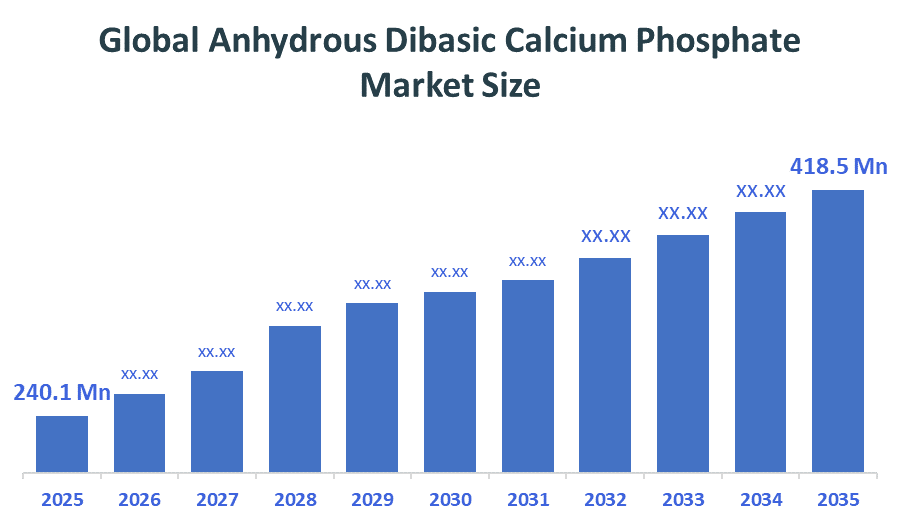
The Global Anhydrous Dibasic Calcium Phosphate Market size is forecast to grow from USD 240.1Million in 2025 to approximately USD 418.5 Million by 2035. According to Decision Advisors, a detailed research report on the anhydrous dibasic calcium phosphate market indicates that the rapid adoption of pharmaceutical-grade anhydrous dibasic calcium phosphate as a tablet excipient trend dominates the market, accounting for approximately 44.6% of the total share globally. ICL Group Ltd. leads the market with an estimated 10-12% global market share. The company reported a 2025 revenue of approximately USD 7.5-8.5 Billion, making it one of the most influential forces shaping industry trends and overall market growth.
Market Snapshot
- Global Anhydrous Dibasic Calcium Phosphate Market Size (2025): USD 240.1 Million
- Projected Global Anhydrous Dibasic Calcium Phosphate Market Size (2035): USD 418.5 Million
- Global Anhydrous Dibasic Calcium Phosphate Market Compound Annual Growth Rate (CAGR): 5.71%
- Largest Regional Market: North America
- Fastest Growing Region: Asia-Pacific
- Market 3rd Largest Region: Europe
- Base Year: 2025
- Historical Period: 2021–2024
- Forecast Period: 2026–2035
Market Overview/ Introduction
The Global Anhydrous Dibasic Calcium Phosphate Market refers to the market that handles the manufacture, distribution, and use of anhydrous dibasic calcium phosphate, which serves as a high-purity inorganic compound that humans use for calcium supplementation and pharmaceutical excipient purposes and as a nutritional supplement in both food and feed production. Anhydrous dibasic calcium phosphate exists as a white salt that has no smell and does not dissolve, while it supplies a consistent source of calcium and phosphorus, which people need for bone development and product formulation development. The market will experience continuous development because dietary supplement demand, pharmaceutical production growth, and animal nutritional needs will create increased market requirements. The market shows future growth opportunities through advanced drug formulation technologies, clean-label food ingredients, and sustainable production methods, which health-conscious people and elderly populations will combine to create extended market growth opportunities.
- The International Finance Corporation provides Environmental, Health & Safety (EHS) guidelines for phosphate and chemical industries. These standards regulate emissions, waste handling, and worker safety. Widely adopted globally, they ensure high-quality and compliant production of calcium phosphates for pharmaceutical and food-grade applications.
- The Government of India implements the Nutrient-Based Subsidy (NBS) scheme to promote phosphate fertilizer production and balanced nutrient use. It provides financial support to manufacturers, encouraging domestic phosphoric acid capacity expansion. This indirectly boosts raw material availability for calcium phosphate production across pharmaceutical and agricultural sectors.
Notable Insights: -
- North America is anticipated to hold the largest share of approximately 32.6% in the anhydrous dibasic calcium phosphate market over the forecast period.
- Asia Pacific is expected to grow at a rapid CAGR of approximately 7.3% in the anhydrous dibasic calcium phosphate market during the forecast period.
- The phosphoric acid segment dominated the market in 2025, approximately 65%, and is projected to grow at a substantial CAGR during the forecast period.
- The pharmaceuticals segment dominated the market in 2025, approximately 60%, and is projected to grow at a substantial CAGR during the forecast period.
- The pharmaceutical industry segment dominated the market in 2025, approximately 55%, and is projected to grow at a substantial CAGR during the forecast period.
- The compound annual growth rate of the Global Anhydrous Dibasic Calcium Phosphate Market is 5.71%.
- The market is likely to achieve a valuation of USD 418.5 Million by 2035.
What is role of technology in grooming the market?
Technology plays a crucial role in grooming the global anhydrous dibasic calcium phosphate market by improving product quality, manufacturing efficiency, and application performance. Advanced production technologies such as wet granulation, spray drying, and continuous processing help achieve high-purity and consistent particle size, which is essential for pharmaceutical-grade excipients. Direct compression technology in tablet manufacturing has increased its demand due to better flowability and binding properties. Automation and process control systems enhance scalability, reduce contamination risks, and lower production costs. Additionally, innovations in quality testing and analytical techniques ensure compliance with strict pharmacopeial standards. In the nutraceutical sector, microencapsulation and formulation technologies expand its use in fortified foods and supplements. Digital supply chain management also improves distribution efficiency and traceability. Overall, technological advancements are driving higher adoption, cost optimization, and product innovation across the pharmaceutical, food, and feed industries globally.
Market Drivers
The global anhydrous dibasic calcium phosphate market is driven by the pharmaceutical industry's need for the product for its tablet and capsule manufacturing processes. The nutraceutical and dietary supplement sectors experience expansion because people become more health-conscious, and they need to address calcium deficiency problems. The market experiences expansion because animal feed and food fortification products continue to find new applications. The use of direct compression technology in drug manufacturing, together with the rising production of generic medicines, leads to higher product usage. Market growth receives additional support from the rapid industrial development and pharmaceutical industry growth that occurs in the Asia-Pacific emerging markets.
Restrain
The global anhydrous dibasic calcium phosphate market faces restraints due the volatility of raw material prices, particularly phosphate rock. Strict regulatory requirements for pharmaceutical and food-grade applications also increase production costs and compliance burdens. Additionally, the availability of alternative calcium phosphate compounds limits market growth and adoption.
Competitive Analysis:
The report offers the appropriate analysis of the key organizations/companies involved within the global Anhydrous dibasic calcium phosphate market, along with a comparative evaluation primarily based on their product offerings, business overviews, geographic presence, enterprise strategies, segment market share, and SWOT analysis. The report also provides an elaborative analysis focusing on the current news and developments of the companies, which includes product development, innovations, joint ventures, partnerships, mergers & acquisitions, strategic alliances, and others. This allows for the evaluation of the overall competition within the market.
Top Companies in Global Anhydrous Dibasic Calcium Phosphate Market
- Merck KGaA
- Innophos Holdings Inc.
- BASF SE
- Prayon S.A.
- ICL Group Ltd.
- Chemische Fabrik Budenheim KG
- Huber Engineered Materials
- Phosphea (Groupe Roullier)
- Aarti Industries Limited
- Hindustan Phosphates Pvt. Ltd.
- CAP Biomaterials LLC
- Gujarat Narmada Valley Fertilizers & Chemicals Ltd (GNFC)
Government Initiatives
|
Country |
Key Government Initiatives |
|
USA |
The FDA has classified Anhydrous Dibasic Calcium Phosphate (ADBCP) as Generally Recognized as Safe (GRAS), facilitating its widespread use in pharmaceuticals and food. Additionally, the FDA is actively implementing the Drug Supply Chain Security Act (DSCSA), which mandates strict electronic traceability for drug ingredients, including excipients. |
|
India |
The DCGI has mandated that all pharmaceutical manufacturers, including those producing excipients like ADBCP, align with revised GMP standards (Schedule M) by January 2026. To boost the sector, the government issued 120 new manufacturing licenses in 2024 and continues to support domestic production through Production Linked Incentive (PLI) schemes to reduce import dependency. |
|
China |
The government has significantly tightened environmental regulations, introducing stricter sulfur-dioxide and particulate emission limits for phosphoric-acid plants in 2024. These initiatives aim to modernize the industry through high-tech, eco-friendly production, though they have led to increased conversion costs and export curbs to stabilize the domestic supply of phosphate-based materials. |
Study on the Supply, Demand, Distribution, and Market Environment of the Anhydrous Dibasic Calcium Phosphate Market
The global anhydrous dibasic calcium phosphate market is shaped by a well-structured but moderately fragmented supply chain, involving phosphate rock miners, chemical processors, and excipient manufacturers. Supply is concentrated among vertically integrated producers in North America, Europe, and Asia-Pacific, ensuring stable availability but exposing the market to raw material volatility and environmental regulations. Demand is primarily driven by pharmaceutical, nutraceutical, food, and animal feed industries, with the pharmaceutical sector accounting for the largest share due to rising tablet production and excipient requirements. Distribution occurs through direct contracts with drug manufacturers, specialty chemical distributors, and global supply networks, ensuring compliance and traceability. The market environment is highly regulated, with strict quality standards such as USP and ICH guidelines influencing production practices. Additionally, increasing demand for high-purity grades and regional capacity expansion, especially in Asia-Pacific, is strengthening supply stability while supporting long-term market growth and global trade integration.
Price Analysis and Consumer Behaviour Analysis
The global anhydrous dibasic calcium phosphate market is strongly influenced by raw material price volatility, energy costs, and regulatory compliance expenses, which directly impact overall pricing structures. Prices tend to remain higher for pharmaceutical-grade products due to strict purity requirements, tighter particle size control, and compliance with pharmacopeial standards. In contrast, food and feed-grade variants are relatively lower priced but face pressure from substitution with alternative calcium phosphates. On the consumer side, pharmaceutical manufacturers prioritize quality, stability, and regulatory approval over cost, often locking in long-term supply contracts to reduce risk. Nutraceutical and food industries, however, show price-sensitive behavior, balancing cost with functional benefits such as calcium fortification and clean-label demand. Overall, rising demand for high-purity excipients and increasing health awareness are shifting purchasing behavior toward premium, compliant grades, even at higher prices, supporting steady market value growth.
Market Segmentation
The Anhydrous Dibasic Calcium Phosphate Market share is classified into source, application, and end user.
- The phosphoric acid segment dominated the market in 2025, approximately 65%, and is projected to grow at a substantial CAGR during the forecast period.
Based on the source, the anhydrous dibasic calcium phosphate market is divided into hydrochloric acid and phosphoric acid. Among these, the phosphoric acid segment dominated the market in 2025, approximately 65%, and is projected to grow at a substantial CAGR during the forecast period. The growth of the phosphoric acid segment is growing due to its ability to produce high-purity, food- and pharmaceutical-grade material. It ensures better compliance with regulatory standards, cost efficiency in large-scale production, and suitability for sensitive applications like tablets and fortified foods.
- The pharmaceuticals segment dominated the market in 2025, approximately 60%, and is projected to grow at a substantial CAGR during the forecast period.
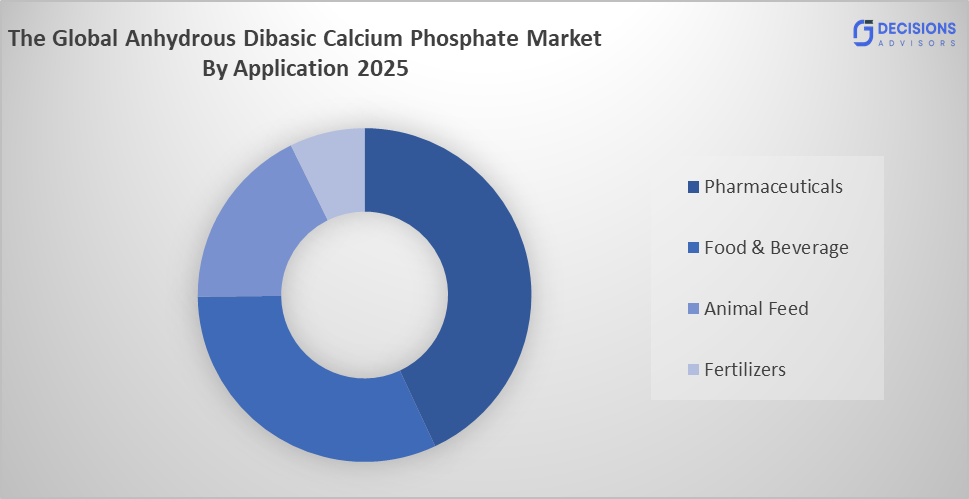
Based on the application, the anhydrous dibasic calcium phosphate market is divided into pharmaceuticals, food & beverage, animal feed, and fertilizers. Among these, the pharmaceuticals segment dominated the market in 2025, approximately 60%, and is projected to grow at a substantial CAGR during the forecast period. The pharmaceuticals segment dominated due to extensive use as a tablet excipient and calcium supplement. Its excellent compressibility, stability, and compatibility with active ingredients make it essential in solid dosage forms. Rising global drug production and increasing nutraceutical consumption further accelerate its demand in this segment.
- The pharmaceutical industry drugs segment dominated the market in 2025, approximately 55%, and is projected to grow at a substantial CAGR during the forecast period.
Based on the end user, the anhydrous dibasic calcium phosphate market is divided into the pharmaceutical industry, nutraceutical industry, food & beverage industry, animal nutrition, and agriculture. Among these, the pharmaceutical industry segment dominated the market in 2025, approximately 55%, and is projected to grow at a substantial CAGR during the forecast period. The growth of the pharmaceutical industry segment is due to widespread use in drug formulation and manufacturing. Anhydrous dibasic calcium phosphate is preferred for direct compression tablets due to its flow properties and binding efficiency. Growth in chronic disease treatments and expanding generic drug manufacturing significantly contribute to this segment’s dominance.
Strategies to Implement for Growth of the Market in Non-Leading Regions
To accelerate the growth of the global anhydrous dibasic calcium phosphate market in non-leading regions such as Latin America, the Middle East, and parts of Africa, companies should focus on localized production and supply chain optimization to reduce import dependency and cost barriers. Establishing partnerships with regional pharmaceutical and nutraceutical manufacturers can enhance market penetration and ensure regulatory compliance. Investing in awareness programs about the benefits of high-quality excipients in tablet formulation will further drive adoption. Additionally, offering cost-effective product grades without compromising safety standards can help capture price-sensitive markets. Strengthening distribution networks and working with government healthcare initiatives can also improve accessibility. Finally, encouraging technology transfer and training programs for local manufacturers will support capacity building and long-term sustainable growth in these emerging regions.
Regional Segment Analysis of the Anhydrous Dibasic Calcium Phosphate Market
- North America (U.S., Canada, Mexico)
- Europe (Germany, France, U.K., Italy, Spain, Rest of Europe)
- Asia-Pacific (China, Japan, India, Rest of APAC)
- South America (Brazil and the Rest of South America)
- The Middle East and Africa (UAE, South Africa, Rest of MEA)
North America is anticipated to hold the largest share of approximately 32.6% the anhydrous dibasic calcium phosphate market over the forecast period.
North America is anticipated to hold the largest share of approximately 32.6% the anhydrous dibasic calcium phosphate market over the forecast period. The dominance of this region is primarily driven by its well-established pharmaceutical and nutraceutical industries, high consumption of dietary supplements, and advanced drug manufacturing infrastructure. Strong regulatory standards ensure demand for high-purity excipients, while the presence of major manufacturers and continuous innovation further supports regional market leadership.
Asia Pacific is expected to grow at a rapid CAGR of approximately 7.3% in the anhydrous dibasic calcium phosphate market during the forecast period.
Asia Pacific is expected to grow at a rapid CAGR of approximately 7.3% in the anhydrous dibasic calcium phosphate market during the forecast period. This growth is driven by expanding pharmaceutical manufacturing in countries like India and China, rising demand for nutraceuticals, and increasing health awareness. Cost-effective production, improving healthcare infrastructure, and supportive government initiatives further accelerate regional market growth during the forecast period.
Europe is the 3rd largest region to grow in the anhydrous dibasic calcium phosphate market during the period.
Europe is the third-largest region in the anhydrous dibasic calcium phosphate market, supported by its well-established pharmaceutical and food industries. The region benefits from strong regulatory frameworks, high demand for quality excipients, and increasing consumption of dietary supplements. Additionally, ongoing innovation, aging population trends, and steady growth in nutraceutical applications contribute to its stable market expansion during the forecast period.
Future Market Trends in Global Anhydrous Dibasic Calcium Phosphate Market: -
1. Rising demand for pharmaceutical-grade excipients
The market will increasingly shift toward high-purity pharmaceutical-grade anhydrous dibasic calcium phosphate due to stricter regulatory standards and growth in solid oral dosage forms. Its excellent compressibility and stability make it essential for direct compression tablets, driving long-term demand in the pharmaceutical sector.
2. Expansion in nutraceutical and functional food applications
Growing health awareness and preventive healthcare trends are boosting use in calcium-fortified foods and dietary supplements. Consumers prefer clean-label, mineral-rich ingredients, and this compound supports bone health while maintaining stability in fortified formulations, increasing adoption in nutraceutical products.
3. Shift toward advanced manufacturing and Asia-Pacific production growth
Manufacturers are adopting continuous processing, granulation, and automation to improve efficiency and product consistency. At the same time, Asia-Pacific is emerging as a key production hub due to expanding pharmaceutical manufacturing in countries like India and China, strengthening global supply capacity.
Recent Development
- In February 2026, Glenmark Pharmaceuticals announced that its U.S.-based subsidiary would launch Sodium Phosphates Injection USP, with commercial distribution scheduled to begin in April 2026. The injectable product, approved by the U.S. FDA and therapeutically equivalent to the reference listed drug, targets hospital and institutional demand.
- In January 2025, Fuji Chemical Industries highlighted its product Fujicalin, a low-nitrite anhydrous dibasic calcium phosphate (DCPA) excipient designed to support pharmaceutical manufacturers in mitigating nitrosamine risks in tablet formulations. The product’s low nitrite content and high purity profile were emphasized as critical for enhancing drug safety and regulatory compliance in solid-dose medicines.
- In October 2024, DSM-Firmenich inaugurated a new animal nutrition production facility in Sete Lagoas, Brazil, aimed at strengthening its presence in the South American feed market. The plant, opened to designed to produce large volumes of nutritional supplements for beef and dairy cattle, supporting the region’s growing livestock sector.
How is Recent Developments Helping the Market?
Recent developments in the global anhydrous dibasic calcium phosphate market are significantly enhancing its growth by improving product quality, application scope, and manufacturing efficiency. Advancements in direct compression technology have increased its use as a preferred excipient in tablet formulations, offering better flowability and stability. Growing demand for high-purity pharmaceutical-grade ingredients, driven by stricter regulatory standards, has encouraged manufacturers to invest in refined processing techniques. Expansion of the nutraceutical and dietary supplement industries has further boosted consumption due to its role as a calcium source. Additionally, innovations in continuous manufacturing and granulation processes have reduced production costs and improved scalability. Rising investments in generic drug production and increased adoption in animal feed and dental applications are also supporting market expansion across emerging economies particularly in Asia Pacific regions.
Market Segment
This study forecasts revenue at global, regional, and country levels from 2020 to 2035. Decision Advisors has segmented the Anhydrous Dibasic Calcium Phosphate Market based on the below-mentioned segments:
Global Anhydrous Dibasic Calcium Phosphate Market, By Source
- Hydrochloric Acid
- Phosphoric Acid
Global Anhydrous Dibasic Calcium Phosphate Market, By Application
- Pharmaceuticals
- Food & Beverage
- Animal Feed
- Fertilizers
Global Anhydrous Dibasic Calcium Phosphate Market, By End User
- Pharmaceutical Industry
- Nutraceutical Industry
- Food & Beverage Industry
- Animal Nutrition
- Agriculture
Global Anhydrous Dibasic Calcium Phosphate Market, By Regional Analysis
- North America
- US
- Canada
- Mexico
- Europe
- Germany
- UK
- France
- Italy
- Spain
- Russia
- Rest of Europe
- Asia Pacific
- China
- Japan
- India
- South Korea
- Australia
- Rest of Asia Pacific
- South America
- Brazil
- Argentina
- Rest of South America
- Middle East & Africa
- UAE
- Saudi Arabia
- Qatar
- South Africa
- Rest of the Middle East & Africa
Frequently Asked Questions (FAQ)
Q. What are the key factors influencing product pricing in the anhydrous dibasic calcium phosphate market?
A. Product pricing is primarily influenced by fluctuations in raw materials such as phosphate rock, energy costs, and compliance with regulatory standards. Pharmaceutical-grade products command higher prices due to stringent purity requirements, advanced processing techniques, and quality certifications, while feed and industrial grades are comparatively lower in cost.
Q. How does anhydrous dibasic calcium phosphate support tablet manufacturing processes?
A. It plays a critical role as a direct compression excipient in tablet manufacturing due to its excellent flowability, compressibility, and chemical stability. These properties reduce the need for additional binders, improve production efficiency, and ensure consistent dosage, making it highly preferred in solid oral dosage formulations.
Q. What challenges do manufacturers face in the global market?
A. Manufacturers face challenges such as strict regulatory compliance, environmental concerns related to phosphate mining, and competition from alternative calcium compounds. Additionally, maintaining consistent product quality while managing production costs and supply chain disruptions remains a key concern for industry players.
Q. Which emerging applications are creating new growth opportunities in the market?
A. Emerging applications include fortified functional foods, dental care products, and advanced nutraceutical formulations. Increasing use in bone health supplements, clean-label food products, and specialty animal nutrition is also creating new revenue streams, supported by rising consumer awareness and demand for mineral-enriched products.
Check Licence
Choose the plan that fits you best: Single User, Multi-User, or Enterprise solutions tailored for your needs.
We Have You Covered
- 24/7 Analyst Support
- Clients Across the Globe
- Tailored Insights
- Technology Tracking
- Competitive Intelligence
- Custom Research
- Syndicated Market Studies
- Market Overview
- Market Segmentation
- Growth Drivers
- Market Opportunities
- Regulatory Insights
- Innovation & Sustainability
Report Details
| Scope | Global |
| Pages | 240 |
| Delivery | PDF & Excel via Email |
| Language | English |
| Release | Apr 2026 |
| Access | Download from this page |