
Global Animal Feed Additives Market
 |
Author:
Sayali T
|
Pages:
210
|
Author:
Sayali T
|
Pages:
210
Animal Feed Additives Market Size, Share, By Product Type (Amino Acids, Vitamins, Minerals, Enzymes, Acidifiers, Probiotics & Prebiotics, Antioxidants, Antibiotics, Flavors & Sweeteners, Mycotoxin Detoxifiers), By Livestock (Poultry, Swine, Ruminants, Aquaculture, Pets, Others), By Form (Dry, Liquid), By Source (Synthetic, Natural), By Function (Nutrition Enhancement, Gut Health Improvement, Disease Prevention, Feed Efficiency Improvement, Growth Promotion), By Region (North America, Europe, Asia-Pacific, Latin America, Middle East & Africa), Analysis and Forecast 2026-2035
CAGR
5.9%
REVENUE 2025
USD Billion 40.2
FORECAST 2035
USD Billion 71.3
REPORT COVERAGE
Global
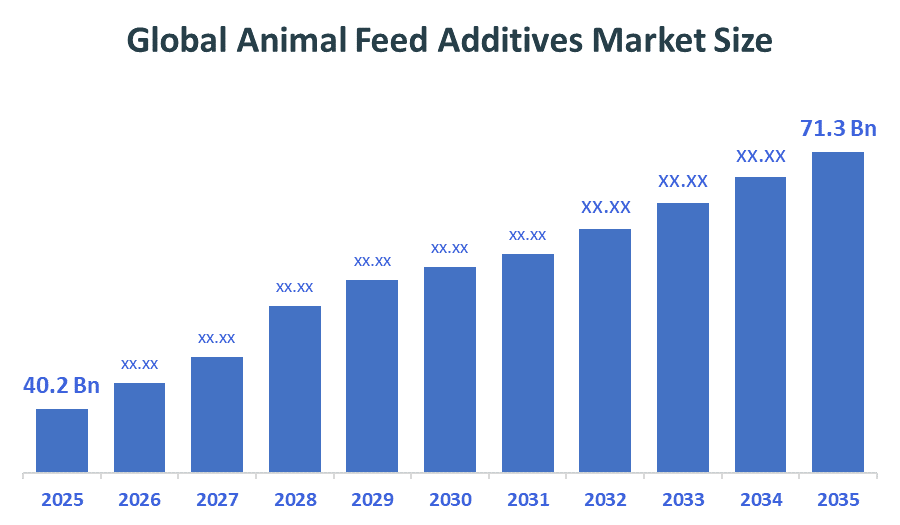
The Global Animal Feed Additives Market Size is foreseen to grow from USD 40.2 Billion in 2025 and is govern to reach around USD 71.3 Billion by 2035. According to Decision Advisors, a detailed research report on the Global Animal Feed Additives Market is boosted by a shift toward sustainable, antibiotic-free production, accounting for nearly up to the 40-50% share of the total share worldwide. Cargill, Incorporated is the prime player in the market with approximately USD 44.42 Billion in annual turnover and a 30-40% market share, positioning it as the primary driver of the Global Animal Feed Additives Market.
Market Snapshot
- Global Animal Feed Additives Market Size (2025): USD 40.2 Billion
- Projected Global Animal Feed Additives Market Size (2035): USD 71.3 Billion
- Global Animal Feed Additives Market Compound Annual Growth Rate (CAGR): 5.9%
- Largest Growing Region: North America
- Fastest Regional Market: Asia Pacific
- 3rd Largest Region: Europe
- Base Year: 2025
- Historical Period: 2021–2024
- Forecast Period: 2026–2035
Market Overview/ Introduction
The animal feed additives market is the modern wellness industry for livestock. At its core, it’s about ditching basic filler food and moving toward a precision diet that includes vitamins, minerals, and healthy bacteria to help animals thrive. What’s really changing the game are the practical initiatives from giant companies and world leaders. Lots of companies like Cargill and DSM-Firmenich aren't just selling bags of feed anymore, they are calling green additives such as plant extracts and insect proteins that help cows produce less methane and chickens stay healthy without drugs. At the same time, governments are stepping in with new laws to fast-track these natural ingredients, making it convenient for farmers to move away from old-school antibiotics. Looking ahead, the biggest opportunity lies in this natural revolution. As consumers demand safe and eco-friendly food, the market is trending toward phytogenic (herbs and spices) and probiotics. The upcoming journey isn't just about making animals grow bigger, it’s about using smart science to raise them in a way that’s better for the animal, better for our health, and much kinder to the planet.
- DSM-Firmenich partnered with local distributors in Asia to expand access to advanced feed additives and strengthen regional supply chains.
- India’s National Livestock Mission (NLM) supports improved feed and fodder practices, directly boosting additive adoption.
- Cargill Incorporated has collaborated with biotechnology firms to develop enzyme-based and sustainable feed solutions for improved livestock productivity.
Notable Insights: -
- North America is anticipated to hold approximately 35% share of the global animal feed additives market over the predicted timeframe.
- Asia Pacific is the fastest-growing region in the global animal feed additives market during the forecast period, holding approximately 39% share.
- By product type, the amino acids segment dominated the market and holds approximately 32% share in 2025 and is projected to grow at a substantial CAGR during the forecast period.
- By function, the nutrition enhancement segment dominated the market and holds approximately 36% share in 2025 and is projected to grow at a substantial CAGR during the forecast period.
- The compound annual growth rate of the global animal feed additives market is 5.9%.
- The market is likely to achieve a valuation of USD 71.3 Billion by 2035.
What is the role of technology in grooming the market?
Technology plays a crucial role in shaping the Animal Feed Additives Market by enhancing product efficiency, safety, and sustainability. Advanced techniques such as biotechnology and precision nutrition enable the development of targeted additives like enzymes and probiotics that improve digestion, immunity, and feed conversion rates. Digital tools, including data analytics and smart farming systems, help monitor animal health and optimize feed formulations in real time. Additionally, innovations in encapsulation and delivery systems ensure better nutrient absorption and stability, while supporting the shift toward antibiotic-free and eco-friendly solutions.
Market Drivers
The global animal feed additives market is essentially evolving into a science-backed pharmacy for livestock, driven by a world that wants more meat and dairy but with a much cleaner conscience. As global populations grow and middle-class incomes rise, the demand for high-quality protein is skyrocketing, forcing farmers to find ways to raise healthier animals more efficiently. This has created a huge shift toward precision nutrition, where additives aren't just fillers, but high-tech tools used to maximise every ounce of feed. At the same time, a powerful green wave is reshaping the industry. With strict new laws banning traditional antibiotics and growing surrounding population pressure to reduce the environmental footprint of farming, the market is tending toward natural alternatives. We’re seeing a surge in super additives like probiotics and plant-based extracts that boost animal immunity naturally and even helps reduce methane emissions. Essentially, the market is being propelled by a dual need, the necessity to feed a hungry planet and the urgent demand to do it sustainably and safely.
Restrain
The Animal Feed Additives Market faces several restraints, including the high cost of advanced and speciality additives, which can limit adoption among small-scale farmers. Stringent regulatory approvals and compliance requirements across different regions also slow down product launches. Additionally, fluctuating raw material prices and limited awareness about the benefits of feed additives in developing markets further hinder market growth.
Competitive Analysis:
The report offers the appropriate analysis of the key organizations/companies involved within the global animal feed additives market, along with a comparative evaluation primarily based on their product of offering, business overviews, geographic presence, enterprise strategies, segment market share, and SWOT analysis. The report also provides an elaborative analysis focusing on the current news and developments of the companies, which includes product development, innovations, joint ventures, partnerships, mergers & acquisitions, strategic alliances, and others. This allows for the evaluation of the overall competition within the market.
Top Companies in the Global Animal Feed Additives Market
- Cargill, Incorporated
- ADM
- dsm-firmenich
- Evonik Industries AG
- BASF SE
- Adisseo
- Nutreco N.V.
- Kemin Industries, Inc.
- Alltech, Inc.
- Novus International, Inc.
Government Initiatives
|
Country |
Key Government Initiatives |
|
US |
The FDA is investing heavily in agency modernisation and data infrastructure ($2 million and $8.3 million, respectively) to improve oversight and speed up the approval process for new feed ingredients. |
|
Germany |
The German Federal Government has allocated significant funds toward restructuring the agricultural sector, including a €3 billion investment to support sustainability and improvements in livestock farming. |
|
Canada |
Government funding, including a $3.4 million investment in companies like AbCelex Technologies, supports the development of non-antibiotic feed additives (e.g., "nanobodies") to combat food-borne bacteria like Salmonella. |
Study on the Supply, Demand, Distribution, and Market Environment of the Global Animal Feed Additives Market
The global Animal Feed Additives Market reflects a well-structured supply demand ecosystem supported by large-scale livestock production and strong distribution networks. On the demand side, the market was valued at around USD 44.42 billion in 2025 and is projected to reach USD 67.26 billion by 2033, growing at a CAGR of about 5.6%, driven by rising consumption of meat, dairy, and aquaculture products worldwide. Supply is dominated by multinational players with integrated manufacturing and global distribution channels, ensuring consistent availability of additives such as amino acids, enzymes, and probiotics. Distribution occurs through feed manufacturers, premix suppliers, and direct farm-level channels, supported by long-term supplier relationships. The overall market environment is innovation-driven and regulation-sensitive, with increasing emphasis on feed efficiency, sustainability, and antibiotic-free solutions shaping both supply strategies and consumption patterns globally.
Price Analysis and Consumer Behaviour Analysis
The price analysis of the Animal Feed Additives Market shows significant volatility due to fluctuating raw material costs and supply chain disruptions, with nearly 30% of manufacturers reporting seasonal shortages impacting pricing and overall cost structures. Additionally, about 34% of feed buyers are highly price-sensitive, pushing demand toward cost-effective synthetic additives despite the rising popularity of premium natural products. From a consumer behaviour perspective, increasing awareness of food quality and safety is influencing purchasing patterns, as demand for antibiotic-free and sustainable livestock products rises. This shift is reflected in the growing adoption of natural additives and functional ingredients, supported by the overall market expansion to USD 44.42 billion in 2025, indicating strong end-user willingness to invest in improved animal nutrition and product quality.
Market Segmentation
The Global Animal Feed Additives Market is classified into product type, application and end user.
- The amino acids segment dominated the market and holds approximately 32% share in 2025 and is projected to grow at a substantial CAGR during the forecast period.
Based on the product type, the global animal feed additives market is divided into amino acids, vitamins, minerals, enzymes, acidifiers, probiotics & prebiotics, antioxidants, antibiotics, flavours & sweeteners, and mycotoxin detoxifiers. Among these, the amino acids segment dominated the market and holds approximately 32% share in 2025 and is projected to grow at a substantial CAGR during the forecast period. This dominance is attributed to their essential role in protein synthesis, improving feed efficiency, and supporting optimal animal growth. Amino acids such as lysine and methionine are widely used across poultry and swine feed, making them indispensable in livestock nutrition. Additionally, their ability to reduce feed costs and enhance productivity is further driving segment growth.
- The poultry segment accounted for the largest share of approximately 45% in 2025 and is anticipated to grow at a significant CAGR during the forecast period.
Based on the livestock, the global animal feed additives market is divided into poultry, swine, ruminants, aquaculture, pets, and others. Among these, the poultry segment accounted for the largest share of approximately 45% in 2025 and is anticipated to grow at a significant CAGR during the forecast period. This is primarily due to the high global consumption of poultry meat and eggs, along with shorter production cycles and efficient feed conversion ratios. Feed additives are extensively used in poultry to enhance growth performance, immunity, and overall health. Furthermore, increasing demand for affordable protein sources and rising commercial poultry farming are significantly contributing to the growth of this segment.
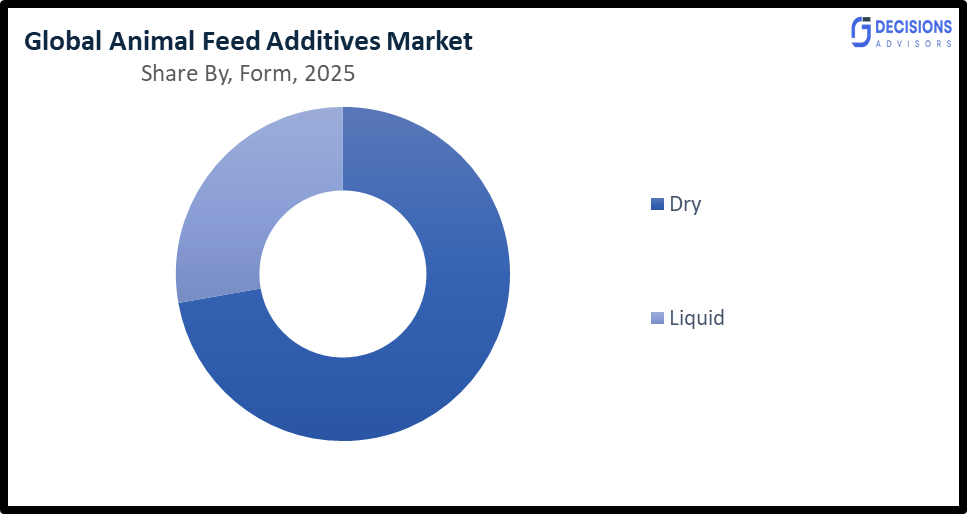
- The dry segment dominated the market and holds approximately 62% share in 2025 and is projected to grow at a substantial CAGR during the forecast period.
Based on the form, the global animal feed additives market is divided into dry and liquid. Among these, the dry segment dominated the market and holds approximately 62% share in 2025 and is projected to grow at a substantial CAGR during the forecast period, owing to its ease of storage, longer shelf life, and convenient handling during feed processing. Dry additives are widely preferred in premix formulations and large-scale feed manufacturing. Additionally, their cost-effectiveness and stability under varying environmental conditions are further supporting segment growth.
- The synthetic segment accounted for the largest share of approximately 58% in 2025 and is anticipated to grow at a significant CAGR during the forecast period.
Based on the source, the global animal feed additives market is divided into synthetic and natural. Among these, the synthetic segment accounted for the largest share of approximately 58% in 2025 and is anticipated to grow at a significant CAGR during the forecast period. This is primarily due to their consistent quality, cost efficiency, and large-scale production capabilities. Synthetic additives are widely used to meet specific nutritional requirements and ensure uniform feed performance. However, the growing demand for natural and organic products is gradually influencing market dynamics.
- The nutrition enhancement segment dominated the market and holds approximately 36% share in 2025 and is projected to grow at a substantial CAGR during the forecast period.
Based on the function, the global animal feed additives market is divided into nutrition enhancement, gut health improvement, disease prevention, feed efficiency improvement, and growth promotion. Among these, the nutrition enhancement segment dominated the market and holds approximately 36% share in 2025 and is projected to grow at a substantial CAGR during the forecast period. This dominance is attributed to the increasing need to improve the nutritional value of animal feed to boost productivity and overall health. Feed additives that enhance nutrient absorption and metabolism are widely adopted across livestock sectors. Additionally, the rising focus on high-quality animal products is further driving segment growth.
Strategies to Implement for Growth of the Market in Non-Leading Regions
To drive growth in non-leading regions, companies in the Animal Feed Additives Market should focus on cost-effective product offerings, local partnerships, and farmer education programs. Expanding distribution through regional feed mills and cooperatives can improve accessibility, while investing in awareness campaigns helps demonstrate the benefits of feed additives in improving yield and animal health. For example, Cargill Incorporated has strengthened its presence in emerging markets like India and Vietnam by partnering with local producers and launching affordable feed solutions tailored to regional livestock needs. Similarly, DSM-Firmenich has expanded in Africa through training programs and sustainable nutrition initiatives, helping farmers adopt advanced feed practices and boosting market penetration.
Regional Segment Analysis of the Global Animal Feed Additives Market
- North America (U.S., Canada, Mexico)
- Europe (Germany, France, U.K., Italy, Spain, Rest of Europe)
- Asia-Pacific (China, Japan, India, Rest of APAC)
- South America (Brazil and the Rest of South America)
- The Middle East and Africa (UAE, South Africa, Rest of MEA)
North America is anticipated to hold approximately 35% share of the global animal feed additives market over the predicted timeframe.
North America is anticipated to hold approximately 35% share of the global animal feed additives market over the predicted timeframe. It maintains a dominant market position due to advanced livestock farming practices, high awareness regarding animal nutrition, and the strong presence of key market players. The United States is the key contributor, supported by large-scale commercial farming and increasing demand for high-quality meat and dairy products. For instance, feed manufacturers in the U.S. widely use amino acids and enzyme-based additives to improve feed efficiency and reduce production costs. Additionally, recent developments such as Cargill’s expansion of its feed additive production capacity in 2024 and increasing investments in sustainable nutrition solutions are further strengthening the region’s leadership.
Asia Pacific is the fastest-growing region in the global animal feed additives market during the forecast period, holding approximately 39% share.
Asia Pacific is the fastest-growing region in the global animal feed additives market during the forecast period, holding approximately 39% share. This growth is driven by the rising livestock population, increasing demand for protein-rich food, and rapid expansion of the poultry and aquaculture industries in countries such as China, India, and Vietnam. The region is witnessing strong adoption of feed additives to enhance productivity and prevent diseases in livestock. For example, in India and China, probiotics and enzyme-based additives are increasingly used to improve gut health and feed conversion ratios. Additionally, recent government initiatives, such as livestock health improvement programs in India and the expansion of feed production facilities by DSM-Firmenich in Asia in 2025, are accelerating market growth.
Europe is expected to hold approximately 22% share and is the 3rd-largest region in the Global Animal Feed Additives Market during the forecast period.
Europe is expected to hold approximately 22% share and is the 3rd-largest region in the Global Animal Feed Additives Market during the forecast period. The region’s growth is supported by strict regulations on antibiotic usage, a strong focus on animal welfare, and high adoption of natural and sustainable feed additives. Countries such as Germany, France, and the United Kingdom are leading the market due to increasing demand for organic and antibiotic-free animal products. For instance, feed producers across Europe are increasingly incorporating probiotics and phytogenic additives as alternatives to antibiotics. Additionally, recent developments such as BASF’s launch of new enzyme solutions for sustainable animal nutrition in 2024 and ongoing research investments are contributing to innovation and market expansion.
Future Market Trends in the Global Animal Feed Additives Market:
1. Rising Shift Toward Natural & Antibiotic-Free Additives
The market is witnessing a strong transition from synthetic to natural feed additives such as probiotics, enzymes, and phytogenic due to increasing regulatory restrictions on antibiotics and growing consumer demand for clean-label animal products. Currently, natural additives are among the fastest-growing segments, while synthetic additives still hold a dominant share of over 65% in 2025, indicating a gradual but steady shift toward sustainable alternatives.
2. Adoption of Precision Nutrition & Functional Additives
Precision nutrition is becoming a key trend, where feed formulations are optimised based on species-specific and performance-based requirements. Around 42% of feed formulators now prioritise enzymes, amino acids, and precision minerals to improve feed conversion efficiency and reduce waste, highlighting the growing importance of performance-driven additive solutions.
3. Increasing Focus on Sustainability & Feed Efficiency
Sustainability is shaping future demand, with emphasis on reducing environmental impact and improving livestock productivity. The global market is driven by the need for efficient feed utilisation, lower emissions, and higher-quality animal output.
Recent Development
- In March 2026, Volta Greentech raised approximately €1.7 million (18 million SEK) in a funding round led by Axel Johnson to support the commercial launch of its innovative feed additive, Lome.
- In October 2025, Alembic Pharmaceuticals Ltd., in collaboration with Amlan International, launched two advanced poultry feed additive solutions, MinerTox-Z and MinerTox-A in India. These products are designed to protect poultry from harmful fungal and bacterial toxins while improving immunity, productivity, and overall flock performance.
- In September 2025, DSM-Firmenich inaugurated its first feed additive manufacturing plant in Hyderabad, marking a significant step in strengthening its presence in the Asia-Pacific region. The 11,200-square-meter facility produces advanced mycotoxin management solutions such as Mycofix products, helping farmers tackle feed contamination challenges caused by climate change and poor harvesting conditions.
- In March 2022, a study published in Scientific Reports introduced a new feed additive designed to enhance nutrient utilisation in ruminants through controlled release technology. The additive combines urea with carbohydrate sources such as cassava starch or sugarcane molasses, coated with natural carnauba wax to regulate nutrient release in the rumen.
Market Segment
This study forecasts revenue at global, regional, and country levels from 2020 to 2035. Decision Advisors has segmented the global animal feed additives market based on the below-mentioned segments:
Global Animal Feed Additives Market, By Product Type
- Amino Acids
- Vitamins
- Minerals
- Enzymes
- Acidifiers
- Probiotics & Prebiotics
- Antioxidants
- Antibiotics
- Flavors & Sweeteners
- Mycotoxin Detoxifiers
Global Animal Feed Additives Market, By Livestock
- Poultry
- Swine
- Ruminants
- Aquaculture
- Pets
- Others
Global Animal Feed Additives Market, By Form
- Dry
- Liquid
Global Animal Feed Additives Market, By Source
- Synthetic
- Natural
Global Animal Feed Additives Market, By Function
- Nutrition Enhancement
- Gut Health Improvement
- Disease Prevention
- Feed Efficiency Improvement
- Growth Promotion
Global Animal Feed Additives Market, By Regional Analysis
- North America
- US
- Canada
- Mexico
- Europe
- Germany
- UK
- France
- Italy
- Spain
- Russia
- Rest of Europe
- Asia Pacific
- China
- Japan
- India
- South Korea
- Australia
- Rest of Asia Pacific
- South America
- Brazil
- Argentina
- Rest of South America
- Middle East & Africa
- UAE
- Saudi Arabia
- Qatar
- South Africa
- Rest of the Middle East & Africa
Frequently Asked Questions (FAQ)
Q1. How do feed additives influence the nutritional value of animal feed?
A. Feed additives enhance the nutritional profile of feed by improving nutrient absorption, digestion, and overall feed efficiency, leading to better growth and productivity in animals.
Q2. What factors determine the selection of feed additives for different livestock?
A. The choice of feed additives depends on factors such as animal species, age, health condition, production goals, and environmental conditions, ensuring optimal performance and health outcomes.
Q3. How do feed additives contribute to disease prevention in livestock?
A. Certain additives like probiotics, prebiotics, and organic acids improve gut health and immunity, reducing the risk of infections and minimising the need for antibiotics.
Q4. What challenges are associated with the use of feed additives in developing regions?
A. Key challenges include high costs, lack of awareness among farmers, limited access to quality products, and inadequate distribution networks.
Q5. How do feed additives impact feed conversion efficiency in animals?
A. Feed additives improve digestion and nutrient utilisation, enabling animals to convert feed into body mass more efficiently, thereby reducing feed costs and enhancing productivity.
Check Licence
Choose the plan that fits you best: Single User, Multi-User, or Enterprise solutions tailored for your needs.
We Have You Covered
- 24/7 Analyst Support
- Clients Across the Globe
- Tailored Insights
- Technology Tracking
- Competitive Intelligence
- Custom Research
- Syndicated Market Studies
- Market Overview
- Market Segmentation
- Growth Drivers
- Market Opportunities
- Regulatory Insights
- Innovation & Sustainability
Report Details
| Scope | Global |
| Pages | 210 |
| Delivery | PDF & Excel via Email |
| Language | English |
| Release | Apr 2026 |
| Access | Download from this page |