
Global Anorexia Market
 |
Pages:
210
|
Pages:
210
Global Anorexia Market Size, Share, By Treatment Type (Psychotherapy, Pharmacotherapy, Nutritional Counseling), By Age Group (Children & Adolescents, Adults), By Severity Level (Mild, Moderate, and Severe), By End User (Hospitals, Clinics, Homecare), and By Region (North America, Europe, Asia-Pacific, Latin America, Middle East, and Africa), Analysis and Forecast 2025 ? 2035
REPORT COVERAGE
Global
Market Snapshot
- Market Size (2025): USD 106.4 Billion
- Projected Market Size (2035): USD 586.9 Billion
- Compound Annual Growth Rate (CAGR): 3.96%
- Largest Regional Market: North America
- Fastest Growing Region: Asia Pacific
- 2nd Largest Region: Europe
- Base Year: 2025
- Historical Period: 2021–2024
- Forecast Period: 2025–2035
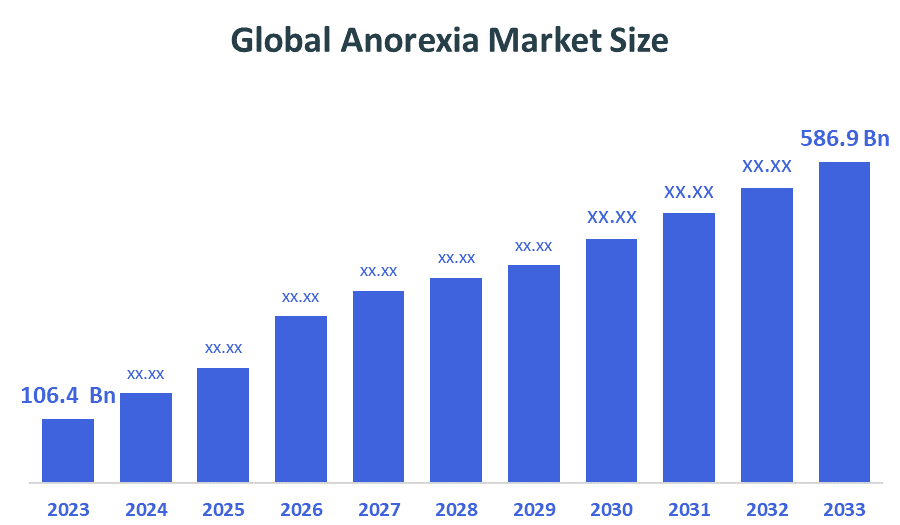
According to Decision Advisors, the Global Anorexia Market Size is expected to grow from USD 106.4 billion in 2025 to USD 586.9 billion by 2035, at a CAGR of 18.62% during the forecast period 2025-2035. The global anorexia market is driven by the rising cases of imbalance in certain neurotransmitters, particularly serotonin and dopamine, which contribute to the complex interplay of biological, psychological, and environmental factors that underlie the disorder, and are primarily driving the anorexia market.
Market Overview/ Introduction
The anorexia market includes all international healthcare resources and pharmaceutical products that are used to diagnose and treat Anorexia Nervosa, which is an eating disorder that causes people to lose excessive weight and have distorted perceptions of their body and limit their food consumption. The market experiences growth because people now understand mental health better, while there has been a rise in eating disorder cases among adolescents and young adults and behavioral healthcare services have become more accessible in various regions worldwide.
Mental health awareness programs need expansion because they present major opportunities for development in emerging markets, while their early diagnosis programs need better execution. The increasing availability of telepsychiatry services, with digital therapy platforms, enables more people to receive mental health treatment. The combination of ongoing drug treatment research, with expanded insurance coverage and multidisciplinary treatment methods, drives future market growth potential.
The American Psychiatric Association (APA) and AvoMD, a software company that develops clinical evidence translation systems for medical workflows, created an interactive screening and assessment tool for eating disorders, which is based on the APA's latest Practice Guideline for the Treatment of Patients with Eating Disorders.
The Australia & New Zealand Academy for Eating Disorders (ANZAED) received positive news from the Federal Government because they announced 0.8 million in funding, which will last for two years from 2025 to 2026. The government funding will support the development and expansion of two projects: the ANZAED Eating Disorder Credential and a national public awareness campaign.
- A 13% increase in referrals (from 7,008 to 7,933) in September 2025.
- The 2024/25 planned spend for children and young people’s eating disorder services in England is 101.0 million, a real terms increase of 2.9% on the 2023/24 spend (98.1 million).
- The Federal Government’s Mid-Year Economic and Fiscal Outlook MYEFO budget announced, with over 26 million in funding dedicated to addressing unmet gaps in the eating disorder system of care, following consistent and compelling advocacy from the Group to extend funding for existing services.
Notable Insights: -
- North America holds the largest regional market share, approximately 44.63% in the global Anorexia market.
- Asia Pacific is the fastest-growing region in the global anorexia market.
- By cause, the viral infection segment held a dominant position in market share in 2025.
- By treatment type, the antibiotics segment is the dominating one in global market share in 2025.
- The compound annual growth rate of the global anorexia market is 18.62%.
- The market is likely to achieve a valuation of USD 586.9 billion by 2035.
What is the role of technology in grooming the market?
Technology plays a crucial role in shaping the anorexia market, as telemedicine and digital mental health platforms provide remote therapy sessions, which enable patients in underserved areas to receive treatment. Mobile health applications, with wearable technology, enable users to track their eating habits, exercise routines and psychological patterns throughout the day. Artificial intelligence (AI) uses behavioral and clinical data analysis to identify problems at an early stage, which enables healthcare providers to implement preventive measures. Virtual support groups, with online counseling services create better opportunities for patients to stay involved with their treatment process while maintaining their relationships with healthcare providers. The development of electronic health record (EHR) systems together with advanced data analytics capabilities creates better opportunities for customized treatment design and healthcare decision support systems. The global management of anorexia nervosa now uses these technological advancements to create better treatment methods which focus on patient needs while enabling healthcare systems to expand their services.
Market Drivers
The global anorexia market is driven by the commonality of eating disorders has risen while people now recognize mental health issues and they can obtain psychological and nutritional treatments. The treatment options for teenagers and young adults have expanded because more people are using telehealth and digital mental health platforms. The market expansion benefits from government programs and mental health service insurance coverage. The development of multidisciplinary treatment methods which integrate psychotherapy with medication and nutritional recovery has improved patient treatment results.
For instance, companies are exploring novel pharmacological therapies and digital therapeutics to address anorexia nervosa, a segment with limited approved drugs
Restrain
The anorexia market is hindered due to mental health problems, expensive treatment options and the possibility of relapse, all of which serve as obstacles that prevent market expansion. The global healthcare system faces challenges because there are not enough qualified specialists to deliver optimal care to patients. The healthcare system in developing regions faces three major challenges, which include restricted access to approved medications, a need for continuous psychotherapy and limited mental health diagnosis capabilities.
Competitive Analysis:
The report offers the appropriate analysis of the key organizations/companies involved within the anorexia market, along with a comparative evaluation primarily based on their product of offering, business overviews, geographic presence, enterprise strategies, segment market share, and SWOT analysis. The report also provides an elaborative analysis focusing on the current news and developments of the companies, which includes product development, innovations, joint ventures, partnerships, mergers & acquisitions, strategic alliances, and others. This allows for the evaluation of the overall competition within the market.
Top Companies in Global Anorexia Market
- Pfizer Inc.
- Eli Lilly and Company
- GlaxoSmithKline plc
- Johnson & Johnson
- AstraZeneca plc
- Novartis AG
- Sanofi S.A.
- Takeda Pharmaceutical Company Limited
- Otsuka Pharmaceutical Co., Ltd.
- H. Lundbeck A/S
Government Initiatives
|
Country |
Key Government Initiatives |
|
US |
The U.S. government has introduced policies like the 21st Century Cures Act, improving insurance coverage, awareness programs, and professional training for eating disorders. Advocacy groups also push for legislation such as the FREED Act to expand research funding and treatment access. |
|
UK |
The UK focuses on NHS-led mental health programs and early intervention strategies for youth. Government-backed initiatives emphasize awareness, school-based support, and workforce expansion, although gaps remain in adult care, and a comprehensive national eating disorder strategy is still evolving. |
|
India |
India is witnessing a rising focus through institutions like NIMHANS, promoting research, awareness, and collaboration on eating disorders. However, the lack of standardized national guidelines and limited specialized treatment centers remain key challenges, indicating strong future policy opportunities |
|
China |
China is improving mental healthcare through healthcare infrastructure expansion and public awareness campaigns. Government support for psychiatric services and integration of mental health into primary care is gradually increasing recognition and diagnosis of anorexia and other eating disorders in urban populations. |
Market Segmentation
The anorexia market share is classified into cause, treatment type, and severity.
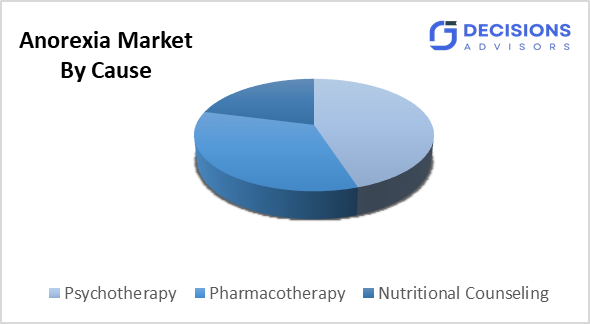
- The psychotherapy segment dominated the market in 2025, and is projected to grow at a substantial CAGR during the forecast period.
Based on cause, the anorexia market is divided into psychotherapy, pharmacotherapy, nutritional counseling. Among these, the psychotherapy segment dominated the market in 2025 and is projected to grow at a substantial CAGR during the forecast period. The growth of the segment is driven by the initial treatment method which successfully treats fundamental psychological and behavioral problems serves as the primary treatment method for this condition. The treatment shows strong clinical evidence, which makes it the first treatment choice for patients and an essential treatment for their long-term recovery. The treatment shows higher patient acceptance rates because it combines pharmacotherapy with nutritional counseling.
- The children & adolescents segment accounted for the largest share in 2025, and is anticipated to grow at a significant CAGR during the forecast period.
Based on the treatment type, the anorexia market is divided into children & adolescents, adults. Among these, the children & adolescents segment accounted for the largest share in 2025 and is anticipated to grow at a significant CAGR during the forecast period. The disorder most commonly develops during teenage years. This group needs treatment because they show early onset in their condition, and their diagnosis rates are higher than those of others, and they require more help from their parents and medical professionals than adults do.
- The moderate segment dominated the market in 2025, and is projected to grow at a substantial CAGR during the forecast period.
Based on the severity, the anorexia market is divided into mild, moderate, severe. Among these, the moderate segment dominated the market in 2025 and is projected to grow at a substantial CAGR during the forecast period. The segmental growth is driven by the medical condition demands permanent medical treatment together with ongoing mental health care, which can be done without requiring hospital stays. The condition becomes more common because people can obtain treatment at affordable costs, and they can access treatment through outpatient services.
- The hospitals segment dominated the market in 2025, and is projected to grow at a substantial CAGR during the forecast period.
Based on the severity, the anorexia market is divided into hospitals, clinics, homecare. Among these, the hospitals segment dominated the market in 2025 and is projected to grow at a substantial CAGR during the forecast period. The growth of the segment is that the hospital system establishes its superiority over clinics and home care services because it can treat more patients with complications who need hospital admission and receive better financial support from insurance companies. The hospital system establishes its superiority over clinics and home care services because it can treat more patients with complications who need hospital admission and receive better financial support from insurance companies.
Regional Segment Analysis of the Anorexia Market
- North America (U.S., Canada, Mexico)
- Europe (Germany, France, U.K., Italy, Spain, Rest of Europe)
- Asia-Pacific (China, Japan, India, Rest of APAC)
- South America (Brazil and the Rest of South America)
- The Middle East and Africa (UAE, South Africa, Rest of MEA)
North America is anticipated to hold the largest share of the anorexia market over the predicted timeframe.
North America is anticipated to hold the largest share of the Anorexia market over the predicted timeframe. North America holds the largest market share which ranges between 38 and 40 percent because the United States contains the largest patient population and the most sophisticated medical treatment centers. The growth of the market receives support from increased mental health expenditures and comprehensive insurance coverage, with higher rates of early diagnosis and specialized treatment centers for eating disorders. Government programs that operate in the region, with research initiatives, create a research environment that supports regional research activities. The main companies that drive innovation in the market are Pfizer, Eli Lilly, Johnson & Johnson, Otsuka Pharmaceutical, and H. Lundbeck. The companies are developing new antidepressant and antipsychotic medications together with digital therapeutic solutions. The latest advancements encompass mobile-based cognitive behavioral therapy platforms and tele-mental health systems, along with research studies that test new drug treatments for anorexia nervosa.
Asia Pacific is expected to grow at a rapid CAGR in the anorexia market during the forecast period. This region is projected to expand at a CAGR of around 7–8%, driven by rising mental health awareness, increasing eating disorder diagnosis rates, and improving healthcare infrastructure in countries like China, India, and Japan. Pharmaceutical and healthcare companies are actively launching and developing treatments to strengthen their presence. For example, AbbVie partnered with Gubra in 2025 to develop a long-acting amylin analog targeting metabolic and appetite-related conditions. Novo Nordisk expanded its pipeline through a $200 million collaboration to develop next-generation obesity and appetite-regulating therapies.
Europe is the 2nd largest region to grow in the anorexia market during the period. Europe holds a significant market share due to its well-established healthcare systems, strong mental health policies, and increasing awareness of eating disorders. In 2024, Europe accounted for a substantial portion of the market, supported by early diagnosis programs and government-backed treatment initiatives.
Strategies to Implement for Growth of the Market in Non-Leading Regions
To drive growth of the anorexia market in non-leading regions such as Latin America, the Middle East & Africa, stakeholders should prioritize awareness and early diagnosis programs to address underreporting and stigma around mental health. Expanding telepsychiatry and digital therapy platforms can improve access in remote areas. Governments and private players should invest in training specialized professionals and developing multidisciplinary treatment centers. Introducing affordable treatment models and insurance coverage will enhance accessibility. Partnerships with NGOs and schools can support early intervention among adolescents. Additionally, encouraging clinical research and localized treatment guidelines will strengthen market adoption and improve patient outcomes in these emerging regions
Future Market Trends in Global Anorexia Market: -
1. Shift Toward Personalized Treatment
The anorexia market is increasingly shifting toward personalized treatment approaches, where therapies are tailored based on individual factors such as psychological profile, metabolic condition, and severity level. This approach improves treatment effectiveness, enhances patient adherence, and supports long-term recovery by addressing unique patient needs rather than applying standardized treatment methods.
2. Growth of Digital Therapeutics & Telehealth
The growth of digital therapeutics and telehealth is transforming anorexia treatment by enabling remote consultations, therapy sessions, and continuous monitoring. Mobile apps and virtual care platforms improve accessibility, especially in underserved regions, enhance patient engagement, and support long-term management, reducing the need for frequent hospital visits and improving overall treatment adherence.
3. Multidisciplinary & Early Intervention Approaches
Multidisciplinary and early intervention approaches combine psychotherapy, nutritional counseling, and medical care to treat anorexia effectively. Early diagnosis, especially in adolescents, improves recovery outcomes and reduces complications. Coordinated care involving psychiatrists, dietitians, and physicians ensures comprehensive treatment.
Recent Development
In October 2021, Health-tech startup Within Health launched, becoming the first comprehensive, virtual treatment solution designed specifically for people suffering from eating disorders
How is Recent Developments Helping the Market?
Recent developments are significantly accelerating the growth of the global anorexia market by improving diagnosis, accessibility, and treatment outcomes. The rise of digital therapeutics, teletherapy, and mobile health platforms enables remote care, expanding access in underserved regions and enhancing patient engagement. Advancements in artificial intelligence (AI), virtual reality, and chatbot-based interventions are supporting early detection and personalized treatment plans, improving clinical effectiveness. Additionally, increased focus on mental health awareness, early intervention programs, and multidisciplinary care models is boosting diagnosis rates and treatment adoption. These innovations, along with ongoing R&D and digital health integration, are transforming anorexia management and driving sustained market growth globally.
Market Segment
This study forecasts revenue at global, regional, and country levels from 2020 to 2035. Decision Advisors has segmented the anorexia market based on the below-mentioned segments:
Global Anorexia Market, By Treatment Type
- Psychotherapy
- Pharmacotherapy
- Nutritional Counseling
Global Anorexia Market, By Age Group
- Children & Adolescents
- Adults
Global Anorexia Market, By Severity Level
- Mild
- Moderate
- Severe
Global Anorexia Market, By End User
- Hospitals
- Clinics
- Homecare
Global Anorexia Market, By Regional Analysis
- North America
- US
- Canada
- Mexico
- Europe
- Germany
- UK
- France
- Italy
- Spain
- Russia
- Rest of Europe
- Asia Pacific
- China
- Japan
- India
- South Korea
- Australia
- Rest of Asia Pacific
- South America
- Brazil
- Argentina
- Rest of South America
- Middle East & Africa
- UAE
- Saudi Arabia
- Qatar
- South Africa
- Rest of the Middle East & Africa
Frequently Asked Questions (FAQ).
Q: What role do hospitals play in anorexia treatment?
A: Hospitals play a critical role in managing severe anorexia cases requiring intensive monitoring, nutritional rehabilitation, and psychiatric care. They provide multidisciplinary treatment teams and advanced facilities, making them essential for handling life-threatening conditions and supporting market growth.
Q: What age group is most affected by anorexia?
A: Anorexia primarily affects adolescents and young adults, especially females, although cases are rising among males and older populations. Early onset during teenage years increases demand for pediatric and adolescent-focused treatment services, making this segment a key driver in the anorexia market.
Q: What is the role of insurance coverage in this market?
A: Insurance coverage significantly influences treatment access, as anorexia care often involves long-term therapy and hospitalization. Improved reimbursement policies in developed regions support market growth, while limited coverage in emerging markets restricts patient access to comprehensive care.
Q: How do technological advancements impact the anorexia market?
A: Technological advancements such as AI-based diagnostics, mobile health apps, and virtual therapy tools enhance early detection and personalized treatment. These innovations improve patient engagement, expand access to care, and support healthcare providers in delivering more effective treatment solutions.
Q: How do government initiatives support the market?
A: Governments support the market through mental health awareness campaigns, funding for research, and policy frameworks that improve access to treatment. Initiatives promoting early diagnosis and reducing stigma help increase patient engagement and drive demand for anorexia treatment services.
Check Licence
Choose the plan that fits you best: Single User, Multi-User, or Enterprise solutions tailored for your needs.
We Have You Covered
- 24/7 Analyst Support
- Clients Across the Globe
- Tailored Insights
- Technology Tracking
- Competitive Intelligence
- Custom Research
- Syndicated Market Studies
- Market Overview
- Market Segmentation
- Growth Drivers
- Market Opportunities
- Regulatory Insights
- Innovation & Sustainability
Report Details
| Scope | Global |
| Pages | 210 |
| Delivery | PDF & Excel via Email |
| Language | English |
| Release | Apr 2026 |
| Access | Download from this page |