
Global Architectural Coatings Market
 |
Author:
Aditya G
|
Pages:
230
|
Author:
Aditya G
|
Pages:
230
Global Architectural Coatings Market Size, Share By Resin Type (Acrylic, Alkyd, Epoxy, Polyurethane, Others), By Technology (Waterborne Coatings, Solvent-borne Coatings), By End-use (Residential, Non-residential), and By Region (North America, Europe, Asia-Pacific, Latin America, Middle East & Africa), Analysis and Forecast 2026-2035.
CAGR
5.0%
REVENUE 2025
USD Billion 82.15
FORECAST 2035
USD Billion 133.8
REPORT COVERAGE
Global
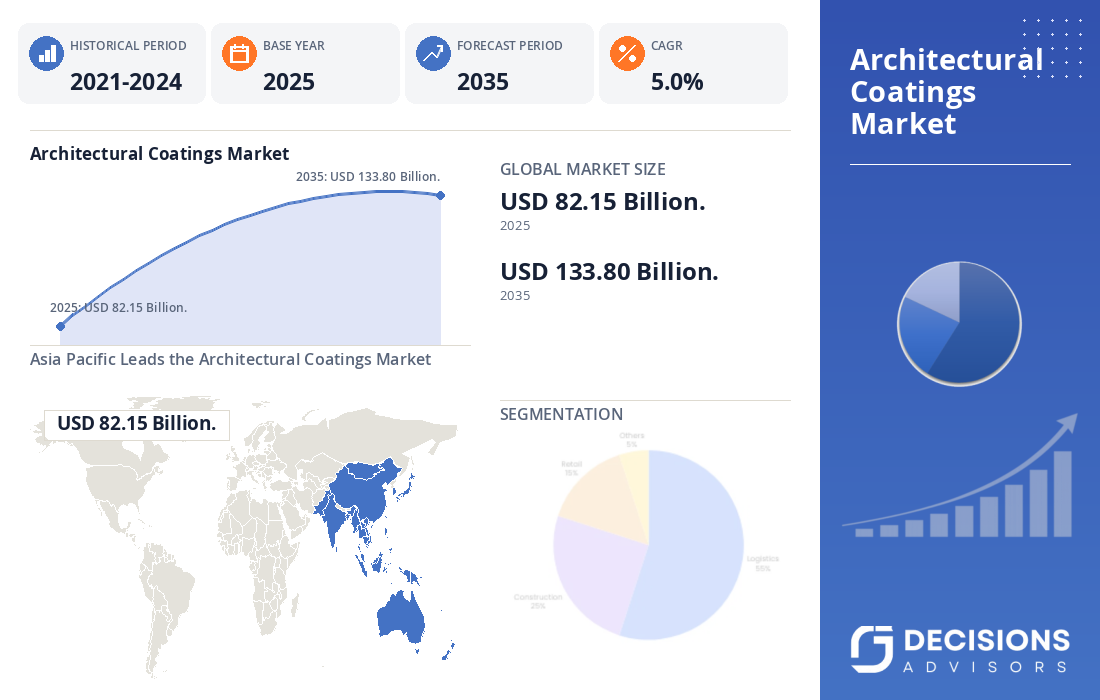
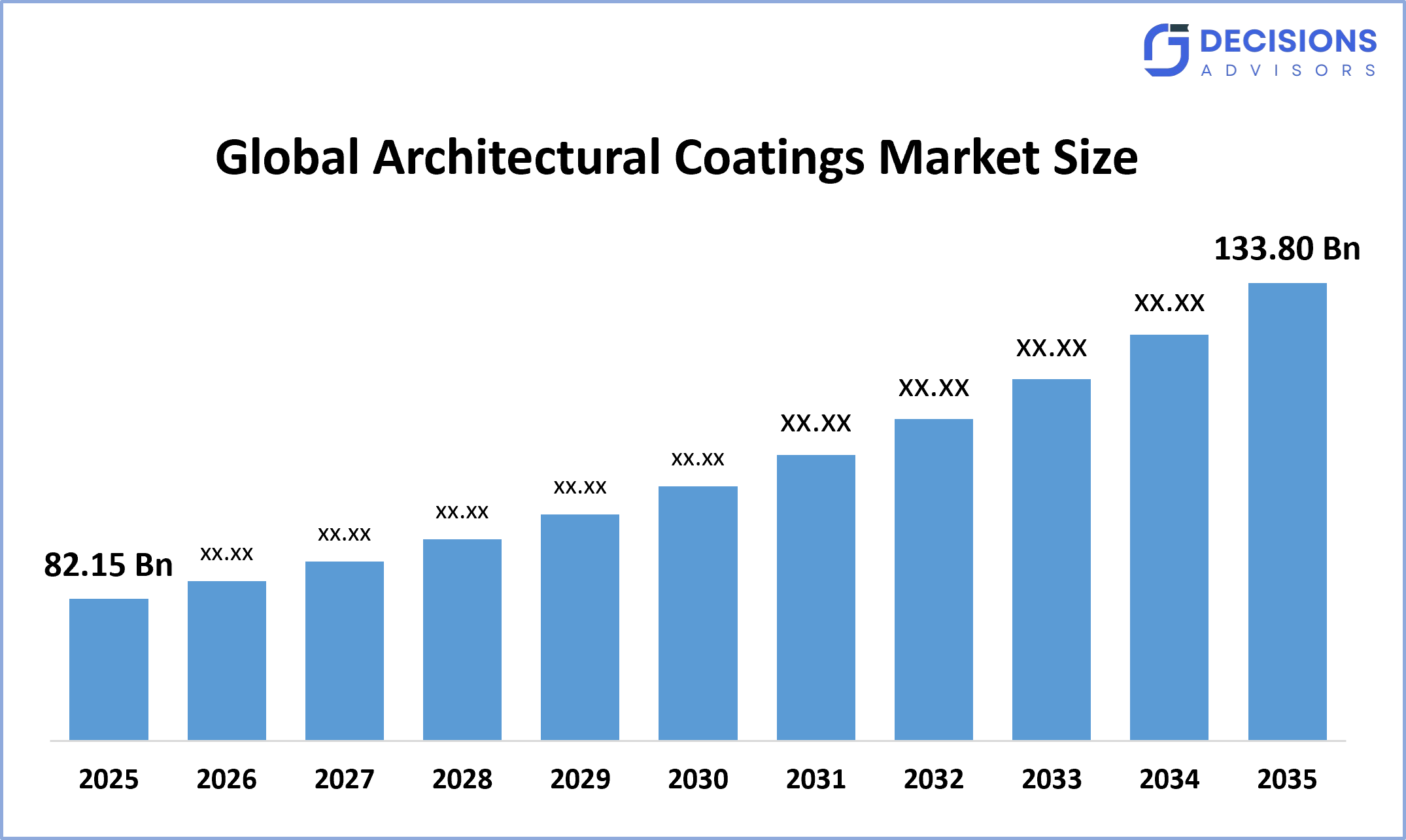
The Global Architectural Coatings Market Size is predicted to grow from USD 82.15 Billion in 2025 and is likely to reach around USD 133.80 Billion by 2035 with a CAGR of 5.0%. According to Decision Advisors, the market is being supported by residential construction, repainting and renovation, urbanization, commercial development, and increasing demand for waterborne and low-VOC formulations. Asia Pacific remains the largest regional contributor because of its substantial construction and housing activity.
Market Snapshot
- Global Architectural Coatings Market Size (2025): USD 82.15 Billion.
- Projected Global Architectural Coatings Market Size (2035): USD 133.80 Billion.
- Global Architectural Coatings Market CAGR: 5.0%.
- Largest Regional Market: Asia Pacific
- 2nd Largest Region: North America
- Fastest Growing Region: Latin America
- Base Year: 2025
- Historical Period: 2021-2024
- Market Forecast Period: 2026-2035
Market Overview/ Introduction
The Global Architectural Coatings Market covers paints and coatings applied to residential and non-residential buildings for decorative appearance and surface protection. These products are used across interior walls, ceilings, floors, façades, roofs, doors, windows, and other architectural surfaces. Demand is closely linked to new construction, refurbishment, repainting, property maintenance, urban development, and increasing consumer preference for premium decorative finishes. The market is also undergoing a formulation shift toward waterborne, low-VOC, durable, energy-efficient, and functional coatings. Environmental requirements are encouraging manufacturers to reduce emissions while maintaining coverage, adhesion, weather resistance, and color performance. The U.S. EPA's architectural-coatings VOC standards specifically require manufacturers and importers to limit VOC content because emissions can contribute to ground-level ozone formation.
- United States, VOC requirements for architectural coatings continue to encourage manufacturers to develop lower-emission coating formulations.
- China, Rapid urban renewal and demand for higher-performance façades are supporting advanced exterior coating technologies, including self-cleaning and thermal-control products.
- Japan, Investment in coating R&D and sustainability is increasing. Nippon Paint and the University of Tokyo launched a second phase of their industry-academia program focused on reducing VOC and CO? emissions and using AI in coating R&D
Notable Insights: -
- Asia Pacific is anticipated to hold approximately 41.80% share of the Global Architectural Coatings Market over the predicted timeframe.
- Latin America is expected to grow at the fastest rate in the Global Architectural Coatings Market, supported by residential construction, urbanization, and renovation activity.
- By Resin Type, the Acrylic segment dominated the market and holds approximately 41.70% share in 2025 and is projected to grow at a substantial CAGR during the forecast period.
- By Technology, the Waterborne Coatings segment dominated the market and holds approximately 56.30% share in 2025 and is projected to grow at a substantial CAGR during the forecast period.
- By End-use, the Residential segment dominated the market and holds approximately 61.40% share in 2025 and is projected to grow at a substantial CAGR during the forecast period.
- The compound annual growth rate of the Global Architectural Coatings Market is 5.0%.
- The market is likely to achieve a valuation of USD 133.80 Billion by 2035.
Market Drivers
The global architectural coatings market is primarily driven by expansion in residential and commercial construction, increasing renovation expenditure, urbanization, and recurring repainting requirements. New housing projects generate significant demand for interior and exterior coatings, while existing buildings create recurring demand through maintenance and refurbishment cycles. Developing economies are particularly important because population growth and urban migration are increasing the requirement for apartments, houses, offices, retail properties, schools, hospitals, and infrastructure-related buildings. Environmental sustainability is another major growth factor. Demand is shifting toward waterborne and low-VOC coatings because builders, contractors, property owners, and consumers increasingly prioritize environmental performance. Regulatory frameworks are reinforcing this transition. The U.S. architectural-coatings VOC standards provide a long-standing regulatory incentive for lower-emission formulations. Technological improvements are further expanding the market beyond conventional decorative paints. Manufacturers are developing self-cleaning, heat-reflective, thermal-control, antimicrobial, stain-resistant, and highly durable coatings.
Restrain
The global architectural coatings market faces restraints from fluctuating prices of raw materials such as acrylic and other resins, pigments, additives, titanium dioxide, and packaging materials. Energy and transportation costs can further increase manufacturing and distribution expenses. Environmental compliance also creates formulation and testing costs as manufacturers redesign products to meet increasingly stringent VOC and chemical requirements. The market is additionally influenced by construction cycles, interest rates, housing affordability, and consumer confidence.
Competitive Analysis:
The report offers the appropriate analysis of the key organizations/companies involved within the global architectural coatings market, along with a comparative evaluation primarily based on their product offerings, business overviews, geographic presence, enterprise strategies, segment market share, and SWOT analysis. The report also provides an elaborative analysis focusing on the current news and developments of the companies, which includes product development, innovations, joint ventures, partnerships, mergers & acquisitions, strategic alliances, and others. This allows for the evaluation of the overall competition within the market.
Top Companies in the Global Architectural Coatings Market
- Sherwin-Williams
- PPG Industries
- AkzoNobel
- Nippon Paint Holdings
- Asian Paints
- RPM International
- Kansai Paint
- Benjamin Moore
- Jotun
- Axalta Coating Systems.
Government Initiatives
|
Country |
Key Government Initiatives |
|
United States |
EPA national VOC emission standards for architectural coatings limit VOC content and encourage manufacturers toward lower-emission coating formulations |
|
Japan |
Building energy-efficiency policies and sustainability programs are encouraging improved building performance and energy-conscious construction practices |
|
China |
Environmental standards and urban-renewal programs are supporting cleaner coating formulations and advanced façade technologies, including self-cleaning and thermal-management coatings |
Market Segmentation
The global architectural coatings market share is classified into resin type, technology, and end-use.
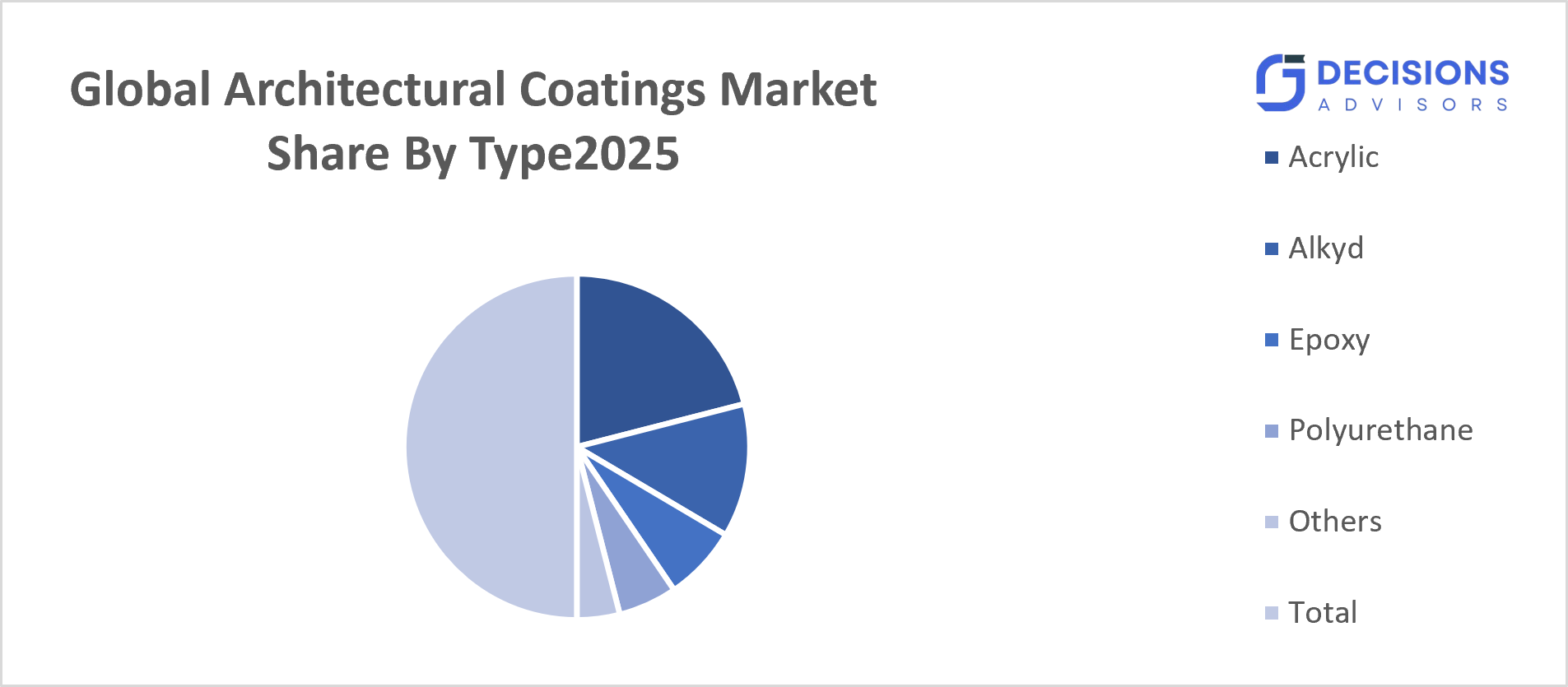
- The Acrylic segment dominated the market and holds approximately 41.70% share in 2025 and is projected to grow at a substantial CAGR during the forecast period.
Based on resin type, the global architectural coatings market is divided into acrylic, alkyd, epoxy, polyurethane, and others. Acrylic coatings dominate because they provide strong weather resistance, color retention, adhesion, flexibility, and cost efficiency. They are widely used in interior and exterior architectural applications and are compatible with both conventional and waterborne formulations. Their performance profile makes acrylic technology particularly attractive for residential repainting and exterior façade applications.
- The waterborne coatings segment accounted for the largest share of approximately 56.30% in 2025 and is anticipated to grow at a significant CAGR during the forecast period.
Based on technology, the market is divided into waterborne coatings and solvent-borne coatings. waterborne products are increasingly preferred because of lower VOC emissions, reduced odor, easier application, and suitability for indoor environments. Improvements in polymer and binder technology have enhanced durability, washability, adhesion, and weather resistance. Continued environmental regulation and sustainability-focused construction are expected to increase their market penetration.
- The residential segment accounted for the largest share of approximately 61.40% in 2025 and is anticipated to grow at a significant CAGR during the forecast period.
???????Based on end-use, the market is divided into Residential and Non-residential. Residential applications dominate because coatings are required across new houses, apartments, remodeling projects, and recurring repainting cycles. Population growth and urbanization support new housing construction, particularly across emerging economies. In developed markets, renovation and premium decorative finishes provide an additional source of recurring demand.
Regional Segment Analysis of the Global Architectural Coatings Market
- North America (U.S., Canada, Mexico)?
- Europe (Germany, U.K., France, Italy, Spain, Netherlands, Rest of Europe).
- Asia-Pacific (China, Japan, India, Australia, South Korea, Rest of Asia-Pacific).
- South America (Brazil, Argentina, Rest of South America).
- Middle East & Africa (UAE, Saudi Arabia, South Africa, Rest of MEA).
Asia Pacific is anticipated to hold approximately 41.80% share of the Global Architectural Coatings Market over the predicted timeframe.
The region remains the largest market because of its substantial residential construction base, urban redevelopment, infrastructure investment, and expanding middle-class population. China and India represent major contributors, while Japan, South Korea, and Southeast Asian economies provide additional opportunities. The region also has strong domestic paint manufacturing capabilities and extensive distribution networks. Demand is increasingly shifting toward premium decorative finishes, durable exterior coatings, waterborne products, and energy-efficient coating technologies.
North America is expected to maintain the second-largest position in the Global Architectural Coatings Market, holding approximately 23.40% of the share during the forecast period.
The U.S. remains the principal contributor because of its large installed housing base, renovation market, commercial construction activity, and established professional contractor network. Environmental requirements support continued investment in lower-VOC products. Major manufacturers also benefit from extensive retail and professional distribution systems. Sherwin-Williams states that its architectural coatings portfolio serves DIY, professional, commercial, and consumer customers across a broad global distribution network.
Europe is expected to hold approximately 19.60% share of the Global Architectural Coatings Market during the forecast period.
The European market is supported by renovation of older buildings, sustainability requirements, energy-efficiency improvements, and increasing demand for durable low-emission coatings. Germany, the U.K., France, Italy, and Spain remain important markets. Manufacturers are emphasizing lower-carbon production, waterborne chemistry, bio-attributed materials, and longer-life coatings. AkzoNobel has highlighted architectural powder-coating innovations incorporating bio-attributed raw materials and lower-energy curing technology.
Future Market Trends in Global Architectural Coatings Market: -
1. Expansion of Waterborne and Low-VOC Formulations
Waterborne architectural coatings are expected to continue gaining market share as environmental regulations and consumer preferences move the industry away from higher-emission formulations. New-generation binders are improving durability, stain resistance, weatherability, and color retention, reducing the performance gap between waterborne and solvent-borne products.
2. Growth of Thermal-Reflective and Energy-Efficient Coatings
Energy-efficient architectural coatings are becoming increasingly important as building owners seek to reduce cooling requirements. AkzoNobel has developed a coating system in China combining a radiative cooling topcoat with a thermal-radiation barrier mid-coat, demonstrating the growing role of coatings in building-energy management.
3. Self-Cleaning and Functional Exterior Coatings
Functional coatings are moving beyond conventional decoration and protection. Self-cleaning technologies can reduce maintenance requirements by helping rain remove accumulated dust and stains. AkzoNobel's TRINAR SC Series, launched in China, uses hydrophilic self-cleaning technology for demanding exterior architectural applications.
4. AI and Data-Driven Coating Development
Artificial intelligence is beginning to influence coating formulation, performance prediction, material selection, and R&D workflows. Nippon Paint's collaboration with the University of Tokyo is specifically using AI foundation models and multimodal data analysis to accelerate coating technology development while addressing environmental challenges.
Recent Development
- In February 2026, Nippon Paint Holdings and the University of Tokyo launched Phase II of their industry-academia co-creation initiative, focusing on environmentally friendly coating technologies, VOC and CO? reduction, and AI-assisted R&D.
- In August 2025, PPG and Asian Paints renewed their India joint-venture agreement for 15 years, extending the partnership from 2026 through 2041.
- In April 2025, BASF introduced Acronal® EDGE 4248, a high-performance binder for exterior architectural paints and primers, designed to provide improved weatherability, dirt-pickup resistance, adhesion, and low-VOC performance.
Market Segment
This study forecasts revenue at global, regional, and country levels from 2021 to 2035. Decision Advisors has segmented the global architectural coatings market based on the below-mentioned segment:
Global Architectural Coatings Market, By Resin Type.
- Acrylic
- Alkyd
- Epoxy
- Polyurethane
- Others.
Global Architectural Coatings Market, By Technology.
- Waterborne Coatings
- Solvent-borne Coatings.
Global Architectural Coatings Market, By End-use.
- Residential
- Non-residential.
Global Architectural Coatings Market, By Regional Analysis.
- North America
- US
- Canada
- Mexico
- Europe
- Germany
- UK
- France
- Italy
- Spain
- Russia
- Rest of Europe
- Asia Pacific
- China
- Japan
- India
- South Korea
- Australia
- Rest of Asia Pacific
- South America
- Brazil
- Argentina
- Rest of South America
- Middle East & Africa
- UAE
- Saudi Arabia
- Qatar
- South Africa
- Rest of the Middle East & Africa
Frequently Asked Questions (FAQ)
Q. What are the major factors driving the Global Architectural Coatings Market?
A. Residential construction, commercial development, renovation, repainting, urbanization, and demand for durable decorative finishes are the primary growth drivers. Sustainability requirements and demand for waterborne, low-VOC, and energy-efficient products are also expanding market opportunities.
Q. Why are waterborne architectural coatings gaining market share?
A. Waterborne coatings generally provide lower VOC emissions and lower odor than many solvent-borne alternatives. Improvements in formulation technology are also enabling better durability, washability, adhesion, and weather resistance.
Q. Which region dominates the Global Architectural Coatings Market?
A. Asia Pacific is expected to remain the largest regional market, with an estimated 41.80% share in the Decision Advisors assessment. High construction volumes, urbanization, housing development, and strong local paint manufacturing capacity support its leadership.
Q. What role does sustainability play in architectural coatings?
A. Sustainability is driving development of waterborne, low-VOC, bio-attributed, energy-efficient, and longer-life coatings. Regulatory requirements and customer demand are encouraging manufacturers to reduce the environmental impact of both coating formulations and manufacturing processes.
Check Licence
Choose the plan that fits you best: Single User, Multi-User, or Enterprise solutions tailored for your needs.
We Have You Covered
- 24/7 Analyst Support
- Clients Across the Globe
- Tailored Insights
- Technology Tracking
- Competitive Intelligence
- Custom Research
- Syndicated Market Studies
- Market Overview
- Market Segmentation
- Growth Drivers
- Market Opportunities
- Regulatory Insights
- Innovation & Sustainability
Report Details
| Scope | Global |
| Pages | 230 |
| Delivery | PDF & Excel via Email |
| Language | English |
| Release | Aug 2026 |
| Access | Download from this page |