
Global Artificial Intelligence in Microscopy Market
 |
Author:
Disha B
|
Pages:
267
|
Author:
Disha B
|
Pages:
267
Global Artificial Intelligence in Microscopy Market Size, Share, and COVID-19 Impact Analysis, By Component (Software, Hardware, and Services), By Technology (Deep Learning, Machine Learning, Computer Vision, and Others), and By Region (North America, Europe, Asia-Pacific, Latin America, Middle East, and Africa), Analysis and Forecast 2025 - 2035
CAGR
13.53%
REVENUE 2024
USD Billion 1.08
FORECAST 2035
USD Billion 4.36
REPORT COVERAGE
Global
Global Artificial Intelligence in Microscopy Market Size Insights Forecasts to 2035
- The Global Artificial Intelligence in Microscopy Market Size Was Estimated at USD 1.08 Billion in 2024
- The Market Size is Expected to Grow at a CAGR of around 13.53 % from 2025 to 2035
- The Worldwide Artificial Intelligence in Microscopy Market Size is Expected to Reach USD 4.36 Billion by 2035
- North America is expected to Grow the fastest during the forecast period.
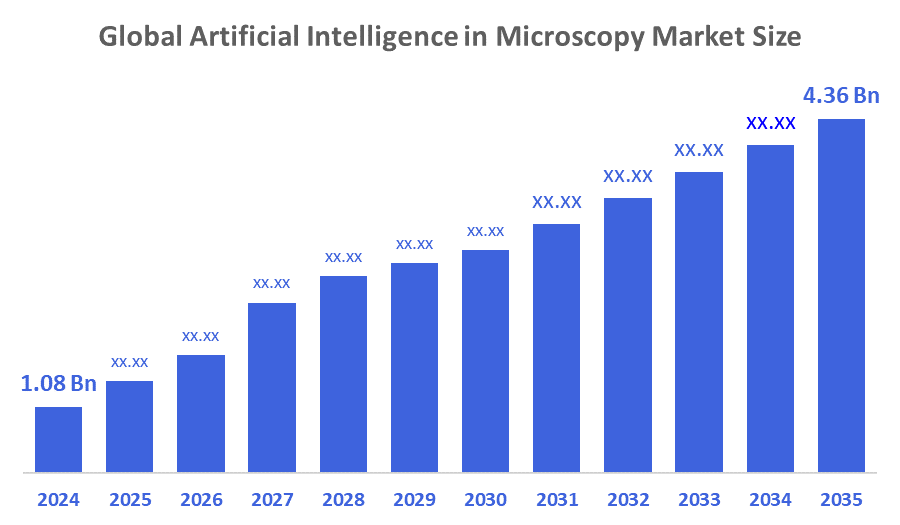
According to a Research Report Published by Decisions Advisors and Consulting, The Global Artificial Intelligence in Microscopy Market Size was worth around USD 1.08 Billion in 2024 and is predicted to Grow to around USD 4.36 Billion by 2035 with a compound annual growth rate (CAGR) of 13.53 % from 2025 to 2035. Laboratories and research institutions are increasingly adopting artificial intelligence microscopy solutions in order to obtain faster, higher-quality, and more reproducible image analysis capabilities. The major drivers for growth in this sector are: improvements in artificial intelligence technology; growing focus on precision medicine; and the growing prevalence of chronic diseases that demand better diagnostic tools for detecting them. A key contributor to the growth of the artificial intelligence microscopy market is the rapid development of artificial intelligence technologies, including machine learning and deep learning.
Market Overview
The artificial intelligence in microscopy market includes the integration of AI technologies—such as machine learning, deep learning, and computer vision—into microscopy systems. Their main focus on enhance image acquisition, analysis, and interpretation across research, healthcare, and industrial applications. Moreover, to improve the existing capabilities of microscopes, advanced image analysis software will be created using two existing technologies: AI and Image Processing. They are automating the complex process of imaging analysis, and microscopes will reduce the time and effort needed by researchers and medical professionals to analyse microscopic images. These solutions will also incorporate machine learning algorithms to identify patterns and anomalies in images, many of which would not be visible to the human eye. This functionality is especially important for the diagnosis of diseases in medicine, as early detection and accurate diagnosis can greatly improve the outcome of a patient. As the demand for precision medicine continues to grow, the demand for advanced software solutions that can analyse biological samples will also increase, leading to additional advancements within this area of microscopy analysis.
In April 2020, Scopio Labs raised $16 million in a Series B round to accelerate the global rollout of its automated digital microscopy solutions. This is because of expanding into human and veterinary diagnostics across the U.S. and Europe.
Report Coverage
This research report categorises the artificial intelligence in microscopy market based on various segments and regions, forecasts revenue growth, and analyzes trends in each submarket. The report analyses the key growth drivers, opportunities, and challenges influencing the artificial intelligence in microscopy market. Recent market developments and competitive strategies, such as expansion, product launch, development, partnership, merger, and acquisition, have been included to draw the competitive landscape in the market. The report strategically identifies and profiles the key market players and analyzes their core competencies in each sub-segment of the artificial intelligence in microscopy market.
Driving Factors
One of the major factors driving the growth of the AI-based microscopic digital pathology market is the increasing emphasis on precision medicine. As more and more healthcare providers begin implementing precise, personalised treatment strategies, their need for accurate and specific analytical tools to analyse patient samples has dramatically increased. Additionally, with an increasing number of individuals living with chronic illnesses such as cancer and diabetes, as well as cardiovascular diseases, there is an increasing need for accurate and efficient diagnostic processes associated with these conditions. Since AI-based microscopy supplies both speed and accuracy to the diagnostic process, it allows clinicians to more effectively diagnose and treat patients with chronic illnesses. The increasing demand for a large amount of new and different data in the fields of life sciences, pathology, and materials research. The increased number of biomedical research studies and the associated need to eliminate human error and inter-observer variability.
In November 2020, Phenix Optics launched its new generation AI smart digital microscope. It's integrating Sony high-performance chips and AI big data algorithms to improve accuracy and efficiency in microscopic observation.
Restraining Factors
The AI microscopy Industry has had an abundance of opportunities, but it also faces some unique challenges and risks. Examples of typical limitations include the high costs associated with AI-enhancements for microscopy systems. These advanced implementations require sophisticated hardware and software components that could easily exceed the budgets of smaller institutions or organisations. There are also numerous technical challenges associated with the incorporation of AI technology into an existing workflow for microscopy that might require extensive effort and advanced skill sets.
Market Segmentation
The artificial intelligence in microscopy market share is classified into component and technology.
- The software segment accounted for the largest market share in 2024 and is projected to grow at a substantial CAGR over the forecast period.
Based on the component, the artificial intelligence in microscopy market is segmented into software, hardware, and services. Among these, the software segment accounted for the largest market share in 2024 and is projected to grow at a substantial CAGR over the forecast period. The software category will expand in the overall market because artificial intelligence (AI) algorithm development and machine learning (ML) model development initiatives continue to advance. AI algorithms enable researchers and healthcare professionals to utilise high-resolution microscopy images for accurate analysis and interpretation of these images at an accelerated rate. Significant growth in the software segment is expected due to continuing innovations in the development of new software applications for the management and analysis of high-dimensional (complex) images.
- The computer vision segment accounted for the highest revenue share in 2024 and is anticipated to grow at a rapid pace during the forecast period.
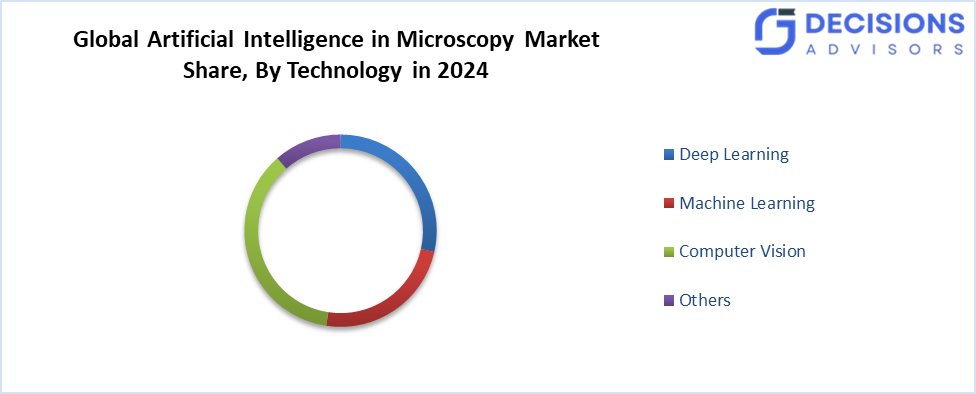
Based on the technology, the artificial intelligence in microscopy market is segmented into deep learning, machine learning, computer vision, and others. Among these, the computer vision segment accounted for the highest revenue share in 2024 and is anticipated to grow at a rapid pace during the forecast period. The computer vision system analyses and interprets images along with vision algorithms from AI Microscopy. Further, computer vision algorithms will provide answers by analysing images of biological samples, identifying features that can be analysed, and providing insights, for instance, precise and accurate analyses of biological samples, which is especially useful in Oncology, where proper identification of cell type is essential for optimal patient care.
Regional Segment Analysis of the Artificial Intelligence in Microscopy Market
- North America (U.S., Canada, Mexico)
- Europe (Germany, France, U.K., Italy, Spain, Rest of Europe)
- Asia-Pacific (China, Japan, India, Rest of APAC)
- South America (Brazil and the Rest of South America)
- The Middle East and Africa (UAE, South Africa, Rest of MEA)
Asia Pacific is anticipated to hold the largest share of the artificial intelligence in microscopy market over the predicted timeframe.
Asia Pacific is anticipated to hold the largest share of the artificial intelligence in microscopy market over the predicted timeframe. The rapid economic growth experienced by the region, along with a rise in healthcare spending in the region and increasing awareness of the value of AI in medical diagnostics, has contributed to the overall growth of the market. The increasing acceptance of new technology, combined with an increasing focus on precision medicine, is anticipated to continue driving the growth of the market.
Countries such as China, Japan and India have emerged as key drivers of this growth, with significant investments in healthcare infrastructure and R&D initiatives. For instance, in January 2026, the Central Silk Board, in collaboration with a Bengaluru-based startup, developed an AI-powered microscope to help silk farmers reduce losses and improve silk quality.
North America is expected to grow at a rapid CAGR in the artificial intelligence in microscopy market during the forecast period. The artificial intelligence microscopy market in North America will be the largest geographically, due to North America's many top biotech and pharmaceutical firms and the large number of investments made to develop healthcare systems. A great deal of research and development occurs in North America, along with a great deal of federal support, thereby supporting the growth of this market. The high number of leading academic research institutions has also helped increase the use of AI microscopy.
Competitive Analysis:
The report offers the appropriate analysis of the key organizations/companies involved within the artificial intelligence in microscopy market, along with a comparative evaluation primarily based on their product offering, business overviews, geographic presence, enterprise strategies, segment market share, and SWOT analysis. The report also provides an elaborative analysis focusing on the current news and developments of the companies, which includes product development, innovations, joint ventures, partnerships, mergers & acquisitions, strategic alliances, and others. This allows for the evaluation of the overall competition within the market.
List of Key Companies
- Angstrom Advanced Inc.
- Ariadne.ai ag
- Keyence Corporation
- KOLAIDO GmbH.
- Leica Microsystems
- Molecular Devices, LLC.
- Motic
- Nikon Corporation Healthcare Business Unit
- Oxford Instruments
- Revvity Signals Software, Inc.
- SigTuple Technologies Pvt. Ltd.
- Thermo Fisher Scientific Inc.
- WITec GmbH
- ZEISS
- Others
Key Target Audience
- Market Players
- Investors
- End-users
- Government Authorities
- Consulting and Research Firm
- Venture capitalists
- Value-Added Resellers (VARs)
Recent Development
- In November 2025, Honeywell announced a breakthrough technology called Digital Holographic Microscopy that uses artificial intelligence (AI) to speed up and simplify healthcare testing, particularly for detecting infections at the point of care. This innovation aims to reduce diagnosis time and improve efficiency across multiple industries.
- In July 2024, Medprime Technologies launched Micalys, India’s first AI-integrated digital microscopy platform, designed to revolutionise digital pathology by combining whole-slide imaging, telepathology, and AI-driven analysis into one affordable, multifunctional system. In the absence of qualified technicians, its ML-based analysis algorithms can help diagnose filaria, malaria, and tuberculosis, filling a significant gap in the present diagnostic landscape.
Market Segment
This study forecasts revenue at global, regional, and country levels from 2020 to 2035. Decisions Advisors has segmented the artificial intelligence in microscopy market based on the below-mentioned segments:
Global Artificial Intelligence in Microscopy Market, By Component
- Software
- Hardware
- Services
Global Artificial Intelligence in Microscopy Market, By Technology
- Deep Learning
- Machine Learning
- Computer Vision
- Others
Global Artificial Intelligence in Microscopy Market, By Regional Analysis
- North America
- US
- Canada
- Mexico
- Europe
- Germany
- UK
- France
- Italy
- Spain
- Russia
- Rest of Europe
- Asia Pacific
- China
- Japan
- India
- South Korea
- Australia
- Rest of Asia Pacific
- South America
- Brazil
- Argentina
- Rest of South America
- Middle East & Africa
- UAE
- Saudi Arabia
- Qatar
- South Africa
- Rest of the Middle East & Africa
Frequently Asked Questions (FAQ)
- What is the current market size and growth forecast?
The market was valued at USD 1.08 billion in 2024 and is projected to reach USD 4.36 billion by 2035, growing at a CAGR of 13.53% from 2025 to 2035.
- What drives growth in this market?
Key drivers include advancements in AI technologies like machine learning and deep learning, rising focus on precision medicine, and increasing prevalence of chronic diseases needing better diagnostics.
- Which component segment leads the market?
The software segment held the largest share in 2024 and is expected to grow at a substantial CAGR, driven by innovations in AI algorithms for high-resolution image analysis.
- Which technology segment is dominant?
Computer vision accounted for the highest revenue share in 2024 and is anticipated to grow rapidly, enabling precise analysis of biological samples in areas like oncology.
- Which region holds the largest market share?
Asia-Pacific is expected to dominate due to rapid economic growth, rising healthcare spending, and investments in countries like China, Japan, and India.
- Why is North America growing quickly?
North America leads in market size with strong R&D from biotech/pharma firms, academic institutions, and government support for healthcare innovations.
- What are the main challenges?
High costs of AI-enhanced hardware/software and technical difficulties in integrating AI into existing microscopy workflows restrain adoption, especially for smaller organisations.
- Who are some key players?
Major companies include Leica Microsystems, Nikon Corporation, Thermo Fisher Scientific, ZEISS, Keyence Corporation, and SigTuple Technologies.
Check Licence
Choose the plan that fits you best: Single User, Multi-User, or Enterprise solutions tailored for your needs.
We Have You Covered
- 24/7 Analyst Support
- Clients Across the Globe
- Tailored Insights
- Technology Tracking
- Competitive Intelligence
- Custom Research
- Syndicated Market Studies
- Market Overview
- Market Segmentation
- Growth Drivers
- Market Opportunities
- Regulatory Insights
- Innovation & Sustainability
Report Details
| Scope | Global |
| Pages | 267 |
| Delivery | PDF & Excel via Email |
| Language | English |
| Release | Jan 2026 |
| Access | Download from this page |