
Global Atopic Dermatitis Market
 |
Pages:
195
|
Pages:
195
Global Atopic Dermatitis Market Size, Share, By Drug Class (Biologics, Calcineurin Inhibitors, PDE-4 Inhibitor, Corticosteroids, Others), By Mode of Administration (Topical, Injectable, Oral), By Distribution Channel (Hospital Pharmacies, Retail Pharmacies, Online Pharmacies), and By Region (North America, Europe, Asia-Pacific, Latin America, Middle East & Africa), Analysis and Forecast 2025?2035
REPORT COVERAGE
Global
Market Snapshot
- Market Size (2025): USD 7.52 Billion
- Projected Market Size (2035): USD 15.96Billion
- Compound Annual Growth Rate (CAGR): 7.82%
- Largest Regional Market: North America
- Fastest Growing Region: Asia-Pacific
- 3rd Largest Region: Europe
- Base Year: 2025
- Historical Period: 2021–2024
- Forecast Period: 2026–2035
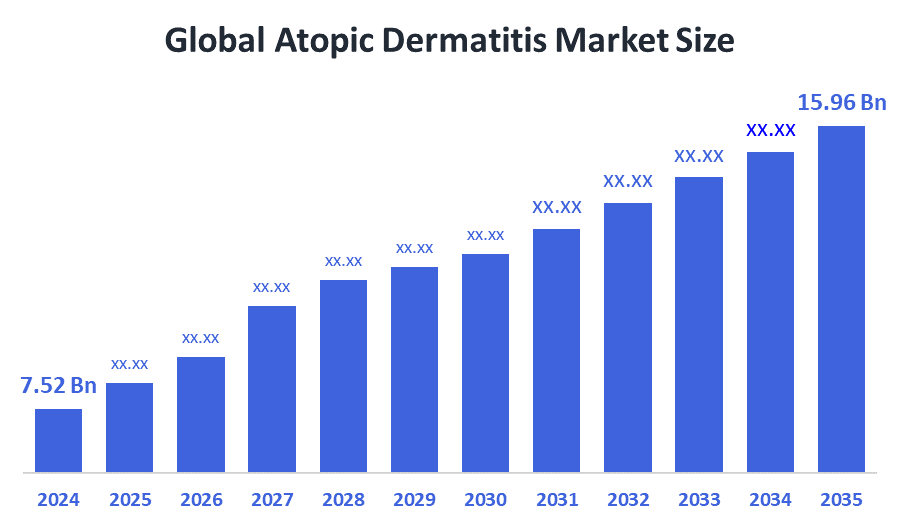
According to Decision Advisors, the Global Atopic Dermatitis Market Size is expected to grow from USD 7.52 billion in 2024 to USD 15.96billion by 2035, at a CAGR of 7.82% during the forecast period 2025-2035. The global atopic dermatitis market is projected to grow significantly over the next decade, fueled by the high prevalence of the disease, rising healthcare expenditure, advancements in biologics, JAK inhibitors, advanced treatment options, a strong product pipeline, and environmental factors.
Market Overview/ Introduction
The global atopic dermatitis market refers to all medical treatment options, which include drugs, therapies, and skincare products that treat and relieve eczema symptoms of the chronic inflammatory skin disease. The treatment addresses three particular symptoms, which include itching, redness, and rash through skin barrier restoration, inflammation reduction, and disease outbreak management. Atopic dermatitis is a persistent skin disorder that people experience through non-infectious episodes, which produce severe itching, dry skin, and skin swelling. The disease progresses through two distinct phases, which feature active symptoms and periods of no symptoms, but it primarily impacts young children, who can also develop the condition at any age. The condition often appears together with allergic disorders. The market expansion exists because more people with the condition receive official medical diagnoses, and dermatology services become available to more patients worldwide. Urban areas experience population growth together with rising environmental pollution, which leads to increased disease transmission, but healthcare systems have developed better methods for discovering and treating illnesses. The market experiences growth because pharmaceutical companies invest more in creating new drugs and because over-the-counter skincare products become more accessible to customers. The market experiences growth because healthcare organizations focus more on patient-centered services and because they use digital health monitoring tools for patient care in both developed and developing countries.
- The National Medical Products Administration in China approved targeted therapies Dupixent, Rinvoq, and Cibinqo for moderate-to-severe atopic dermatitis, while ongoing pipeline developments highlighted unmet needs and strong clinical and commercial potential.
- Patients were advised to use network hospitals, obtain dermatologist prescriptions, maintain medical records, and choose OPD-inclusive policies while considering waiting periods. In India, Ayushman Bharat – Pradhan Mantri Jan Arogya Yojana covered hospitalization for eczema, improving treatment access.
Notable Insights: -
- North America is anticipated to hold the largest share of approximately 41% the atopic dermatitis market over the forecast period.
- Asia Pacific is expected to grow at a rapid CAGR of approximately 13.70% in the atopic dermatitis market during the forecast period.
- The biologics segment dominated the market in 2025 and is projected to grow to approximately 50% of market share during the forecast period.
- The topical segment accounted for the largest share in 2025, and it's anticipated to grow at a significant CAGR of approximately 7.5% during the forecast period.
- The retail pharmacies segment dominated the market in 2025 and is projected to grow at a substantial CAGR of approximately 7% during the forecast period.
- The compound annual growth rate of the Global Atopic Dermatitis Market is 7.82%.
- The market is likely to achieve a valuation of USD 15.96 billion by 2035.
What is role of technology in grooming the market?
Technology plays a crucial role in shaping the growth of the global atopic dermatitis market by enabling more accurate diagnosis, effective treatment, and improved patient management. Advances in biologics and targeted therapies, such as monoclonal antibodies and JAK inhibitors, have revolutionized treatment outcomes by addressing underlying immune pathways. Digital health tools, including teledermatology and mobile health apps, enhance patient monitoring and adherence to treatment plans. Artificial intelligence and data analytics support early detection and personalized treatment strategies, improving clinical outcomes. Additionally, innovations in drug delivery systems and ongoing research in genomics and biomarker identification are accelerating the development of safer, more efficient therapies, thereby driving market expansion.
Market Drivers
The global atopic dermatitis market is experiencing strong growth due to the rising incidence of chronic skin conditions and increasing awareness about effective treatment options. Expanding patient populations, driven by environmental factors and lifestyle changes, are fueling demand for long-term disease management. The introduction and widespread adoption of advanced therapies, including biologics and JAK inhibitors, have significantly improved treatment outcomes and boosted market revenue. Additionally, higher healthcare spending on severe and chronic dermatological conditions is enhancing access to premium therapies. A robust pipeline of novel, targeted treatments under development further supports sustained market expansion and future growth opportunities.
Restrain
The global atopic dermatitis market faces restraints due to high costs of advanced therapies such as biologics and JAK inhibitors, limiting accessibility in low- and middle-income regions. Additionally, stringent regulatory requirements, potential side effects, and lack of awareness in developing areas hinder treatment adoption and overall market growth.
Competitive Analysis:
The report offers the appropriate analysis of the key organizations/companies involved within the Global Atopic dermatitis market, along with a comparative evaluation primarily based on their product of offering, business overviews, geographic presence, enterprise strategies, segment market share, and SWOT analysis. The report also provides an elaborative analysis focusing on the current news and developments of the companies, which includes product development, innovations, joint ventures, partnerships, mergers & acquisitions, strategic alliances, and others. This allows for the evaluation of the overall competition within the market.
Top Companies in Global Atopic dermatitis market
- Sanofi
- Regeneron Pharmaceuticals
- Pfizer
- AbbVie
- Eli Lilly and Company
- Novartis
- LEO Pharma
- Galderma
- Incyte Corporation
- Otsuka Holdings
- Astellas Pharma
- Viatris
Government Initiatives
|
Country |
Key Government Initiatives |
|
UK |
Governments in the United Kingdom promoted digital healthcare through national health services to improve dermatology access, while Brazil implemented nationwide teledermatology programs, enabling remote diagnosis, reducing wait times, and supporting effective management of atopic dermatitis. |
|
US |
Government-supported telehealth expansion in the United States improved access to dermatology services, especially in underserved regions. Various programs and grants promoted teledermatology models, enhancing remote diagnosis, treatment accessibility, and effective management of atopic dermatitis among diverse patient populations. |
|
Singapore |
The government of Singapore considered including eczema under the Chronic Disease Management Programme (CDMP) to improve long-term care and affordability. This initiative supported structured treatment access, enhanced disease management, and strengthened reimbursement policies for patients with atopic dermatitis. |
Market Segmentation
The atopic dermatitis market share is classified into drug class, mode of administration, and distribution channel.
- The biologics segment dominated the market in 2025 and is projected to grow its market share by approximately 50% of market share during the forecast period.
Based on the drug class, the atopic dermatitis market is divided into biologics, calcineurin inhibitors, PDE-4 inhibitor, corticosteroids, and others. Among these, the biologics segment dominated the market in 2025 and is projected to grow approximately 50% during the forecast period. Due to their high efficacy in treating moderate-to-severe atopic dermatitis by targeting specific immune pathways. Their growing adoption, strong clinical outcomes, and increasing approvals of advanced therapies have significantly contributed to their leading market share.
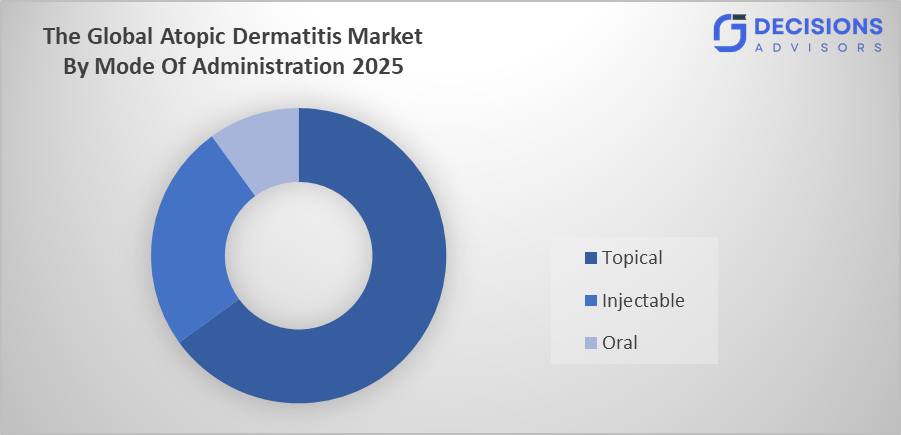
- The topical segment accounted for the largest share in 2025 and is anticipated to grow at a significant CAGR of approximately 7.5% during the forecast period.
Based on the mode of administration, the atopic dermatitis market is divided into topical, injectable, and oral. Among these, the topical segment accounted for the largest share in 2025, and it's anticipated to grow at a significant CAGR of approximately 7.5% during the forecast period. Topical therapies dominate the market as they are the first-line treatment for mild-to-moderate atopic dermatitis. Their widespread use, easy application, cost-effectiveness, and availability of various formulations like creams and ointments contribute to their leading market share.
- The retail pharmacies segment dominated the market in 2025 and is projected to grow at a substantial CAGR of approximately 7% during the forecast period.
Based on the distribution channel, the atopic dermatitis market is divided into hospital pharmacies, retail pharmacies, and online pharmacies. Among these, the retail pharmacies segment dominated the market in 2025 and is projected to grow at a substantial CAGR of approximately 7% during the forecast period. The growth of the soil remediation segment is driven by the wide accessibility, convenience, and availability of both prescription and over-the-counter treatments. Patients commonly prefer retail outlets for recurring purchases, making them the leading distribution channel globally.
Strategies to Implement for Growth of the Market in Non-Leading Regions
To drive growth in non-leading regions of the global atopic dermatitis market, companies should focus on improving access, affordability, and awareness. Expanding distribution networks and strengthening partnerships with local healthcare providers can enhance product reach in underserved areas. Pricing strategies, including tiered pricing and patient assistance programs, help address cost barriers. Increasing awareness through educational campaigns supports early diagnosis and treatment adoption. Investment in telemedicine and digital health platforms can bridge gaps in dermatology care, especially in rural regions. Additionally, collaborations with regional governments and organizations such as World Health Organization can improve healthcare infrastructure. Local clinical trials and regulatory alignment further support market entry and acceptance of advanced therapies, accelerating sustainable growth.
Regional Segment Analysis of the Atopic dermatitis market
- North America (U.S., Canada, Mexico)
- Europe (Germany, France, U.K., Italy, Spain, Rest of Europe)
- Asia-Pacific (China, Japan, India, Rest of APAC)
- South America (Brazil and the Rest of South America)
- The Middle East and Africa (UAE, South Africa, Rest of MEA)
North America is anticipated to hold the largest share of approximately 46% the atopic dermatitis market over the forecast period.
North America is anticipated to hold the largest share of approximately 46% the atopic dermatitis market over the forecast period. The dominance of this region is primarily driven by the high prevalence of atopic dermatitis, advanced healthcare infrastructure, and the strong presence of key players. Additionally, early adoption of biologics, favourable reimbursement policies, and increasing awareness further drive regional market dominance.
Asia Pacific is expected to grow at a rapid CAGR of approximately 10.5% in the atopic dermatitis market during the forecast period.
Asia Pacific is expected to grow at a rapid CAGR of approximately 10.5% in the atopic dermatitis market during the forecast period. This growth is driven by the growing prevalence of the disease, a large patient base, and heightened awareness of healthcare. Enhancing healthcare facilities, broadening access to advanced treatments, and increasing investments in research and development further boost market growth in emerging economies.
Europe is the 3rd largest region to grow in the atopic dermatitis market during the period.
Europe ranks as the third largest area in the atopic dermatitis market, driven by the disease's high occurrence, particularly in children and urban communities. Robust healthcare systems, growing use of advanced biologics and JAK inhibitors, and heightened awareness drive growth. Furthermore, enhanced diagnostic methods and the growth of dermatology services significantly contribute to market growth.
Future Market Trends in Global Atopic Dermatitis Market: -
- Rising Adoption of Advanced Biologics and Targeted Therapies
The rising adoption of advanced biologics and targeted therapies in the atopic dermatitis market is driven by their ability to address underlying immune pathways rather than just symptoms. These treatments offer higher efficacy, faster relief, and fewer side effects compared to conventional therapies, improving patient outcomes and increasing physician preference globally.
- Growth of Personalized and Precision Medicine
The growth of personalized and precision medicine in the atopic dermatitis market is driven by advancements in biomarker research and genetic profiling, enabling tailored treatment approaches. These methods help identify patient-specific disease mechanisms, improving treatment effectiveness, reducing adverse effects, and enhancing long-term disease management, thereby increasing adoption among healthcare providers.
- Expansion of Digital Health and Teledermatology
The expansion of digital health and teledermatology in the atopic dermatitis market is driven by increasing demand for remote care and improved access to dermatology services. These technologies enable early diagnosis, continuous monitoring, and better treatment adherence, especially in underserved areas, while reducing healthcare costs and enhancing overall patient convenience and outcomes.
Recent Development
- In March 2026, Rezpegaldesleukin, developed by Nektar Therapeutics, demonstrated dose-dependent and statistically significant improvements in atopic dermatitis outcomes. It showed consistent efficacy across moderate and severe patients, regardless of baseline severity, geographic region, or asthma comorbidity, highlighting strong therapeutic potential and broad clinical applicability.
- In March 2026, Topical roflumilast (Zoryve) cream 0.05% demonstrated favorable efficacy and safety in children aged 3 months to 2 years with mild-to-moderate atopic dermatitis. The findings were presented at the American Academy of Dermatology 2026 Annual Meeting, highlighting promising pediatric treatment potential.
- In March 2026, at the American Academy of Dermatology Annual Meeting 2026, long-term data showed that upadacitinib maintained a consistent safety profile across age groups in patients with moderate-to-severe atopic dermatitis. Results, observed over several years, supported sustained use and demonstrated reliable safety outcomes across global populations.
- In March 2026, Tralokinumab demonstrated strong real-world efficacy in treating atopic dermatitis among patients with skin of color. Findings presented by April Armstrong highlighted improved clinical outcomes in diverse populations, supporting broader treatment applicability and addressing gaps in care for underrepresented patient groups.
How is Recent Developments Helping the Market?
Recent developments are significantly supporting the growth of the global atopic dermatitis market by introducing more effective and targeted treatment options. The approval and expansion of advanced biologics and JAK inhibitors have improved clinical outcomes, particularly for moderate-to-severe cases. Continuous research and development activities are accelerating the pipeline of novel therapies with enhanced safety and efficacy profiles. Additionally, increasing adoption of digital health solutions, including teledermatology, is improving patient access to timely diagnosis and treatment. Strategic collaborations among leading companies such as Sanofi and Regeneron Pharmaceuticals are further driving innovation. Growing awareness initiatives and supportive regulatory frameworks are also facilitating faster drug approvals and broader market penetration globally.
Market Segment
This study forecasts revenue at global, regional, and country levels from 2020 to 2035. Decision Advisors has segmented the atopic dermatitis market based on the below-mentioned segments:
Global Atopic Dermatitis Market, By Drug Class
- Biologics
- Calcineurin Inhibitors
- PDE-4 Inhibitor
- Corticosteroids
- Others
Global Atopic Dermatitis Market, By Mode of Administration
- Topical
- Injectable
- Oral
Global Atopic Dermatitis Market, By Distribution Channel
- Hospital Pharmacies
- Retail Pharmacies
- Online Pharmacies
Global Atopic Dermatitis Market, By Regional Analysis
- North America
- US
- Canada
- Mexico
- Europe
- Germany
- UK
- France
- Italy
- Spain
- Russia
- Rest of Europe
- Asia Pacific
- China
- Japan
- India
- South Korea
- Australia
- Rest of Asia Pacific
- South America
- Brazil
- Argentina
- Rest of South America
- Middle East & Africa
- UAE
- Saudi Arabia
- Qatar
- South Africa
- Rest of the Middle East & Africa
Frequently Asked Questions (FAQ)
Q How do environmental factors influence the growth of the atopic dermatitis market?
A. Environmental factors such as rising pollution levels, climate change, and urbanization significantly contribute to increasing cases of atopic dermatitis. These factors weaken the skin barrier and trigger immune responses, leading to higher disease prevalence and, consequently, increased demand for effective treatments.
Q. Why are pediatric patients an important focus segment in this market?
A. Atopic dermatitis commonly begins in early childhood, making pediatric patients a key focus group. Early diagnosis and long-term management needs drive consistent demand for safe and mild therapies, encouraging pharmaceutical companies to develop specialized treatments for infants and children.
Q. How does patient adherence impact market growth?
A. Patient adherence to prescribed treatments plays a critical role in treatment outcomes and market expansion. Improved adherence, supported by user-friendly formulations and digital monitoring tools, enhances therapy effectiveness and encourages repeat purchases, boosting overall market revenue.
Q. What role do over-the-counter (OTC) products play in the market?
A. OTC skincare products, including moisturizers and anti-itch creams, form a significant part of the market by addressing mild symptoms and maintenance care. Their easy availability and affordability make them widely used, contributing to steady market growth alongside prescription therapies.
Check Licence
Choose the plan that fits you best: Single User, Multi-User, or Enterprise solutions tailored for your needs.
We Have You Covered
- 24/7 Analyst Support
- Clients Across the Globe
- Tailored Insights
- Technology Tracking
- Competitive Intelligence
- Custom Research
- Syndicated Market Studies
- Market Overview
- Market Segmentation
- Growth Drivers
- Market Opportunities
- Regulatory Insights
- Innovation & Sustainability
Report Details
| Scope | Global |
| Pages | 195 |
| Delivery | PDF & Excel via Email |
| Language | English |
| Release | Apr 2026 |
| Access | Download from this page |