
Global Atrial Fibrillation Market
 |
Pages:
256
|
Pages:
256
Global Atrial Fibrillation Market Size, Share, and COVID-19 Impact Analysis, By Type (Paroxysmal Atrial Fibrillation, Persistent Atrial Fibrillation, and Permanent Atrial Fibrillation), By Treatment Approach (Drug Therapy, Cardioversion, Catheter Ablation, and Surgical Procedures), and By Region (North America, Europe, Asia-Pacific, Latin America, Middle East, and Africa), Analysis and Forecast 2025 - 2035
REPORT COVERAGE
Global
Global Atrial Fibrillation Market Size Insights Forecasts to 2035
- The Global Atrial Fibrillation Market Size Was Estimated at USD 2.75 Billion in 2024
- The Market Size is Expected to Grow at a CAGR of around 10.39% from 2025 to 2035
- The Worldwide Atrial Fibrillation Market Size is Expected to Reach USD 8.16 Billion by 2035
- North America is expected to Grow the fastest during the forecast period.
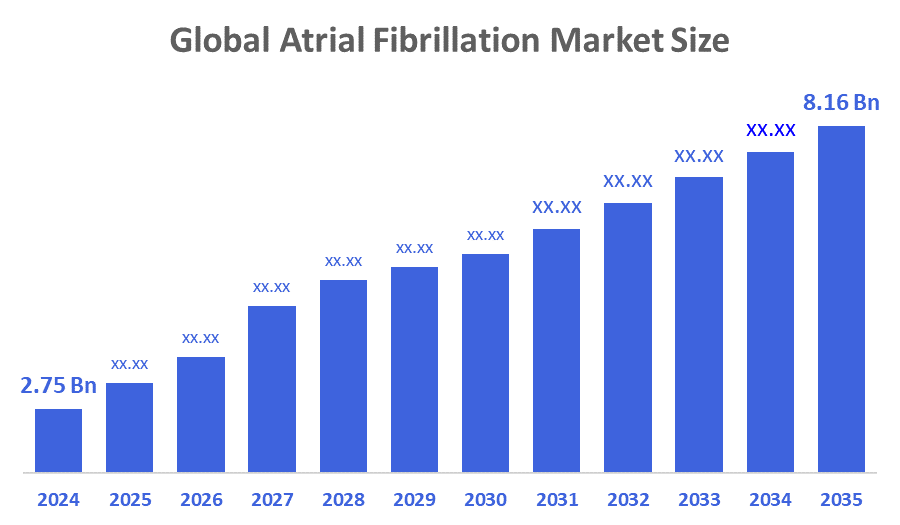
According to a Research Report Published by Decisions Advisors and Consulting, The Global Atrial Fibrillation Market Size was worth around USD 2.75 Billion in 2024 and is predicted to Grow to around USD 8.16 Billion by 2035 with a compound annual growth rate (CAGR) of 10.39% from 2025 to 2035. Growing disease burdens, quick technical advancements in diagnosis and treatment, and the move to remote patient monitoring are the market's main drivers. The best predictor of atrial fibrillation, an aging population, and higher life expectancy among those with chronic diseases like heart failure and hypertension are two major factors contributing to the increased prevalence of atrial fibrillation. The rising frequency of atrial fibrillation instances has also been attributed to bad lifestyle choices like obesity, inactivity, and excessive alcohol consumption, as well as better detection and diagnosis.
Market Overview
The atrial fibrillation therapy market is a sector of the health care industry that addresses atrial fibrillation (AFib) through the diagnosis, treatment, and management of patients with this condition. This includes medications, devices, and other services offered by various companies. The atrial fibrillation therapy market also includes technologies used to treat AFib, such as radiofrequency ablation, pulsed field ablation (PFA), cryoablation, surgical procedures, and the use of drugs to manage blood clotting (anticoagulants) or heart rhythm (antiarrhythmics). The most common type of cardiac arrhythmia is atrial fibrillation (AF). AF is caused by irregular electrical signals in the atria, resulting in a rapid and disorganised heartbeat. Numerous risk factors have been established for AF, including older age, anticoagulation therapy for atrial fibrillation, and comorbidities such as high blood pressure (hypertension), lung disease, congenital heart defects, and excessive alcohol use. Symptoms of AF may range from mild to severe and may include chest pain, palpitations, rapid heart rate, shortness of breath, dizziness, nausea, sweating, and fatigue. Atrial fibrillation can also become a chronic condition, but there are many options available for both treating AF and reducing the risk of developing AF.
In July 2025, Kardium announced that it raised US$250 million (CA$340 million) in an oversubscribed financing round to accelerate the global launch of its Globe Pulsed Field System for atrial fibrillation (AFib). This funding will support commercial expansion, manufacturing scale-up, and regulatory initiatives.
Ablacon, Inc. raised $21.5 million in a Series A financing round to advance its AI-enabled atrial fibrillation (AFib) mapping system, which uses artificial intelligence to analyse Electrographic Flow in the heart and guide targeted catheter ablation therapy.
Report Coverage
This research report categorises the atrial fibrillation market based on various segments and regions, forecasts revenue growth, and analyzes trends in each submarket. The report analyses the key growth drivers, opportunities, and challenges influencing the atrial fibrillation market. Recent market developments and competitive strategies, such as expansion, product launch, development, partnership, merger, and acquisition, have been included to draw the competitive landscape in the market. The report strategically identifies and profiles the key market players and analyzes their core competencies in each sub-segment of the atrial fibrillation market.
Driving Factors
From the last several years, technology improvements and awareness regarding cardiovascular disease and ongoing development within the atrial fibrillation industry have boosted the market expansion. Further, the growing number of older individuals who are living longer lives, combined with an increase in lifestyle-based illnesses, creates a greater need for the development of solutions to manage atrial fibrillation through improved treatment protocols effectively, which opens up market opportunities. Moreover, the new treatments such as catheter ablation and newer anticoagulants are being developed along with a shift towards more personalised and efficient care expand the industry growth. Additionally, the utilisation of telehealth and remote patient monitoring technology is increasing patient engagement and compliance with treatment plans, which can facilitate better outcomes with atrial fibrillation. Along with the increase in collaborative relationships between healthcare providers and technology companies continues to demonstrate (that there is a developing trend moving toward developing holistic approaches in treating atrial fibrillation. As the atrial fibrillation market continues to grow, stakeholders must continue to monitor and adapt to changing regulations and the needs of the patients to ensure that the innovations continue to meet or exceed both clinical standards for effectiveness and safety.
Restraining Factors
The increasing voluntary recalls of a few products due to safety concerns, mislabeling, manufacturing quality issues, and other issues may impede market growth, even in the face of increased knowledge of the condition's correct management and vigorous research and development to introduce new medications. The increase in product recalls is probably going to hurt the brand's reputation and cause patients to select other forms of treatment, which will limit the use of these medications.
Market Segmentation
The Atrial Fibrillation market share is classified into type, and treatment.
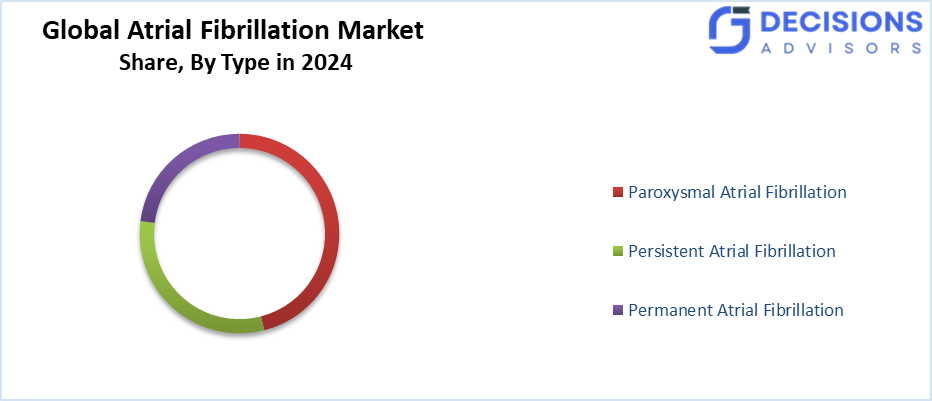
- The paroxysmal atrial fibrillation segment accounted for the largest market share in 2024 and is projected to grow at a substantial CAGR over the forecast period.
Based on the type, the atrial fibrillation market is divided into paroxysmal atrial fibrillation, persistent atrial fibrillation, and permanent atrial fibrillation. Among these, the paroxysmal atrial fibrillation segment accounted for the largest market share in 2024 and is projected to grow at a substantial CAGR over the forecast period. This is due to its episodic nature, which results in prompt and efficient management actions. This kind is frequently sought after by patients, creating a significant demand for medical resources and treatments.
- The drug therapy segment accounted for the highest market share in 2024 and is projected to grow at a remarkable CAGR during the forecast period.
Based on the treatment, the atrial fibrillation market is segmented into drug therapy, cardioversion, catheter ablation, and surgical procedures. Among these, the drug therapy segment accounted for the highest market share in 2024 and is projected to grow at a remarkable CAGR during the forecast period. This segment growth is driven by its availability and proven track record in treating arrhythmias. Medication therapy continues to be the most popular method for treating atrial fibrillation. This strategy includes a variety of drugs, such as anticoagulants and antiarrhythmics, offering choices for both short-term treatment and long-term care.
Regional Segment Analysis of the Atrial Fibrillation Market
- North America (U.S., Canada, Mexico)
- Europe (Germany, France, U.K., Italy, Spain, Rest of Europe)
- Asia-Pacific (China, Japan, India, Rest of APAC)
- South America (Brazil and the Rest of South America)
- The Middle East and Africa (UAE, South Africa, Rest of MEA)
Asia Pacific is anticipated to hold the largest share of the atrial fibrillation market over the predicted timeframe.
Asia Pacific is anticipated to hold the largest share of the atrial fibrillation market over the predicted timeframe. Increased access to the latest medical technology, a growing number of unexplored patient possibilities and greater funding efforts will drive growth in the electrophysiology lab market in emerging economies. The Japanese electrophysiology market will show steady development by utilising new technologies and investments into the training of doctors and clinical staff. An International Company will establish a very strong presence through the latest technology offered to Japanese healthcare providers, which aligns with Japan's advanced medical community and quality control standards.
In May 2025, Abbott launched the TactiFlex Sensor-Enabled Ablation Catheter in India, introducing the world’s first ablation catheter with a flexible electrode tip and contact force sensing technology for atrial fibrillation (AFib) treatment. When paired with Abbott’s EnSite™ X EP System, the catheter enhances visualisation, precision, and safety during cardiac ablation procedures.
North America is expected to grow at a rapid CAGR in the atrial fibrillation market during the forecast period. The growing need for atrial fibrillation AFib treatments in the United States is anticipated to expand with the support of an advanced healthcare infrastructure and increasing adoption of new treatment technology. The growing emphasis on less-invasive procedures in US healthcare systems, along with the use of customised treatment plans and comprehensive patient management programs, drives this growth. In addition, the market demand includes the need for new catheter ablation systems, better anticoagulant drugs, and more holistic methods for cardiac monitoring.
In October 2025, Kardium announced that the first commercial procedures using its Globe® Pulsed Field System for atrial fibrillation (AFib). It has been successfully performed in the U.S., marking the official commercial launch of what the company calls the world’s most advanced integrated mapping and ablation solution.
Competitive Analysis:
The report offers the appropriate analysis of the key organizations/companies involved within the atrial fibrillation market, along with a comparative evaluation primarily based on their product offering, business overviews, geographic presence, enterprise strategies, segment market share, and SWOT analysis. The report also provides an elaborative analysis focusing on the current news and developments of the companies, which includes product development, innovations, joint ventures, partnerships, mergers & acquisitions, strategic alliances, and others. This allows for the evaluation of the overall competition within the market.
List of Key Companies
- Abbott (St. Jude Medical Inc.)
- AtriCure Inc.
- Biosense Webster Inc.
- Boehringer Ingelheim GmbH
- Boston Scientific Corporation
- Bristol-Myers Squibb Corporation
- Cardio Focus Inc.
- Endoscopic Technologies Inc.
- Johnson & Johnson
- Sanofi Aventis
- Others
Key Target Audience
- Market Players
- Investors
- End-users
- Government Authorities
- Consulting and Research Firm
- Venture capitalists
- Value-Added Resellers (VARs)
Recent Development
- In January 2026, Boston Scientific received FDA approval for its Farapoint pulsed field ablation (PFA) catheter, expanding its electrophysiology portfolio in the U.S. The device is specifically approved for cavotricuspid isthmus (CTI) ablation and integrates with the company’s Farapulse PFA platform, offering electrophysiologists a nav-enabled solution for both focal and linear lesions.
- In July 2025, Johnson & Johnson MedTech (via Biosense Webster) launched the VARIPULSE™ Pulsed Field Ablation (PFA) Platform across Asia-Pacific, marking the first fully CARTO™ 3-integrated PFA system approved in Japan, Hong Kong, China, Australia, Taiwan, and Korea. This platform is designed to enhance efficiency, reproducibility, and procedural accuracy in the treatment of atrial fibrillation (AFib).
- In April 2025, Medtronic’s Affera™ pulsed field ablation (PFA) technologies have shown strong one-year clinical trial results, with the investigational Sphere-360™ single-shot catheter demonstrating high safety and efficiency in paroxysmal atrial fibrillation (AFib), and the FDA-approved Sphere-9™ dual-energy catheter proving effective for persistent AFib.
Market Segment
This study forecasts revenue at global, regional, and country levels from 2020 to 2035. Decisions Advisors has segmented the atrial fibrillation market based on the below-mentioned segments:
Global Atrial Fibrillation Market, By Type
- Paroxysmal Atrial Fibrillation
- Persistent Atrial Fibrillation
- Permanent Atrial Fibrillation
Global Atrial Fibrillation Market, By Treatment Approach
- Drug Therapy
- Cardioversion
- Catheter Ablation
- Surgical Procedures
Global Atrial Fibrillation Market, By Regional Analysis
- North America
- US
- Canada
- Mexico
- Europe
- Germany
- UK
- France
- Italy
- Spain
- Russia
- Rest of Europe
- Asia Pacific
- China
- Japan
- India
- South Korea
- Australia
- Rest of Asia Pacific
- South America
- Brazil
- Argentina
- Rest of South America
- Middle East & Africa
- UAE
- Saudi Arabia
- Qatar
- South Africa
- Rest of the Middle East & Africa
Frequently Asked Questions (FAQ)
- What is the current size of the global atrial fibrillation market?
The market was valued at USD 2.75 billion in 2024.
- What is the projected market size by 2035?
It is expected to reach USD 8.16 billion by 2035.
- What is the CAGR for the forecast period?
The market is projected to grow at a CAGR of 10.39% from 2025 to 2035.
- Which region holds the largest market share?
Asia Pacific is anticipated to hold the largest share during the forecast period.
- Which region is expected to grow the fastest?
North America is expected to grow at the fastest CAGR.
- What are the main market segments by type?
Paroxysmal, persistent, and permanent atrial fibrillation; paroxysmal held the largest share in 2024.
- What are the main treatment approaches?
Drug therapy, cardioversion, catheter ablation, and surgical procedures; drug therapy dominated in 2024.
- What are the key drivers of market growth?
Ageing population, rising disease prevalence, technological advancements in diagnosis/treatment, and remote monitoring.
Check Licence
Choose the plan that fits you best: Single User, Multi-User, or Enterprise solutions tailored for your needs.
We Have You Covered
- 24/7 Analyst Support
- Clients Across the Globe
- Tailored Insights
- Technology Tracking
- Competitive Intelligence
- Custom Research
- Syndicated Market Studies
- Market Overview
- Market Segmentation
- Growth Drivers
- Market Opportunities
- Regulatory Insights
- Innovation & Sustainability
Report Details
| Scope | Global |
| Pages | 256 |
| Delivery | PDF & Excel via Email |
| Language | English |
| Release | Jan 2026 |
| Access | Download from this page |