
Australia Circuit Breaker Market
 |
Pages:
210
|
Pages:
210
Australia Circuit Breaker Market Size, Share, By Type (Miniature Circuit Breakers, Molded Case Circuit Breakers, Air Circuit Breakers, Vacuum Circuit Breakers), By Voltage (Low Voltage, Medium Voltage, High Voltage), By End Use (Residential, Commercial, Industrial, Utilities, Renewable Energy)), By Region (North America, Europe, Asia-Pacific, Latin America, Middle East, and Africa) Analysis and Forecast 2026 - 2035.
REPORT COVERAGE
Country
Market Snapshot
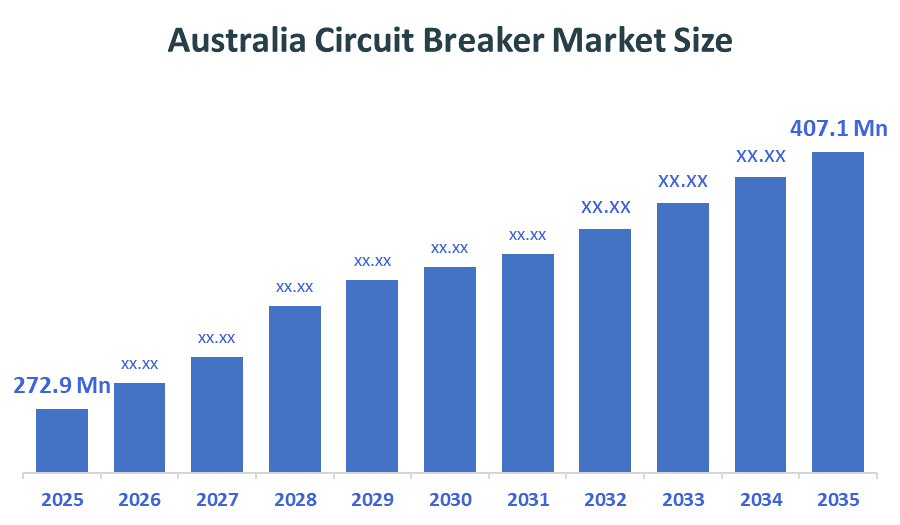
- Market Size (2025): USD 272.9 Million
- Projected Market Size (2035): USD 407.1 Million
- Compound Annual Growth Rate (CAGR): 4.08%
- Base Year: 2025
- Historical Period: 2021–2025
- Forecast Period: 2026–2035
Market Overview/Introduction
The Australia Circuit Breaker Market refers to electrical protection systems designed to automatically interrupt current flow during overloads or short circuits, ensuring safety in residential, commercial, industrial, and utility applications. These systems are essential for protecting electrical infrastructure and improving grid reliability. Growing adoption of renewable energy sources such as solar and wind is increasing demand for advanced circuit protection systems. Smart circuit breakers with IoT-enabled monitoring are also gaining traction, enabling real-time fault detection and predictive maintenance. Australia’s focus on grid modernization and decarbonization is further accelerating market adoption. Additionally, rising investments in transmission and distribution infrastructure upgrades are boosting deployment of high-performance circuit breakers across utility-scale projects. Increasing electrification in mining operations and industrial automation is also contributing significantly to demand, as these sectors require highly reliable power protection systems. Smart grid initiatives are expected to increase adoption of intelligent breakers by nearly 30–35% in new installations, improving operational efficiency and reducing outage risks. Growing urbanization and construction of energy-efficient buildings further support market expansion, while strict safety regulations and Australian standards for electrical systems are pushing industries toward advanced, compliant circuit protection technologies.
Notable Insights: -
- By type, the miniature circuit breakers held a dominant position with 4.8 % in terms of market share in 2025.
- By technology, low voltage circuit breaker is the dominating accounting for over 4.5% of the United Kingdom market share in 2025.
- The compound annual growth rate of the Australia Circuit Breaker Market is 4.08%.
- The market is likely to achieve a valuation of USD 407.1Million by 2035.
What is role of Technology in grooming the market?
Technology is transforming the Australia circuit breaker market through digital protection systems and automation. IoT-enabled breakers allow real-time monitoring of electrical loads and fault detection, improving system reliability by up to 30%. Smart grid integration and remote-control capabilities are increasing adoption in utilities. Advanced arc fault detection, AI-based predictive maintenance, and vacuum interruption technologies are improving safety and reducing downtime. Around 35% of new installations in commercial and utility sectors now include smart monitoring features, enhancing operational efficiency. Additionally, the integration of digital substations and SCADA-based control systems is further strengthening grid automation, enabling faster fault isolation and reducing outage restoration time by nearly 20–25%. Demand for energy-efficient and eco-friendly SF6-free circuit breakers is also rising due to stricter environmental regulations. Adoption of cloud-based energy monitoring platforms is increasing across industrial facilities, improving load management and reducing energy losses by up to 15–20%. Furthermore, miniaturization of components and advancements in solid-state circuit breaker technology are expected to enhance switching speed and overall system performance in future smart grids.
Market Drivers
The Australia Circuit Breaker Market develops because wastewater treatment facilities demand more than 30% of industrial blowers which environmental regulations mandate. Industrial automation drives manufacturing facilities to install automated air handling systems because more than 60% of these facilities use these systems to boost their productivity. Energy-efficient blowers help companies save operational expenses which reach as high as 25% thus making these blowers the most wanted equipment in all business sectors. The expansion of chemical processing and food and beverage sectors has created a greater need for systems that control airflow. Government initiatives that support carbon emission reduction create an environment which drives businesses to adopt energy-efficient blower technologies.
Restrain
High installation and maintenance costs of advanced circuit breakers limit adoption in small-scale residential and rural applications. Integration complexity with existing grid systems also poses challenges. Additionally, price-sensitive consumers often prefer conventional systems over smart circuit breakers.
Furthermore, the requirement for skilled technical manpower for installation, configuration, and maintenance increases overall operational costs by nearly 15–25%, making adoption slower in developing and semi-urban regions
Study on the Supply, Demand, Distribution, and Market Environment Australia Circuit Breaker Market
The Australia Circuit Breaker Market operates through a well-structured supply chain involving global manufacturers, local distributors, electrical contractors, and utility companies. Demand is primarily driven by utilities, mining operations, renewable energy projects, and commercial infrastructure, which collectively account for a major share of total consumption. Australia’s strong focus on grid modernization and renewable integration is increasing the need for advanced protection systems. Distribution is dominated by electrical equipment wholesalers and EPC contractors, while imports play a significant role due to limited domestic manufacturing of high-voltage components. Rising investments in smart grid infrastructure and energy storage projects are further strengthening market demand. Additionally, maintenance and aftermarket services contribute significantly to long-term revenue generation, especially in industrial and utility segments, supporting steady market expansion across the country.
Price Analysis and Healthcare Facilities Behaviour Analysis
Advanced circuit breakers in Australia show a wide price variation depending on voltage level, smart features, and application type. Basic low-voltage circuit breakers typically range between USD 25–100 per unit, while industrial-grade molded case and air circuit breakers can range from USD 150–1,200+ per unit. Smart IoT-enabled breakers with predictive maintenance and digital monitoring capabilities are priced higher due to advanced sensors and communication modules. Despite higher upfront costs, these systems deliver long-term operational savings of nearly 20–35% through reduced downtime, improved fault detection, and lower maintenance frequency. From a behavioural perspective, utilities and industrial end-users prioritize reliability, safety compliance, and lifecycle cost efficiency over initial pricing. Around 50–60% of utility operators are shifting toward smart circuit protection systems to improve grid stability and outage management. However, small residential and rural consumers remain cost-sensitive and prefer conventional breakers due to lower installation complexity. Increasing awareness of electrical safety standards and energy efficiency is gradually improving adoption, especially in urban housing and commercial infrastructure projects.
Strategies to Implement for Growth of the Market
The Australia circuit breaker market can achieve strong growth through targeted strategies focused on modernization, localization, and digital adoption. Expanding investments in smart grid infrastructure and renewable energy integration projects can significantly increase demand for advanced circuit protection systems. Promoting adoption of IoT-enabled and AI-based circuit breakers in utilities and commercial buildings can improve operational efficiency and reduce outage risks by nearly 25–30%. Strengthening local manufacturing and assembly capabilities can reduce dependency on imports and lower product costs by around 15–25%, improving affordability in price-sensitive segments. Partnerships between manufacturers, utility providers, and EPC contractors can enhance large-scale deployment in infrastructure projects. Increasing awareness programs on electrical safety and energy efficiency standards can also boost residential adoption. Additionally, offering flexible financing models and government-backed incentives for smart electrical systems can help accelerate adoption in rural and small-scale applications, supporting long-term market expansion.
Market Segmentation
The Australia Circuit Breaker Market share is classified into light source, application, and end-user
- The miniature circuit breakers dominated the market in 2018, and is projected to grow at a substantial CAGR of approximately 4.8 % during the forecast period.
Based on the type, the Australia Circuit Breaker Market is divided into miniature circuit breakers, molded case circuit breakers, air circuit breakers, vacuum circuit breakers. Among these, the miniature circuit breakers dominated the market in 2018, and is projected to grow at a substantial CAGR of approximately 4.8 % during the forecast period. The market is projected to grow at a substantial CAGR of approximately 4.8% during the forecast period, supported by increasing residential construction, rising safety regulations, and growing adoption of compact and reliable low-voltage protection systems. Their dominance is further strengthened by strong demand from urban housing projects and small commercial buildings, where they are preferred for overload and short-circuit protection due to their reliability, affordability, and minimal maintenance requirements.
- The low voltage circuit breaker accounted for the largest share in 2018, and is anticipated to grow at a significant CAGR of approximately 4.5% during the forecast period.
Based on the voltage, the Australia Circuit Breaker Market is divided low voltage, medium voltage, high voltage. Among these, the low voltage circuit breaker accounted for the largest share in 2018, and is anticipated to grow at a significant CAGR of approximately 4.5% during the forecast period. Low voltage circuit breaker driven by extensive use in residential buildings, commercial infrastructure, and small-scale industrial applications. This segment is anticipated to grow at a significant CAGR of approximately 4–5% during the forecast period, supported by rising urbanization, increasing residential construction activities, and growing emphasis on electrical safety standards in modern building infrastructure. Low voltage circuit breakers remain highly preferred due to their cost-effectiveness, easy installation, and strong compatibility with smart home and building automation systems, which further strengthens their long-term demand outlook.
The wastewater treatment Facilities segment dominated the market in 2018, and is projected to grow at a substantial CAGR approximately 5.1% during the forecast period.
Based on the end use, the Australia Circuit Breaker Market is divided into Residential, Commercial, Industrial, Utilities, Renewable Energy. Among these, the industrial segment dominated the market in 2018, and is projected to grow at a substantial CAGR approximately 5.1% during the forecast period. strong demand from mining operations, manufacturing facilities, and heavy industrial infrastructure requiring reliable high-capacity electrical protection systems. This segment is projected to grow at a substantial CAGR of approximately 5.1% during the forecast period, driven by increasing industrial automation, expansion of energy-intensive industries, and rising investments in grid reliability and safety systems. Additionally, utilities and renewable energy segments are also witnessing strong growth due to Australia’s ongoing transition toward clean energy and smart grid modernization initiatives.
Competitive Analysis
The report offers the appropriate analysis of the key organisations/companies involved within the Australia Circuit Breaker Market, along with a comparative evaluation primarily based on their technology offering, business overviews, geographic presence, enterprise strategies, segment market share, and SWOT analysis. The report also provides an elaborative analysis focusing on the current news and developments of the companies, which includes technology development, innovations, joint ventures, partnerships, mergers & acquisitions, strategic alliances, and others. This allows for the evaluation of the overall competition within the market.
Top Key Companies in Australia Circuit Breaker Market
- Siemens
- Schneider Electric
- ABB
- Eaton Corporation
- Mitsubishi Electric
- Fuji Electric
- Legrand
- Hitachi Energy
- Toshiba
- LS Electric
- Hager Group
- C&S Electric
- General Electric (GE)
- Mitsubishi Electric
- NHP Electrical Engineering
- Others
Key Target Audience
- Market Players
- Investors
- End-users
- Government Authorities
- Consulting and Research Firm
- Venture capitalists
- Value-Added Resellers (VARs)
Market Segment
This study forecasts revenue at the India, regional, and country levels from 2020 to 2035. Decision Advisors has segmented the Australia Circuit Breaker Market based on the below-mentioned segments
Australia Circuit Breaker Market, By type
- Miniature Circuit Breakers (MCB)
- Molded Case Circuit Breakers (MCCB)
- Air Circuit Breakers (ACB)
- Vacuum Circuit Breakers
Australia Circuit Breaker Market, By Pressure Level
- Low Voltage
- Medium Voltage
- High Voltage
Australia Circuit Breaker Market, By Application
- Residential
- Commercial
- Industrial
- Utilities
- Renewable Energy
Frequently Asked Questions (FAQ)
1. What are circuit breakers used for in Australia?
They are used to protect electrical systems from overloads and short circuits in residential, industrial, and utility applications.
2. Which segment dominates the market?
Low voltage circuit breakers dominate due to high residential and commercial usage.
3. What is driving market growth?
Growth is driven by renewable energy expansion, mining industry demand, and grid modernization.
4. Why is Australia investing in smart circuit breakers?
To improve grid reliability, reduce downtime, and enable predictive maintenance.
5. What is the future trend in this market?
Smart, IoT-enabled, and renewable-integrated circuit breakers will dominate future installations.
Check Licence
Choose the plan that fits you best: Single User, Multi-User, or Enterprise solutions tailored for your needs.
We Have You Covered
- 24/7 Analyst Support
- Clients Across the Globe
- Tailored Insights
- Technology Tracking
- Competitive Intelligence
- Custom Research
- Syndicated Market Studies
- Market Overview
- Market Segmentation
- Growth Drivers
- Market Opportunities
- Regulatory Insights
- Innovation & Sustainability
Report Details
| Scope | Country |
| Pages | 210 |
| Delivery | PDF & Excel via Email |
| Language | English |
| Release | Apr 2026 |
| Access | Download from this page |