
Australia Digital Pathology Market
 |
Author:
Disha B
|
Pages:
225
|
Author:
Disha B
|
Pages:
225
Australia Digital Pathology Market Size, Share, and COVID-19 Impact Analysis, By Product Type (Software, Device, Scanners, Slide Management Systems, and Storage Systems), By Application (Drug Discovery & Development, Academic Research, Disease Diagnostics, Cancer Cell Detection, and Others), and Australia Digital Pathology Market Insights, Industry Trend, Forecasts to 2035
CAGR
10.15%
REVENUE 2024
USD Million 14.3
FORECAST 2035
USD Million 41.4
REPORT COVERAGE
Country
Australia Market Size Insights Forecasts to 2035
- The Australia Digital Pathology Market Size Was Estimated at USD 14.3 Million in 2024
- The Market Size is Expected to Grow at a CAGR of Around 10.15% from 2025 to 2035
- The Australia Digital Pathology Market Size is Expected to Reach USD 41.4 Million by 2035
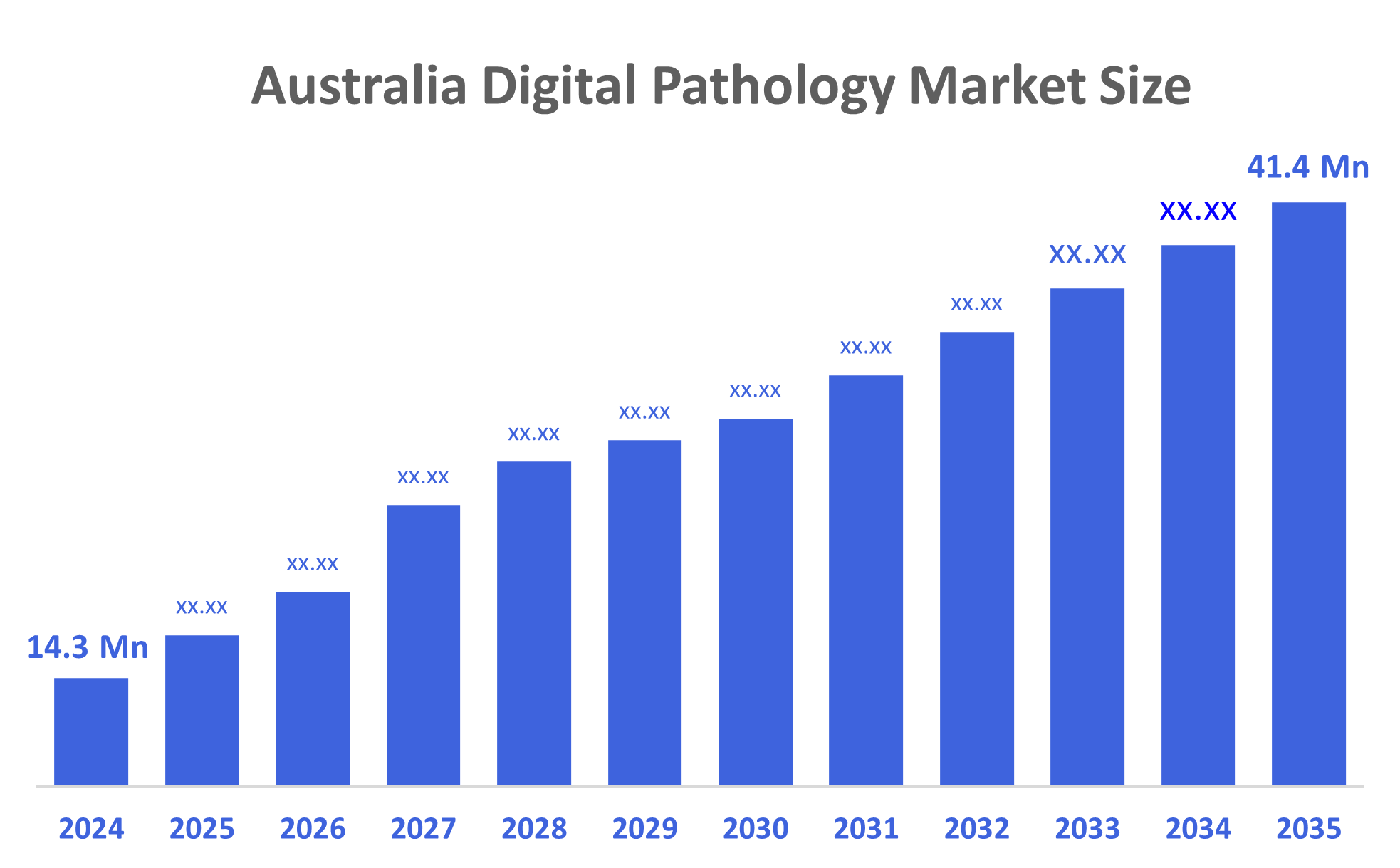
According to a research report published by Decisions Advisors, The Australia Digital Pathology Market Size is Anticipated to Reach USD 41.4 Million by 2035, Growing at a CAGR of 10.15% from 2025 to 2035. The digital pathology market in Australia is driven by the increasing use of AI-enabled pathology tools, the rising incidence of cancer, the development of slide-scanning technologies, and government initiatives that support digital transformation in laboratory and healthcare workflows.
Market Overview
The digital pathology market is a market that provides the technology needed to transform traditional glass slides into high-quality digital images, which are used for analysis, storage, and sharing. Growing demand for faster diagnostic tests, a growing cancer population, and an increase in the uptake of AI-enabled analysis techniques have driven a rapidly expanding digital pathology industry in Australia. The Australian government supports digital pathology through My Health Record “share-by-default” reforms, national digital-health infrastructure funding, and Quality Use of Pathology projects promoting structured digital reporting. Other states, such as Queensland, have also made significant investments in supporting digital pathology, including the AUD 6.9 million grant towards the purchase of digital slide scanners. This will help to improve interoperability, promote faster adoption, and ultimately build on the national capacity for digital pathology.
Significant opportunities for growth will be found in the development of telepathology for rural Australia, the use of AI technology to improve diagnostic accuracy of disease detection, and to use of digital workflow automation to improve efficiencies. Recent developments in the digital pathology industry in Australia include the purchase of high-resolution whole slide scanners through state government funding, the establishment of pilot programs for testing the implementation of digital pathology technology in hospitals and laboratory settings, and the creation of collaborations with industry.
Report Coverage
This research report categorizes the market for the Australia digital pathology market based on various segments and regions, and forecasts revenue growth and analyses trends in each submarket. The report analyses the key growth drivers, opportunities, and challenges influencing the Australia digital pathology market. Recent market developments and competitive strategies, such as expansion, product launch, development, partnership, merger, and acquisition, have been included to draw the competitive landscape in the market. The report strategically identifies and profiles the key market players and analyses their core competencies in each sub-segment of the Australia digital pathology market.
Driving Factors
The digital pathology market in Australia is driven by a rise in the incidence of cancer and an increasing demand for rapid and precise diagnostic workflows. The advancement of whole slide imaging (WSI), artificial intelligence (AI), and cloud platforms provides higher efficiency with less manual workload on pathologists than traditional methods. Governments are providing initiatives to support the modernization of health care through digital technology, and regional telepathology also contributes to the continued growth of the digital pathology field. In addition, the current shortage of qualified pathology personnel, the ability to report remotely, and continued investment by hospitals into digital infrastructure are all helping to accelerate the transition from traditional to completely digital pathology.
Restraining Factors
The digital pathology market in Australia is mostly constrained by the high costs associated with implementation, limited reimbursement structures currently available to support the use of digital technologies, concerns regarding data security, and the slow integration of workflows within small laboratories. There is also a current shortage of skilled IT personnel in this area, complexity in regulations that govern the industry, and resistance to replacing traditional microscopy with digital methods.
Market Segmentation
The Australia digital pathology market share is classified into product type and application.
- The software segment accounted for the largest revenue market share in 2024 and is expected to grow at a significant CAGR during the forecast period.
The Australia digital pathology market is segmented by product type into software, device, scanners, slide management systems, and storage systems. Among these, the software segment accounted for the largest revenue market share in 2024 and is expected to grow at a significant CAGR during the forecast period. Due to its ability to facilitate image analysis, workflow automation, data management, AI integration, and remote reporting, the software segment leads Australia's digital pathology industry. Software is now the primary factor influencing productivity and clinical decision support due to the increasing use of telepathology and cloud platforms.
- The disease diagnostics segment accounted for the largest revenue share in 2024 and is expected to grow at a significant CAGR during the forecast period.
The Australia digital pathology market is segmented by application into drug discovery & development, academic research, disease diagnostics, cancer cell detection, and others. Among these, the disease diagnostics segment accounted for the largest revenue share in 2024 and is expected to grow at a significant CAGR during the forecast period. In order to expedite diagnosis, handle an increase in cancer cases, shorten turnaround times, and enhance accuracy throughout standard clinical workflows, hospitals and pathology labs are depending more and more on digital slides, AI-assisted analysis, and telepathology.
Competitive Analysis:
The report offers the appropriate analysis of the key organizations/companies involved within the Australia digital pathology market, along with a comparative evaluation primarily based on their product offering, business overviews, geographic presence, enterprise strategies, segment market share, and SWOT analysis. The report also provides an elaborate analysis focusing on the current news and developments of the companies, which includes product development, innovations, joint ventures, partnerships, mergers & acquisitions, strategic alliances, and others. This allows for the evaluation of the overall competition within the market.
List of Key Companies
- Sonic Healthcare
- Healius
- Australian Clinical Labs (ACL)
- SA Pathology
- Leica Biosystems
- Philips
- Roche (Ventana)
- 3DHISTECH
- Sectra
- Indica Labs
- Others
Key Target Audience
- Market Players
- Investors
- End-users
- Government Authorities
- Consulting and Research Firm
- Venture capitalists
- Value-Added Resellers (VARs)
Recent Developments:
- In November 2025, Optiscan and Australian Clinical Labs' collaboration was announced to advance the deployment and testing of the InForm digital pathology platform across ACL’s labs, accelerating innovation and real-world validation.
- In October 2025, Immediate pathology result release in My Health Record went live, allowing patients to view most pathology results as soon as uploaded, supporting faster digital workflows.
- In September 2025, Phenomics Australia & ACEMID collaborate to digitise histology slides for melanoma research and diagnosis with advanced scanning infrastructure.
Market Segment
This study forecasts revenue at the Australia, regional, and country levels from 2020 to 2035. Decisions Advisors has segmented the Australia digital pathology market based on the below-mentioned segments:
Australia Digital Pathology Market, By Product Type
- Software
- Device, Scanners
- Slide Management Systems
- Storage Systems
Australia Digital Pathology Market, By Application
- Drug Discovery & Development
- Academic Research
- Disease Diagnostics
- Cancer Cell Detection
- Others
FAQ’s
Q: What is the Australia digital pathology market size?
A: Australia digital pathology market size is expected to grow from USD 14.3 million in 2024 to USD 41.4 million by 2035, growing at a CAGR of 10.15% during the forecast period 2025-2035.
Q: What are the key growth drivers of the market?
A: Market growth is driven by a rise in the incidence of cancer and an increasing demand for rapid and precise diagnostic workflows. The advancement of whole slide imaging (WSI), artificial intelligence (AI), and cloud platforms provides higher efficiency with less manual workload on pathologists than traditional methods. Governments are providing initiatives to support the modernization of health care through digital technology, and regional telepathology also contributes to the continued growth of the digital pathology field. In addition, the current shortage of qualified pathology personnel, the ability to report remotely, and continued investment by hospitals into digital infrastructure are all helping to accelerate the transition from traditional to completely digital pathology.
Q: What factors restrain the Australia digital pathology market?
A: Constraints include the high costs associated with implementation, limited reimbursement structures currently available to support the use of digital technologies, concerns regarding data security, and the slow integration of workflows within small laboratories.
Q: How is the market segmented by product type?
A: The market is segmented into software, device, scanners, slide management systems, and storage systems.
Q: Who are the key players in the Australia digital pathology market?
A: Key companies include Sonic Healthcare, Healius, Australian Clinical Labs (ACL), SA Pathology, Leica Biosystems, Philips, Roche (Ventana), 3DHISTECH, Sectra, Indica Labs, and Others.
Q: Who are the target audiences for this market report?
A: The report targets market players, investors, end-users, government authorities, consulting and research firms, venture capitalists, and value-added resellers (VARs)
Check Licence
Choose the plan that fits you best: Single User, Multi-User, or Enterprise solutions tailored for your needs.
We Have You Covered
- 24/7 Analyst Support
- Clients Across the Globe
- Tailored Insights
- Technology Tracking
- Competitive Intelligence
- Custom Research
- Syndicated Market Studies
- Market Overview
- Market Segmentation
- Growth Drivers
- Market Opportunities
- Regulatory Insights
- Innovation & Sustainability
Report Details
| Scope | Country |
| Pages | 225 |
| Delivery | PDF & Excel via Email |
| Language | English |
| Release | Dec 2025 |
| Access | Download from this page |