
Australia Energy Harvesting System Market
 |
Author:
Somesh R
|
Pages:
240
|
Author:
Somesh R
|
Pages:
240
Australia Energy Harvesting System Market Size, Share, and COVID-19 Impact Analysis, By Component (Sensor, Transducer, Power-Management IC (PMIC), Secondary/Backup Battery, and Others), By Application (Consumer Technology, Home and Building Automation, Industrial, Transportation, Security, and Others), and Australia Energy Harvesting System Market Insights, Industry Trend, Forecasts to 2035
CAGR
11.17%
REVENUE 2024
USD Million 11.2
FORECAST 2035
USD Million 35.9
REPORT COVERAGE
Country
Australia Energy Harvesting System Market Insights Forecasts to 2035
- The Australia Energy Harvesting System Market Size Was Estimated at USD 11.2 Million in 2024
- The Market Size is Expected to Grow at a CAGR of Around 11.17% from 2025 to 2035
- The Australia Energy Harvesting System Market Size is Expected to Reach USD 35.9 Million by 2035
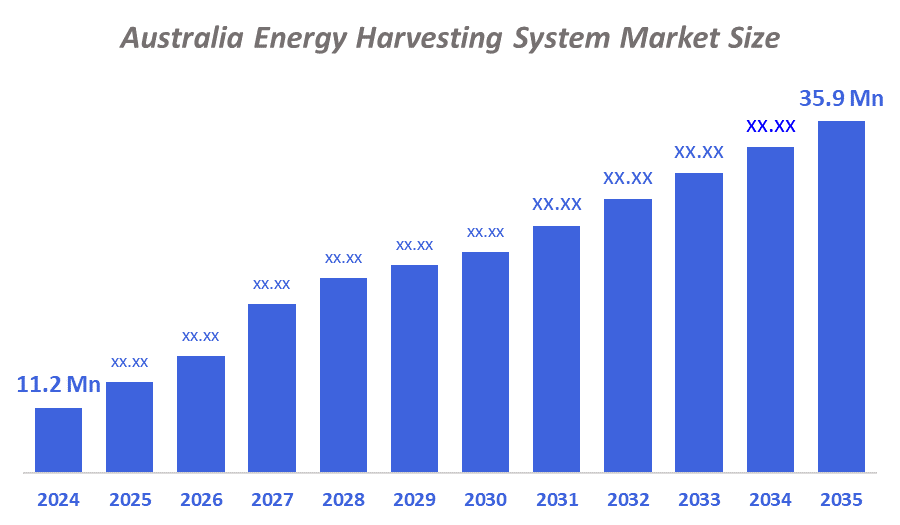
According to a research report published by Decision Advisor & Consulting, The Australia Energy Harvesting System Market Size is Anticipated to reach USD 35.9 Million by 2035, Growing at a CAGR of 11.17% from 2025 to 2035. The energy harvesting system market in Australia is driven by growing demand for renewable energy, more use of IoT and wireless sensor networks, a greater emphasis on energy efficiency, and robust government support for low-carbon and sustainable technologies.
Market Overview
The Australian energy harvesting market mainly includes the technologies that absorb and convert ambient energy, like solar, thermal, vibration, RF, and wind, into electrical power. They are used for wireless sensors, IoT devices, building control systems, and other places like industrial monitoring, hospitals, and smart manufacturing. The applications are mainly aimed at low-power, battery-less, or long-life devices that are less prone to maintenance, more efficient in energy usage, and support sustainable, decentralized power solutions across sectors.
The Australian government backs clean energy, efficiency, and innovative power technologies through various programs. A $30 million Grid Enhancing Technologies grants program (2025–26 to 2028–29) finances the development and application of state-of-the-art energy systems and network technologies. Powering Business Grants give a maximum of 50% funding for investments in energy-efficient equipment. Scholarships such as the Thales Energy Harvesting PhD stipend ($35,950 p.a.) promote research and development in energy harvesting. The broader renewable incentives under Small-scale and Large-scale Renewable Energy Schemes facilitate the deployment of low-emission technologies.
Energy harvesting technologies are being developed by Australian companies with the help of commercial IoT-focused inventions like tiny supercapacitors for batteries and devices that can generate power from the environment. The future prospects are smart grid integration, energy systems for ambient IoT, and across sectors, the network of sensors that are smart, battery-free, and self-powered.
Report Coverage
This research report categorizes the market for the Australia energy harvesting system market based on various segments and regions, and forecasts revenue growth and analyses trends in each submarket. The report analyses the key growth drivers, opportunities, and challenges influencing the Australia energy harvesting system market. Recent market developments and competitive strategies, such as expansion, product launch, development, partnership, merger, and acquisition, have been included to draw the competitive landscape in the market. The report strategically identifies and profiles the key market players and analyses their core competencies in each sub-segment of the Australia energy harvesting system market.
Driving Factors
The energy harvesting system market in Australia is driven by the increasing demand for renewable energy and sustainable energy options, an increase in the adoption of both IoT devices and wireless sensor networks, and an increasing emphasis on energy efficiency across various industries. Strong government initiatives that promote the use of clean energy through smart infrastructure and low-carbon technology are also expected to aid in the growth of the energy harvesting systems market. A number of new developments in the field of energy harvesting technologies, including solar, vibration, and thermal energy harvesting systems, are enabling reliable and efficient ways to generate power for remote and off-grid applications, resulting in increased market penetration of these types of products.
Restraining Factors
The energy harvesting system market in Australia is mostly constrained by the high initial costs of investment, the low power output, which limits large-scale applications, technological intricacies, the absence of standardization, and the probability of slow adoption because of uncertain ROI in the traditional industries.
Market Segmentation
The Australia energy harvesting system market share is classified into component and application.
- The power-management IC (PMIC) segment accounted for the largest revenue market share in 2024 and is expected to grow at a significant CAGR during the forecast period.
The Australia energy harvesting system market is segmented by component into sensor, transducer, power-management IC (PMIC), secondary/backup battery, and others. Among these, the power-management IC (PMIC) segment accounted for the largest revenue market share in 2024 and is expected to grow at a significant CAGR during the forecast period. This is because PMICs are essential for effectively gathering, controlling, and storing harvested energy, guaranteeing a steady power supply to sensors and Internet of Things devices, which promotes increased adoption and revenue share.
- The home and building automation segment dominated the share in 2024 and is anticipated to grow at a remarkable CAGR during the forecast period.
The Australia energy harvesting system market is segmented by application into consumer technology, home and building automation, industrial, transportation, security, and others. Among these, the home and building automation segment dominated the share in 2024 and is anticipated to grow at a remarkable CAGR during the forecast period. This is because energy harvesting provides low-maintenance, battery-free operation and supports sustainability goals in smart buildings, energy-efficient systems, and IoT-enabled devices like sensors, lighting controls, and HVAC monitoring.
Competitive Analysis:
The report offers the appropriate analysis of the key organizations/companies involved within the Australia energy harvesting system market, along with a comparative evaluation primarily based on their product offering, business overviews, geographic presence, enterprise strategies, segment market share, and SWOT analysis. The report also provides an elaborate analysis focusing on the current news and developments of the companies, which includes product development, innovations, joint ventures, partnerships, mergers & acquisitions, strategic alliances, and others. This allows for the evaluation of the overall competition within the market.
List of Key Companies
- CAP-XX
- Xped Limited
- LiXiA
- Myriota
- Wattwatchers
- OneSense
- Element14 Australia
- Smart IoT Solutions
- CSIRO
- University spin-outs & research groups
- Others
Key Target Audience
- Market Players
- Investors
- End-users
- Government Authorities
- Consulting and Research Firm
- Venture capitalists
- Value-Added Resellers (VARs)
Recent Developments:
- In August 2025, the groundbreaking wireless energy harvesting project, which received funding from the EESN Seed Grant Scheme, commenced its activities to collect energy from high-voltage powerlines to help power remote infrastructures.
- In June 2025, Halocell Energy introduced its first series of flexible perovskite Ambient Modules, which are energy-harvesting PV modules made specifically for use in indoor and industrial areas with low light, consequently cutting down on the need for batteries for IoT sensors and smart devices.
- In April 2025, there were reports from the industry that pointed out the increasing use of energy harvesting technologies in the future IoT device market, thus indicating a growing interest and development of the ecosystem.
Market Segment
This study forecasts revenue at the Australia, regional, and country levels from 2020 to 2035. Decision Advisor has segmented the Australia energy harvesting system market based on the below-mentioned segments:
Australia Energy Harvesting System Market, By Component
- Sensor
- Transducer
- Power-Management IC (PMIC)
- Secondary/Backup Battery
- Others
Australia Energy Harvesting System Market, By Application
- Consumer Technology
- Home and Building Automation
- Industrial
- Transportation
- Security
- Others
FAQ’s
Q: What is the Australia energy harvesting system market size?
A: Australia energy harvesting system market size is expected to grow from USD 11.2 million in 2024 to USD 35.9 million by 2035, growing at a CAGR of 11.17% during the forecast period 2025-2035.
Q: What are the key growth drivers of the market?
A: Market growth is driven by increasing demand for renewable energy and sustainable energy options, an increase in the adoption of both IoT devices and wireless sensor networks, and an increasing emphasis on energy efficiency across various industries. Strong government initiatives that promote the use of clean energy through smart infrastructure and low-carbon technology are also expected to aid in the growth of the energy harvesting systems market.
Q: What factors restrain the Australia energy harvesting system market?
A: Constraints include the high initial costs of investment, the low power output, which limits large-scale applications, technological intricacies, the absence of standardization, and the probability of slow adoption because of uncertain ROI in the traditional industries.
Q: How is the market segmented by component?
A: The market is segmented into sensor, transducer, power-management IC (PMIC), secondary/backup battery, and others.
Q: Who are the key players in the Australia energy harvesting system market?
A: Key companies include CAP-XX, Xped Limited, LiXiA, Myriota, Wattwatchers, OneSense, Element14 Australia, Smart IoT Solutions, CSIRO, University spin-outs & research groups, and Others.
Q: Who are the target audiences for this market report?
A: The report targets market players, investors, end-users, government authorities, consulting and research firms, venture capitalists, and value-added resellers (VARs).
Check Licence
Choose the plan that fits you best: Single User, Multi-User, or Enterprise solutions tailored for your needs.
We Have You Covered
- 24/7 Analyst Support
- Clients Across the Globe
- Tailored Insights
- Technology Tracking
- Competitive Intelligence
- Custom Research
- Syndicated Market Studies
- Market Overview
- Market Segmentation
- Growth Drivers
- Market Opportunities
- Regulatory Insights
- Innovation & Sustainability
Report Details
| Scope | Country |
| Pages | 240 |
| Delivery | PDF & Excel via Email |
| Language | English |
| Release | Jan 2026 |
| Access | Download from this page |