
Australia Smart Factory Market
 |
Pages:
210
|
Pages:
210
Australia Smart Factory Market Size, Share, and COVID-19 Impact Analysis, By Technology (Product Lifecycle Management, Human Machine Interface, Enterprise Resource Planning, Manufacturing Execution Systems, Distributed Control Systems, Industrial Control System, and Others), By End Use (Pharmaceuticals, Food and Beverages, Chemical, Oil and Gas, Automotive and Transportation, Semiconductor and Electronics, Aerospace and Defense, and Others), and Australia Smart Factory Market Insights, Industry Trend, Forecasts to 2035
REPORT COVERAGE
Country
Australia Smart Factory Market Insights Forecasts to 2035
- The Australia Smart Factory Market Size Was Estimated at USD 4.76 Billion in 2024
- The Market Size is Expected to Grow at a CAGR of Around 12.18% from 2025 to 2035
- The Australia Smart Factory Market Size is Expected to Reach USD 16.85 Billion by 2035
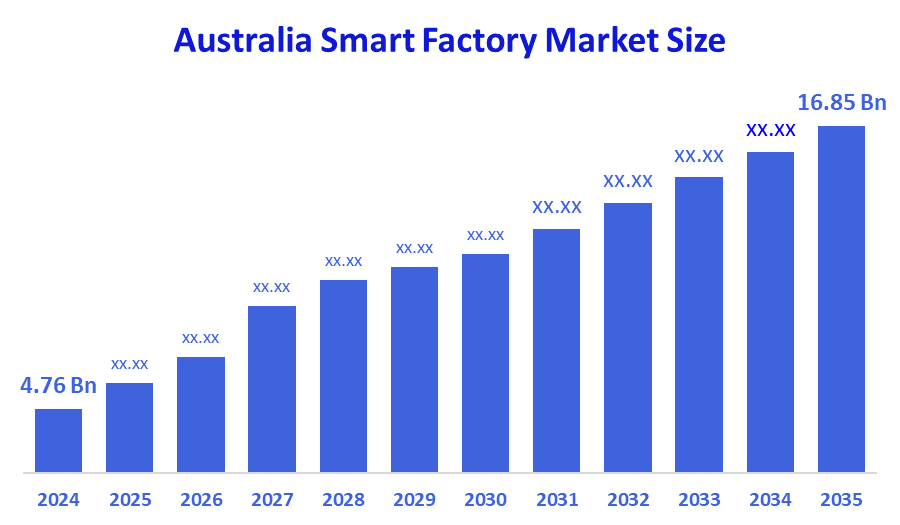
According to a research report published by Decision advisors , The Australia Smart Factory Market Size is anticipated to reach USD 16.85 billion by 2035, growing at a CAGR of 12.18% from 2025 to 2035. The smart factory market in Australia is driven by forthcoming Industry 4.0, the upsurge in the use of robots, the high cost of labor, the government backing for sophisticated manufacturing, and the seamless connection of IoT, AI, and data analysis.
Market Overview
The Australia smart factory market is a digital innovation in the manufacturing sector that has witnessed complete transformation through the use of IoT, AI, robotics, automation, digital twins, and advanced analytics. Smart factories are capable of allowing real-time monitoring, predictive maintenance, and optimized production. The applications of this technology are in automotive, food & beverage, mining equipment, pharmaceuticals, electronics, and metal fabrication sectors, whereby manufacturers are gaining benefits such as increased productivity, flexibility, quality control, and energy efficiency, and at the same time, they are contributing to the Industry 4.0 changeover.
The government programs like the Modern Manufacturing Initiative, which provides co-funding ranging from AUD 1 to 20 million, AMGC Industry 4.0 grants, and the CSIRO Future Digital Manufacturing Fund, are the main drivers of the Australia Smart Factory Market. The R&D Tax Incentive lowers the cost of innovation for manufacturers. Among the various benefits the aforementioned government programs offer, the adoption of IoT, robotics, AI, and automation is also one of them.
In Australia, the manufacturers are progressing towards the implementation of smart factories with AI-assisted automation, IoT sensor networks, and digital twin platforms for the purpose of maximizing production and maintenance. The likes of Redarc Electronics and Amtex Systems are the ones piloting the Industry 4.0 technology. Among the future opportunities are predictive analytics, integration of robots, edge computing, and cyber-secure connected factories, which would result in increased productivity and competitiveness in export markets.
Report Coverage
This research report categorizes the market for the Australia smart factory market based on various segments and regions, and forecasts revenue growth and analyses trends in each submarket. The report analyses the key growth drivers, opportunities, and challenges influencing the Australia smart factory market. Recent market developments and competitive strategies, such as expansion, product launch, development, partnership, merger, and acquisition, have been included to draw the competitive landscape in the market. The report strategically identifies and profiles the key market players and analyses their core competencies in each sub-segment of the Australia smart factory market.
Driving Factors
The smart factory market in Australia is driven by the fast adoption of Industry 4.0, the growing need for automation to boost productivity, and the increasing costs of labor which are increasing. Furthermore, strong governmental backing for advanced manufacturing, the growth of IoT and AI integration, the focus on energy efficiency and sustainability, and the necessity of real-time data analytics for operational efficiency and competitiveness have all come together to push the market growth even more.
Restraining Factors
The smart factory market in Australia is mostly constrained by the high capital outlay, lack of digital proficiency in the manufacturing sector, worries about data security, difficulties in merging with old systems, and slower uptake by SMEs due to budget and infrastructure constraints.
Market Segmentation
The Australia smart factory market share is classified into technology and end use.
- The enterprise resource planning segment accounted for the largest revenue market share in 2024 and is expected to grow at a significant CAGR during the forecast period.
The Australia smart factory market is segmented by technology into product lifecycle management, human machine interface, enterprise resource planning, manufacturing execution systems, distributed control systems, industrial control system, and others. Among these, the enterprise resource planning segment accounted for the largest revenue market share in 2024 and is expected to grow at a significant CAGR during the forecast period. The main reason for the stronghold of the enterprise resource planning segment is the extensive use of it for integrating operations, improving supply chain visibility, enabling real-time decision-making, and supporting digital transformation throughout the Australian manufacturing sectors.
- The food and beverages segment dominated the share in 2024 and is anticipated to grow at a remarkable CAGR during the forecast period.
The Australia smart factory market is segmented by end use into pharmaceuticals, food and beverages, chemical, oil and gas, automotive and transportation, semiconductor and electronics, aerospace and defense, and others. Among these, the food and beverages segment dominated the share in 2024 and is anticipated to grow at a remarkable CAGR during the forecast period. Due to strong automation adoption for quality control, traceability, compliance with food safety standards, growing export demand, and the need to increase productivity while lowering labor dependency, the food and beverage category leads the Australian smart factory market.
Competitive Analysis:
The report offers the appropriate analysis of the key organizations/companies involved within the Australia smart factory market, along with a comparative evaluation primarily based on their product offering, business overviews, geographic presence, enterprise strategies, segment market share, and SWOT analysis. The report also provides an elaborate analysis focusing on the current news and developments of the companies, which includes product development, innovations, joint ventures, partnerships, mergers & acquisitions, strategic alliances, and others. This allows for the evaluation of the overall competition within the market.
List of Key Companies
- SAGE Automation
- Automation Innovation Pty Ltd
- Automation IT
- Mobile Automation
- Probe CX
- Robotic Automation
- 2AutomateAnything (2AA)
- Cerexio Pty Ltd
- Clever Ops
- Ericom
- Others
Key Target Audience
- Market Players
- Investors
- End-users
- Government Authorities
- Consulting and Research Firm
- Venture capitalists
- Value-Added Resellers (VARs)
Recent Developments:
- In December 2025, Tetra Pak introduced its Factory OS platform for AI-ready, integrated smart manufacturing at Gulfood Manufacturing 2025, making the integration of automation and data analytics possible.
Market Segment
This study forecasts revenue at the Australia, regional, and country levels from 2020 to 2035. Decision advisors has segmented the Australia smart factory market based on the below-mentioned segments:
Australia Smart Factory Market, By Technology
- Product Lifecycle Management
- Human Machine Interface
- Enterprise Resource Planning
- Manufacturing Execution Systems
- Distributed Control Systems
- Industrial Control System
- Others
Australia Smart Factory Market, By End Use
- Pharmaceuticals
- Food and Beverages
- Chemical
- Oil and Gas
- Automotive and Transportation
- Semiconductor and Electronics
- Aerospace and Defense
- Others
FAQ’s
Q: What is the Australia smart factory market size?
A: Australia smart factory market size is expected to grow from USD 4.76 billion in 2024 to USD 16.85 billion by 2035, growing at a CAGR of 12.18% during the forecast period 2025-2035.
Q: What are the key growth drivers of the market?
A: Market growth is driven by fast adoption of Industry 4.0, the growing need for automation to boost productivity, and the increasing costs of labor which are increasing. Furthermore, strong governmental backing for advanced manufacturing, the growth of IoT and AI integration, the focus on energy efficiency and sustainability, and the necessity of real-time data analytics for operational efficiency and competitiveness have all come together to push the market growth even more.
Q: What factors restrain the Australia smart factory market?
A: Constraints include the high capital outlay, lack of digital proficiency in the manufacturing sector, worries about data security, difficulties in merging with old systems, and slower uptake by SMEs due to budget and infrastructure constraints.
Q: How is the market segmented by technology?
A: The market is segmented into product lifecycle management, human machine interface, enterprise resource planning, manufacturing execution systems, distributed control systems, industrial control system, and others.
Q: Who are the key players in the Australia smart factory market?
A: Key companies include SAGE Automation, Automation Innovation Pty Ltd, Automation IT, Mobile Automation, Probe CX, Robotic Automation, 2AutomateAnything (2AA), Cerexio Pty Ltd, Clever Ops, Ericom, and Others.
Q: Who are the target audiences for this market report?
A: The report targets market players, investors, end-users, government authorities, consulting and research firms, venture capitalists, and value-added resellers (VARs).
Check Licence
Choose the plan that fits you best: Single User, Multi-User, or Enterprise solutions tailored for your needs.
We Have You Covered
- 24/7 Analyst Support
- Clients Across the Globe
- Tailored Insights
- Technology Tracking
- Competitive Intelligence
- Custom Research
- Syndicated Market Studies
- Market Overview
- Market Segmentation
- Growth Drivers
- Market Opportunities
- Regulatory Insights
- Innovation & Sustainability
Report Details
| Scope | Country |
| Pages | 210 |
| Delivery | PDF & Excel via Email |
| Language | English |
| Release | Jan 2026 |
| Access | Download from this page |