
Australia Targeted Protein Degradation Market
 |
Pages:
240
|
Pages:
240
Australia Targeted Protein Degradation Market Size, Share, and COVID-19 Impact Analysis, By Type (PROTAC, Molecular Glues, LYTACs, and Others), By End Use (Pharmaceutical & Biotechnology Companies, Hospitals & Clinical Laboratories, Academic & Research Institutes, and Others), and Australia Targeted Protein Degradation Market Insights, Industry Trend, Forecasts to 2035
REPORT COVERAGE
Country
Australia Targeted Protein Degradation Market Insights Forecasts to 2035
- The Australia Targeted Protein Degradation Market Size Was Estimated at USD 7.4 Million in 2024
- The Market Size is Expected to Grow at a CAGR of Around 22.87% from 2025 to 2035
- The Australia Targeted Protein Degradation Market Size is Expected to Reach USD 71.3 Million by 2035
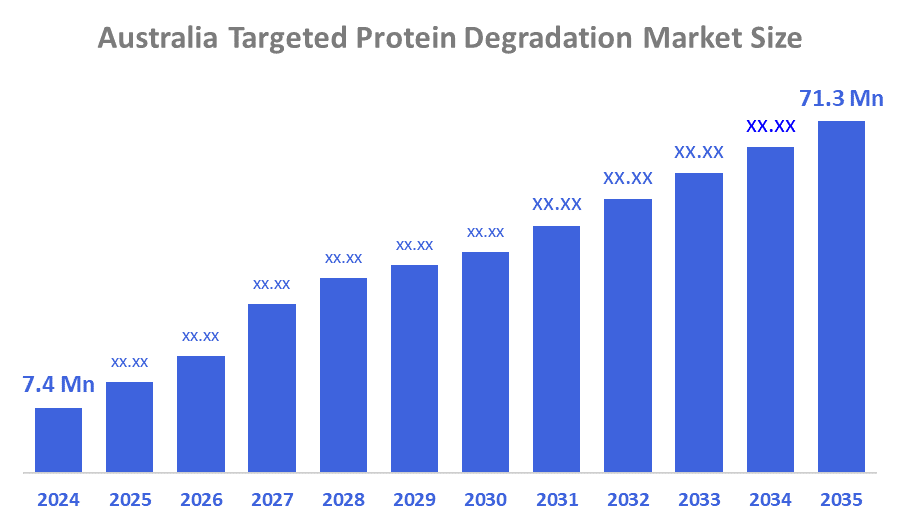
According to a research report published by Decision Advisor & Consulting, The Australia Targeted Protein Degradation Market Size is Anticipated to reach USD 71.3 Million by 2035, Growing at a CAGR of 22.87% from 2025 to 2035. The targeted protein degradation market in Australia is driven by increased biopharmaceutical R&D investments, growing demand for precision therapeutics, strong academic-industry partnerships, and advancements in proteomics, genomics, and drug-discovery technologies, which support innovative treatment development.
Market Overview
The Australia targeted protein degradation market consists of the development and commercialization of treatments through the selective elimination of disease-causing proteins by using mechanisms like PROTACs and molecular glues. Applications comprise cancer treatment, neurodegenerative disorders, inflammatory diseases, and rare genetic conditions, thus making precise, effective, and next-generation therapeutic interventions possible.
The market for targeted protein degradation in Australia has strong support from the government through its initiatives like the Medical Research Future Fund, which has granted about AUD 15 million for the targeted therapeutic area. Other measures such as the R&D Tax Incentive, Patent Box scheme (17% tax rate), and grants from the Australian Research Council (ARC) are also among the factors pushing the biotech innovation and commercialization.
The market for targeted protein degradation in Australia is making giant strides with the research and development of PROTACs and novel degrader platforms for cancer therapy by biotech startups and research institutes. The prospects of the future are increasing the scope of the drug discovery process for neurodegenerative diseases, deploying AI, and providing the necessary academic-industry bridges for faster commercialization.
Report Coverage
This research report categorizes the market for the Australia targeted protein degradation market based on various segments and regions, and forecasts revenue growth and analyses trends in each submarket. The report analyses the key growth drivers, opportunities, and challenges influencing the Australia targeted protein degradation market. Recent market developments and competitive strategies, such as expansion, product launch, development, partnership, merger, and acquisition, have been included to draw the competitive landscape in the market. The report strategically identifies and profiles the key market players and analyses their core competencies in each sub-segment of the Australia targeted protein degradation market.
Driving Factors
The targeted protein degradation market in Australia is driven by the increasing number of cases of cancer and chronic diseases, the growing need for precision and personalized therapies, and the generous support of the government for biomedical research. Apart from these factors, there are more reasons like the cutting-edge academic research, the rise of biotech startups, the increasing investments in pharmaceutical R&D, the supportive regulatory environments, and the innovations in PROTACs, molecular glues, and proteomics that further the market. All of these allow the creation of the next generation of therapeutics for the so-called undruggable targets.
Restraining Factors
The targeted protein degradation market in Australia is mostly constrained by the huge investments in research and development, the complicated processes of drug design and validation, the lack of experience at the clinical stage, the lengthy times for regulatory approval, and the difficulties in producing the advanced and novel therapeutic modalities on a large scale.
Market Segmentation
The Australia targeted protein degradation market share is classified into type and end use.
- The PROTAC segment accounted for the largest revenue market share in 2024 and is expected to grow at a significant CAGR during the forecast period.
The Australia targeted protein degradation market is segmented by type into PROTAC, molecular glues, LYTACs, and others. Among these, the PROTAC segment accounted for the largest revenue market share in 2024 and is expected to grow at a significant CAGR during the forecast period. Because of its advanced clinical development, wide applicability across oncology and chronic diseases, strong research focus, and increased investment from biotech and pharmaceutical companies, which drives greater commercialization and revenue generation, the PROTAC segment dominates the Australian targeted protein degradation market.
- The pharmaceutical & biotechnology companies segment dominated the share in 2024 and is anticipated to grow at a remarkable CAGR during the forecast period.
The Australia targeted protein degradation market is segmented by end use into pharmaceutical & biotechnology companies, hospitals & clinical laboratories, academic & research institutes, and others. Among these, the pharmaceutical & biotechnology companies segment dominated the share in 2024 and is anticipated to grow at a remarkable CAGR during the forecast period. Because of substantial R&D expenditures, sophisticated drug-development infrastructure, ongoing trial pipelines, and more commercialization potential in comparison to university research institutes and hospitals.
Competitive Analysis:
The report offers the appropriate analysis of the key organizations/companies involved within the Australia targeted protein degradation market, along with a comparative evaluation primarily based on their product offering, business overviews, geographic presence, enterprise strategies, segment market share, and SWOT analysis. The report also provides an elaborate analysis focusing on the current news and developments of the companies, which includes product development, innovations, joint ventures, partnerships, mergers & acquisitions, strategic alliances, and others. This allows for the evaluation of the overall competition within the market.
List of Key Companies
- Ternarx
- Walter and Eliza Hall Institute of Medical Research (WEHI)
- Monash University
- Children’s Cancer Institute
- Medicenna Therapeutics
- Australian Proteome Analysis Facility (APAF)
- Academic R&D centers (e.g., The University of Sydney)
- Others
Key Target Audience
- Market Players
- Investors
- End-users
- Government Authorities
- Consulting and Research Firm
- Venture capitalists
- Value-Added Resellers (VARs)
Recent Developments:
- In November 2025, TPD Day at Lorne Ubiquitin Summit: Targeted Protein Degradation Day was included among the highlights of the Australian Ubiquitin Summit, mainly focusing on the TPD technologies that are the result of cutting-edge research and inter-disciplinary collaboration.
- In November 2025, Australian Ubiquitin Summit 2025: FIMECS made an announcement inviting to show its TPD discovery platform at the first Australian Ubiquitin Summit in Lorne, which is an indication of the progress in the research field of targeted protein degradation.
- In June 2024, Ternarx launch: The Walter and Eliza Hall Institute (WEHI) has officially launched Ternarx, which is the first biotech company in Australia exclusively dedicated to developing targeted protein degrader medicines with a grant of AUD 15 million from the government as part of its support.
Market Segment
This study forecasts revenue at the Australia, regional, and country levels from 2020 to 2035. Decision Advisor has segmented the Australia targeted protein degradation market based on the below-mentioned segments:
Australia Targeted Protein Degradation Market, By Type
- PROTAC
- Molecular Glues
- LYTACs
- Others
Australia Targeted Protein Degradation Market, By End Use
- Pharmaceutical & Biotechnology Companies
- Hospitals & Clinical Laboratories
- Academic & Research Institutes
- Others
FAQ’s
Q: What is the Australia targeted protein degradation market size?
A: Australia targeted protein degradation market size is expected to grow from USD 7.4 million in 2024 to USD 71.3 million by 2035, growing at a CAGR of 22.87% during the forecast period 2025-2035.
Q: What are the key growth drivers of the market?
A: Market growth is driven by an increasing number of cases of cancer and chronic diseases, the growing need for precision and personalized therapies, and the generous support of the government for biomedical research.
Q: What factors restrain the Australia targeted protein degradation market?
A: Constraints include the huge investments in research and development, the complicated processes of drug design and validation, and the lack of experience at the clinical stage.
Q: How is the market segmented by type?
A: The market is segmented into PROTAC, molecular glues, LYTACs, and others.
Q: Who are the key players in the Australia targeted protein degradation market?
A: Key companies include Ternarx, Walter and Eliza Hall Institute of Medical Research (WEHI), Monash University, Children’s Cancer Institute, Medicenna Therapeutics, Australian Proteome Analysis Facility (APAF), Academic R&D centers (e.g., The University of Sydney), and Others.
Q: Who are the target audiences for this market report?
A: The report targets market players, investors, end-users, government authorities, consulting and research firms, venture capitalists, and value-added resellers (VARs).
Check Licence
Choose the plan that fits you best: Single User, Multi-User, or Enterprise solutions tailored for your needs.
We Have You Covered
- 24/7 Analyst Support
- Clients Across the Globe
- Tailored Insights
- Technology Tracking
- Competitive Intelligence
- Custom Research
- Syndicated Market Studies
- Market Overview
- Market Segmentation
- Growth Drivers
- Market Opportunities
- Regulatory Insights
- Innovation & Sustainability
Report Details
| Scope | Country |
| Pages | 240 |
| Delivery | PDF & Excel via Email |
| Language | English |
| Release | Jan 2026 |
| Access | Download from this page |