
Global Automatic Floodgate Market
 |
Author:
Pranali P
|
Pages:
200
|
Author:
Pranali P
|
Pages:
200
Global Automatic Floodgate Market Size, Share, By Product Type (Hydraulic Automatic Floodgates, Self-Activating Flood Barriers, Pneumatic Floodgates, and Mechanical Floodgates) By Application (Urban Flood Control, Industrial Facilities, Coastal Protection, River and Dam Management, and Residential Protection) By End User (Government and Municipal Authorities, Industrial Sector, Commercial Infrastructure, and Residential Sector) and By Region (North America, Europe, Asia-Pacific, Latin America, Middle East and Africa), Analysis and Forecast 2026 ? 2035
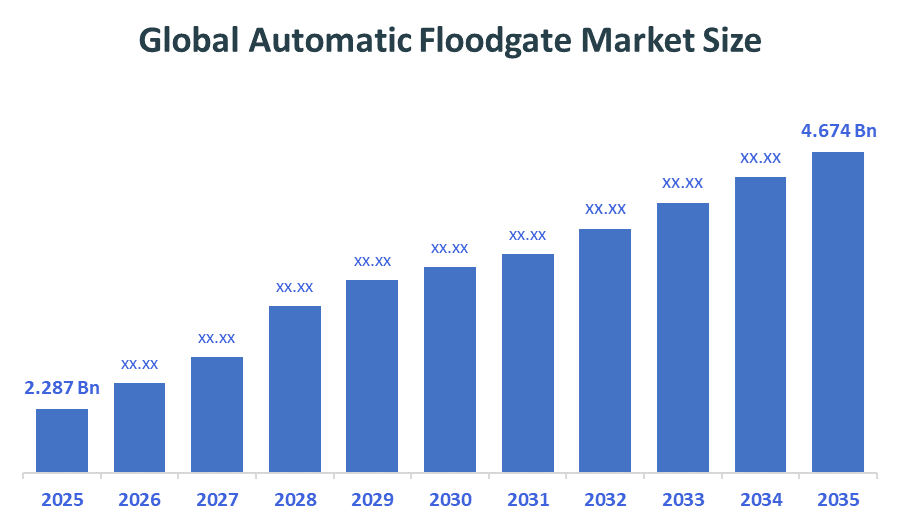
CAGR
7.41%
REVENUE 2025
USD Billion 2.29
FORECAST 2035
USD Billion 4.67
REPORT COVERAGE
Global
Market Snapshot
- Global Automatic Floodgate Market Size (2025): USD 2.287 Billion
- Global Automatic Floodgate Projected Market Size (2035): USD 4.674 Billion
- Global Automatic Floodgate Compound Annual Growth Rate (CAGR): 7.41%
- Largest Regional Market: Asia-Pacific
- Fastest Growing Region: Asia-Pacific
- 3rd Largest Region: North America
- Base Year: 2025
- Historical Period: 2021 to 2024
- Forecast Period: 2026 to 2035
Automatic floodgates represent an essential range of water management systems designed to provide immediate protection against rising floodwaters by sealing off entry points to residential, commercial, and industrial properties. These units act as a critical bridge between traditional manual barriers and permanent civil engineering works, utilising advanced buoyant forces and self-activating mechanical triggers to ensure rapid deployment without human intervention. Modern systems incorporate revolutionary features such as non-powered buoyancy chambers and hydrodynamic seals to maintain steady performance while significantly reducing the risk of property damage during flash floods. Originally developed as simple manual panels, these systems have evolved into sophisticated autonomous platforms characterised by high reliability ratings, zero-energy operation, and seamless integration into urban architectural designs. A primary factor driving growth in the Global Automatic Floodgate Market is the surging demand for climate-resilient infrastructure and real-time disaster mitigation in both modern coastal developments and low-lying inland municipalities. Automatic floodgates play a vital role in ensuring structural integrity and community safety, particularly as city planners and property developers seek to maintain constant environmental protection without relying on the delayed response times associated with manual emergency labor.
- The commercial and municipal infrastructure segments contribute to approximately 65% of the application-based use in the market, driven by the increasing demand for flood-proof basement parking, transit station protection, and the safeguarding of essential utility hubs.
- Automated protection technology in the industrial sector is experiencing substantial growth, with a CAGR forecasted to surpass 11% on account of the increasing adoption of passive defense systems as part of the advanced generation of resilient infrastructure for providing optimised safety to large-scale manufacturing plants and high-value logistics centers.
Notable Insights: -
- Hydraulic automatic gates make up about 46.8% of the total market share of this sector. They have gained a reputation in flood control operations in large systems, particularly dams, rivers, and drainage systems in urban areas.
- About 72.5% of all installations occur in governmental projects and municipal constructions. These investments are stimulated mainly by high levels of investment into construction projects in flood prevention infrastructure because many countries experience climate-driven problems that result in the flooding of populated territories.
- Applications of floodgates in the sphere of flood prevention in urban areas account for almost 41.3% of all demand. The rapid development of smart cities, alongside increased worries about urban flooding because of the absence of appropriate drainage systems, has become one of the main drivers of using these gates.
- About 48.6% of the market value belongs to the Asia-Pacific region in 2026. Many countries within this region, like China and India, invest considerable amounts of money in flood prevention systems in order to address threats such as coastal flooding and heavy rains.
- Coastal protection systems show an annual increase above 6.9%. The rise in sea levels and frequent occurrences of storm surges create the conditions that encourage governments to invest more money in automated floodgate barriers.
What is the Role of Technology in Shaping the Market?
Advancements in technology are bringing about revolutionary changes in the field of the automatic floodgate industry through the improvements made in deployment speed, structural durability, and automation in terms of operational performance. Today's contemporary flood protection platforms are no longer just static barriers but rather sophisticated hydraulic and buoyant management systems that have the ability to operate autonomously for a long time due to their ability to incorporate high-grade stainless steel components, advanced hydrodynamic seals, and compatibility with real-time early warning networks.
How are Recent Developments Helping the Market?
New developments, such as the use of sensor-integrated barrier controls, the use of high-performance composite materials, and passive buoyancy-driven activation systems, have provided considerable assistance to drive growth in the market. Companies have developed modular floodgate platforms that can protect different types of entry points, ranging from pedestrian walkways to wide industrial bay doors, and operate effectively during sudden flash floods with minimal manual intervention. With the help of float-activated mechanical designs, these units will be able to autonomously rise using the upward pressure of rising water in order to maintain a watertight seal while eliminating the risk of human error or power failure. This feature is expected to make large-scale municipal infrastructure and commercial building management operations easier. Also, the integration of wireless monitoring technology will provide more speed in identifying barrier status and contribute to effective predictive maintenance and long-term equipment reliability.
Market Drivers
The global automatic floodgate market is growing with the increasing investments of urban developers and government agencies in sustainable flood resilience and disaster-proof building standards to meet modern climate adaptation requirements. Modern floodgate platforms are gaining strong preference in the market with the advantage of integrating multiple functions, such as aesthetic subterranean storage, rapid self-activation, and low-profile installation, into a single durable and low-maintenance system. On the other hand, the growing phenomenon of extreme weather volatility is fuelling the market demand for reliable flood mitigation technologies that could address the transition toward water-sensitive urban design in flood-prone zones or locations where the implementation of traditional levees is becoming restricted. Climate change and fluctuating sea levels have also spurred property owners to use these systems for the regular protection of underground assets and safeguarding of high-value real estate investments.
Restraints
The development of the international automatic floodgate market is hindered by the challenges involved in ensuring the durability of the mechanical hinge components in harsh aquatic environments due to the presence of high silt levels and corrosive saltwater. The costs involved in developing specific high-strength alloys and specialized underground excavation procedures, as well as the costs related to custom-engineered drainage integration, pose further barriers to the quick implementation of the technology by smaller municipal authorities. Dependencies on specialized structural engineers and the necessity for certified installation teams to control the calibration and testing of heavy-duty gate fleets pose additional challenges to the widespread adoption of the latest technology in less developed regions.
Competitive Analysis:
The report offers the appropriate analysis of the key organisations/companies involved within the automatic floodgate market, along with a comparative evaluation primarily based on their product offerings, business overviews, geographic presence, enterprise strategies, segment market share, and SWOT analysis. The report also provides an elaborate analysis focusing on the current news and developments of the companies, which includes product development, innovations, joint ventures, partnerships, mergers & acquisitions, strategic alliances, and others. This allows for the evaluation of the overall competition within the market.
Top 10 Companies in the Global Automatic Floodgate Market
- Flood Control International Ltd.
- FloodBreak Automatic Flood Barriers
- PS Industries (PS Flood Barriers)
- AWMA Water Control Solutions
- AquaFence
- IBS Technics GmbH
- Presray Corporation
- Blobel Umwelttechnik
- NoFloods (Environment Solutions ApS)
- Denilco Environmental Technology
Government Initiatives
|
Country |
Key Government Initiatives |
|
US |
In light of the development of the Building Resilient Infrastructure and Communities program, the Federal Emergency Management Agency announced that it had amended the FY24 Flood Mitigation Assistance Swift Current program, allocating 500 million dollars through May 2025 in competitive grants to state and local governments for implementing smart flood defense measures. |
|
India |
In April 2026, the state government of Odisha announced an overall plan against flooding with a budget of 2,781 crore INR. The scheme is meant to minimise water damage by upgrading its infrastructure. In addition, the State Flood Control Council of Bihar has allocated funds worth 1,117 crore INR to be spent on 384 projects against flooding before the onset of the monsoon in 2026. |
|
UK |
The Environment Agency made an unprecedented investment of £1.4 billion towards safeguarding property through over 600 schemes that include automatic flood gates and reinforced embankments. This effort forms part of a wider program valued at £10.5 billion which aims to fortify the nation against natural disasters up to the year 2036. |
Study on the Supply, Demand, Distribution, and Market Environment
The success of the automatic floodgate industry depends on finding the sweet spot between the ability to operate with maximum mechanical reliability and the growing need for constant, smart-enabled disaster management. The supply of automatic floodgates comes from a focus on producing high-strength corrosion-resistant alloys and highly efficient buoyancy-driven triggers capable of delivering instantaneous protection without the excessive operational lag associated with manual barriers. The demand side derives from the transition toward fully resilient urban infrastructure ecosystems, the inclusion of high-resolution water level sensors in monitoring equipment used to trigger barriers and alert municipal authorities, and the need for reliable structural observation in regions facing extreme rainfall fluctuations. Delivery of products occurs via lucrative municipal infrastructure deals, large-scale commercial real estate projects, and strategic collaborations with international engineering and disaster mitigation networks.
Price Analysis and Consumer Behaviour Analysis
The pricing for automatic floodgates varies depending on the structural span, hydrostatic pressure ratings, and passive activation capabilities. Higher-end products using subterranean self-closing technology and equipped with state-of-the-art remote monitoring sensors coupled with integrated drainage systems are more expensive. However, modular flip-up barriers and smaller hinged units for residential driveways are less costly and provide an ideal opportunity for localized supplemental protection and temporary water diversion services in compact urban spaces. Consumers have clearly demonstrated a preference toward long-term cost-effectiveness and durability; hence, companies are expected to favor products that ensure operational autonomy, easy architectural integration, and precise watertight positioning for long periods of time. There is a growing tendency toward modular structural payloads to ensure hardware updates in response to evolving needs in climate resilience standards and international building safety regulations.
Market Segmentation
The Global Automatic Floodgate Market share is classified into product type, application, and end user.
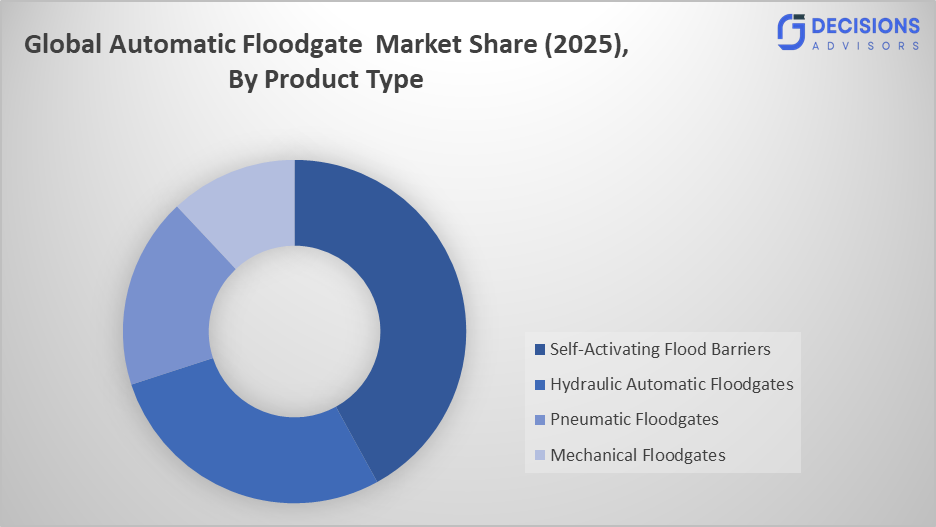
- Self-Activating Flood Barriers segment holds the largest share, contributing approximately 42% of the market in 2025.
Based on the product type, the global automatic floodgate market is divided into Hydraulic Automatic Floodgates, Self-Activating Flood Barriers, Pneumatic Floodgates, and Mechanical Floodgates. Among these, the Self-Activating Flood Barriers segment holds the largest share, contributing approximately 42% of the market in 2025. Their dominance is owed to superior reliability during power outages and the passive capability to deploy using only the hydrostatic pressure of rising water without human intervention. Hydraulic and pneumatic systems constitute the other significant parts of the market, which remain important due to their high load-bearing capacity and established use in protecting heavy industrial entrances and large-scale municipal tunnels.
- Urban Flood Control segment accounts for the largest share, representing over 38% of the global market in 2025.
Based on the application, the global automatic floodgate market is divided into urban flood control, industrial facilities, coastal protection, river and dam management, and residential protection. among these, the urban flood control segment accounts for the largest share, representing over 38% of the global market in 2025. These deployments are critical for maintaining the safety of metropolitan transit systems, improving drainage resilience, and reducing city-wide economic losses through the adoption of modern, autonomous barrier equipment.
- Government and Municipal Authorities dominate the global market, accounting for approximately 52% of the total revenue in 2025.
Based on the End User, the global automatic floodgate market is divided into government and municipal authorities, industrial sector, commercial infrastructure, and residential sector. Among these, the government and municipal authorities dominate the global market, accounting for approximately 52% of the total revenue in 2025. This segment is preferred by planners who require large-scale integrated solutions and professional engineering services for complex public safety infrastructure. The Residential Sector category is seeing a sharp increase in use, especially by homeowners in flood-prone coastal regions who value the peace of mind and the convenience of automatic property protection for driveways and garage entrances.
Strategies to Implement for Growth of the Market in Non-Leading Regions
The potential for growth within the automatic floodgate industry in emerging regions could be increased through the deployment of efficient modular protection platforms for local residential developers, as well as local agencies tasked with urban infrastructure management. Programs aimed at achieving climate resilience by governments, coupled with the expansion of high-strength structural engineering standards, contribute substantially toward demand within regions with traditional housing that poses significant challenges to the installation of massive permanent levees on the ground. Further support through increasing investments in training local civil engineering technicians, as well as setting up regional maintenance facilities, will facilitate the adoption of sustainable flood defense and smart disaster response solutions.
Regional Segment Analysis of the Global Automatic Floodgate Market
- North America (U.S., Canada, Mexico)
- Europe (Germany, France, U.K., Italy, Spain, Rest of Europe)
- Asia-Pacific (China, Japan, India, South Korea, Rest of APAC)
- Latin America (Brazil and the Rest of Latin America)
- The Middle East and Africa (UAE, South Africa, Rest of MEA)
Asia-Pacific is projected to be the fastest-growing region over the forecast period. This region is anticipated to witness a growth rate of around 9.0% CAGR, maintaining a dominant market share within the global industry. In 2025, Asia-Pacific already accounts for approximately 35.2% of global revenue. This is owing to the fast-developing urban housing infrastructure, coupled with the growing demand for modern property protection in countries such as China, India, and Japan. Other reasons for the same include greater investments made toward sustainable city planning in the region, state-supported indigenous research and development projects for low-cost passive flood barriers, and widespread adoption of buoyancy-based water control strategies.
North America is expected to hold a significant share of the automatic floodgate market during the forecast period. This region holds approximately 26.8% share of global revenue in 2025, its highly sophisticated infrastructure related to commercial construction, along with the extensive adoption of disaster-resilient technology in both national safety goals and high-value asset security applications. The largest part of this region’s revenues comes from the United States, as there is a lot of spending at the government level in flood mitigation assistance programs for automated barrier adoption, along with local research related to sensor-integrated hydraulic systems. Over-the-horizon upgrades to building codes and the early adoption of smart-connected systems in municipal retrofit operations have played key roles here.
Europe is anticipated to hold a substantial share, contributing approximately 22.4% of the global market share. There is a competitive advantage in the region owing to clusters of maritime technology innovation and financing for sustainable protection of the environment, as well as flood risk management research. There is also a comparative advantage with countries like Germany, the United Kingdom, and the Netherlands, which are highly skilled at precision engineering for high-performance self-activating gates. Moreover, the rigorous regulatory standards that they have regarding coastal defense and urban drainage further gives them a comparative advantage. The presence of big manufacturing firms, along with improved environmental awareness systems, has also helped introduce advanced automatic floodgates slowly but steadily.
Recent Developments
- In March 2026, the European Commission is investing more than €103 million in seven strategic projects across Europe with funding under the LIFE programme including automated floodgate systems, to enhance protection across more than 200 high-risk regions in Europe.
- In February 2026, the loan of $182 million was made by ADB in February 2026 for expanding flood and erosion management that involves developing an intelligent forecast system for floods, early warning systems, and constructing resilient river embankments against disasters.
- In November 2025, approximately 1.9 billion dollars were allotted for the purpose of flood risk management projects, where several installations of gate control system automation would lead to a reduction of up to 40% in manual intervention during an emergency flooding situation.
- In September 2025, the Environment Agency revealed an investment greater than 5.2 billion pounds in their strategic plan to manage risks associated with floods and coastal erosion by adopting sophisticated measures, like automatic flood gates and barriers to protect more than 336,000 homes.
- In August 2025, according to the World Bank, the flood-resilient initiative implemented in Vietnam has safeguarded more than 420,000 people living in almost 2500 hectares of land, through an investment worth 250 million dollars, including advanced systems for flood prevention.
Market Segmentation
This study forecasts revenue at global, regional, and country levels from 2021 to 2035. The global automatic floodgate market is segmented based on the following categories:
Global Automatic Floodgate Market, By Product Type
- Hydraulic Automatic Floodgates
- Self-Activating Flood Barriers
- Pneumatic Floodgates
- Mechanical Floodgates
Global Automatic Floodgate Market, By Application
- Urban Flood Control
- Industrial Facilities
- Coastal Protection
- River and Dam Management
- Residential Protection
Global Automatic Floodgate Market, By End User
- Government and Municipal Authorities
- Industrial Sector
- Commercial Infrastructure
- Residential Sector
Global Automatic Floodgate Market, By Regional Analysis
- North America
- United States
- Canada
- Mexico
- Europe
- Germany
- United Kingdom
- France
- Italy
- Spain
- Russia
- Rest of Europe
- Asia Pacific
- China
- Japan
- India
- South Korea
- Australia
- Rest of Asia Pacific
- Latin America
- Brazil
- Argentina
- Rest of Latin America
- Middle East & Africa
- United Arab Emirates
- Saudi Arabia
- Qatar
- South Africa
- Rest of Middle East & Africa
Frequently Asked Questions (FAQ)
- What is an automatic floodgate, and why is it important?
An automatic floodgate is a specialised water management system designed to regulate or block the flow of floodwaters by sealing entry points to infrastructure and public spaces. These systems are essential for maintaining public safety and structural integrity during extreme weather events, protecting high-value assets from water damage, and ensuring operational continuity in urban settings. As global sea levels rise and precipitation patterns change, these barriers play a critical role in the transition toward climate-resilient and disaster-proof city planning.
- What factors are driving the growth of the automatic floodgate market?
The market growth can be attributed to the massive investments made in flood-resilient infrastructure by municipal agencies, the rising requirements for autonomous disaster mitigation systems, and the widespread adoption of passive self-activating barriers. The development in this area also owes to the increased interest in reducing economic losses from urban flooding and the implementation of strict building codes regarding property protection in flood-prone zones.
- Which product type dominates the automatic floodgate market?
Self-activating flood barriers represent the largest and most influential segment of the market due to their exceptional operational reliability, the capability to function without external power sources, and their versatility in adapting to various architectural entry points. They have significant potential when used in long-term municipal drainage projects and in coastal regions striving for immediate, fail-safe flood protection.
- Which applications are widely used in this market?
Urban flood control and industrial facilities are the most prominent applications due to the acute necessity to maintain stable drainage operations and provide reliable protection for critical utilities and large-scale commercial complexes. The growing trend of smart-city infrastructure management has further accelerated the integration of advanced automatic floodgate units into these sectors to optimize emergency response and long-term safety.
Check Licence
Choose the plan that fits you best: Single User, Multi-User, or Enterprise solutions tailored for your needs.
We Have You Covered
- 24/7 Analyst Support
- Clients Across the Globe
- Tailored Insights
- Technology Tracking
- Competitive Intelligence
- Custom Research
- Syndicated Market Studies
- Market Overview
- Market Segmentation
- Growth Drivers
- Market Opportunities
- Regulatory Insights
- Innovation & Sustainability
Report Details
| Scope | Global |
| Pages | 200 |
| Delivery | PDF & Excel via Email |
| Language | English |
| Release | Apr 2026 |
| Access | Download from this page |