
Global Automation Market
 |
Author:
Kunal M
|
Pages:
250
|
Author:
Kunal M
|
Pages:
250
Global Automation Market Size, Share, By Component (Hardware, Software, Services), By Application (Manufacturing, Automotive, Electronics, Healthcare, Energy & Utilities, Logistics & Transportation, Others), By End User (Industrial, Commercial, Residential), and By Region (North America, Europe, Asia-Pacific, Latin America, Middle East & Africa), Analysis and Forecast 2026?2035.
CAGR
9.1%
REVENUE 2025
USD Billion 112.4
FORECAST 2035
USD Billion 268.5
REPORT COVERAGE
Global
The Global Automation Market Size is projected to grow from USD 112.4 Billion in 2026 and is expected to reach approximately USD 268.5 Billion by 2035, expanding at a CAGR of 9.1% during the forecast period. According to industry estimates, market growth is driven by increasing adoption of Industry 4.0 technologies, industrial robotics, artificial intelligence, machine learning, IoT-enabled systems, and smart manufacturing initiatives. Rising demand for operational efficiency, workforce optimisation, predictive maintenance, and digital transformation across industries is accelerating automation adoption worldwide. North America remains a leading regional market due to strong technological advancement and industrial automation deployment, while Asia-Pacific is expected to emerge as the fastest-growing region owing to rapid industrialisation and manufacturing expansion.
Market Snapshot
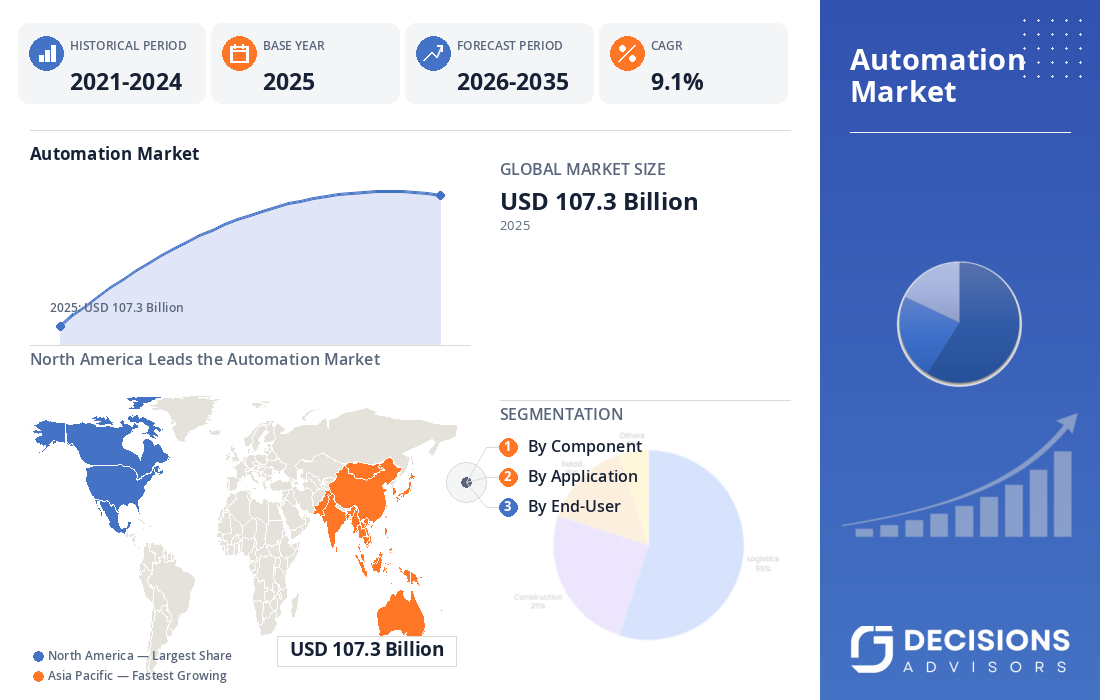
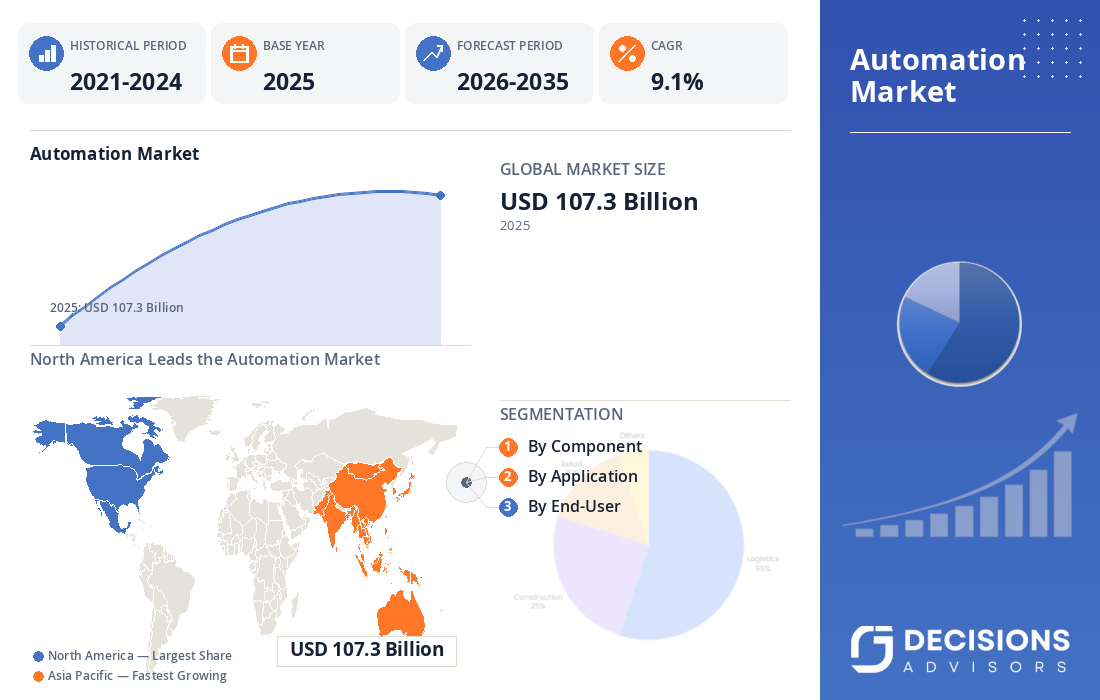
- Global Automation Market Size (2025): USD 107.3 Billion
- Global Automation Market Size (2026): USD 112.4 Billion
- Projected Market Size (2035): USD 268.5 Billion
- Global Market CAGR (2026–2035): 9.1%
- Largest Regional Market: North America
- 2nd Largest Region: Europe
- Fastest Growing Region: Asia-Pacific
- Base Year: 2025
- Historical Period: 2021–2024
- Forecast Period: 2026–2035
Market Overview/ Introduction
The Global Automation Market encompasses technologies, software, hardware, and integrated systems designed to automate industrial, commercial, and business processes with minimal human intervention. Automation has become a fundamental component of modern industries, enabling organizations to improve productivity, operational efficiency, quality control, workplace safety, and cost optimization. The market includes industrial automation, process automation, robotics, artificial intelligence (AI)-driven automation, programmable logic controllers (PLCs), supervisory control and data acquisition (SCADA) systems, distributed control systems (DCS), machine vision systems, and industrial Internet of Things (IIoT) solutions serving industries such as manufacturing, automotive, electronics, healthcare, energy & utilities, logistics, food & beverages, and pharmaceuticals. Increasing adoption of Industry 4.0 technologies, growing demand for smart factories, rising labor costs, and the need for real-time monitoring and predictive maintenance are fueling automation market growth worldwide. Emerging technologies such as artificial intelligence, machine learning, collaborative robots (cobots), digital twins, cloud-based automation platforms, and autonomous systems are transforming industrial operations and business processes. Leading companies including Siemens AG, ABB Ltd., Schneider Electric SE, Rockwell Automation Inc., Honeywell International Inc., Mitsubishi Electric Corporation, Emerson Electric Co., and Yokogawa Electric Corporation continue investing in advanced automation technologies, industrial software, and intelligent manufacturing solutions to strengthen market competitiveness. Future market growth is expected to be driven by industrial digitization, autonomous production systems, smart logistics expansion, and increasing adoption of AI-powered automation.
- The U.S. government continues supporting industrial automation growth through advanced manufacturing initiatives, semiconductor investments, smart factory programs, and artificial intelligence development strategies.
- Several Asia-Pacific countries are expanding smart manufacturing initiatives, industrial digitalization programs, and robotics adoption strategies to improve productivity and strengthen global manufacturing competitiveness.
Notable Insights: -
- North America is anticipated to maintain a leading position in the Global Automation Market with approximately 35% market share due to advanced industrial infrastructure and strong adoption of Industry 4.0 technologies.
- Asia-Pacific is expected to witness the fastest growth during the forecast period owing to rapid industrialization, manufacturing expansion, and increasing investments in smart factories.
- By component, the Hardware segment accounted for approximately 48% market share in 2025 and continues to dominate due to widespread deployment of industrial robots, controllers, sensors, and automation equipment.
- By application, the Manufacturing segment accounted for approximately 38% market share in 2025 due to increasing automation of production processes and smart manufacturing adoption.
- The Global Automation Market is expected to register a CAGR of 8.9% during 2026–2035.
- The market is projected to reach approximately USD 143.7 Billion by 2035.
Market Drivers
The Global Automation Market is primarily driven by increasing adoption of Industry 4.0 technologies, growing demand for operational efficiency, rising labor costs, and the need to improve productivity across industrial and commercial sectors. Organizations are increasingly deploying automation solutions to optimize production processes, reduce operational downtime, improve quality control, and enhance workplace safety. Advancements in artificial intelligence, machine learning, industrial IoT, robotics, and predictive analytics are enabling intelligent automation and real-time decision-making capabilities. Rising investments in smart factories, warehouse automation, autonomous logistics systems, and digital transformation initiatives are further supporting market growth. Additionally, increasing emphasis on energy efficiency, sustainable manufacturing, and workforce optimization continues to create significant opportunities for automation technology providers worldwide.
Restrain
The Global Automation Market faces challenges including high initial implementation costs, cybersecurity threats, system integration complexities, shortage of skilled automation professionals, and concerns regarding workforce displacement. Small and medium-sized enterprises often face financial constraints when adopting advanced automation technologies. Furthermore, compatibility issues with legacy infrastructure, maintenance costs, and data privacy concerns may limit market expansion in certain industries and developing regions.
Competitive Analysis:
The report offers the appropriate analysis of the key organizations/companies involved within the Global Global Automation Market, along with a comparative evaluation primarily based on their product offerings, business overviews, geographic presence, enterprise strategies, segment market share, and SWOT analysis. The report also provides an elaborative analysis focusing on the current news and developments of the companies, which includes product development, innovations, joint ventures, partnerships, mergers & acquisitions, strategic alliances, and others. This allows for the evaluation of the overall competition within the market.
Top Companies in the Global Automation Market
- Siemens AG
- ABB Ltd.
- Schneider Electric SE
- Rockwell Automation Inc.
- Honeywell International Inc.
- Mitsubishi Electric Corporation
- Emerson Electric Co.
- Yokogawa Electric Corporation
- Omron Corporation
- Bosch Rexroth AG
Government Initiatives
|
Country |
Key Government Initiatives |
|
US |
Federal investments in advanced manufacturing, semiconductor production, industrial AI, and smart factory modernization programs support automation growth. |
|
Germany |
Industry 4.0 initiatives continue promoting industrial digitalization, intelligent manufacturing, and automation technology deployment. |
|
China |
Made in China 2025 and smart manufacturing development programs are accelerating robotics adoption and industrial automation investments. |
Market Segmentation
The Global Automation Market share is classified into component, application, and end-user industry.
- The Hardware Segment Dominated the Market
Based on component, the market is divided into Hardware, Software, and Services. Among these, the Hardware segment dominates the market and holds approximately 48% share in 2025. This dominance is attributed to increasing deployment of industrial robots, sensors, machine vision systems, PLCs, actuators, and industrial control systems across manufacturing facilities worldwide.
- The Manufacturing Segment Accounted for the Largest Share
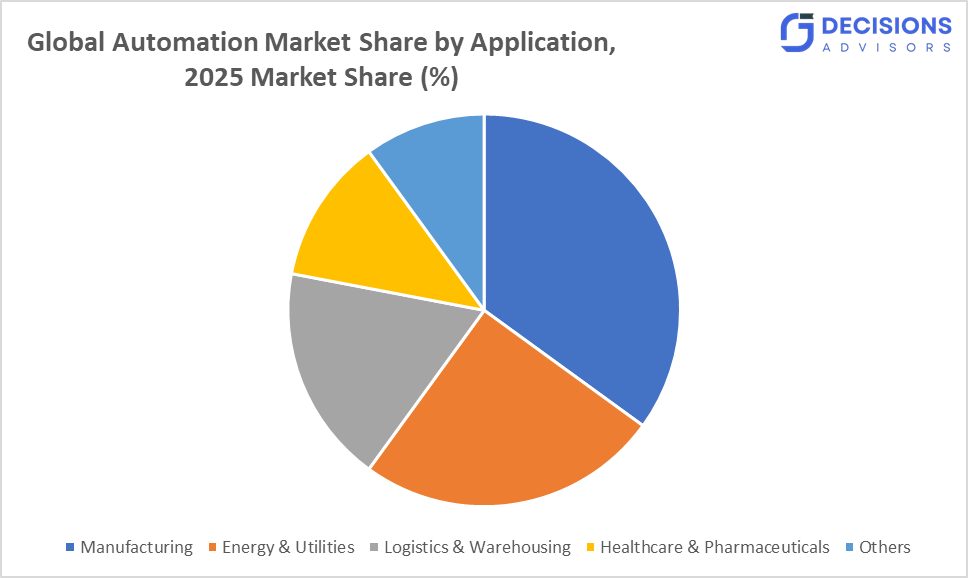
Based on application, the market is divided into Manufacturing, Automotive, Electronics, Healthcare, Energy & Utilities, Logistics & Transportation, and Others. Among these, the Manufacturing segment accounted for the largest share and holds approximately 38% share in 2025. This dominance is driven by growing investments in smart factories, industrial robotics, predictive maintenance, and automated production systems.
- The Industrial Segment Accounted for the Largest Share
Based on end-user industry, the market is divided into Industrial, Commercial, and Residential. Among these, the Industrial segment dominates the market and holds approximately 72% share in 2025. This dominance is attributed to extensive automation deployment across manufacturing plants, process industries, logistics facilities, and energy infrastructure.
Regional Segment Analysis of the Global Automation Market
- North America (U.S., Canada, Mexico)
- Europe (Germany, U.K., France, Italy, Spain, Netherlands, Rest of Europe)
- Asia-Pacific (China, Japan, India, Australia, South Korea, Rest of Asia-Pacific)
- South America (Brazil, Argentina, Rest of South America)
- Middle East & Africa (UAE, Saudi Arabia, South Africa, Rest of MEA)
North America is anticipated to hold approximately 35% share of the Global Automation Market over the predicted timeframe.
North America holds approximately 35% share of the Global Automation Market due to advanced industrial infrastructure, strong adoption of smart manufacturing technologies, extensive investments in robotics and AI-powered automation systems, and the presence of major automation technology providers. Increasing digital transformation initiatives and Industry 4.0 implementation continue supporting market growth.
Europe is expected to hold approximately 28% share of the Global Automation Market during the forecast period.
Europe is expected to account for approximately 28% share of the market due to strong manufacturing capabilities, increasing adoption of industrial robotics, government support for digitalization, and growing investments in sustainable production technologies. Germany, France, Italy, and the United Kingdom remain key contributors to regional automation demand.
Asia-Pacific is the fastest-growing region in the Global Automation Market during the forecast period, holding approximately 29% share.
Asia-Pacific is expected to emerge as the fastest-growing region and hold approximately 29% share of the market due to rapid industrialization, manufacturing expansion, rising labor costs, increasing robotics adoption, and government-backed smart manufacturing initiatives. China, Japan, India, South Korea, and Southeast Asian economies continue driving regional automation investments.
Future Market Trends in Global Automation Market: -
- Expansion of AI-Powered Industrial Automation
Artificial intelligence is increasingly being integrated into automation platforms to enhance predictive maintenance, process optimization, quality control, and autonomous operational decision-making.
- Growth of Collaborative Robotics
Collaborative robots are becoming increasingly popular across manufacturing facilities as they improve productivity, flexibility, and worker safety by operating alongside human employees.
- Increasing Adoption of Digital Twin Technology
Organizations are deploying digital twin platforms to simulate, monitor, and optimize industrial operations in real time, improving efficiency and reducing operational downtime.
- Rising Demand for Autonomous Manufacturing Systems
Manufacturers are investing in autonomous production environments that leverage robotics, machine learning, and industrial IoT technologies to maximize operational efficiency and reduce costs.
Recent Development
- In February 2024, major automation technology providers expanded AI-powered industrial automation platforms to improve predictive maintenance, production efficiency, and operational intelligence.
- In August 2024, leading industrial companies increased investments in smart factory projects, industrial robotics deployment, and digital twin technologies to accelerate manufacturing modernization.
- In November 2024, several automation vendors launched next-generation cloud-based industrial automation and IIoT solutions to support connected manufacturing ecosystems.
Market Segment
This study forecasts revenue at global, regional, and country levels from 2026 to 2035. Decision Advisors has segmented the Global Automation Market based on the below-mentioned segments:
Global Automation Market, By Component
- Hardware
- Software
- Services
- Others
Global Automation Market, By Application
- Manufacturing
- Automotive
- Electronics
- Healthcare
- Energy & Utilities
- Logistics & Transportation
- Others
Global Automation Market, By End-User
- Industrial
- Commercial
- Residential
- Others
Global Automation Market, By Regional Analysis
- North America
- US
- Canada
- Mexico
- Europe
- Germany
- UK
- France
- Italy
- Spain
- Russia
- Rest of Europe
- Asia Pacific
- China
- Japan
- India
- South Korea
- Australia
- Rest of Asia Pacific
- South America
- Brazil
- Argentina
- Rest of South America
- Middle East & Africa
- UAE
- Saudi Arabia
- Qatar
- South Africa
- Rest of the Middle East & Africa
Frequently Asked Questions (FAQ)
Q. Why is automation becoming increasingly important for industries?
A. Automation enables organizations to improve productivity, reduce operational costs, enhance product quality, improve workplace safety, and optimize resource utilization through intelligent and efficient process management.
Q. Why does the hardware segment dominate the automation market?
A. The hardware segment dominates because industrial robots, sensors, controllers, machine vision systems, and automation equipment form the foundation of automated industrial operations.
Q. What role does artificial intelligence play in automation growth?
A. Artificial intelligence enhances automation systems by enabling predictive maintenance, intelligent decision-making, process optimization, quality inspection, and autonomous operational capabilities.
Q. How are technological advancements influencing automation platforms?
A. Innovations such as AI, machine learning, collaborative robotics, industrial IoT, digital twins, cloud computing, and advanced analytics are improving operational efficiency, flexibility, productivity, and real-time decision-making across automated environments.
Check Licence
Choose the plan that fits you best: Single User, Multi-User, or Enterprise solutions tailored for your needs.
We Have You Covered
- 24/7 Analyst Support
- Clients Across the Globe
- Tailored Insights
- Technology Tracking
- Competitive Intelligence
- Custom Research
- Syndicated Market Studies
- Market Overview
- Market Segmentation
- Growth Drivers
- Market Opportunities
- Regulatory Insights
- Innovation & Sustainability
Report Details
| Scope | Global |
| Pages | 250 |
| Delivery | PDF & Excel via Email |
| Language | English |
| Release | Aug 2026 |
| Access | Download from this page |