
Global Automotive Parts Magnesium Die Casting Market
 |
Author:
Atul K
|
Pages:
240
|
Author:
Atul K
|
Pages:
240
Global Automotive Parts Magnesium Die Casting Market Size, Share By Production Process (Pressure Die Casting, Vacuum Die Casting, Gravity Die Casting, and Squeeze Die Casting), By Application (Body Parts, Engine Parts, Transmission Parts, and Others), and By Region (North America, Europe, Asia-Pacific, Latin America, Middle East & Africa), Analysis and Forecast 2026-2035.
CAGR
8.48%
REVENUE 2025
USD Billion 53.8
FORECAST 2035
USD Billion 92.93
REPORT COVERAGE
Global
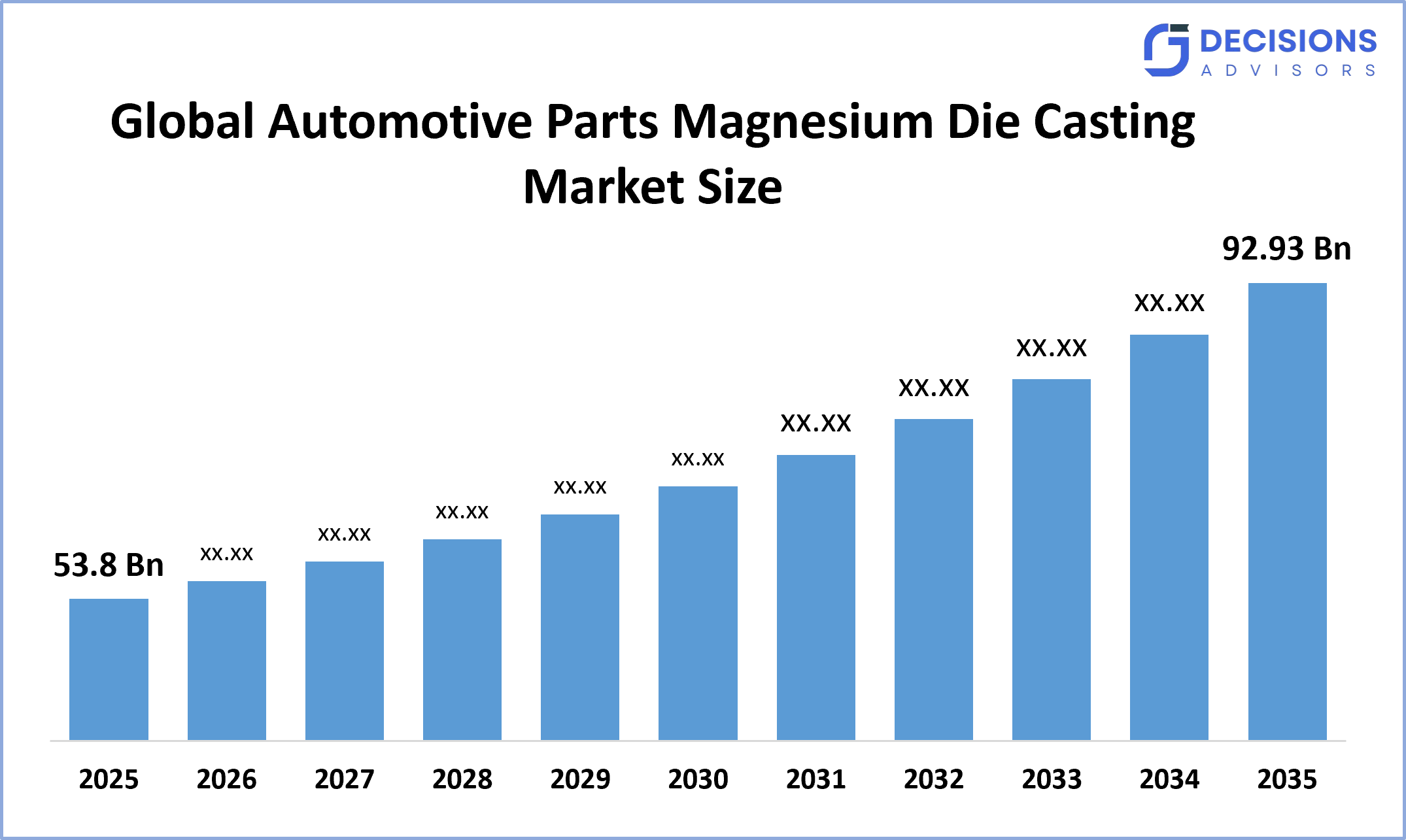
The Global Automotive Parts Magnesium Die Casting Market Size is predicted to grow from USD 53.8 Billion in 2025 and is likely to reach around USD 92.93 Billion by 2030 with a CAGR of 8.48%. According to Decision Advisors, a detailed research report on the market reflects that the touchless sensing adoption trend dominates the Global Automotive Parts Magnesium Die Casting Market, accounting for approximately 55% of the total share worldwide. Georg Fischer Automotive, Ryobi Die Casting, Shiloh Industries, and Pace Industries lead the market with a combined global market share of over 30%, making them key contributors to global market development and growth dynamics.
Market Snapshot
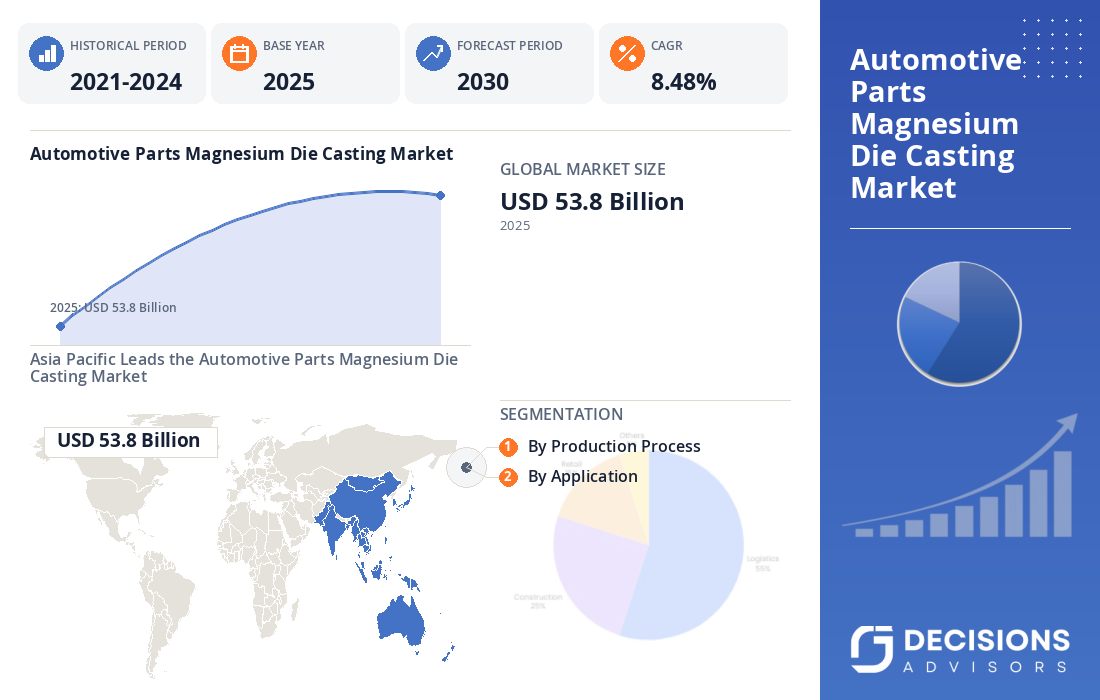
- Global Automotive Parts Magnesium Die Casting Market Size (2025): USD 53.8 Billion
- Projected Global Automotive Parts Magnesium Die Casting Market Size (2035): USD 92.93 Billion
- Global Automotive Parts Magnesium Die Casting Market Compound Annual Growth Rate (CAGR): 5.62%.
- Largest Regional Market: Asia-Pacific
- 2nd Largest Region: North America
- Fastest Growing Region: Europe
- Base Year: 2025
- Historical Period: 2021-2024
- Market Forecast Period: 2026-2035
Market Overview/ Introduction
The Global Automotive Parts Magnesium Die Casting Market focuses on producing lightweight automotive components using magnesium alloys and die-casting technology. These parts are widely used for components such as instrument panels, seat frames, transmission housings, brackets, steering components, and other structural parts. The market is growing as the automotive industry increasingly focuses on vehicle weight reduction, fuel efficiency, lower emissions, and electric vehicle (EV) development. Automakers and component manufacturers are adopting magnesium die casting because magnesium is lightweight, strong, and suitable for producing complex shapes with high dimensional accuracy. Leading companies are investing in advanced die-casting equipment, automation, material development, and improved manufacturing processes to increase production efficiency and product quality. The rising production of EVs is creating additional opportunities because lightweight components can help improve driving range and energy efficiency. Looking ahead, increasing vehicle electrification, demand for lightweight materials, and technological improvements in die-casting processes are expected to support steady market growth through 2035.
- U.S. Department of Energy – Vehicle Technologies Office (VTO) supports research and development of lightweight materials, including magnesium alloys, to reduce vehicle weight, improve fuel efficiency, and support advanced vehicle technologies.
- European Union – Horizon Europe supports research and innovation projects focused on advanced materials, sustainable manufacturing, lightweight components, and cleaner transportation technologies, creating opportunities for magnesium applications in the automotive sector.
Notable Insights: -
- Asia Pacific is anticipated to hold approximately 38% share of the Global Automotive Parts Magnesium Die Casting Market over the predicted timeframe.
- North America is expected to grow at a rapid CAGR in the Global Automotive Parts Magnesium Die Casting Market by holding approximately 28% of the share during the forecast period.
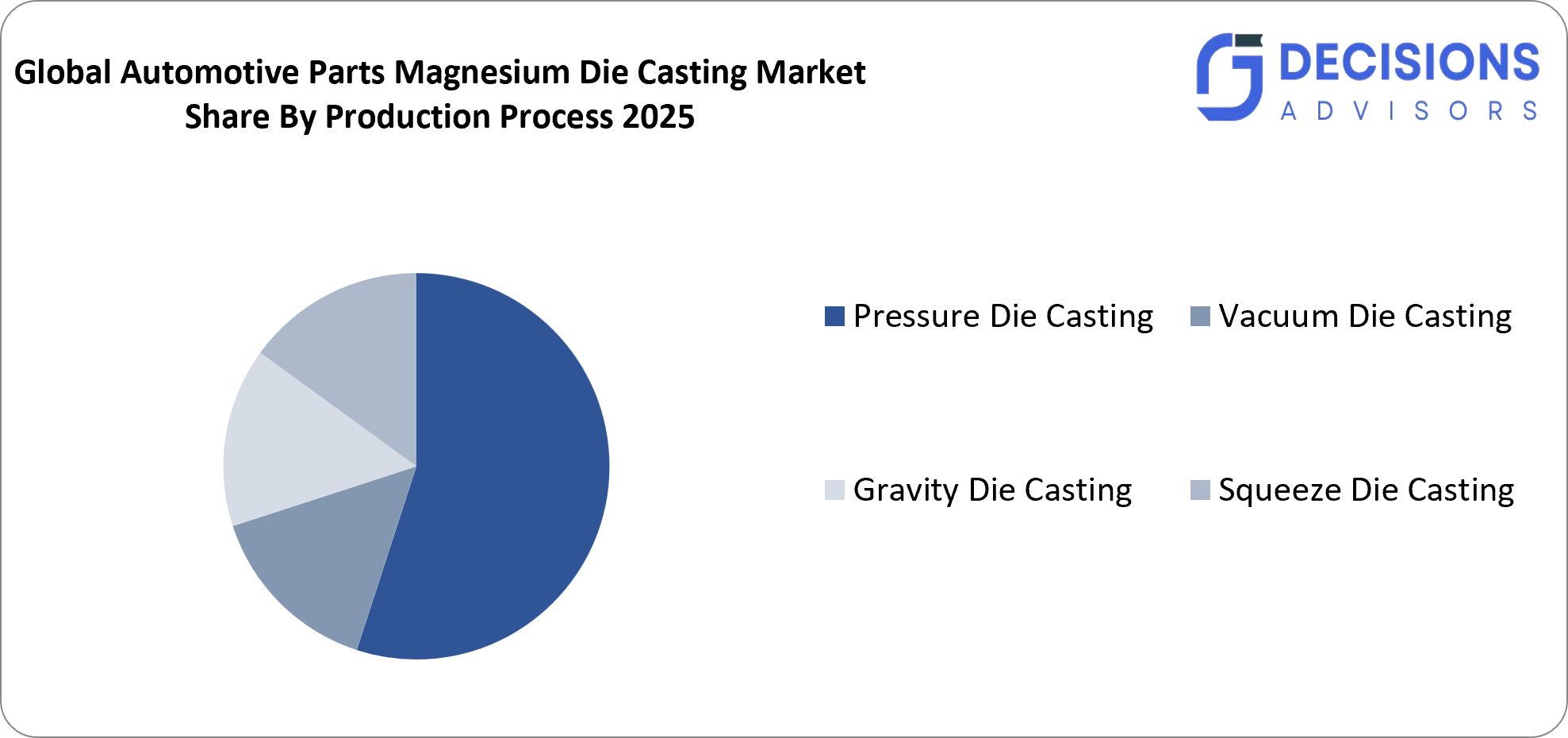
- By production process, the Pressure Die Casting segment dominated the market and holds approximately 55% share in 2025 and is projected to grow at a substantial CAGR during the forecast period.
- By application, the Body Parts segment dominated the market and holds approximately 44% share in 2025 and is projected to grow at a substantial CAGR during the forecast period.
- The compound annual growth rate of the Global Automotive Parts Magnesium Die Casting Market is 5.62%.
- The market is likely to achieve a valuation of USD 92.93 Billion by 2035.
Market Drivers
The Global Automotive Parts Magnesium Die Casting Market experiences growth because automotive manufacturers increasingly focus on vehicle lightweighting to improve fuel efficiency and reduce carbon emissions. The expansion of electric vehicles (EVs) drives increased adoption of magnesium die-cast components because lightweight parts can help improve vehicle range and energy efficiency. The growing use of advanced materials in automotive manufacturing supports the demand for magnesium alloys in structural and non-structural components. The automotive sector shows increasing demand because of the rising production of passenger vehicles, commercial vehicles, and electric mobility solutions. Advancements in die-casting technologies, automation, and precision manufacturing also encourage manufacturers to produce complex and lightweight automotive components efficiently. The global shift toward sustainable and energy-efficient transportation further drives manufacturers to adopt lightweight magnesium components for improving overall vehicle performance.
Restrain
The Global Automotive Parts Magnesium Die Casting Market faces challenges such as the relatively high cost of magnesium compared with some alternative materials, which can increase manufacturing expenses. Magnesium's susceptibility to corrosion and limitations in high-temperature applications can also restrict its use in certain automotive components. Complex processing requirements, material handling considerations, and the need for specialized die-casting equipment further increase production costs.
Competitive Analysis:
The report offers the appropriate analysis of the key organizations/companies involved within the Global Automotive Parts Magnesium Die Casting Market along with a comparative evaluation primarily based on their product offerings, business overviews, geographic presence, enterprise strategies, segment market share, and SWOT analysis. The report also provides an elaborative analysis focusing on the current news and developments of the companies, which includes product development, innovations, joint ventures, partnerships, mergers & acquisitions, strategic alliances, and others. This allows for the evaluation of the overall competition within the market.
Top Companies in the Global Automotive Parts Magnesium Die Casting Market
- Georg Fischer AG
- Ryobi Limited
- Shiloh Industries
- Pace Industries
- Bühler Group
- Rheinmetall AG
- Nemak
- Meridian Lightweight Technologies
- Endurance Technologies
- Gibbs Die Casting
Government Initiatives
|
Country |
Key Government Initiatives |
|
US |
The U.S. Department of Energy, through its Transportation Technologies Office (TTO), supports R&D in lightweight materials such as magnesium alloys to reduce vehicle weight, improve fuel efficiency, and advance lightweight automotive components. |
|
Japan |
Japan's Ministry of Economy, Trade and Industry (METI) supports automotive industry transformation, including initiatives for automotive parts suppliers and the development and adoption of next-generation, environmentally efficient vehicles, creating opportunities for lightweight automotive components. |
|
China |
China's government is strengthening standards and applications for magnesium alloys. For example, the national standard GB/T 26650-2025 covers magnesium-alloy castings for motorcycle and electric-bicycle wheels, supporting standardized production and wider use of magnesium alloy components in lightweight mobility applications. |
Market Segmentation
The Global Automotive Parts Magnesium Die Casting Market share is classified into production process and application.
- The Pressure Die Casting segment dominated the market and holds approximately 55% share in 2025 and is projected to grow at a substantial CAGR during the forecast period.
Based on the production process, the Global Automotive Parts Magnesium Die Casting Market is divided into Pressure Die Casting, Vacuum Die Casting, Gravity Die Casting, and Squeeze Die Casting. Among these, the Pressure Die Casting segment dominates the market and holds approximately 55% share in 2025. This dominance is due to its ability to produce lightweight, complex, and high-precision automotive components at high production volumes. The process offers excellent dimensional accuracy, faster production cycles, and consistent product quality, making it widely preferred for automotive applications requiring weight reduction and manufacturing efficiency.
- The Body Parts segment accounted for the largest share of approximately 44% in 2025 and is anticipated to grow at a significant CAGR during the forecast period.
Based on the application, the market is divided into Body Parts, Engine Parts, Transmission Parts, and Others. Among these, the Body Parts segment accounted for the largest share and holds approximately 44% share in 2025. This dominance is due to increasing demand for lightweight automotive structures that help improve fuel efficiency and reduce vehicle emissions. Magnesium die-cast body components also provide strength, dimensional stability, and weight reduction, supporting their growing adoption in passenger vehicles, commercial vehicles, and electric vehicles.
Regional Segment Analysis of the Global Automotive Parts Magnesium Die Casting Market
- North America (U.S., Canada, Mexico)?
- Europe (Germany, France, U.K., Italy, Spain, Rest of Europe)
- Asia-Pacific (China, Japan, India, Rest of APAC)
- South America (Brazil and the Rest of South America)?
- The Middle East and Africa (UAE, South Africa, Rest of MEA)
Asia Pacific is anticipated to hold approximately 38% share of the Global Automotive Parts Magnesium Die Casting Market over the predicted timeframe.
Asia Pacific holds approximately 38% share of the Global Automotive Parts Magnesium Die Casting Market due to strong automotive manufacturing ecosystems in China, Japan, South Korea, and India, along with large-scale production of passenger vehicles, commercial vehicles, and electric vehicles. The region benefits from the presence of major automotive manufacturers and component suppliers, which support continuous innovation in lightweight materials and die-casting technologies. Growing demand for fuel-efficient and lightweight vehicles further strengthens market growth. Additionally, rapid electric vehicle adoption is increasing the need for lightweight magnesium components to improve vehicle efficiency and driving range. Expanding investments in advanced manufacturing, automation, and material technologies across the region are also supporting the adoption of magnesium die-cast automotive parts.
North America is expected to grow at a rapid CAGR in the Global Automotive Parts Magnesium Die Casting Market, holding approximately 28% of the share during the forecast period.
North America is expected to grow at a rapid CAGR in the Global Automotive Parts Magnesium Die Casting Market, holding approximately 28% share during the forecast period due to strong demand for lightweight automotive components and advanced vehicle manufacturing technologies. The region benefits from the presence of major automotive manufacturers and component suppliers, which are investing in lightweight materials, advanced die-casting equipment, and manufacturing automation. Increasing production of electric vehicles and hybrid vehicles further supports market expansion because magnesium components can help reduce overall vehicle weight. Additionally, growing emphasis on fuel efficiency, lower emissions, and advanced vehicle performance is encouraging manufacturers to adopt magnesium die-cast components across automotive applications.
Europe is the fastest-growing region in the Global Automotive Parts Magnesium Die Casting Market during the period, holding approximately 23% share.
Europe is the fastest-growing region in the Global Automotive Parts Magnesium Die Casting Market during the forecast period, holding approximately 23% share due to strong adoption of lightweight automotive technologies, electric vehicles, and sustainable manufacturing practices. The region benefits from the presence of leading automotive manufacturers and component suppliers that are increasingly focusing on vehicle weight reduction and improved energy efficiency. Growing electric vehicle production is creating additional demand for lightweight magnesium components that can support improved driving range and vehicle performance. Additionally, stringent emission-reduction targets and sustainability regulations are encouraging manufacturers to use advanced lightweight materials. Continuous investments in advanced die-casting technologies, automation, and material innovation across countries such as Germany, France, Italy, and the UK are accelerating the adoption of magnesium automotive components.
Future Market Trends in Global Automotive Parts Magnesium Die Casting Market:
-
- Expansion of Lightweight Automotive Components
Magnesium die-cast components are increasingly being used in automotive applications because of their lightweight structure and favorable strength-to-weight ratio. They help manufacturers reduce overall vehicle weight, improve fuel efficiency, and lower emissions. Growing demand for lightweight passenger vehicles, commercial vehicles, and electric vehicles is accelerating adoption globally.
-
- Rising Adoption in Electric Vehicles
Electric vehicle manufacturers are increasingly adopting lightweight magnesium components to reduce vehicle weight and improve battery efficiency and driving range. Magnesium die casting can be used for various structural and non-structural components, supporting vehicle performance and energy efficiency. Growing global EV production is expected to create significant opportunities for magnesium die-casting manufacturers.
-
- Advancements in Die-Casting Technology
Automotive manufacturers are increasingly investing in advanced pressure die-casting, vacuum die-casting, automation, and precision manufacturing technologies. These developments improve component quality, production speed, dimensional accuracy, and material efficiency. Continuous technological improvements are enabling manufacturers to produce more complex magnesium components for modern automotive applications.
-
- Growing Demand for Sustainable Vehicle Manufacturing
Automotive companies are increasingly focusing on sustainable manufacturing and reducing vehicle emissions. Magnesium's lightweight characteristics make it an attractive material for improving vehicle efficiency and supporting environmental objectives. Growing emphasis on fuel economy, carbon reduction, and recyclable lightweight materials is expected to accelerate the adoption of magnesium die-cast components across the global automotive industry..
Recent Development
- In March 2025, Ryobi introduced a 6,500-ton ultra-large die-casting machine at its Kikugawa Plant, enabling prototyping of large integrated automotive parts and supporting lightweight, lower-cost vehicle manufacturing.
- In July 2025, YIZUMI successfully delivered its 6,600-ton UN6600MGII-Plus semi-solid magnesium alloy thixomolding machine, supporting the large-scale production of lightweight magnesium components for electric vehicles and other applications.
- In August 2025, YIZUMI and DGS China announced a strategic partnership to expand Thixomolding technology and strengthen the development and application of magnesium alloy die casting.
Market Segment
This study forecasts revenue at global, regional, and country levels from 2020 to 2035. Decision Advisors has segmented Global Automotive Parts Magnesium Die Casting Market based on the below-mentioned segments:
Global Automotive Parts Magnesium Die Casting Market, By Production Process
- Pressure Die Casting
- Vacuum Die Casting
- Gravity Die Casting
- Squeeze Die Casting
Global Automotive Parts Magnesium Die Casting Market, By Application
- Body Parts
- Engine Parts
- Transmission Parts
- Others
Global Automotive Parts Magnesium Die Casting Market, By Regional Analysis
- North America
- US
- Canada
- Mexico
- Europe
- Germany
- UK
- France
- Italy
- Spain
- Russia
- Rest of Europe
- Asia Pacific
- China
- Japan
- India
- South Korea
- Australia
- Rest of Asia Pacific
- South America
- Brazil
- Argentina
- Rest of South America
- Middle East & Africa
- UAE
- Saudi Arabia
- Qatar
- South Africa
- Rest of the Middle East & Africa
Frequently Asked Questions (FAQ)
Q. Why is magnesium die casting increasingly used in automotive manufacturing?
A. Magnesium die casting provides lightweight, strong, and dimensionally accurate components, helping automotive manufacturers reduce vehicle weight, improve fuel efficiency, and enhance overall vehicle performance.
Q. What types of automotive components are manufactured using magnesium die casting?
A. Magnesium die casting is used for body components, engine parts, transmission housings, brackets, structural components, instrument panels, and other lightweight automotive parts.
Q. How are electric vehicles influencing the magnesium die casting market?
A. The growing adoption of electric vehicles is increasing demand for lightweight magnesium components because reducing vehicle weight can improve battery efficiency, driving range, and overall vehicle performance.
Q. How is technology innovation influencing magnesium die casting development?
A. Advances in pressure die casting, vacuum die casting, automation, and precision manufacturing are enabling producers to manufacture complex, lightweight, and high-quality magnesium automotive components more efficiently.
Check Licence
Choose the plan that fits you best: Single User, Multi-User, or Enterprise solutions tailored for your needs.
We Have You Covered
- 24/7 Analyst Support
- Clients Across the Globe
- Tailored Insights
- Technology Tracking
- Competitive Intelligence
- Custom Research
- Syndicated Market Studies
- Market Overview
- Market Segmentation
- Growth Drivers
- Market Opportunities
- Regulatory Insights
- Innovation & Sustainability
Report Details
| Scope | Global |
| Pages | 240 |
| Delivery | PDF & Excel via Email |
| Language | English |
| Release | Aug 2026 |
| Access | Download from this page |