
Global Back Bar Coolers Market
 |
Author:
Pranali P
|
Pages:
210
|
Author:
Pranali P
|
Pages:
210
Global Back Bar Coolers Market Size, Share, By Product Type (Glass Door Back Bar Coolers, Solid Door Back Bar Coolers, and Sliding Door Back Bar Coolers) By Application (Bars and Pubs, Restaurants, Hotels, Cafes, and Others) By End User (Hospitality Sector, Food Service Industry, Commercial Establishments, and Others) and By Region (North America, Europe, Asia Pacific, Latin America, and Middle East and Africa), Analysis and Forecast 2026 ? 2035
CAGR
5.11%
REVENUE 2025
USD Billion 6.26
FORECAST 2035
USD Billion 10.3
REPORT COVERAGE
Global
Market Snapshot
- Global Back Bar Coolers Market Size (2025): USD 6.26 Billion
- Global Back Bar Coolers Projected Market Size (2035): USD 10.3 Billion
- Global Back Bar Coolers Compound Annual Growth Rate (CAGR): 5.11%
- Largest Regional Market: North America
- Fastest Growing Region: Asia-Pacific
- 3rd Largest Region: Europe
- Base Year: 2025
- Historical Period: 2021 to 2024
- Forecast Period: 2026 to 2035
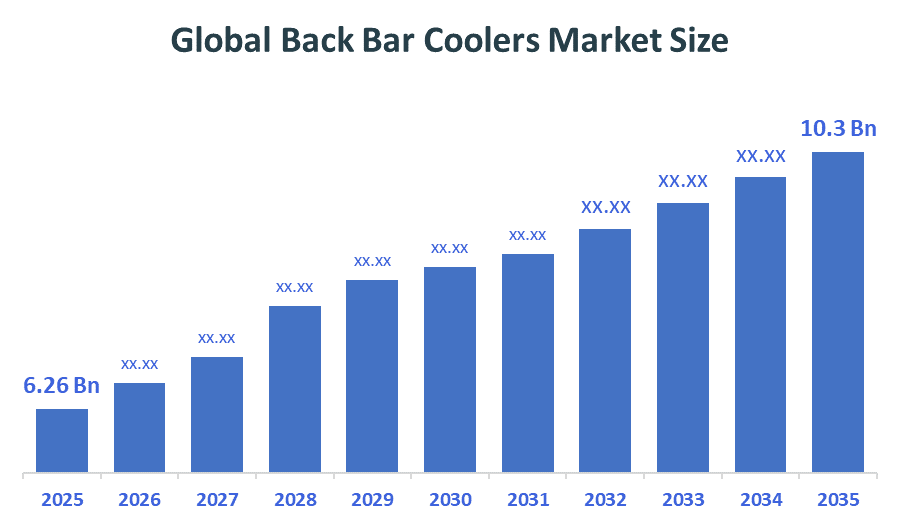
According to Decision Advisors, the global back bar coolers market size is expected to grow from USD 6.26 billion in 2025 to USD 10.3 billion by 2035, with a CAGR of 5.11% during the forecast period from 2026 to 2035. The rise in this industry has always been on a consistent upward path due to the importance of sophisticated drink cooling and storage in the hotel and retail industries around the world, mainly because of the increased demand for sophisticated refrigeration and luxury for guests. Due to advancements in technology such as vacuum insulation glass and the use of hydrocarbon refrigerant, these kinds of units have become reliable to provide sufficient thermal regulation, even in a congested environment, and hence acting as a means to close the gap between conventional household refrigeration units and the refrigeration walk-ins. Due to the cost-effectiveness of these units compared to the old refrigeration units, they have been widely used in the remodelling of city lounges and boutique cafes.
Market Overview / Introduction
Back bar coolers can be explained as highly efficient refrigerating devices tailored to meet the needs of the hospitality industry by maximizing utilization of under-counter spaces and enhancing the visibility of beverages. The technological trend has seen a move towards the development of refrigerating equipment using hydrocarbons and advanced sensing systems that will ensure accurate temperatures despite regular door openings in applications such as busy bars, upmarket hotels, and craft breweries. Recent government initiatives, like the introduction of mandatory energy star ratings by 2026 and a stringent phase-down process of high-GWP refrigerants internationally, have forced manufacturers to focus on energy transparency. The effect of such measures has been the adoption of sustainable and efficient cooling systems that lead to cost savings of about 30 percent while adhering to the new standards. One of the main drivers behind the rise of the global back bar coolers market is the increasing need for craft beverage display and real-time inventory visibility in modern nightlife areas and upmarket food joints. Back bar coolers are essential equipment needed for ensuring quality products and efficiency in service provision without depending on bulky and inaccessible conventional back-of-the-house cooling devices.
- The bar and club segments contribute to approximately 60% of the application-based use in the market, driven by the increasing demand for specialized beer cooling, quick-access wine storage, and the safeguarding of premium spirit collections.
- Automated temperature technology in the commercial foodservice sector is experiencing substantial growth, with a CAGR forecasted to surpass 7% on account of the increasing adoption of smart-connected systems as part of the advanced generation of intelligent kitchens for providing optimized energy management to large-scale hotel chains and high-volume entertainment venues.
Notable Insights: -
- The use of refrigeration in beverages accounts for more than 40% of the refrigeration equipment requirements, underscoring how strongly dependent the industry is on the increased consumption of cold beverages by businesses.
- According to research, the back bar coolers market globally will have a compound annual growth rate of around 5.6%. This growth rate will be attributed to the rising demand for back bar coolers from the food services industry worldwide.
- The glass door back bar coolers have about 62% market share among all door types. The reason for their popularity is due to high visibility, since it makes it easier for bars and restaurants to make additional money by selling more drinks.
- Approximately 34% of the total demand is met by section back bar coolers because these coolers provide the perfect combination of volume and compactness, making them suitable for commercial use.
What is the Role of Technology in Shaping the Market?
Technological innovations are contributing to the revolution in the realm of back bar coolers industry as a result of the developments in cooling accuracy, energy efficiency of structure, and operational performance. Modern beverage refrigerators are not mere stationary boxes but are complex thermal control systems that can sustain consistent operations over an extended period of time owing to their capability to employ premium quality interior material made from stainless steel, vacuum insulated doors made from glass, and integration with real-time inventory monitoring networks.
How are Recent Developments Helping the Market?
The introduction of new technologies, such as sensor-based temperature control technology, the implementation of high-efficiency hydrocarbon refrigerant technology, and self-cleaning condenser technology, has been immensely helpful in supporting growth in the market. Companies have come up with modular cooling systems that suit various architectural configurations, from narrow back counter bars to broad underbars bars, and function efficiently at peak times without any reduction in cooling efficiency. Thanks to the incorporation of variable speed compressors, the system will regulate itself according to the external heating and the number of times the doors open for serving drinks to keep the beverages chilling without any possibility of internal icing or sudden surges in electricity consumption. This technology is likely to simplify large-scale hospitality management and commercial bar business management. Moreover, the deployment of wireless sensing technology will increase the speed of determining the performance of the equipment and ensure efficient predictive maintenance and durability of the hardware.
Market Drivers
The Back Bar Coolers Market in the global arena continues to experience growth on account of the investments that hospitality developers and retail agencies are making on sustainable cooling technology, along with energy-efficient standards that can be used to meet today’s carbon emission requirements. Contemporary platforms for refrigeration have become extremely popular within this industry because of their ability to incorporate a wide range of functionalities, including customizable LED lighting, quick pull-down capabilities, and an ergonomic design that saves space, among others, in one robust unit. Conversely, the emerging trend towards the appreciation of craft beverages has been driving the demand for display technologies that can help facilitate the process of moving towards high visibility in the marketing and display of premium beverages in sophisticated environments.
Restraints
The following are some of the influencing factors in the development of the international back bar coolers market. The challenges involved in manufacturing tough door seals in the presence of high humidity and friction. The cost of manufacturing specific tough thermal alloys and new methods of insulation using thin walls. The cost of developing ventilation systems specifically for small areas.
Competitive Analysis:
The report offers the appropriate analysis of the key organisations/companies involved within the back bar coolers market, along with a comparative evaluation primarily based on their product offerings, business overviews, geographic presence, enterprise strategies, segment market share, and SWOT analysis. The report also provides an elaborate analysis focusing on the current news and developments of the companies, which includes product development, innovations, joint ventures, partnerships, mergers & acquisitions, strategic alliances, and others. This allows for the evaluation of the overall competition within the market.
Top 10 Companies in the Global Back Bar Coolers Market
- True Manufacturing Co., Inc.
- Hoshizaki Corporation
- Perlick Corporation
- The Middleby Corporation (Beverage-Air)
- Carrier Commercial Refrigeration
- Turbo Air Inc.
- Haier Group Corporation
- Ali Group S.r.l.
- Arneg Group
- Metalfrio Solutions S.A.
Government Initiatives
|
Country |
Key Government Initiatives |
|
US |
EPA has tightened the regulations via the AIM Act for reducing emissions due to refrigeration equipment. As per the requirement of the AIM Act, starting January 1, 2026, low GWP refrigerants have to be used in newly manufactured refrigerators, which is expected to be about 300 or 150, based on system capacity. |
|
India |
Beginning January 1, 2026, the Bureau of Energy Efficiency extended the compulsory star labelling scheme to include appliances like refrigerators, air conditioners, and deep freezers. This guarantees clarity regarding the energy efficiency of these products and aids companies in minimizing electricity use by adopting energy-efficient cooling systems. |
|
EU |
The EU amended its F-gas Regulation in 2024 by imposing a ban on the commercial use of self-contained refrigerating appliances containing any refrigerant with a GWP greater than 150 from 2025 onwards. This amendment will fast-track the use of natural refrigerants, such as R290 and CO2, for back bar cooler units. |
Study on the Supply, Demand, Distribution, and Market Environment
The prosperity of the back bar coolers industry will be determined by the delicate balance that should be maintained between maximizing cooling capacity with minimal operational failures and rising demands for energy efficiency and constant control of energy consumption through the integration of intelligence technologies. The supply of back bar coolers is related to manufacturing of sturdy, corrosion resistant stainless-steel frameworks and advanced refrigerators based on hydrocarbons which can instantly provide necessary cooling effect without the time delay typical for old inefficient units. The demand is driven by the development of modernized hospitality facilities and incorporation of intelligent controllers in the cooling triggering equipment used to notify bar managers about the necessity of initiating cooling procedures in areas with significant ambient temperature changes. Products will be delivered through profitable contracts with companies providing commercial kitchen equipment as well as hospitality real estate projects and cooperation with beverage brands and refrigeration distributors worldwide.
Price Analysis and Consumer Behaviour Analysis
The pricing for back bar coolers varies depending on the structural span, door configuration, and smart monitoring capabilities. Higher-end products using multi-zone temperature technology and equipped with state-of-the-art remote monitoring sensors coupled with integrated self-cleaning condensers are more expensive. However, single-section solid door units and smaller countertop coolers for boutique cafes are less costly and provide an ideal opportunity for localized supplemental storage and temporary beverage service in compact urban spaces. Consumers have clearly demonstrated a preference toward long-term cost-effectiveness and durability; hence, companies are expected to favor products that ensure operational autonomy, easy architectural integration, and precise thermal positioning for long periods of time. There is a growing tendency toward modular shelving payloads to ensure hardware updates in response to evolving needs in merchandising standards and international energy efficiency regulations.
Market Segmentation
The Global Back Bar Coolers Market share is classified into product type, application, and end user.
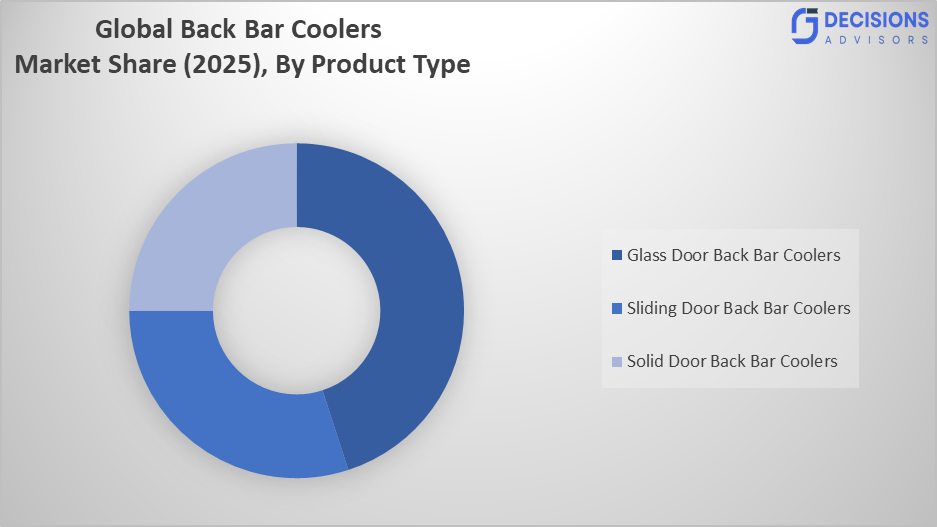
Glass Door Back Bar Coolers segment holds the largest share, contributing approximately 45% of the market in 2025.
Based on the product type, the global back bar coolers market is divided into glass door back bar coolers, solid door back bar coolers, and sliding door back bar coolers. Among these, the glass door back bar coolers segment holds the largest share, contributing approximately 45% of the market in 2025. Their dominance is owed to superior product visibility for beverage merchandising and the aesthetic capability to showcase premium craft brands to consumers without opening the unit. Sliding door systems constitute the other significant part of the market, which remains important due to their space-saving design and established use in tight behind-the-counter service areas where swinging doors would obstruct staff movement.
Bars and Pubs segment accounts for the largest share, representing over 38% of the global market in 2025.
Based on the application, the global back bar coolers market is divided into bars and pubs, restaurants, hotels, cafes, and others. Among these, the bars and pubs segment accounts for the largest share, representing over 38% of the global market in 2025. These deployments are critical for maintaining the high-speed service of chilled beverages, improving inventory turnover, and reducing operational energy losses through the adoption of modern, rapid-recovery cooling equipment. On the other hand, the Cafes segment has emerged as a rapidly growing application, thanks to the increasing expansion of specialized coffee chains and the refurbishment of aging refrigeration systems to include grab-and-go beverage sections.
Hospitality Sector dominates the global market, accounting for approximately 52% of the total revenue in 2025.
Based on the End User, the global back bar coolers market is divided into hospitality sector, food service industry, commercial establishments, and others. Among these, the Hospitality Sector dominates the global market, accounting for approximately 52% of the total revenue in 2025. This segment is preferred by planners who require large-scale integrated cooling solutions and professional maintenance services for complex hotel and resort infrastructure. The Commercial Establishments category is seeing a sharp increase in use, especially by retailers in high-traffic urban transit hubs who value the high-durability builds and the convenience of automated temperature monitoring for keeping bottled assets at precise serving conditions.
Strategies to Implement for Growth of the Market in Non-Leading Regions
The potential for growth within the back bar coolers industry in emerging regions could be increased through the deployment of efficient modular cooling platforms for local independent retailers, as well as local agencies tasked with modernizing hospitality infrastructure management. Programs aimed at achieving energy efficiency by governments, coupled with the expansion of high-standard commercial refrigeration requirements, contribute substantially toward demand within regions with traditional storefronts that pose significant challenges to the installation of massive walk-in cold rooms on the ground. Further support through increasing investments in training local refrigeration technicians, as well as setting up regional maintenance facilities, will facilitate the adoption of sustainable cooling and smart temperature response solutions.
Regional Segment Analysis of the Global Back Bar Coolers Market
- North America (U.S., Canada, Mexico)
- Europe (Germany, France, U.K., Italy, Spain, Rest of Europe)
- Asia-Pacific (China, Japan, India, South Korea, Rest of APAC)
- Latin America (Brazil and the Rest of Latin America)
- The Middle East and Africa (UAE, South Africa, Rest of MEA)
North America is expected to hold the largest share of the back bar coolers market during the forecast period. This region holds approximately 39.5% share of global revenue in 2025, its highly sophisticated infrastructure related to commercial foodservice, along with the extensive adoption of energy-resilient technology in both national sustainability goals and high-volume hospitality applications. The largest part of this region’s revenues comes from the United States, as there is a lot of spending at the corporate level in equipment upgrade programs for automated cooling adoption, along with local research related to sensor-integrated variable speed systems. Over-the-horizon upgrades to energy codes and the early adoption of smart-connected systems in franchise retrofit operations have played key roles here.
Asia-Pacific is projected to be the fastest-growing region over the forecast period. This region is anticipated to witness a growth rate of around 7.8% CAGR, maintaining a rising market share within the global industry. In 2025, Asia-Pacific already accounts for a significant portion of global revenue, following closely behind the leading regions. This is owing to the fast-developing urban retail infrastructure, coupled with the growing demand for modern beverage merchandising in countries such as China, India, and Vietnam. Other reasons for the same include greater investments made toward sustainable tourism planning in the region, state-supported indigenous research and development projects for low-cost eco-friendly chillers, and widespread adoption of hydrocarbon-based cooling strategies.
Europe is anticipated to hold a substantial share, contributing approximately 23.2% of the global market share. There is a competitive advantage in the region owing to clusters of commercial appliance innovation and financing for sustainable protection of the environment, as well as refrigeration efficiency research. There is also a comparative advantage with countries like Germany, the United Kingdom, and Italy, which are highly skilled at precision engineering for high-performance vacuum-insulated units. Moreover, the rigorous regulatory standards that they have regarding F-gas phase-downs and urban energy consumption further gives them a comparative advantage. The presence of big manufacturing firms, along with improved environmental awareness systems, has also helped introduce advanced back bar coolers slowly but steadily.
Recent Developments
- In March 2025, The Blue Star Limited introduced its extended range of commercial refrigeration products for various sectors such as HoReCa, as the organisation is looking forward to benefiting from the growing market, which records yearly increases in demand by up to 25% to 50%.
- In January 2025, new environmental laws in leading countries banned the production of self-contained refrigeration units utilizing refrigerants with high GWP exceeding certain levels, with implementation dates running into 2026, raising the cost of the units by 7%-10%.
- In May 2025, the global industrial refrigeration market crossed USD 34.7 billion in 2024 and is forecast to touch around USD 55.1 billion in 2033, expanding at a CAGR of approximately 5.27%, making way for companies to develop energy-efficient and sustainable solutions for industrial cooling.
- In March 2024, The Indian government launched a voluntary star labeling system for commercial beverage coolers as part of its Standards and Labeling initiative, which will enhance energy efficiency in an industry projected to increase by nearly double within ten years.
Market Segmentation
This study forecasts revenue at global, regional, and country levels from 2021 to 2035. The global back bar coolers market is segmented based on the following categories:
Global Back Bar Coolers Market, By Product Type
- Glass Door Back Bar Coolers
- Solid Door Back Bar Coolers
- Sliding Door Back Bar Coolers
Global Back Bar Coolers Market, By Application
- Bars and Pubs
- Restaurants
- Hotels
- Cafes
- Others
Global Back Bar Coolers Market, By End User
- Hospitality Sector
- Food Service Industry
- Commercial Establishments
- Others
Global Back Bar Coolers Market, By Regional Analysis
- North America
- United States
- Canada
- Mexico
- Europe
- Germany
- United Kingdom
- France
- Italy
- Spain
- Russia
- Rest of Europe
- Asia Pacific
- China
- Japan
- India
- South Korea
- Australia
- Rest of Asia Pacific
- Latin America
- Brazil
- Argentina
- Rest of Latin America
- Middle East & Africa
- United Arab Emirates
- Saudi Arabia
- Qatar
- South Africa
- Rest of Middle East & Africa
Frequently Asked Questions (FAQ)
What is a back bar cooler, and why is it important?
A back bar cooler is a specialized commercial refrigeration system designed to store and display beverages at precise temperatures while fitting into the restricted spaces behind service counters. These units are essential for maintaining the quality and carbonation of craft beers, wines, and mixers, ensuring that drinks are ready to serve during high-traffic periods. By combining rapid cooling recovery with high-visibility glass doors, they act as critical merchandising tools that drive impulse sales and improve the overall aesthetic of a professional bar or cafe environment.
What factors are driving the growth of the back bar coolers market?
The market growth is primarily attributed to the massive investments in premium hospitality infrastructure and the global expansion of specialized nightlife venues like craft breweries and rooftop lounges. The rising demand for energy-efficient equipment, fueled by strict government regulations on carbon footprints and electricity consumption, is also a major driver. Furthermore, the shift toward "premiumization" in the beverage industry has led to a widespread adoption of high-tech coolers that offer advanced LED lighting, smart temperature monitoring, and whisper-quiet operation.
Which product type dominates the back bar coolers market?
Glass door back bar coolers represent the largest and most influential segment of the market due to their exceptional ability to showcase inventory directly to the customer without thermal loss. They provide a significant advantage in retail-heavy environments and high-end bars by enhancing product visibility and allowing staff to monitor stock levels at a glance. Their versatility in adapting to various interior designs makes them the preferred choice for both large-scale hotel chains and independent boutique cafes striving for a modern, functional look.
Which applications are widely used in this market?
Bars, pubs, and restaurants are the most prominent applications due to the acute necessity to maintain high-volume beverage turnover and provide reliable cooling in fast-paced service settings. The growing trend of smart-integrated kitchen management has further accelerated the adoption of advanced back bar units into these sectors to optimize energy usage and ensure food safety compliance. Additionally, the hotel and catering segments are increasingly utilizing these systems to provide high-quality, on-demand drink service in executive suites and large-scale event venues.
Check Licence
Choose the plan that fits you best: Single User, Multi-User, or Enterprise solutions tailored for your needs.
We Have You Covered
- 24/7 Analyst Support
- Clients Across the Globe
- Tailored Insights
- Technology Tracking
- Competitive Intelligence
- Custom Research
- Syndicated Market Studies
- Market Overview
- Market Segmentation
- Growth Drivers
- Market Opportunities
- Regulatory Insights
- Innovation & Sustainability
Report Details
| Scope | Global |
| Pages | 210 |
| Delivery | PDF & Excel via Email |
| Language | English |
| Release | Apr 2026 |
| Access | Download from this page |