
Global Bacterial Pneumonia Market
 |
Pages:
240
|
Pages:
240
Global Bacterial Pneumonia Market Size, Share, and COVID-19 Impact Analysis, By Type (Community-Acquired Pneumonia (CAP), and Hospital-Acquired Pneumonia (HAP)), By Treatments (Vaccines and Drugs), By Route of Administration (Oral, Subcutaneous, and Others) and By Region (North America, Europe, Asia-Pacific, Latin America, Middle East, and Africa), Analysis and Forecast 2025-2035
REPORT COVERAGE
Global
Global Bacterial Pneumonia Market Size Insights Forecasts to 2035
- The Global Bacterial Pneumonia Market Size Was valued at USD 2.33 Billion in 2024
- The Global Bacterial Pneumonia Market Size is Expected to Grow at a CAGR of around 8.14% from 2025 to 2035
- The Worldwide Bacterial Pneumonia Market Size is Expected to Reach USD 5.51 Billion by 2035
- Asia-Pacific is expected to grow the fastest during the forecast period.
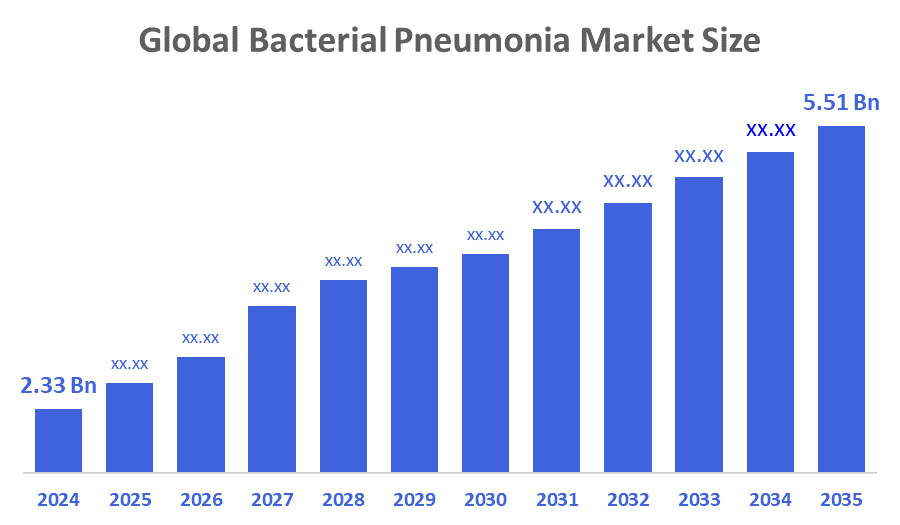
According to a research report published by Decisions Advisors and Consulting, The Global Bacterial Pneumonia Market Size Was Worth Around USD 2.33 Billion In 2024 And Is Predicted To Grow To Around USD 5.51 Billion By 2035 With A Compound Annual Growth Rate (CAGR) Of 8.14% From 2025 To 2035. The Global Bacterial Pneumonia Market provides opportunities through vaccine development, new diagnostic tests, telehealth services expansion, antimicrobial research and development, and public health programs which the World Health Organization supports by building surveillance systems and healthcare access and vaccine adoption programs.
Market Overview
The Global Bacterial Pneumonia Market Size refers to the worldwide industry which focuses on diagnosing and preventing and treating bacterial lung infections through the use of antibiotics and vaccines and diagnostic tools that comply with World Health Organization standards. Additionally, the trend toward precision medicine in bacterial pneumonia now creates an exciting chance to develop customized treatments and diagnostic tests. Clinicians increasingly select treatment based on the specific bacterial pathogen, antibiotic?susceptibility profile and patient risk?factors which encourages development of targeted antimicrobials and monoclonal antibodies and phage therapies. New products in the market achieve two benefits because this shift improves effectiveness and decreases usage of broad-spectrum antibiotics. Manufacturers and diagnostic developers can use this opportunity by developing their products according to defined patient groups while providing solutions that merge testing with treatment. For instance, AR-301, a monoclonal antibody targeting the alpha-toxin of Staphylococcus aureus, is currently in Phase 3 trials as an adjunctive treatment for hospital-acquired bacterial pneumonia, demonstrating specificity against a key virulence factor.
Report Coverage
This research report categorizes the bacterial pneumonia market based on various segments and regions, forecasts revenue growth, and analyzes trends in each submarket. The report analyses the key growth drivers, opportunities, and challenges influencing the bacterial pneumonia market. Recent market developments and competitive strategies such as expansion, type launch, development, partnership, merger, and acquisition, have been included to draw the competitive landscape in the market. The report strategically identifies and profiles the key market players and analyses their core competencies in each sub-segment of the bacterial pneumonia market.
Driving Factors
The Global Bacterial Pneumonia Market Size expands because worldwide immunization and vaccination programs United States Military develop novel conjugate vaccines that extend their ability to protect against multiple bacterial strains. The advanced biologics which target invasive strain protection require faster approval processes from regulatory authorities. For instance, according to Merck, June 2024, in the 'FDA Approves CAPVAXIVE' press release, the U.S. Food and Drug Administration approved a new 21-valent conjugate vaccine which specifically covers serotypes responsible for approximately 84% of invasive pneumococcal disease in adults aged 50 and older. This drive towards enhanced preventative care is further evidenced by the scale of international deployment; according to the World Health Organization, July 2024, in the 'Immunization Coverage' report, the global coverage of the third dose of pneumococcal conjugate vaccine was estimated to have reached 65% by the end of 2023, reflecting a sustained commitment to reducing disease burden through widespread inoculation.
Restraining Factors
The global bacterial pneumonia market experiences growth restrictions because of several factors which include antibiotic resistance and high treatment costs and limited diagnostic access and regulatory delays and uneven healthcare infrastructure. The World Health Organization stewardship frameworks which the organization promotes to improve antimicrobial use show no impact on market growth.
Market Segmentation
The bacterial pneumonia market share is classified into type, treatments, and route of administration.
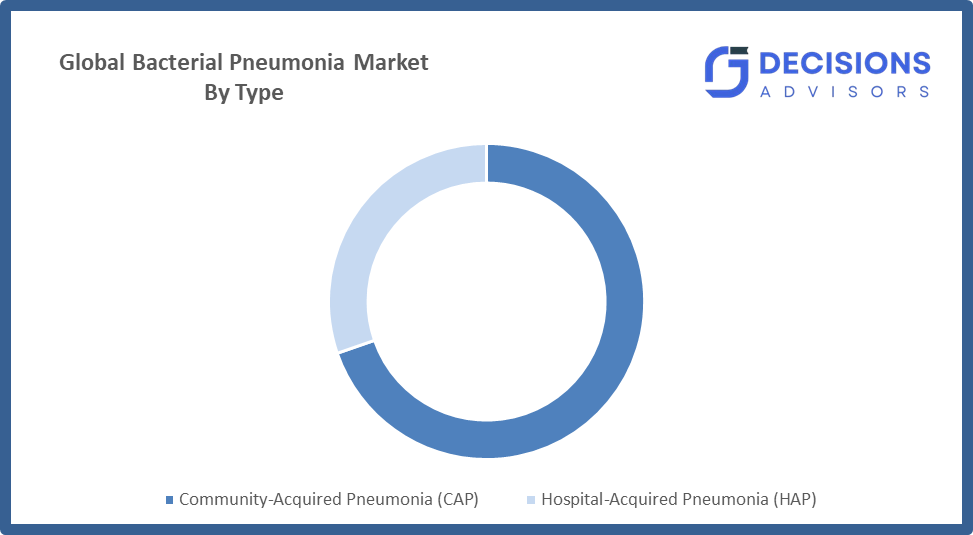
- The community-acquired pneumonia (CAP) segment dominated the market in 2024, approximately 51.4% and is projected to grow at a substantial CAGR during the forecast period.
Based on the type, the bacterial pneumonia market is divided into community-acquired pneumonia (CAP) and hospital-acquired pneumonia (HAP). Among these, the community-acquired pneumonia (CAP) segment dominated the market in 2024, approximately 51.4% and is projected to grow at a substantial CAGR during the forecast period. The world population faces increasing health challenges because of its widespread occurrence and because aging people and pollution exposure and climbing multiple health conditions and other diseases create additional risk factors for people. The sustained demand for medical services and market expansion in both advanced and developing markets arises from increased outpatient medical evaluations and higher need for antibiotics and vaccination knowledge and early detection services which World Health Organization guidelines support.
- The drugs segment accounted for the largest share in 2024, approximately 67.7% and is anticipated to grow at a significant CAGR during the forecast period.
Based on the treatments, the bacterial pneumonia market is divided into vaccines and drugs. Among these, the drugs segment accounted for the largest share in 2024, approximately 67.7% and is anticipated to grow at a significant CAGR during the forecast period. Antibiotics serve as the main treatment method for bacterial pneumonia which results in hospitals and outpatient facilities needing to maintain constant demand for this medication. The combination of increasing infection rates with immediate treatment start times and broader access to generic medications and better prescribing methods which World Health Organization stewardship guidelines support, leads to increased usage and stable procurement patterns which enable wider treatment access, thereby supporting permanent growth in market segments.
- The oral segment accounted for the highest market revenue in 2024, approximately 55.5% and is anticipated to grow at a significant CAGR during the forecast period.
Based on the route of administration, the bacterial pneumonia market is divided into oral, subcutaneous, and others. Among these, the oral segment accounted for the highest market revenue in 2024, approximately 55.5% and is anticipated to grow at a significant CAGR during the forecast period. The world health organization guidelines support primary care accessibility expansion through their standardized prescribing framework which establishes patient treatment protocols. The world health organization guidelines create standardized prescribing processes which enable healthcare personnel to deliver treatment to patients through developed healthcare systems and emerging medical markets.
Regional Segment Analysis of the Bacterial Pneumonia Market
- North America (U.S., Canada, Mexico)
- Europe (Germany, France, U.K., Italy, Spain, Rest of Europe)
- Asia-Pacific (China, Japan, India, Rest of APAC)
- South America (Brazil and the Rest of South America)
- The Middle East and Africa (UAE, South Africa, Rest of MEA)
North America is anticipated to hold the largest share of the bacterial pneumonia market over the predicted timeframe.
North America is anticipated to hold the largest share of the bacterial pneumonia market over the predicted timeframe. The country holds its position as the leading nation because of its established healthcare system and its strong investment in research and development and its high number of pneumonia cases among elderly people. People can quickly use advanced diagnostic tools and treatment techniques which include new antibiotics and vaccines. The combination of regulatory backing and reimbursed medical services creates an environment that promotes market adoption. The premium pricing system of the region together with its immediate access to new innovations establishes a growth environment which surpasses typical development patterns of emerging markets and strengthens North America's position as the leading region.
Asia-Pacific is expected to grow at a rapid CAGR in the bacterial pneumonia market during the forecast period. The demand for healthcare services is increasing because of four main factors which include rapid urban growth and higher healthcare spending and expanded hospital networks and the greater healthcare needs of older people in developing nations. The government is working to boost immunization rates while making it easier for people to get testing and medical services. The region held a market share of about 22.5% but it still lags behind North America and Europe. The Asia Pacific region presents the quickest potential for growth because of its extensive population base and increasing health insurance accessibility and greater adoption of cutting-edge medical treatments. The combination of these factors establishes Asia Pacific as a primary driver of future expansion.
Competitive Analysis:
The report offers the appropriate analysis of the key organizations/companies involved within the bacterial pneumonia market, along with a comparative evaluation primarily based on their type of offering, business overviews, geographic presence, enterprise strategies, segment market share, and SWOT analysis. The report also provides an elaborative analysis focusing on the current news and developments of the companies, which includes type development, innovations, joint ventures, partnerships, mergers & acquisitions, strategic alliances, and others. This allows for the evaluation of the overall competition within the market.
List of Key Companies
- Pfizer Inc.
- Merck & Co. Inc.
- AbbVie Inc.
- Bayer AG
- AstraZeneca PLC
- Novartis AG
- GSK plc
- bioMerieux SA
- Shionogi & Co. Ltd.
- Wockhardt Limited.
- Others
Key Target Audience
- Market Players
- Investors
- End-users
- Government Authorities
- Consulting and Research Firm
- Venture capitalists
- Value-Added Resellers (VARs)
Recent Development
- In November 2025, the American Thoracic Society released updated clinical guidelines for adult pneumonia, refining antibiotic duration, tailoring steroid use to severity, and recommending lung ultrasound as an alternative diagnostic tool to improve targeted treatment.
Market Segment
This study forecasts revenue at global, regional, and country levels from 2020 to 2035. Decisions Advisors has segmented the bacterial pneumonia market based on the below-mentioned segments:
Global Bacterial Pneumonia Market, By Type
- Community-Acquired Pneumonia (CAP)
- Hospital-Acquired Pneumonia (HAP)
Global Bacterial Pneumonia Market, By Treatments
- Vaccines
- Drugs
Global Bacterial Pneumonia Market, By Route of Administration
- Oral
- Subcutaneous
- Others
Global Bacterial Pneumonia Market, By Regional Analysis
- North America
- US
- Canada
- Mexico
- Europe
- Germany
- UK
- France
- Italy
- Spain
- Russia
- Rest of Europe
- Asia Pacific
- China
- Japan
- India
- South Korea
- Australia
- Rest of Asia Pacific
- South America
- Brazil
- Argentina
- Rest of South America
- Middle East & Africa
- UAE
- Saudi Arabia
- Qatar
- South Africa
- Rest of the Middle East & Africa
Frequently Asked Questions (FAQ)
Q1. What is the long-term growth outlook for the bacterial pneumonia market?
A: According to Decisions Advisors and Consulting, the market expands from USD 2.33 billion in 2024 to USD 5.51 billion by 2035, driven by vaccines, diagnostics, telehealth, and antimicrobial innovation globally.
Q2. Why does the CAP segment dominate the market?
A: The CAP segment leads due to high incidence, aging populations, pollution exposure, and comorbidities, increasing outpatient visits, antibiotic demand, vaccination awareness, and early detection, sustaining long-term revenue growth worldwide consistently.
Q3. Why do drugs hold the largest treatment share?
A: Drug dominance reflects antibiotics as first-line therapy, ensuring continuous hospital and outpatient demand, guided by stewardship frameworks from World Health Organization, supporting optimized prescribing, procurement stability, broader access, and scalable therapeutic expansion.
Q4. What drives oral administration market leadership?
A: Oral administration leads because it offers convenience, affordability, and patient adherence, enabling outpatient pneumonia management, reducing hospitalization burden, accelerating prescriptions, and supporting standardized care delivery across developed and emerging systems.
Q5. Why is Asia-Pacific the fastest-growing regional market?
A: Asia-Pacific growth is fueled by urbanization, higher healthcare spending, expanding hospitals, aging demographics, improved insurance coverage, and advanced therapy adoption, positioning the region as an engine for future pneumonia expansion.
Check Licence
Choose the plan that fits you best: Single User, Multi-User, or Enterprise solutions tailored for your needs.
We Have You Covered
- 24/7 Analyst Support
- Clients Across the Globe
- Tailored Insights
- Technology Tracking
- Competitive Intelligence
- Custom Research
- Syndicated Market Studies
- Market Overview
- Market Segmentation
- Growth Drivers
- Market Opportunities
- Regulatory Insights
- Innovation & Sustainability
Report Details
| Scope | Global |
| Pages | 240 |
| Delivery | PDF & Excel via Email |
| Language | English |
| Release | Feb 2026 |
| Access | Download from this page |