
Global Bale Handling Equipment Market
 |
Author:
Pranali P
|
Pages:
190
|
Author:
Pranali P
|
Pages:
190
Global Bale Handling Equipment Market Size, Share, By Product Type (Bale Wrappers, Bale Spears, Bale Carriers, and Others), By Application (Agriculture, Livestock, Industrial Use, and Others) By End User (Farmers, Contractor, Industrial User, Others), By Farm Size (Small Farms, and Large Farms), and By Region (North America, Europe, Asia-Pacific, Latin America, Middle East, and Africa), Analysis and Forecast 2026?2035.
CAGR
6.09%
REVENUE 2025
USD Billion 3.39
FORECAST 2035
USD Billion 6.12
REPORT COVERAGE
Global
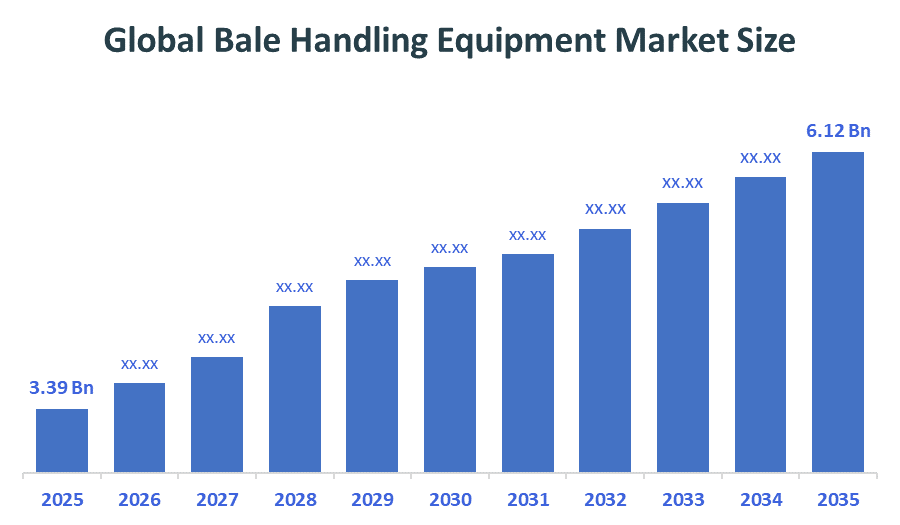
The Global Bale Handling Equipment Market Size is projected USD 3.39 Billion in 2025 and is forecasted to reach around USD 6.12 Billion by 2035. According to Decision Advisors, a detailed report on analysis of the Global Bale Handling Equipment Market indicates that the Increasing Adoption of Automation and Precision Farming Technologies trend dominates the Market, accounting for approx. 40% of the total Global demand worldwide. Deere & Company dominates the Global Bale Handling Equipment Market, supported by revenue of approx. USD 45.7 billion, due to its strong global distribution network, advanced precision agriculture technologies, and extensive product portfolio, enabling high market penetration, continuous innovation, and consistent revenue leadership.
Market Snapshot
- Global Bale Handling Equipment Market Size (2025): USD 3.39 Billion
- Projected Global Bale Handling Equipment Market Size (2035): USD 6.12 Billion
- Global Bale Handling Equipment Compound Annual Growth Rate (CAGR): 6.09%
- Largest Regional Market: Asia Pacific
- Fastest Growing Region: North America
- 3rd Largest Region: Europe
- Base Year: 2025
- Historical Period: 2021–2024
- Forecast Period: 2026–2035
Market Overview/ Introduction
The Global Bale Handling Equipment Market comprises one of the emerging segments in industrial machines that include devices used for the efficient handling, transportation, stacking, and management of bales made of various materials like agricultural waste, textile bales, paper, and other types of industrial waste. Such equipment is commonly utilized in industries such as agriculture, recycling, packaging, and manufacturing. They help to increase the efficiency of operations by making them labour intensive, safer, and uniform with regard to the handling of bulky materials. Increased mechanization in industrial activities is among the major factors fuelling the demand for automated bale handling equipment. Growth in this market is significantly affected by the increase in industrialization around the world, mechanization in agriculture, and demands for automated handling of materials. Moreover, technological innovations like IoT-enabled monitoring, automation, and artificial intelligence-based predictive maintenance continue to revolutionize the industry. There is an increasing adoption of smart sensors and digital control systems by manufacturers for enhanced efficiency, lower downtime, and optimized performance. In addition, government regulations promoting industrial development, energy efficiency, and environmental sustainability are aiding in the growth of the market. Developing nations, particularly in the Asia-Pacific region, have been seeing substantial investment in industrial infrastructure.
- In March 2026, Europe and North America strengthened EPR regulations, boosting recycling infrastructure and increasing demand for bale handling equipment in waste management and agricultural applications.
- In February 2026, India expanded subsidized agricultural machinery programs under SMAM, boosting mechanization and accelerating adoption of advanced bale handling equipment for efficient forage and residue management.
- In February 2026, Singapore expanded Productivity Solutions Grant (PSG) support under ITMs, accelerating automation adoption and boosting demand for advanced bale handling equipment across logistics and agriculture sectors.
Notable Insights: -
- Asia-Pacific holds the largest regional market share approximately 22.1% in the Global Bale Handling Equipment Market.
- North America is the fastest growing region market share approximately 37.7 % in the Global Bale Handling Equipment Market.
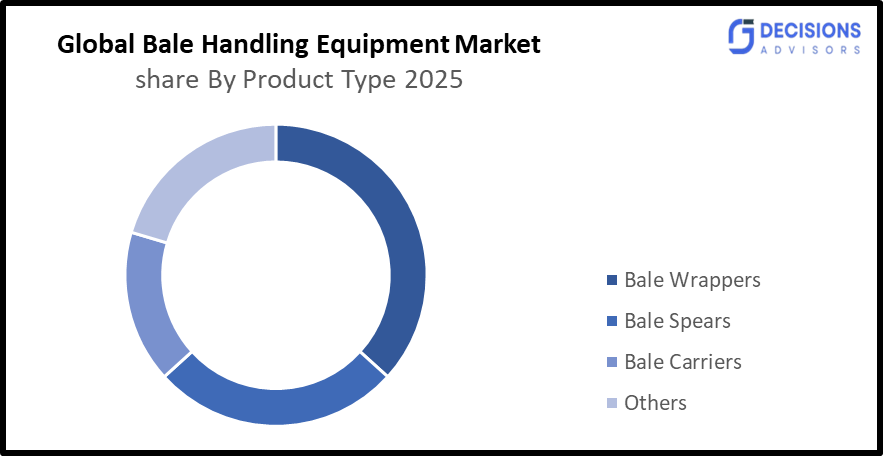
- By product type, the bale wrappers segment held a dominant position with 40% in terms of market share in 2025.
- By farm size, large farms segment is the dominating accounting for market is approximately 62%.
- By application, agriculture segment held a dominant position market is approximately 53%.
- By end user, farmers segment held a dominant position market is approximately 58%.
- The market is likely to achieve a valuation of USD 6.12 Billion by 2035.
What is role of technology in grooming the market?
The Bale Handling Equipment Market is revolutionized through technology. The implementation of Internet-of-Things based sensors along with automation enables the monitoring of operations, resulting in increased efficiency and decreased downtime. Predictive maintenance is possible because of these technological innovations, thereby reducing unexpected breakdowns. Control systems make use of advanced technologies to increase equipment efficiency by modifying the operation process according to load and other factors. Artificial intelligence helps in making decisions that will lead to better resource management. New technologies, like hybrid and modular designs, help to customize equipment according to industry requirements. Corrosion-resistant material and advanced mechanical design are among other new developments that increase longevity and durability. Digital technologies improve the energy efficiency of equipment and minimize energy wastage.
How is Recent Developments Helping the Market?
Several recent advancements have had a significant impact on increasing the efficiency of the Bale Handling Equipment Market. The use of modern technologies and designs such as AI control systems and IoT devices is improving efficiency in managing these systems. The capability to change the operating mode based on conditions has enabled the reduction of energy utilization by up to 40%–50%. Such innovations prove to be very advantageous for those who deal with irregular loads. Hybrid and modular systems have improved the process of retrofitting, making it possible to integrate new systems into old ones without any major modifications. As a result, the speed of adoption increases. Furthermore, several material improvements such as anti-corrosive protection and better metals have increased the lifetime of bale handling equipment. Besides, manufacturers have recently turned their attention towards sustainable development.
Market Drivers
There are several factors that drive the growth of the Bale Handling Equipment Market. The rising demand for efficient material handling equipment is the major one among them. The process of rapid industrialization is significantly fuelling the rising demand for advanced material handling equipment. The rising emphasis on operational efficiency and minimization of labour costs is encouraging companies to invest in automated material handling equipment. Advanced equipment improves production efficiency while maintaining workplace safety standards. Another important factor that drives market growth is environmental consciousness and sustainable initiatives. Companies try to reduce waste and improve their recycling procedures and require efficient bale handling equipment in return. Furthermore, the development of agricultural and biomass energy markets fuels the growth of the studied market. The handling of large quantities of agricultural waste necessitates the purchase of bale handling equipment. Technological innovations are another driver of the Bale Handling Equipment Market. The use of IoT technologies and artificial intelligence makes such equipment more effective and economical. Lastly, supportive government regulations aimed at promoting the growth of the manufacturing industry encourage the growth of the market in question.
Restrain
High initial investment costs and complex system integration limit adoption among small and medium enterprises. Dependence on operational conditions and maintenance requirements increases lifecycle complexity. Limited awareness in developing regions and the need for skilled workforce further restrict market growth despite long-term efficiency benefits.
Competitive Analysis:
The report offers the appropriate analysis of the key organizations/companies involved within the Bale Handling Equipment market, along with a comparative evaluation primarily based on their Product of offering, business overviews, geographic presence, enterprise strategies, segment market share, and SWOT analysis. The report also provides an elaborative analysis focusing on the current news and developments of the companies, which includes Product development, innovations, joint ventures, partnerships, mergers & acquisitions, strategic alliances, and others. This allows for the evaluation of the overall competition within the market.
Top Companies in Global Bale Handling Equipment Market
- Deere & Company
- Kubota Corporation
- Vermeer Corporation
- AGCO Corporation
- CLAAS KGaA mbH
- CNH Industrial N.V.
- Alamo Group Inc.
- McHale Engineering Ltd.
- Maschinenfabrik Bernard Krone GmbH & Co. KG
- Kuhn Group
Government Initiatives
|
Country |
Key Government Initiatives |
|
|
India
|
In April 2026, India’s MSP-backed cotton support strengthened output, boosting bale handling demand, while manufacturers expanded certifications and after-sales networks to enhance global competitiveness. |
|
|
India |
In February 2026, India expanded biomass energy incentives under the National Bioenergy Programme, increasing agricultural residue utilization and boosting demand for bale handling equipment in biomass supply chains. |
|
|
India |
In January 2026: India expanded agricultural mechanization subsidies under SMAM, accelerating adoption of automated farm equipment and boosting demand for efficient bale handling solutions to enhance farm productivity. |
|
Study on the Supply, Demand, Distribution, and Market Environment of Bale Handling Equipment Market
The global market for bale handling equipment demonstrates a harmonious balance between supply and demand forces. The largest companies supplying the market, such as Deere & Company, AGCO Corporation, and Kubota Corporation, enjoy efficient supply chains with modernized production processes and dealership services. Agricultural mechanization, labour shortages, and efficiency needs in managing hay and forage are driving the growth of demand in the segment. Distribution of the products is carried out via both direct channels and dealerships, providing easy access even to rural areas. Market factors include government support in terms of subsidies for farm equipment, technology innovations in automatic bale handling systems, and volatile costs of raw materials. Moreover, sustainable and precision farming methods are affecting product development, while variations in farm sizes and incomes across different regions have an effect on adoption trends.
Price Analysis and Consumer Behaviour Analysis
The prices for this type of equipment vary depending on its technological content, capacity, and size of the farms where it is used. The entry-level machines are cheap enough, but higher-end hydraulic equipment is up to 30-50% more expensive compared to the former, which affects operating costs since they require more fuel. The sensitivity to price changes is quite significant among consumers in developing countries, who find high upfront investment an important obstacle. The main drivers behind buying are effectiveness, safety features, and the potential for saving money in the future. Almost 40% of all users opt for modern machines for the sake of better efficiency, whereas nearly 35% choose them for their safety benefits. Finally, another factor driving the growth in sales is the need to shift from manual labour to mechanical one, which results in about 30% increase in the number of buyers. Consumers prefer multipurpose and sturdy equipment suitable for use with tractors. About 50% of all enterprises are planning future investments.
Market Segmentation
The Bale Handling Equipment Market share is classified into product type, application, end-user, and farm size
- The product type segment dominated the market in 2025, and is projected to grow at a substantial CAGR of approximately 7.0% during the forecast period.
Based on the product type, the Bale Handling Equipment Market is divided into bale wrappers, bale spears, bale carriers, and others. Among these, Bale Wrappers dominate the Bale Handling Equipment Market, accounting for the highest revenue share of around 38–42% in 2025, driven by strong demand for silage preservation and improved forage quality. This segment is also the fastest-growing, registering a CAGR of approximately 6.5–7.2% (2026–2035) due to rising mechanization in agriculture and increasing adoption of advanced wrapping technologies. Their efficiency in reducing spoilage and enhancing storage life makes bale wrappers the leading and most preferred equipment globally.
- The farm size segment accounted for the largest share in 2025, and is anticipated to grow at a significant CAGR of approximately 6.5% during the forecast period.
Based on the farm size, the Bale Handling Equipment Market is divided into small farms, and large farms. Among these, The Large Farms dominate the Bale Handling Equipment Market, contributing the highest revenue share of approximately 60–65% in 2025, driven by higher mechanization levels and bulk handling requirements. This segment is also growing steadily, with a CAGR of around 6.2–6.8% (2026–2035) due to increasing adoption of advanced machinery and efficiency-focused operations. Large-scale farms prioritize productivity and time-saving solutions, making them the primary contributors to market revenue, while small farms show gradual but comparatively slower growth.
- The application segment dominated the market in 2025, and is projected to grow at a substantial CAGR of approximately 6.7% during the forecast period.
Based on the application, the Bale Handling Equipment Market is divided into agriculture, livestock, industrial use, and others. Among these, the agriculture segment dominates the Bale Handling Equipment Market, accounting for the largest revenue share of approximately 50–55% in 2025, driven by widespread use in crop harvesting, baling, and field operations. This segment is also the fastest-growing, with a CAGR of around 6.3–7.0% (2026–2035) due to rising farm mechanization and efficiency needs. Increasing demand for improved productivity and reduced labour dependency continues to strengthen agriculture’s leading position in the global market.
- The end user segment dominated the market in 2025, and is projected to grow at a substantial CAGR of approximately 6.5% during the forecast period.
Based on the capacity, the Bale Handling Equipment Market is divided into farmers, contractors, industrial users, and others. Among these, the farmers dominate the Bale Handling Equipment Market, accounting for roughly 55–60% of total revenue in 2025, as they are the primary users across daily agricultural operations. The segment is also expanding steadily with a CAGR of about 6.0–6.6% (2026–2035), driven by increasing mechanization and government support for farm equipment. While contractors and industrial users are growing, farmers remain the core demand drivers globally.
Strategies to Implement for Growth of the Market in Non-Leading Regions
To promote the development of the Bale Handling Equipment Market in underdeveloped areas like Asia-Pacific, Latin America, and the Middle East & Africa, businesses need to emphasize affordability and availability. The agricultural mechanization level in developing countries is still less than 50%, suggesting immense scope for improvement, whereas globally, there has been an increase in agricultural mechanization levels of nearly 30%, denoting growing demand. Agricultural machinery producers need to launch affordable, portable, and versatile equipment, especially designed for small and medium-scale farms, which are predominant in these areas. It is crucial to enhance the regional sales network and dealership systems, which would help increase equipment penetration rates. Moreover, regional firms currently control about 25-30% of the supply chain. Launching initiatives for training farmers and conducting demonstrations would also facilitate increased use. Offering flexible financing arrangements and manufacturing durable and easy-to-maintain machines, customized according to local conditions, would encourage higher adoption.
Regional Segment Analysis of the Bale Handling Equipment Market
- North America (U.S., Canada, Mexico)
- Europe (Germany, France, U.K., Italy, Spain, Rest of Europe)
- Asia-Pacific (China, Japan, India, Rest of APAC)
- South America (Brazil and the Rest of South America)
- The Middle East and Africa (UAE, South Africa, Rest of MEA)
Asia Pacific is anticipated to hold the largest share of the Bale Handling Equipment market over the predicted timeframe.
Asia Pacific is set to witness considerable revenue from the Bale Handling Equipment Market and will contribute about 22.1% to the global value by 2025, valued at approximately USD 787 million, growing to USD 1,290 million by 2033 at a CAGR of 6.3%. This regional dominance can be attributed to its huge agricultural sector and fast-paced industrialization in countries such as China and India, which drive up the demand for more efficient means of handling forages. Moreover, with increasing livestock population and government incentives towards modernized agriculture, Asia Pacific is set to emerge as an influential player in this industry.
North America is expected to grow at a rapid CAGR in the Bale Handling Equipment market during the forecast period. The market in North America will register steady yet considerable growth in the Bale Handling Equipment Market, with the value estimated at around USD 1,289.44 million in 2025 and forecast to rise up to USD 1,775.73 million in 2033, resulting in a CAGR of about 4.0-4.1%. A number of factors that drive the growth of this region include the widespread adoption of cutting-edge agricultural machines and precision farming techniques, especially in the United States. What sets North America apart from other regions is the early implementation of automation and large-scale cattle breeding, leading to an increased need for effective bale handling equipment. Furthermore, constant investment in increasing the efficiency of farms and reducing the labour force further fuels consistent growth in the region.
Europe is the 3rd largest region to grow in the Bale Handling Equipment market during the region. Europe ranks as the third-largest region in the Bale Handling Equipment Market, contributing approximately 20–24% of global revenue in 2025, with an estimated market value of around USD 700–850 million. The region is projected to grow at a CAGR of about 5.5–6.0% during 2026–2035, supported by steady modernization in agriculture. A unique factor driving Europe’s position is its strong focus on sustainable and precision farming practices, particularly in countries like Germany and France. Strict environmental regulations and increasing adoption of efficient forage management techniques are boosting demand for advanced bale handling solutions. Additionally, well-established dairy and livestock industries continue to support consistent equipment demand across the region.
Future Market Trends in Global Bale Handling Equipment Market: -
- Increasing Adoption of Smart & Precision Farming Equipment
The integration of smart technologies into bale handling equipment is emerging as a major trend. Farmers are increasingly adopting GPS-enabled and sensor-based machinery to improve efficiency and reduce operational costs. Precision farming practices help optimize bale handling, minimize wastage, and enhance productivity. Additionally, the use of automation and IoT-based monitoring systems allows real-time tracking and maintenance, supporting better decision-making. This trend is expected to accelerate as digital agriculture expands globally.
2. Rising Demand for Compact & Multi-Functional Equipment
Growing dominance of small and medium-sized farms, especially in developing regions, is driving demand for compact and versatile bale handling equipment. Manufacturers are focusing on designing machines that can perform multiple functions such as lifting, wrapping, and transporting bales. These cost-effective solutions reduce the need for multiple machines, lowering investment costs. Their adaptability to different farm sizes and conditions makes them increasingly popular, contributing to steady market growth.
3. Shift Toward Sustainable and Energy-Efficient Machinery
Sustainability is becoming a key focus in the bale handling equipment market. Manufacturers are developing energy-efficient and low-emission machinery to meet strict environmental regulations and reduce carbon footprints. The use of electric and hybrid-powered equipment is gradually increasing, particularly in developed regions. Additionally, improved bale wrapping technologies that reduce plastic usage and enhance silage preservation are gaining traction. This trend aligns with global sustainability goals and is expected to shape future product innovations.
Recent Development
- In April 2026, Marcrest Manufacturing Inc. introduced Swing-Max tandem power hitch, enabling one tractor to operate two balers with automated steering, doubling productivity.
- In March 2026, Vermeer Corporation advanced its Bale Hawk autonomous bale mover concept, using sensors to transport up to three bales, reducing labour and improving operational efficiency.
- In March 2026, Kuhn Group advanced its SW 4014 bale wrapper with laser-guided AUTOLOAD technology, enabling automatic loading, wrapping, and unloading of square and round bales.
- In February 2026, CNH Industrial introduced New Holland BigBaler 1290 High Density with Loop Master technology, improving bale density and transport efficiency.
Market Segment
This study forecasts revenue at global, regional, and country levels from 2021 to 2035. Decision Advisors has segmented the Global Bale Handling Equipment Market based on the below-mentioned segments:
Global Bale Handling Equipment Market, By Product Type
- Bale Wrappers
- Bale Spears
- Bale Carriers
- Others
Global Bale Handling Equipment Market, By Application
- Agriculture
- Livestock
- Industrial Use
- Others
Global Bale Handling Equipment Market, By Capacity
- Farmers
- Contractors
- Industrial Users
- Others
Global Bale Handling Equipment Market, By Farm Size
- Small Farms
- Large Farms
Global Bale Handling Equipment Market, By Regional Analysis
- North America
- US
- Canada
- Mexico
- Europe
- Germany
- UK
- France
- Italy
- Spain
- Russia
- Rest of Europe
- Asia Pacific
- China
- Japan
- India
- South Korea
- Australia
- Rest of Asia Pacific
- South America
- Brazil
- Argentina
- Rest of South America
- Middle East & Africa
- UAE
- Saudi Arabia
- Qatar
- South Africa
- Rest of the Middle East & Africa
Frequently Asked Questions (FAQ)
1. What factors are driving the growth of the Bale Handling Equipment Market?
The market is primarily driven by increasing agricultural mechanization, rising demand for efficient material handling solutions, and the need to reduce labour dependency. Technological advancements such as automation and smart equipment are further enhancing operational efficiency and supporting market expansion.
2. Which segment holds the dominant position in the market?
The agriculture application segment holds a leading position due to its extensive use in crop handling and field operations. Additionally, end users such as farmers contribute significantly to overall demand due to widespread adoption across farming activities.
3. What challenges are faced by the market?
Key challenges include high initial investment costs, maintenance complexity, and limited awareness in developing regions. The need for skilled operators and integration with existing systems also creates barriers to adoption.
4. How is technology influencing market development?
Technological advancements such as IoT integration, automation, and predictive maintenance systems are improving equipment performance, reducing downtime, and enhancing productivity, thereby playing a crucial role in market growth.
5. What opportunities exist for market expansion?
Opportunities lie in emerging economies where mechanization levels are still developing. Increasing investments in agriculture, supportive government initiatives, and demand for cost-effective and energy-efficient equipment are expected to drive future growth.
Check Licence
Choose the plan that fits you best: Single User, Multi-User, or Enterprise solutions tailored for your needs.
We Have You Covered
- 24/7 Analyst Support
- Clients Across the Globe
- Tailored Insights
- Technology Tracking
- Competitive Intelligence
- Custom Research
- Syndicated Market Studies
- Market Overview
- Market Segmentation
- Growth Drivers
- Market Opportunities
- Regulatory Insights
- Innovation & Sustainability
Report Details
| Scope | Global |
| Pages | 190 |
| Delivery | PDF & Excel via Email |
| Language | English |
| Release | Apr 2026 |
| Access | Download from this page |