
Global Biofuel Enzymes Market
 |
Author:
David J
|
Pages:
210
|
Author:
David J
|
Pages:
210
The Global Biofuel Enzymes Market Size, Share By Type (Amylases, Cellulases, Proteases, Lipases, Hemicelluloses), By Application (Bioethanol Production, Biodiesel Production), By End User (Transportation, Power Generation, Industrial Fuel) and By Region (North America, Europe, Asia-Pacific, Latin America, Middle East & Africa), Analysis and Forecast 2025?2035
CAGR
7.36%
REVENUE 2025
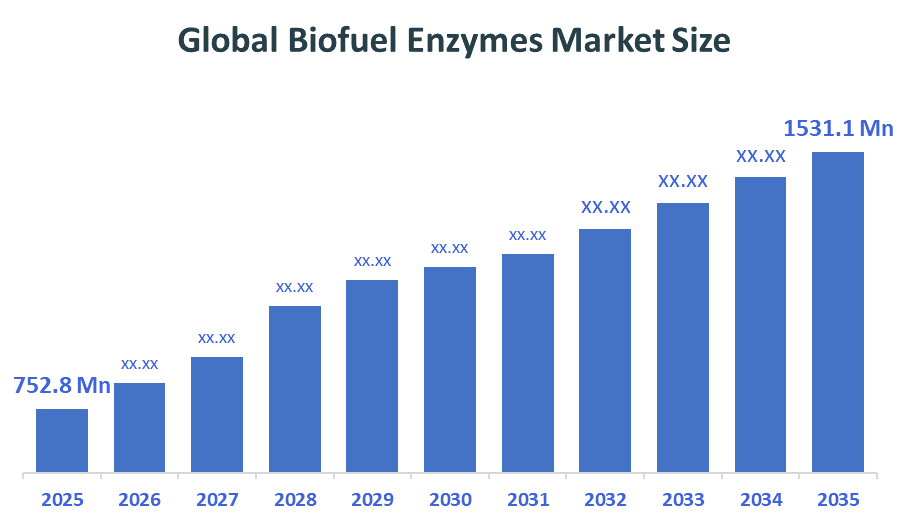
USD Million 752.8
FORECAST 2035
USD Million 1531.1
REPORT COVERAGE
Global
Market Snapshot
- Global Biofuel Enzymes Market Size (2025): USD 752.8 Million
- Projected Global Biofuel Enzymes Market Size (2035): USD 1531.1 Million
- Global Biofuel Enzymes Market Compound Annual Growth Rate (CAGR): 7.36%
- Largest Regional Market: North America
- Fastest Growing Region: Asia Pacific
- 3rd Largest Region: Europe
- Base Year: 2025
- Historical Period: 2021–2024
- Forecast Period: 2026–2035
Market Overview/ Introduction
The Global Biofuel Enzymes Market is defined as the specialized sector focused on the production and application of biocatalysts such as amylases, cellulases, and lipases, which accelerate the biochemical conversion of biomass into renewable fuels like bioethanol and biodiesel. As the world moves away from food-based fuels toward second-generation options like agricultural leftovers and wood waste. Industry leaders aren't just sitting back, companies like Novonesis (the powerhouse merger of Novozymes and Chr. Hansen) are using AI and advanced engineering to make these enzymes approximately 40% more efficient, while giants like BASF and IFF are building new plants in places like India and Brazil to keep up with local demand. Looking forward, the market is on track to hit a large amount, fueled by a global push for net-zero emissions. The real win here goes beyond the numbers, these enzymes allow us to create high-energy fuel with much less electricity and heat, turning trash into a powerful tool for cutting carbon and securing a cleaner energy future.
- Global Blending Mandates: Over 60 nations now have binding mandates covering more than 80% of global fuel demand.
- Programs like Brazil’s RenovaBio, which implements a nationwide B15 biodiesel mandate by March 2025, provide the carbon-intensity-based credits that reward the efficiency gains provided by modern enzymes.
Notable Insights: -
- North America is anticipated to hold the largest share, approximately 40% of the Global Biofuel Enzymes Market over the predicted timeframe.
- Asia Pacific is expected to grow at the fastest CAGR in the Global Biofuel Enzymes Market during the forecast period.
- By type, the cellulase segment dominated the market in 2025, and is projected to grow at a substantial CAGR of approximately 7.5% during the forecast period.
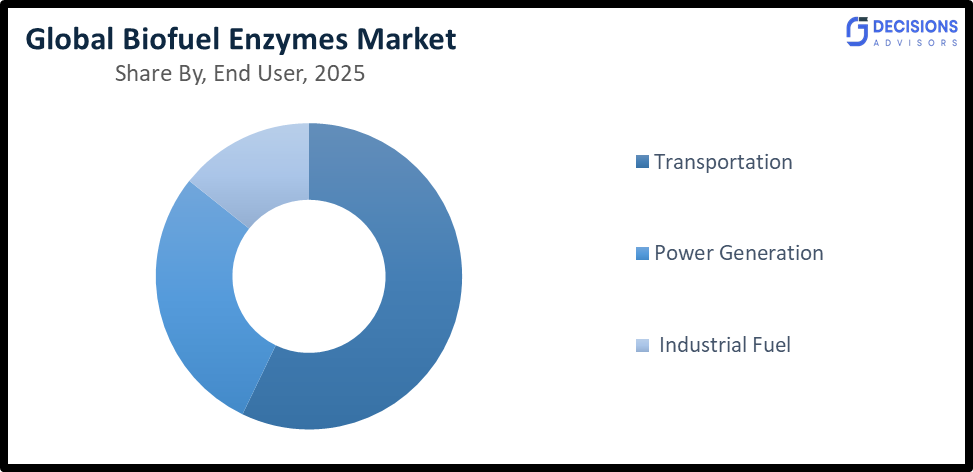
- By end user, the transportation sector segment dominated the market at a share of approximately 60% in 2025, and is projected to grow at a substantial CAGR during the forecast period.
- The compound annual growth rate of the Global Biofuel Enzymes Market is 7.36%.
6. The market is likely to achieve a valuation of USD 1531.1 Million by 2035.
What is the role of technology in grooming the market?
Technology plays a transformative role in advancing the biofuel enzymes market by improving enzyme efficiency, stability, and cost-effectiveness. Innovations such as genetically engineered enzymes and enzyme cocktails enhance biomass conversion rates and reduce processing time. For example, advanced cellulase formulations can break down plant fibers more efficiently, enabling higher ethanol yields from agricultural waste. Furthermore, developments in industrial biotechnology and fermentation processes are helping producers scale operations while maintaining cost efficiency.
Market Drivers
Seeing a massive move toward second generation biofuels, which turn leftovers like corn stalks, wheat straw, and wood waste into high-quality energy. This shift is being supercharged by government mandates like the EU’s strict green energy targets and India’s push for 20% ethanol blending, which essentially legally require cleaner fuel options. On the tech side, things are getting much smarter. AI-driven enzyme engineering has made these biological Pac-Men nearly 40% more efficient at breaking down tough plant matter, which brings down the cost of production significantly. Finally, the worldwide race for energy security and decarbonization is pouring investment into new biorefineries, especially in places like Asia and Latin America. By turning local agricultural waste into a valuable power source, these regions are cutting carbon and creating a more stable, self-sufficient energy future. The real engine behind the biofuel enzymes market is a global shift away from using food crops for fuel. Instead, we’re seeing a massive move toward second generation biofuels, which turn leftovers like corn stalks, wheat straw, and wood waste into high-quality energy. This shift is being supercharged by government mandates like the EU’s strict green energy targets and India’s push for 20% ethanol blending, which essentially legally require cleaner fuel options.
Restrain
Despite strong growth potential, the market faces several challenges. High production costs associated with enzyme development and processing remain a significant barrier. Additionally, variability in raw material quality and supply can impact enzyme performance and overall production efficiency.
Competitive Analysis:
The report offers the appropriate analysis of the key organizations/companies involved within the Global biofuel enzymes market, along with a comparative evaluation primarily based on their product of offering, business overviews, geographic presence, enterprise strategies, segment market share, and SWOT analysis. The report also provides an elaborative analysis focusing on the current news and developments of the companies, which includes product development, innovations, joint ventures, partnerships, mergers & acquisitions, strategic alliances, and others. This allows for the evaluation of the overall competition within the market.
Top Companies in the Global Biofuel Enzymes Market
- Novonesis
- DSM-Firmenich
- DuPont Industrial Biosciences
- BASF SE
- AB Enzymes GmbH
- Codexis, Inc.
- Dyadic International, Inc.
- Amano Enzyme Inc.
- Advanced Enzyme Technologies Ltd.
- Biocatalysts Ltd
Government Initiatives
|
Country |
Key Government Initiatives |
|
India |
he National Policy on Biofuels (amended in 2024) is a major driver, advancing the 20% ethanol blending target (E20) to the 2025–26 fiscal year. Key schemes like Pradhan Mantri JI-VAN Yojana provide significant financial support over ?1,969 crores specifically for commercial-scale second-generation (2G) bio-ethanol projects that rely on advanced enzymes.
|
|
US |
The EPA’s RFS program has set final volume targets through 2025, specifically mandating 1.38 billion gallons of cellulosic biofuel and 3.35 billion gallons of biomass-based diesel. These targets create a guaranteed market for enzymes that can break down non-food cellulosic materials.
|
|
Europe |
The updated Renewable Energy Directive (RED III) effectively doubles the requirements for renewable content in transport fuels by 2030, emphasizing advanced biofuels that do not compete with food crops.
|
Study on the Supply, Demand, Distribution, and Market Environment of the Global Biofuel Enzymes Market
The supply of biofuel enzymes is driven by biotechnology companies with advanced manufacturing capabilities. Demand is increasing due to rising biofuel production capacities globally. Distribution typically occurs through direct partnerships between enzyme manufacturers and bio-refineries. The market environment is dynamic and innovation-driven, supported by strong regulatory backing and increasing investments in renewable energy infrastructure
Price Analysis and Consumer Behaviour Analysis
Prices of biofuel enzymes depend on factors such as enzyme type, efficiency, and production technology. Advanced enzyme formulations tend to be priced higher due to their superior performance and cost-saving potential in the long run. From a consumer perspective, biofuel producers prioritize efficiency, yield improvement, and cost reduction over initial pricing. Companies are increasingly willing to invest in high-quality enzymes that can enhance overall process economic
Market Segmentation
The Global Biofuel Enzymes Market share is classified into product type, application and end user.
- The cellulase segment dominated the market in 2025, and is projected to grow at a substantial CAGR of approximately 7.5% during the forecast period.
Based on the type, the global biofuel enzymes market is divided into cellulases, amylases, lipases, and hemicellulases. Among these, the cellulase segment dominated the market in 2025, and is projected to grow at a substantial CAGR of approximately 7.5% during the forecast period. It is attributed to its critical role in breaking down lignocellulosic biomass into fermentable sugars, which is a key step in bioethanol production. Additionally, cellulases are widely used in second-generation biofuel processes due to their efficiency in converting agricultural residues and non-food biomass, thereby increasing their adoption across advanced bio-refineries.
- The bioethanol production segment accounted for the largest share in 2025, and is anticipated to grow at a significant CAGR of approximately 7.8% during the forecast period.
Based on the application, the global biofuel enzymes market is divided into bioethanol production and biodiesel production. Among these, the bioethanol production segment accounted for the largest share in 2025, and is anticipated to grow at a significant CAGR of approximately 7.8% during the forecast period. It is attributed to the widespread use of enzymes such as cellulases and amylases in converting starch and cellulose into ethanol. The increasing global demand for cleaner transportation fuels, along with government mandates for ethanol blending in gasoline, is further driving the adoption of biofuel enzymes in this segment.
- The transportation segment dominated the market at a share of approximately 60% in 2025, and is projected to grow at a substantial CAGR during the forecast period.
Based on the end user, the global biofuel enzymes market is divided into transportation, power generation, and industrial fuel. Among these, the transportation segment dominated the market at a share of approximately 60% in 2025, and is projected to grow at a substantial CAGR during the forecast period. It is attributed to the extensive use of biofuels such as ethanol and biodiesel as alternatives to conventional fossil fuels in vehicles. Additionally, increasing environmental regulations, rising fuel demand, and the global push toward reducing carbon emissions are driving the demand for enzyme-based biofuel production in the transportation sector.
Strategies to Implement for Growth of the Market in Non-Leading Regions
Growth in non-leading regions of the biofuel enzymes market can be accelerated by focusing on expanding local bio-refinery infrastructure and strengthening supply chain networks for biomass feedstock. Companies should invest in regional production facilities to reduce costs and improve enzyme accessibility, while forming partnerships with local biofuel producers to enhance market penetration. Additionally, increasing awareness of advanced biofuel technologies, along with government support through subsidies and blending mandates, can drive adoption. Emphasizing the use of low-cost agricultural residues and waste biomass as feedstock can further create sustainable growth opportunities in these regions.
Regional Segment Analysis of the Global Biofuel Enzymes Market
- North America (U.S., Canada, Mexico)
- Europe (Germany, France, U.K., Italy, Spain, Rest of Europe)
- Asia-Pacific (China, Japan, India, Rest of APAC)
- South America (Brazil and the Rest of South America)
- The Middle East and Africa (UAE, South Africa, Rest of MEA)
North America is anticipated to hold the largest share, approximately 40% of the global biofuel enzymes market over the predicted timeframe.
North America is anticipated to hold the largest share, approximately 40% of the global biofuel enzymes market over the predicted timeframe. The region dominates due to its well-established biofuel industry, particularly in the United States, were large-scale bioethanol production drives significant demand for biofuel enzymes. The presence of advanced technologies, strong R&D capabilities, and key market players further strengthens regional leadership. Additionally, supportive government policies such as the Renewable Fuel Standard (RFS), along with increasing investments in second-generation biofuels, are accelerating market growth. For instance, the extensive use of corn-based ethanol production in the U.S. significantly boosts the demand for enzymes such as amylases and cellulases.
Asia Pacific is expected to grow at the fastest CAGR in the global biofuel enzymes market during the forecast period.
Asia Pacific is expected to grow at the fastest CAGR in the global biofuel enzymes market during the forecast period. The growth is driven by increasing energy demand, rapid industrialization, and strong government initiatives promoting biofuel adoption in countries such as China, India, and Southeast Asian nations. The region benefits from abundant agricultural residues and low-cost feedstock availability, which supports enzyme-based biofuel production. Additionally, rising investments in bio-refineries and favorable policies such as ethanol blending mandates are further driving market expansion. For instance, India’s ethanol blending program is significantly increasing the demand for enzymes used in biomass conversion processes.
Europe is the third largest region in the global biofuel enzymes market during the forecast period.
Europe is the third largest region in the global biofuel enzymes market during the forecast period. The region is characterized by stringent environmental regulations and a strong focus on sustainability and carbon emission reduction. Increasing adoption of advanced biofuels, particularly from lignocellulosic biomass, is driving the demand for specialized enzymes. The market is also supported by the European Union’s Renewable Energy Directive (RED II), which promotes the use of renewable fuels. Additionally, growing investments in green technologies and bio-refinery projects are encouraging the adoption of high-performance biofuel enzymes across the region.
Future Market Trends in the Global Biofuel Enzymes Market: -
1. Increasing Shift Toward Second-Generation Biofuels
There is a growing transition from first-generation (food-based) biofuels to second-generation biofuels derived from non-food biomass such as agricultural residues and waste materials. This shift is significantly increasing the demand for advanced enzymes like cellulases and hemicellulases, which are essential for breaking down complex lignocellulosic feedstock. This trend is expected to enhance sustainability while reducing competition with food resources.
2. Advancements in Enzyme Engineering and Biotechnology
Continuous innovations in enzyme engineering, including genetically modified enzymes and optimized enzyme cocktails, are improving efficiency, stability, and yield in biofuel production. These advancements are helping reduce processing costs and enabling large-scale commercialization of biofuels. As a result, companies are increasingly investing in R&D to develop high-performance enzymes tailored for specific feedstocks and industrial conditions.
3. Expansion of Integrated Biorefineries
The development of integrated biorefineries is emerging as a key trend, where multiple bio-based products, including biofuels, chemicals, and energy, are produced from a single biomass source. This approach maximizes resource utilization and improves overall process economics, thereby increasing the demand for versatile and efficient biofuel enzymes. Additionally, collaborations between energy companies and biotechnology firms are accelerating the adoption of this model.
Recent Development
- In June 2024, Basecamp Research launched ZymCTRL, a world-first open-source generative AI tool designed to create novel enzyme sequences for sustainable industrial applications. The ChatGPT-like platform enables users to generate functional enzymes from scratch without requiring a starter sequence, accelerating the development of biofuels, therapeutics, and green chemical processes.
- In March 2024, Terragia secured $6 million in seed funding led by Engine Ventures and Energy Impact Partners to advance its low-carbon biofuel technology. The company developed a consolidated bioprocessing approach using engineered thermophilic bacteria to convert cellulosic biomass into fuels without added enzymes or thermochemical pretreatment, aiming to reduce production costs and support decarbonization of hard-to-electrify sectors.
- In January 2023, the National Renewable Energy Laboratory (NREL) launched a synthetic biology project in collaboration with LanzaTech, Northwestern University, and Yale University to accelerate biofuel discovery technologies. The initiative focused on using genome engineering and machine learning to develop carbon-negative biofuels and chemicals by designing microorganisms capable of converting carbon emissions into sustainable fuels and industrial products.
- In July 2021, Kemin Industries launched ZyloZyme AA, a high-temperature alpha-amylase enzyme for bioethanol production. The product was designed to improve starch breakdown during liquefaction, reduce viscosity, and enhance ethanol yields while requiring a lower dosage compared to conventional enzymes, helping producers optimise efficiency and reduce costs.
- In March 2021, Kemin Industries launched ZyloCell, a dry cellulase enzyme for bioethanol production, designed to break down cellulose in corn kernel fiber and enhance ethanol yields. The product offered a cost-effective alternative to liquid enzymes with benefits such as longer shelf life, easier handling, and support for low-carbon fuel production.
How are recent developments helping the Market?
Recent developments in the biofuel enzymes market are significantly enhancing efficiency, scalability, and overall adoption of biofuel production processes. Advancements in enzyme engineering and increased investments in research and development are enabling the creation of more efficient and cost-effective enzymes, which improve biomass conversion rates and biofuel yields. For instance, innovations in cellulase and enzyme cocktail formulations are allowing better breakdown of lignocellulosic biomass, making second-generation biofuels more commercially viable.
Market Segment
This study forecasts revenue at global, regional, and country levels from 2020 to 2035. Decision Advisors has segmented the global biofuel enzymes market based on the below-mentioned segments:
Global Biofuel Enzymes Market, By Type
- Cellulases
- Amylases
- Lipases
- Hemicellulases
Global Biofuel Enzymes Market, By Application
- Bioethanol Production
- Biodiesel Production
Global Biofuel Enzymes Market, By End User
- Transportation
- Power Generation
- Industrial Fuel
Global Biofuel Enzymes Market, By Regional Analysis
- North America
- US
- Canada
- Mexico
- Europe
- Germany
- UK
- France
- Italy
- Spain
- Russia
- Rest of Europe
- Asia Pacific
- China
- Japan
- India
- South Korea
- Australia
- Rest of Asia Pacific
- South America
- Brazil
- Argentina
- Rest of South America
- Middle East & Africa
- UAE
- Saudi Arabia
- Qatar
- South Africa
- Rest of the Middle East & Africa
Frequently Asked Questions (FAQ)
Q. How do storage conditions affect the performance of biofuel enzymes?
A. Biofuel enzymes are sensitive to temperature, pH, and moisture. Improper storage conditions can lead to loss of enzyme activity and reduced efficiency in biomass conversion. Maintaining optimal storage conditions, such as controlled temperature and humidity, is essential to preserve enzyme stability and performance.
Q. Can biofuel enzymes be reused in production processes?
A. In some advanced processes, enzymes can be partially recovered and reused through immobilization techniques. However, reuse efficiency depends on the type of enzyme and processing conditions. Research is ongoing to improve enzyme recyclability and reduce overall production costs.
Q. What role do biofuel enzymes play in reducing waste generation?
A. Biofuel enzymes enable the conversion of agricultural residues, forestry waste, and industrial by-products into usable fuels. This reduces waste accumulation and promotes a circular economy by turning low-value biomass into high-value energy products.
Q. Are biofuel enzymes compatible with all types of biomass feedstock?
A. Not all enzymes work equally well with every type of biomass. Different feedstocks, such as corn stover, sugarcane bagasse, or wood chips, require specific enzyme combinations for efficient breakdown. Custom enzyme formulations are often developed to match specific feedstock characteristics.
Q. How does water usage impact enzyme-based biofuel production?
A. Water plays a crucial role in enzymatic reactions during biofuel production. Efficient water management is important because excessive water use can increase operational costs and environmental impact. New technologies are focusing on reducing water consumption while maintaining high enzyme efficiency.
Check Licence
Choose the plan that fits you best: Single User, Multi-User, or Enterprise solutions tailored for your needs.
We Have You Covered
- 24/7 Analyst Support
- Clients Across the Globe
- Tailored Insights
- Technology Tracking
- Competitive Intelligence
- Custom Research
- Syndicated Market Studies
- Market Overview
- Market Segmentation
- Growth Drivers
- Market Opportunities
- Regulatory Insights
- Innovation & Sustainability
Report Details
| Scope | Global |
| Pages | 210 |
| Delivery | PDF & Excel via Email |
| Language | English |
| Release | Apr 2026 |
| Access | Download from this page |