
Global Biometric Sensor Market
 |
Pages:
240
|
Pages:
240
Global Biometric Sensor Market Size, Share By Sensor Type (Fingerprint Sensors, Face Recognition Sensors, Iris Recognition Sensors, Voice Recognition Sensors, Vein Recognition Sensors), By Technology (Capacitive Sensors, Optical Sensors, Ultrasound Sensors, Infrared Sensors, RFID Sensors), By Application (Access Control, Time and Attendance, Identity Verification, Smartphones and Tablets, Banking and Payment), and By Region (North America, Europe, Asia-Pacific, Latin America, Middle East & Africa), Analysis and Forecast 2026-2035.
REPORT COVERAGE
Global
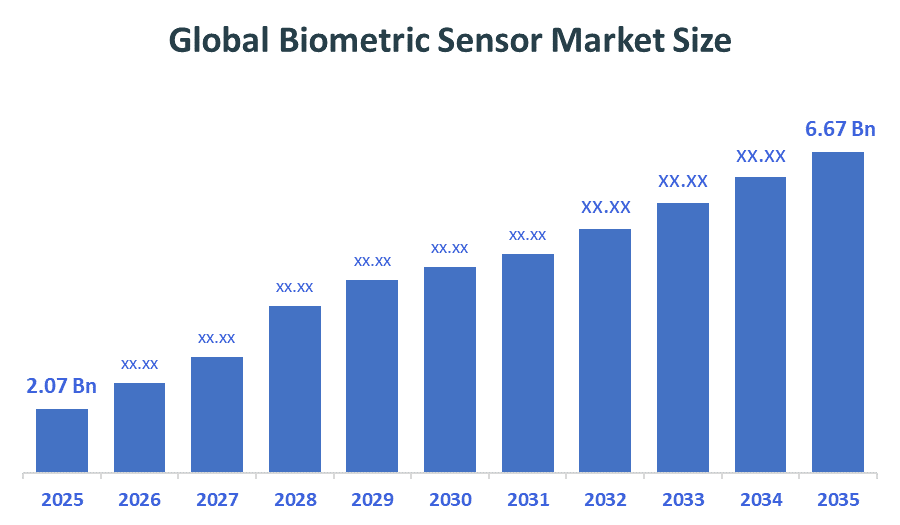
The Global Biometric Sensor Market Size is predicted to grow from USD 2.07 Billion in 2025 and is likely to reach around USD 6.67 Billion by 2035 with a CAGR of 12.41%. According to Decision Advisors, a detailed research report on the market reflects that the consumer electronics and mobile authentication trend dominates the Global Biometric Sensor Market, accounting for approximately 46% of the total share worldwide. Apple Inc. leads the market with approximately annual revenue of USD 8.2 billion and approx 16 - 20% global market share, making it the key contributor to global market development and growth dynamics.
Market Snapshot
- Global Biometric Sensor Market Size (2025): USD 2.07 Billion
- Projected Global Biometric Sensor Market Size (2035): USD 6.67 Billion
- Global Biometric Sensor Market Compound Annual Growth Rate (CAGR): 12.41%
- Largest Regional Market: North America
- 2nd Largest Region: Asia Pacific
- Fastest Growing Region: Europe
- Base Year: 2025
- Historical Period: 2021-2024
- Market Forecast Period: 2026-2035
Market Overview/ Introduction
The Global Biometric Sensor Market includes technologies that use unique biological characteristics from people to identify and verify their identities through methods such as fingerprinting, facial recognition, iris scanning, and voice identification. The market is experiencing strong growth because users now need secure digital authentication solutions to access their digital resources, while smart device usage continues to expand, and people become more concerned about cybersecurity threats. Government ID programs and border security initiatives have created national identification systems that help to accelerate user adoption. Leading companies are using their resources to develop AI recognition systems together with advanced sensor technology while forming strategic alliances to expand their product capabilities and market presence. The market provides benefits which include better security measures, protection against fraud, improved workplace productivity, and a user-friendly interface. The increasing use of technology in banking services, healthcare operations, and consumer electronics shows that demand for these solutions will keep increasing. Future market growth will be driven by advancements in contactless biometrics, multimodal authentication systems, and integration with IoT and cloud platforms, which will deliver worldwide identity verification solutions that provide accurate, safe, and scalable results.
- Since 2010, British passports have incorporated embedded biometric chips containing facial and fingerprint data, aligning with international travel security standards to enhance identity verification and strengthen border control systems.
- Biometric technologies, particularly facial recognition systems, are widely integrated into public surveillance infrastructure and social governance frameworks, including their deployment in metro stations and railway hubs for real-time security screening and identity verification.
Notable Insights: -
- North America is anticipated to hold approximately 34% share of the global biometric sensor market over the predicted timeframe.
- Asia Pacific is expected to grow at a rapid CAGR in the Global biometric sensor marketby holding approximately 30% of the share during the forecast period.
- By sensor type of transaction, the fingerprint sensors segment dominated the market and holds approximately 46% share in 2025 and is projected to grow at a substantial CAGR during the forecast period.
- By technology, the capacitive sensors segment dominated the market and holds approximately 42% share in 2025 and is projected to grow at a substantial CAGR during the forecast period.
- The compound annual growth rate of the Global biometric sensor market is 12.41%.
- The market is likely to achieve a valuation of USD 6.67 Billion by 2035.
What is the role of technology in grooming the market?
Technology plays a critical role in advancing the biometric sensor market by improving accuracy, speed, and security of authentication systems. AI and machine learning enhance pattern recognition and reduce false acceptance rates. Advanced sensor technologies such as ultrasonic and 3D facial recognition improve precision and enable contactless authentication. Integration with smartphones, cloud platforms, and IoT ecosystems enhances scalability and usability. Additionally, encryption technologies and liveness detection mechanisms strengthen data protection and prevent spoofing, making biometric systems more reliable for critical applications.
Market Drivers
The biometric sensor market exists because people need secure digital authentication methods that their current technology cannot provide. The growth of online banking services and digital payment systems requires businesses to implement advanced fraud detection methods. National ID systems and e-passports, together with government programs, drive the widespread implementation of biometric technology. Organizations seek to strengthen their security measures through strong identity verification systems because of the rising cybersecurity threats. The ongoing development of sensor technology, AI-based recognition systems and contactless authentication systems has increased both accuracy and user satisfaction. The market continues to expan6d because of rising healthcare needs, workplace access control requirements and border security demands. The combination of these factors creates ongoing global market demand, which leads to sustainable growth in the industry.
Restrain
High implementation costs and integration complexity can limit adoption, particularly in small enterprises. Privacy concerns and data security risks related to biometric information pose significant challenges. Variability in environmental conditions can affect sensor accuracy. Regulatory compliance and data protection laws also create barriers. Additionally, spoofing risks and technical limitations in certain biometric modalities may hinder widespread adoption.
Competitive Analysis:
The report offers the appropriate analysis of the key organizations/companies involved within the Global biometric sensor market along with a comparative evaluation primarily based on their product offerings, business overviews, geographic presence, enterprise strategies, segment market share, and SWOT analysis. The report also provides an elaborative analysis focusing on the current news and developments of the companies, which includes product development, innovations, joint ventures, partnerships, mergers & acquisitions, strategic alliances, and others. This allows for the evaluation of the overall competition within the market.
Top Companies in the Global Biometric Sensor Market
- Apple Inc.
- Samsung Electronics Co. Ltd.
- Qualcomm Technologies Inc.
- Synaptics Incorporated
- Fingerprint Cards AB
- IDEMIA
- NEC Corporation
- Thales Group
- HID Global Corporation
- Infineon Technologies AG
Government Initiatives
|
Country |
Key Government Initiatives |
|
US |
The Department of Homeland Security (DHS) is expanding its biometric entry–exit system across all U.S. commercial ports of entry, requiring large-scale deployment of advanced biometric scanners to strengthen identity verification and border security. |
|
UK |
Biometric scanners are widely deployed across UK airport border control systems, with recent advancements enabling passport-free travel through facial recognition technology on selected routes, enhancing passenger processing efficiency and strengthening automated identity verification in travel security infrastructure. |
|
China |
China’s “Digital China” strategy is a long-term national digital transformation initiative aiming to achieve near-universal digital identity and biometric ID coverage by 2030, strengthening secure authentication and governance systems across public services and financial ecosystems. |
Study on the Supply, Demand, Distribution, and Market Environment of the Global Biometric Sensor Market
The biometric sensor market is supported by strong demand from consumer electronics, banking, and government applications requiring secure identity verification. Supply is driven by semiconductor firms and sensor manufacturers enhancing precision and scalability. Distribution primarily occurs through OEM integration, system integrators, and direct enterprise deployment channels. Demand is highest in digitally advanced economies and regions experiencing rapid cybersecurity expansion. Increasing collaboration between technology providers and enterprises is improving product accessibility, accelerating deployment efficiency, and strengthening overall market penetration across multiple end-use industries.
Price Analysis and Consumer Behaviour Analysis
The biometric sensor market is influenced by sensor type, technology, and integration costs. Approximately 65% of consumers prefer biometric authentication due to convenience and enhanced security. Businesses prioritize cost-effective and scalable solutions with high accuracy. Around 58% of enterprises adopt biometrics to reduce fraud and improve operational efficiency. However, privacy concerns remain a key factor influencing adoption. Continuous innovation and declining sensor costs are improving affordability and user acceptance.
Market Segmentation
The Global biometric sensor market share is classified into equipment type of transaction, payment platform and business category.
- The fingerprint sensors segment dominated the market and holds approximately 46% share in 2025 and is projected to grow at a substantial CAGR during the forecast period.
Based on the sensor type, the Global biometric sensor market is divided into fingerprint sensors, face recognition sensors, iris recognition sensors, voice recognition sensors, and vein recognition sensors. Among these, the fingerprint sensors segment dominated the market and holds approximately 46% share in 2025 and is projected to grow at a substantial CAGR during the forecast period. This dominance is due to its high accuracy, cost-effectiveness, and widespread integration in smartphones, laptops, and access control systems. It is widely used across consumer electronics and enterprise security applications due to fast authentication and reliable performance.
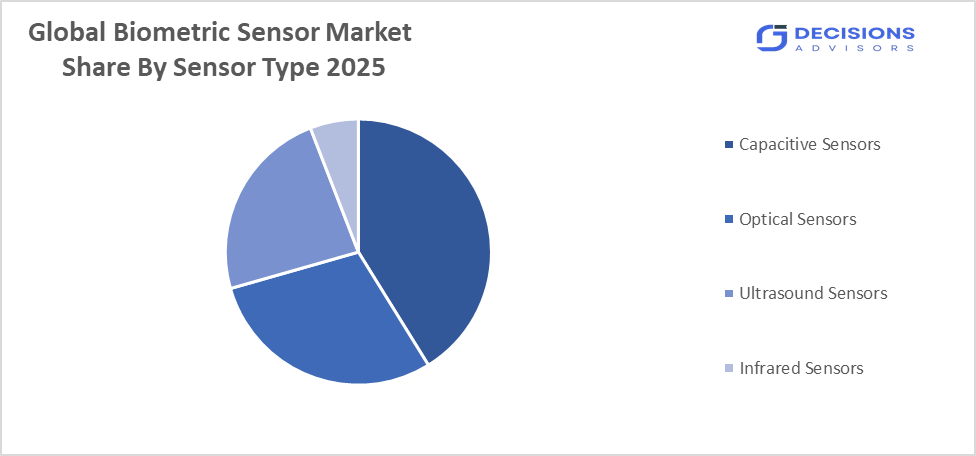
- The capacitive sensors segment accounted for the largest share of approximately 42% in 2025 and is anticipated to grow at a significant CAGR during the forecast period.
Based on the technology, the market is divided into capacitive sensors, optical sensors, ultrasound sensors, infrared sensors, and RFID sensors. Among these, the capacitive sensors segment accounted for the largest share of approximately 42% in 2025 and is anticipated to grow at a significant CAGR during the forecast period. This dominance is due to its high precision, durability, and strong resistance to spoofing attempts. It is widely adopted in mobile devices and security systems for reliable and fast biometric authentication.
- The smartphones and tablets segment accounted for the largest share of approximately 48% in 2025 and is anticipated to grow at a significant CAGR during the forecast period.
Based on the application, the market is divided into access control, time and attendance, identity verification, smartphones and tablets, and banking and payment. Among these, the smartphones and tablets segment accounted for the largest share of approximately 48% in 2025 and is anticipated to grow at a significant CAGR during the forecast period. This growth is driven by increasing demand for secure device unlocking, mobile payments, and app authentication. Widespread adoption of biometric-enabled devices across global consumer electronics is further supporting segment expansion.
Strategies to Implement for Growth of the Market in Non-Leading Regions
Strategies for growth in non-leading regions include increasing awareness about biometric technologies to address privacy concerns and improve user acceptance. Companies should develop cost-effective and region-specific solutions to enhance accessibility among diverse populations. Partnerships with governments, financial institutions, and enterprises can accelerate deployment and adoption. Investment in cloud-based biometric platforms and mobile-integrated solutions will improve scalability and operational efficiency. Strengthening compliance with data protection laws and implementing robust security frameworks are essential for building trust. Additionally, expanding infrastructure and promoting digital identity programs will further support market penetration and long-term sustainable growth across emerging economies.
Regional Segment Analysis of the Global Biometric Sensor Market
- North America (U.S., Canada, Mexico)?
- Europe (Germany, France, U.K., Italy, Spain, Rest of Europe)
- Asia-Pacific (China, Japan, India, Rest of APAC)
- South America (Brazil and the Rest of South America)?
- The Middle East and Africa (UAE, South Africa, Rest of MEA)
North America is anticipated to hold approximately 34% share of the Global Biometric Sensor Market over the predicted timeframe.
North America holds approximately 34% share of the Global Biometric Sensor Market, supported by strong technological infrastructure and high adoption across security, banking, and consumer electronics sectors. The region benefits from widespread deployment of biometric authentication in smartphones, government identification systems, and enterprise access control. Increasing cybersecurity concerns and demand for fraud prevention solutions are further accelerating market penetration. Presence of leading technology companies and continuous investment in AI-driven biometric solutions also strengthen regional growth. Additionally, supportive regulatory frameworks and rapid digital transformation across industries contribute to sustained expansion of biometric sensor adoption in North America.
Asia Pacific is expected to grow at a rapid CAGR in the Global Atomic Layer Deposition Equipment Market, holding approximately 28% of the share during the forecast period
The region’s expansion is driven by strong semiconductor manufacturing capacity, increasing investments in advanced electronics, and rising demand for miniaturized and high-performance devices. Countries such as China, Japan, South Korea, and India are strengthening domestic production through government support and foreign investments. Growing applications in AI chips, memory devices, and consumer electronics further enhance demand. Additionally, expanding fabrication facilities and technological innovation are supporting long-term market development and regional competitiveness in advanced deposition technologies.
Europe is the fastest-growing region in the Global Biometric Sensor Market during the period, holding approximately 25% share.
The region’s growth is driven by increasing adoption of advanced authentication systems across banking, government, and consumer electronics sectors. Strong regulatory frameworks supporting data security and digital identity management are further accelerating deployment. Rising demand for contactless biometric solutions, along with rapid digital transformation and expansion of e-commerce platforms, is strengthening market penetration. Additionally, growing investments in AI-based security technologies and biometric-enabled infrastructure are contributing to sustained market expansion across key European economies.
Future Market Trends in Global Atomic Layer Deposition Equipment Market: -
1. Adoption of contactless biometrics
Rising demand for hygiene, convenience, and faster authentication is accelerating adoption of contactless biometric technologies such as facial and iris recognition. These systems reduce physical interaction, improve user experience, and are increasingly deployed in airports, smartphones, banking systems, and high-security access control environments globally.
2. Integration with AI and IoT
Integration of biometric sensors with AI and IoT enables intelligent authentication systems with higher accuracy and real-time processing capabilities. AI enhances pattern recognition and reduces errors, while IoT connectivity supports seamless device interaction, enabling smart homes, workplaces, and connected security ecosystems across industries.
3. Growth in multimodal biometrics
Multimodal biometrics combine multiple identifiers such as fingerprint, face, and iris to improve authentication accuracy and reduce fraud risks. This approach enhances security levels in sensitive applications like banking, defense, and border control, ensuring stronger identity verification and minimizing false acceptance or rejection rates.???????
4. Expansion in financial services
Financial institutions are increasingly adopting biometric systems for secure transactions, customer authentication, and fraud prevention. Biometrics improve digital banking security, reduce reliance on passwords, and streamline user verification processes. Growing digital payment adoption and regulatory compliance requirements are further driving integration in financial services worldwide.
Recent Development
- In June 2025, NEXT Biometrics launched the L1 Slim fingerprint sensor, enabling compact integration for secure authentication devices, improving accuracy, performance, and miniaturization across identity verification and financial payment applications.
- In June 2025, NEXT Biometrics launched the FAP 30 fingerprint sensor, designed for national ID, banking, and border control applications, offering higher accuracy and larger sensing area for secure authentication systems.
- In April 2024, Synaptics introduced AI-enhanced fingerprint sensors, improving authentication accuracy, low-power performance, and seamless integration into smartphones and IoT devices, strengthening secure biometric authentication across consumer electronics applications.
How is Recent Developments Helping the Market?
Recent developments are significantly accelerating the Global biometric sensor market by enhancing authentication accuracy, processing speed, and system reliability. The adoption of AI-powered recognition, machine learning algorithms, and contactless biometric solutions is improving user convenience and reducing fraud risks. Advanced sensor technologies, including ultrasonic and 3D imaging systems, are enabling higher precision and faster verification. Strategic collaborations between technology providers and end-use industries are expanding deployment across banking, government, and consumer electronics. Continuous product innovations and ecosystem integration are strengthening market competitiveness and supporting scalable, secure, and efficient biometric authentication systems globally.
Market Segment
This study forecasts revenue at global, regional, and country levels from 2020 to 2035. Decision Advisors has segmented the global biometric sensor market based on the below-mentioned segments:
Global Biometric Sensor Market, By Sensor Type
- Fingerprint Sensors
- Face Recognition Sensors
- Iris Recognition Sensors
- Voice Recognition Sensors
- Vein Recognition Sensors
Global Biometric Sensor Market, By Technology
- Capacitive Sensors
- Optical Sensors
- Ultrasound Sensors
- Infrared Sensors
- RFID Sensors
Global Biometric Sensor Market, By Application
- Access Control
- Time and Attendance
- Identity Verification
- Smartphones and Tablets
- Banking and Payment
Global Biometric Sensor Market, By Regional Analysis
- North America
- US
- Canada
- Mexico
- Europe
- Germany
- UK
- France
- Italy
- Spain
- Russia
- Rest of Europe
- Asia Pacific
- China
- Japan
- India
- South Korea
- Australia
- Rest of Asia Pacific
- South America
- Brazil
- Argentina
- Rest of South America
- Middle East & Africa
- UAE
- Saudi Arabia
- Qatar
- South Africa
- Rest of the Middle East & Africa
Frequently Asked Questions (FAQ)
Q. What are the emerging use cases of biometric sensors beyond traditional authentication?
A. Biometric sensors are increasingly used in personalized healthcare monitoring, behavioral analytics, smart retail experiences, and automotive driver monitoring systems to enhance safety and user personalization.
Q. How is edge computing influencing biometric sensor performance?
A. Edge computing enables biometric data processing closer to the device, reducing latency, improving real-time authentication speed, and enhancing privacy by limiting data transfer to centralized servers.
Q. What role do biometric sensors play in smart city development?
A. Biometric systems support smart city infrastructure through secure public access control, surveillance systems, transport authentication, and citizen identity verification for efficient urban management.
Q. How are biometric sensors being adapted for wearable devices?
A. Miniaturized, low-power biometric sensors are being integrated into wearables for continuous authentication, health tracking, and secure device unlocking without compromising battery efficiency.
Check Licence
Choose the plan that fits you best: Single User, Multi-User, or Enterprise solutions tailored for your needs.
We Have You Covered
- 24/7 Analyst Support
- Clients Across the Globe
- Tailored Insights
- Technology Tracking
- Competitive Intelligence
- Custom Research
- Syndicated Market Studies
- Market Overview
- Market Segmentation
- Growth Drivers
- Market Opportunities
- Regulatory Insights
- Innovation & Sustainability
Report Details
| Scope | Global |
| Pages | 240 |
| Delivery | PDF & Excel via Email |
| Language | English |
| Release | Apr 2026 |
| Access | Download from this page |