
Global Biosimulation Market
 |
Author:
Disha B
|
Pages:
250
|
Author:
Disha B
|
Pages:
250
Global Biosimulation Market Size, Share, and COVID-19 Impact Analysis, By Simulations Type (Physiological Simulation, Pharmacokinetic Simulation, Pharmacodynamic Simulation, and Molecular Simulation), By Software Type (On-Premises Software, and Cloud-Based Software), and By Region (North America, Europe, Asia-Pacific, Latin America, Middle East, and Africa), Analysis and Forecast 2025-2035
CAGR
16.84%
REVENUE 2024
USD Billion 3.85
FORECAST 2035
USD Billion 21.32
REPORT COVERAGE
Global
Global Biosimulation Market Size Insights Forecasts to 2035
- The Global Biosimulation Market Size Was Estimated at USD 3.85 Billion in 2024
- The Market Size is Expected to Grow at a CAGR of around 16.84 % from 2025 to 2035
- The Worldwide Biosimulation Market Size is Expected to Reach USD 21.32 Billion by 2035
- North America is expected to grow the fastest during the forecast period.
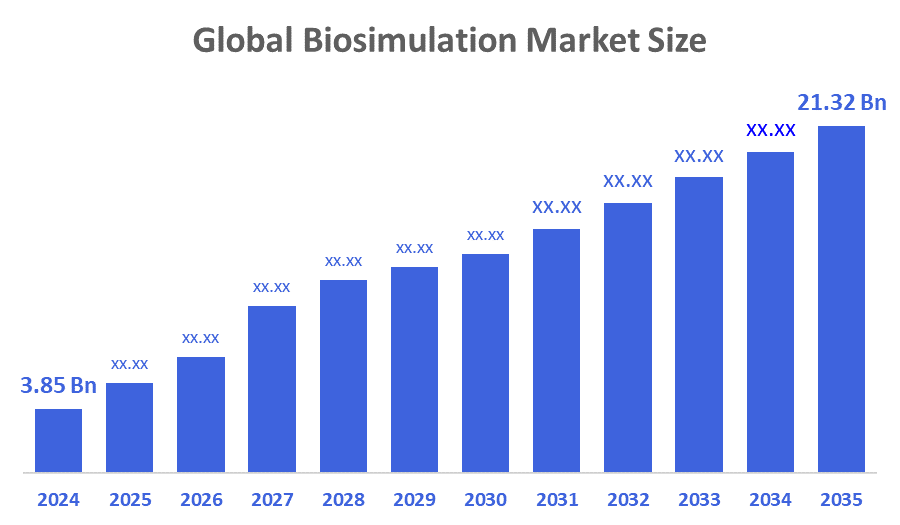
According to a research report published by Decisions Advisors and Consulting, The Global Biosimulation Market Size Was Worth Around USD 3.85 Billion In 2024 And Is Predicted To Grow To Around USD 21.32 Billion By 2035 With A Compound Annual Growth Rate (CAGR) Of 16.84 % From 2025 To 2035. Future industry growth prospects are expected to arise from the rising demand for precision medicine approaches, biologics and advanced therapy platforms, and the use of artificial intelligence to support simulation platforms. Continuous advancements being made in the field of data analytics, along with the interdisciplinary collaboration of computational scientists and life science experts, are creating opportunities for deeper market penetration.
Market Overview
The worldwide biosimulation market refers to the global industry centred on computational modelling and simulation technologies that replicate biological processes, drug interactions, and disease progression. It enables researchers, pharmaceutical companies, and healthcare providers to predict outcomes, optimise drug development, and reduce reliance on costly and time-consuming clinical trials. Biosimulation is a process that guides the effective performance of virtual clinical trials and reduces the costs as well as the development timeline of the drugs, which is very essential owing to the high incidence rates of chronic diseases and the demand for personalised medicine services. Biosimulation is the utilisation of computer-aided mathematical models for the simulation of biological processes. Biosimulation has different applications, such as the creation of new drugs, the discovery of new drugs, etc. There is a need for the prediction of future outcomes related to the drug development process, which can be done by simulating biological processes.
VeriSIM Life, a San Francisco–based biosimulation company, secured $15 million in Series A funding to advance its AI-powered platform that makes preclinical R&D more predictable by bridging the translational gap between animal studies and human outcomes.
Mubadala Investment Company, Abu Dhabi’s sovereign wealth fund, invested approximately $250 million in Certara, a global leader in biosimulation, by acquiring 9.6 million shares at $26 each in July 2021. This strategic move strengthens Mubadala’s focus on healthcare innovation and cost-efficient drug development.
Report Coverage
This research report categorises the biosimulation market based on various segments and regions, forecasts revenue growth, and analyses trends in each submarket. The report analyses the key growth drivers, opportunities, and challenges influencing the biosimulation market. Recent market developments and competitive strategies, such as expansion, product launch, development, partnership, merger, and acquisition, have been included to draw the competitive landscape in the market. The report strategically identifies and profiles the key market players and analyses their core competencies in each sub-segment of the biosimulation market.
Driving Factors
The market for biosimulation is going to be spurred by improvements in computer science and technology, as well as the increased focus on personalised medicine that has come to define modern pharmaceutical developments and innovations. With further developments in artificial intelligence and its application to biosimulation technology, precision and increased accuracy may be achieved, thus creating room for furtherinnovation in drug discovery and development processes. This situation may be an indication that there is an increased acceptance and endorsement of biosimulation as an essential tool for ensuring that new drugs pass through the trials and approval process for new therapies, thus creating an opportunity for a paradigm shift to emerge in relation to new and innovative techniques for discovering and developing new drugs and medicine. The future of this market appears bright and promising, and further developments and innovations may likely usher in new frontiers and possibilities for biosimulation technology.
Restraining Factors
There are several challenges regarding biosimulation modelling, primarily because of the complexity of human biology, data limitations, and no standardized validation process. Thus, error propagation during multi-scale simulations and simplicity-based modelling reduces confidence levels. However, it becomes difficult to encapsulate all physiological dependents using computer capabilities, which acts as a hindrance to the revolutionary use of biosimulation.
Market Segmentation
The biosimulation market share is classified into simulations type and software types.
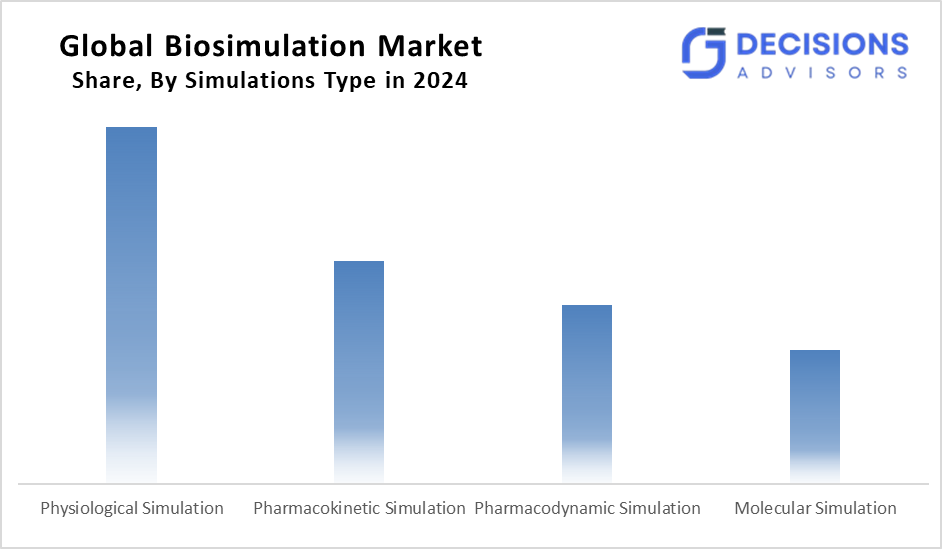
- The physiological simulation segment accounted for the largest market share in 2024 and is anticipated to grow at a remarkable CAGR over the forecast period.
Based on the simulations type, the biosimulation market is segmented into physiological simulation, pharmacokinetic simulation, pharmacodynamic simulation, and molecular simulation. Among these, the physiological simulation segment accounted for the largest market share in 2024 and is anticipated to grow at a remarkable CAGR over the forecast period. Physiological simulation represents a type of biosimulation that is able to model complex biological processes, which are integral in viewing the interaction between various drugs and human systems. Its segment has gained momentum among pharmaceutical and research institutions owing to its accuracy and reliability.
- The cloud-based software segment accounted for the highest market share in 2024 and is projected to grow at a substantial CAGR over the forecast period.
Based on the software type, the biosimulation market is divided into on-premises software and cloud-based software. Among these, the cloud-based software segment accounted for the highest market share in 2024 and is projected to grow at a substantial CAGR over the forecast period. Cloud-Based Software in the Biosimulation market is a characteristic associated with this kind of solution, where extensive computing resources are made available along with high levels of collaboration, making this solution a widely accepted option by most research centres and companies. This solution effectively handles large-scale simulations, where data can be shared and analysed in real time.
Regional Segment Analysis of the Biosimulation Market
- North America (U.S., Canada, Mexico)
- Europe (Germany, France, U.K., Italy, Spain, Rest of Europe)
- Asia-Pacific (China, Japan, India, Rest of APAC)
- South America (Brazil and the Rest of South America)
- The Middle East and Africa (UAE, South Africa, Rest of MEA)
Asia Pacific is anticipated to hold the largest share of the biosimulation market over the predicted timeframe.
Asia Pacific is anticipated to hold the largest share of the biosimulation market over the predicted timeframe. The Asia Pacific biosimulation market is expected to have the highest growth rate due to factors such as technological advancements, a strong pharmaceutical and biopharmaceutical industry, CROs, CDMOs, and rising biotech R&D funding. Certara, Inc. is expanding its Certainty client events across China, South Korea, and Japan, thus confirming its position in APAC’s pharmaceutical market, which is expected to reach $210 billion. The key driver behind this ramp-up is Japan, which contributes significantly in terms of revenue, given its adoption and approval of biosimulation tools, led by PMDA’s renewal of Certara’s licenses. The Chinese biosimulation market is expected to grow through personalised medicine initiatives and collaborations, led by Certara’s acquisition of Pinnacle 21, totaling $310 million.
North America is expected to grow at a rapid CAGR in the biosimulation market during the forecast period. The North American biosimulation market is fueled by the dominance of key players in the industry, investments in drug development, and the incidence of chronic diseases. The use of in silico techniques, along with stringent government regulations that guarantee patient safety and treatment, contributed to the growth in the region. The United States contributed the highest segment towards the North America biosimulation market, thanks to a strong pharmaceutical and biotechnology industry, high investments in research and development, and the use of artificial intelligence and machine learning in healthcare. Its growing preference for personalised medicine is another major driver that contributed considerably towards the growth in the region, making the United States a major growth driver for the overall biosimulation industry.
Competitive Analysis:
The report offers the appropriate analysis of the key organisations/companies involved within the biosimulation market, along with a comparative evaluation primarily based on their product offering, business overviews, geographic presence, enterprise strategies, segment market share, and SWOT analysis. The report also provides an elaborative analysis focusing on the current news and developments of the companies, which includes product development, innovations, joint ventures, partnerships, mergers & acquisitions, strategic alliances, and others. This allows for the evaluation of the overall competition within the market.
List of Key Companies
- ANSYS, Inc.
- Atomwise, Inc.
- BioSymetrics, Inc.
- Cadence
- Cellworks Group, Inc.
- Certara, Inc.
- Dassault Systèmes
- Exonate
- Exploristics
- Genedata AG
- Physiomics Plc
- Schrodinger
- Simulations Plus
- VeriSim Life
- Others
Key Target Audience
- Market Players
- Investors
- End-users
- Government Authorities
- Consulting and Research Firm
- Venture capitalists
- Value-Added Resellers (VARs)
Recent Development
- In July 2025, Simulations Plus, Inc. (a leader in modelling and simulation software for drug discovery) and the Institute of Medical Biology of the Polish Academy of Sciences announced successful validation results of ADMET Predictor® models, strengthening AI-driven drug design capabilities. Researchers reported that 70% of compounds designed using Simulations Plus’ ADMET Predictor demonstrated significant activity during in vitro testing.
- In October 2024, Simulations Plus, Inc. and its research partners were awarded a new FDA grant to validate in vitro–in vivo extrapolation (IVIVE) methods for complex drug formulations. This initiative aims to strengthen predictive biosimulation tools and improve regulatory confidence in computational modelling.
- In November 2023, Cellworks announced its expansion into Precision Pharma, a new initiative designed to accelerate cancer drug development and revive shelved pharmaceutical assets using biosimulation and AI-driven predictive modelling. Cellworks’ expansion into two new business units under Precision Pharma is designed to leverage its biosimulation platform and Computational Biology Model (CBM) to transform drug development.
Market Segment
This study forecasts revenue at global, regional, and country levels from 2020 to 2035. Decisions Advisors has segmented the biosimulation market based on the following segments:
Global Biosimulation Market, By Simulations Type
- Physiological Simulation
- Pharmacokinetic Simulation
- Pharmacodynamic Simulation
- Molecular Simulation
Global Biosimulation Market, By Software Type
- On-Premises Software
- Cloud-Based Software
Global Biosimulation Market, By Regional Analysis
- North America
- US
- Canada
- Mexico
- Europe
- Germany
- UK
- France
- Italy
- Spain
- Russia
- Rest of Europe
- Asia Pacific
- China
- Japan
- India
- South Korea
- Australia
- Rest of Asia Pacific
- South America
- Brazil
- Argentina
- Rest of South America
- Middle East & Africa
- UAE
- Saudi Arabia
- Qatar
- South Africa
- Rest of the Middle East & Africa
Frequently Asked Questions (FAQ)
- What is the projected size and growth rate of the global biosimulation market?
The market was valued at USD 3.85 billion in 2024 and is expected to reach USD 21.32 billion by 2035, growing at a CAGR of 16.84% from 2025 to 2035.
- Which region is expected to dominate the biosimulation market?
Asia Pacific is anticipated to hold the largest market share over the forecast period, driven by technological advancements, strong pharmaceutical industries, CROs, CDMOs, and rising biotech R&D funding.
- What are the main market segments by simulation type and software type?
By simulation type: Physiological, Pharmacokinetic, Pharmacodynamic, and Molecular Simulation (Physiological held the largest share in 2024). By software type: On-Premises and Cloud-Based (cloud-based led in 2024).
- What drives growth in the biosimulation market?
Key drivers include rising demand for precision medicine, biologics, advanced therapies, AI integration in simulations, data analytics advancements, and interdisciplinary collaborations between computational and life sciences experts.
- What are the main challenges or restraining factors?
Challenges involve the complexity of human biology, data limitations, lack of standardised validation, error propagation in multi-scale simulations, and difficulties in fully capturing physiological dependencies with current computing power.
- Who are the key players in the global biosimulation market?
Major companies include ANSYS, Inc., Atomwise, Inc., BioSymetrics, Inc., Cadence, Cellworks Group, Inc., Certara, Inc., Dassault Systèmes, Exonate, Exploristics, Genedata AG, Physiomics Plc, Schrodinger, Simulations Plus, VeriSIM Life, and others.
- What recent developments highlight market activity?
Examples include VeriSIM Life's $15 million Series A funding for its AI-powered platform and Mubadala's $250 million investment in Certara in 2021 to advance biosimulation for drug development.
Check Licence
Choose the plan that fits you best: Single User, Multi-User, or Enterprise solutions tailored for your needs.
We Have You Covered
- 24/7 Analyst Support
- Clients Across the Globe
- Tailored Insights
- Technology Tracking
- Competitive Intelligence
- Custom Research
- Syndicated Market Studies
- Market Overview
- Market Segmentation
- Growth Drivers
- Market Opportunities
- Regulatory Insights
- Innovation & Sustainability
Report Details
| Scope | Global |
| Pages | 250 |
| Delivery | PDF & Excel via Email |
| Language | English |
| Release | Feb 2026 |
| Access | Download from this page |