
Global Bladder Cancer Market
 |
Author:
David J
|
Pages:
190
|
Author:
David J
|
Pages:
190
Global Bladder Cancer Market Size, Share by Cancer Type (Non-Muscle Invasive Bladder Cancer, Muscle-Invasive Bladder Cancer, Metastatic Bladder Cancer), By Therapy Type (Immunotherapy, Chemotherapy, Targeted Therapy, Radiation Therapy, Others), By Diagnosis Method (Cystoscopy, Urine Cytology, Biomarker Testing, Imaging, Others), By End User (Hospitals, Cancer Research Institutes, Specialty Clinics), and By Region (North America, Europe, Asia-Pacific, Latin America, Middle East & Africa), Analysis and Forecast 2026-2035.
CAGR
11.5%
REVENUE 2025
USD Billion 3.12
FORECAST 2035
USD Billion 9.27
REPORT COVERAGE
Global
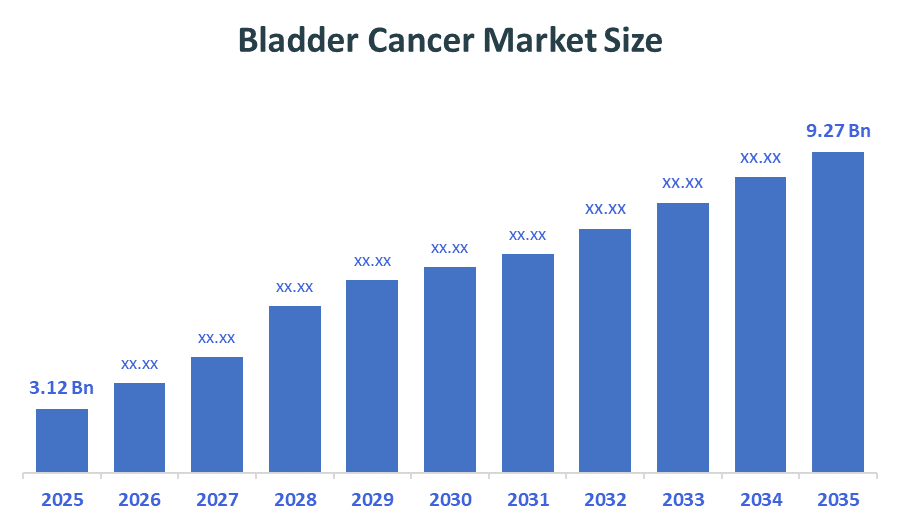
The Global Bladder Cancer Market Size is expected to grow from USD 3.12 Billion in 2025 to USD 9.27 Billion by 2035, registering a steady CAGR during the forecast period. According to Decisions Advisors, the market is primarily driven by the increasing prevalence of urothelial carcinoma, rising adoption of immunotherapies, and rapid advancements in precision oncology and targeted treatment approaches. Immunotherapy emerged as one of the dominant segments in 2025, supported by strong clinical adoption of immune checkpoint inhibitors for advanced bladder cancer. Furthermore, Merck & Co., Inc. reinforced its leadership in oncology with Keytruda generating global revenue exceeding USD 29.5 billion in 2024, highlighting the growing importance of immunotherapy solutions in bladder cancer treatment.
Market Snapshot
- Bladder Cancer Market Size (2025): USD 3.12 Billion
- Projected Bladder Cancer Market Size (2035): USD 9.27 Billion
- Bladder Cancer Market Compound Annual Growth Rate (CAGR): 11.5%
- Largest Regional Market: North America
- Fastest Growing Region: Asia Pacific
- 2nd Largest Region: Europe
- Base Year: 2025
- Historical Period: 2021-2024
- Forecast Period: 2026-2035
Market Overview/ Introduction
The Global Bladder Cancer Market is a significant segment of the oncology industry, focused on the diagnosis, treatment, and long-term management of malignant bladder tumors, with urothelial carcinoma accounting for the majority of cases worldwide. Bladder cancer is primarily categorized into non-muscle invasive bladder cancer (NMIBC), muscle-invasive bladder cancer (MIBC), and metastatic bladder cancer, based on the stage and severity of tumor progression. The market is experiencing robust growth driven by the rising prevalence of smoking-related cancers, the expanding aging population, and increased exposure to industrial carcinogens and environmental pollutants. Furthermore, advancements in immunotherapy, targeted therapies, biomarker testing, and precision oncology are substantially improving treatment outcomes for bladder cancer patients. Rising healthcare expenditure, expanding oncology infrastructure, and growing awareness about early cancer screening programs are also playing a vital role in supporting the overall expansion of the Global Bladder Cancer Market.
Notable Insights: -
- North America is anticipated to hold the largest share, approximately 40% of the Bladder Cancer Market over the predicted timeframe.
- Asia Pacific is expected to grow at the fastest CAGR in the global Bladder Cancer market during the forecast period.
- By therapy type, the immunotherapy segment dominated the market in 2025 with approximately 43% share, and is projected to grow at a substantial CAGR during the forecast period.
- By cancer type, the non-muscle invasive bladder cancer segment dominated the market in 2025 with approximately 49% share, and is projected to grow at a substantial CAGR during the forecast period.
- The compound annual growth rate of the Bladder Cancer Market is 11.5%.
- The market is likely to achieve a valuation of USD 9.27 Billion by 2035.
What is the role of technology in grooming the market?
Technology plays a critical role in shaping the Global Bladder Cancer Market through rapid advancements in precision oncology, biomarker testing, and minimally invasive diagnostics. Innovations such as liquid biopsy technologies, AI-assisted pathology systems, and next-generation sequencing (NGS) are significantly improving early detection, accurate staging, and personalized treatment planning for bladder cancer patients. Additionally, robotic-assisted surgeries and advanced imaging systems are enhancing surgical precision while reducing treatment-related complications and recovery time. The market is further strengthened by continuous innovation in immunotherapy combinations, targeted therapies, and molecular diagnostic platforms aimed at improving survival rates and minimizing disease recurrence. The integration of teleoncology platforms and AI-powered clinical decision support systems is also expanding access to high-quality cancer care, particularly in emerging regions.
Market Drivers
The Global Bladder Cancer Market is experiencing strong growth primarily due to the rising prevalence of urothelial carcinoma, increasing adoption of immunotherapy and targeted therapies, and growing demand for precision oncology solutions. The market is further driven by the rising incidence of smoking-related cancers, the expanding aging population, and increased exposure to industrial chemicals and environmental carcinogens. Additionally, the shift toward biomarker-driven treatment approaches and personalized medicine is accelerating market expansion. Higher healthcare expenditure, development of advanced oncology infrastructure, and growing awareness about early detection of bladder cancer are also supporting wider treatment adoption globally. Technological improvements in cystoscopy systems, molecular diagnostics, liquid biopsy tests, and AI-assisted imaging are enhancing early detection and long-term patient management, while increased funding for oncology clinical trials and the development of novel immuno-oncology therapies continue to fuel future market growth.
Restrain
The Global Bladder Cancer Market faces several restraints, primarily due to the high cost of immunotherapies, targeted therapies, and advanced molecular diagnostic testing, especially in low- and middle-income regions with limited reimbursement support. High recurrence rates of bladder cancer and treatment-related adverse effects further increase the long-term disease management burden on patients and healthcare systems. Additionally, stringent regulatory approval requirements, limited accessibility to advanced oncology infrastructure, and the complexity of personalized treatment selection are expected to hinder overall market growth during the forecast period.
Competitive Analysis:
The report offers the appropriate analysis of the key organizations/companies involved within the Bladder Cancer Market, along with a comparative evaluation primarily based on their product of offering, business overviews, geographic presence, enterprise strategies, segment market share, and SWOT analysis. The report also provides an elaborative analysis focusing on the current news and developments of the companies, which includes product development, innovations, joint ventures, partnerships, mergers & acquisitions, strategic alliances, and others. This allows for the evaluation of the overall competition within the market.
Top Companies in the Bladder Cancer Market
- Merck & Co., Inc.
- Bristol-Myers Squibb
- Roche
- AstraZeneca
- Pfizer Inc.
- Johnson & Johnson
- Astellas Pharma Inc.
- Bayer AG
- Novartis AG
- Seagen Inc.
Government Initiatives
|
Country |
Key Government Initiatives |
|
Japan |
Japan’s Ministry of Health, Labour and Welfare supports nationwide cancer screening initiatives and investment in advanced oncology treatment infrastructure. |
|
US |
The National Cancer Institute (NCI) supports bladder cancer research, immunotherapy development, and precision oncology initiatives for early cancer diagnosis and treatment. |
|
Europe |
The European Medicines Agency (EMA) promotes accelerated approvals for innovative oncology therapies and advanced molecular diagnostic technologies in bladder cancer care. |
Study on the Supply, Demand, Distribution, and Market Environment of the Bladder Cancer Market
The Global Bladder Cancer Market demonstrates a strong interplay between supply, demand, distribution channels, and the overall oncology healthcare infrastructure. On the supply side, leading pharmaceutical and biotechnology companies are actively developing and supplying immunotherapies, chemotherapy agents, targeted therapies, and advanced diagnostic technologies. Demand is primarily driven by the rising prevalence of bladder cancer, the expanding aging population, and increasing adoption of biomarker-driven treatment approaches across regions. Distribution is efficiently facilitated through hospital pharmacies, oncology centers, specialty clinics, and cancer research institutes, ensuring better access to advanced therapies. Meanwhile, the market environment is shaped by regulatory approvals, evolving reimbursement policies, rapid progress in molecular diagnostics, and growing investments in oncology clinical research and precision medicine initiatives.
Price Analysis and Consumer Behaviour Analysis
Price analysis in the Global Bladder Cancer Market indicates that treatment costs remain significantly high, primarily due to the premium pricing of immunotherapies, targeted therapies, and advanced molecular diagnostic testing. These high-end immuno-oncology drugs and precision medicine approaches command higher prices owing to their superior clinical outcomes, personalized treatment capabilities, and improved survival rates. From a consumer behaviour perspective, both oncologists and patients are increasingly favoring therapies that offer better survival rates, reduced risk of recurrence, and more individualized treatment plans with manageable side effects. Growing awareness regarding early cancer detection and the rising acceptance of biomarker testing are further driving the adoption of advanced bladder cancer therapies across global markets.
Market Segmentation
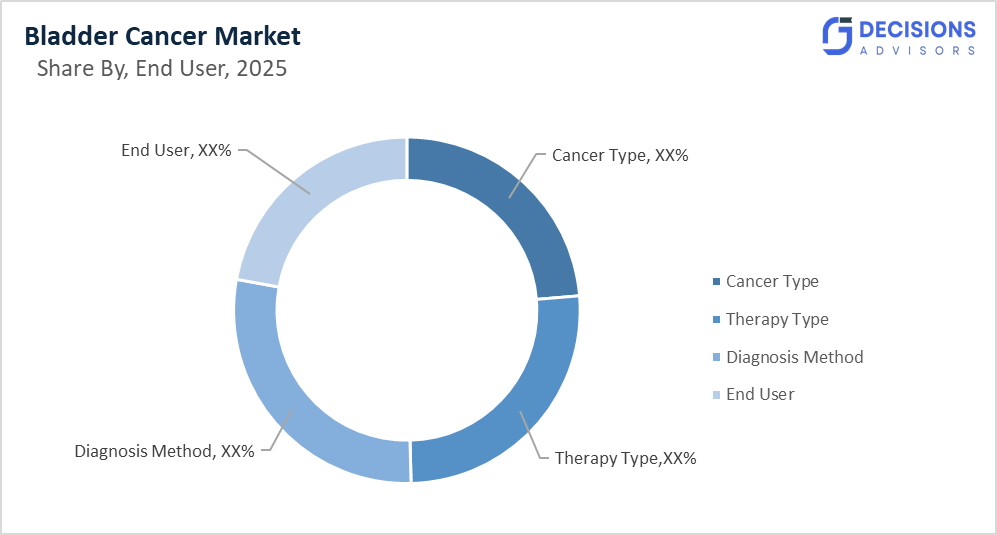
The Bladder Cancer Market share is classified into cancer type, therapy type, diagnosis method, and end user.
- The immunotherapy segment dominated the market in 2025 with approximately 43% share, and is projected to grow at a substantial CAGR during the forecast period.
Based on the therapy type, the Bladder Cancer Market is divided into immunotherapy, chemotherapy, targeted therapy, radiation therapy, and others. Among these, the immunotherapy segmen segment dominated the market in 2025 with approximately 43% share, and is projected to grow at a substantial CAGR during the forecast period, owing to the increasing clinical adoption of PD-1 and PD-L1 inhibitors in advanced bladder cancer treatment. For instance, immunotherapies such as Keytruda and Opdivo are widely prescribed to improve survival outcomes and reduce disease progression among bladder cancer patients. The targeted therapy segment also held a significant share due to rising adoption of precision oncology treatment approaches.
- The non-muscle invasive bladder cancer segment accounted for the largest share in 2025 with approximately 49%, and is anticipated to grow at a significant CAGR during the forecast period.
Based on the cancer type, the Bladder Cancer Market is divided into non-muscle invasive bladder cancer, muscle-invasive bladder cancer, and metastatic bladder cancer. Among these, the non-muscle invasive bladder cancer segment accounted for the largest share in 2025 with approximately 49%, and is anticipated to grow at a significant CAGR during the forecast period, driven by its high global prevalence and increasing early-stage diagnosis rates. For example, non-muscle invasive bladder cancer patients commonly undergo intravesical therapy and long-term cystoscopic monitoring, significantly contributing to segment demand.
- The cystoscopy segment dominated the market in 2025 with approximately 45% share, and is projected to grow at a substantial CAGR during the forecast period.
Based on the diagnosis method, the Bladder Cancer Market is divided into cystoscopy, urine cytology, biomarker testing, imaging, and others. Among these, the cystoscopy segment dominated the market in 2025 with approximately 45% share, and is projected to grow at a substantial CAGR during the forecast period, owing to its high diagnostic accuracy and widespread clinical use in bladder cancer detection and monitoring. Cystoscopy remains the gold standard diagnostic procedure for evaluating bladder abnormalities and supporting early-stage cancer diagnosis globally.
Strategies to Implement for Growth of the Market in Non-Leading Regions
- Increase awareness regarding early bladder cancer screening, biomarker testing, and precision oncology through public healthcare campaigns and oncology education programs.
- Expand access to affordable immunotherapies, targeted therapies, and advanced molecular diagnostic solutions to reduce treatment barriers in developing economies.
- Strengthen partnerships with hospitals, oncology centres, and speciality clinics to improve accessibility and distribution of advanced bladder cancer treatment solutions.
Regional Segment Analysis of the Bladder Cancer Market
- North America (U.S., Canada, Mexico)
- Europe (Germany, France, U.K., Italy, Spain, Rest of Europe)
- Asia-Pacific (China, Japan, India, Rest of APAC)
- South America (Brazil and the Rest of South America)
- The Middle East and Africa (UAE, South Africa, Rest of MEA)
North America is anticipated to hold the largest share, approximately 40% of the Bladder Cancer Market over the predicted timeframe.
North America is anticipated to hold the largest share, approximately 40% of the Bladder Cancer Market over the predicted timeframe. The region dominates due to its advanced oncology infrastructure, strong adoption of immunotherapies, and increasing implementation of precision oncology approaches across the United States and Canada. The rising prevalence of bladder cancer, increasing healthcare expenditure, and growing awareness regarding early cancer screening are significantly driving regional market growth.
Asia Pacific is expected to grow at the fastest CAGR in the Bladder Cancer Market during the forecast period.
Asia Pacific is expected to grow at the fastest CAGR in the Bladder Cancer Market during the forecast period. The growth is driven by the increasing aging population, rising smoking prevalence, and expanding access to advanced oncology care in countries such as China, Japan, India, and South Korea. Increasing healthcare expenditure, growing adoption of targeted cancer therapies, and improving awareness regarding bladder cancer diagnosis are accelerating regional market development. Additionally, government-supported cancer screening initiatives and the expansion of oncology treatment centres are contributing to strong market growth across the region.
Europe is the second largest region in the Bladder Cancer Market during the forecast period.
Europe is the second largest region in the Bladder Cancer Market during the forecast period. The region is characterised by advanced healthcare systems, increasing adoption of biomarker-guided cancer therapies, and strong demand for immuno-oncology treatments, particularly in countries such as Germany, the UK, and France. Rising prevalence of urothelial carcinoma, increasing investments in oncology research, and growing implementation of personalized medicine approaches are supporting market expansion.
Future Market Trends in the Bladder Cancer Market: -
- Increasing Adoption of Immunotherapy-Based Treatments
Immunotherapy and immune checkpoint inhibitors are gaining rapid traction due to their ability to deliver better survival outcomes and slow disease progression in patients with advanced and metastatic bladder cancer.
- Expansion of Biomarker-Driven Precision Oncology
Biomarker testing and precision oncology approaches are becoming mainstream, enabling more personalized treatment selection and significantly improving the effectiveness of targeted therapies in bladder cancer management.
- Rising Development of Liquid Biopsy Technologies
Liquid biopsy technologies are emerging as a game-changer by facilitating early detection, real-time disease monitoring, and minimally invasive molecular profiling to support personalized treatment strategies.
- Growing Integration of AI-assisted Cancer Diagnostics
AI-powered imaging systems and digital pathology platforms are enhancing diagnostic accuracy, optimizing treatment planning, and improving early-stage bladder cancer detection rates.
Recent Development
- In April 2026, Johnson & Johnson advanced its TAR-200 intravesical gemcitabine system with new positive Phase 2b data for BCG-unresponsive high-risk non-muscle invasive bladder cancer (NMIBC), strengthening its position in innovative bladder-sparing therapies.
- In February 2026, Pfizer and Merck expanded clinical collaboration on combination immunotherapy regimens, aiming to improve outcomes in muscle-invasive and advanced bladder cancer.
- In November 2025, AstraZeneca received key regulatory progress for durvalumab-based combinations in locally advanced urothelial carcinoma, boosting its oncology portfolio in bladder cancer.
- In August 2025, Bristol Myers Squibb launched new initiatives to expand access to Opdivo (nivolumab) in perioperative bladder cancer settings across major markets.
- In May 2025, several leading companies accelerated the integration of AI-powered imaging and liquid biopsy technologies to support early detection and personalized treatment planning in bladder cancer management.
Market Segment
This study forecasts revenue at global, regional, and country levels from 2020 to 2035. Decision Advisors has segmented the Bladder Cancer Market based on the below-mentioned segments:
Bladder Cancer Market, By Cancer Type
- Non-Muscle Invasive Bladder Cancer
- Muscle-Invasive Bladder Cancer
- Metastatic Bladder Cancer
Bladder Cancer Market, By Therapy Type
- Immunotherapy
- Chemotherapy
- Targeted Therapy
- Radiation Therapy
- Others
Bladder Cancer Market, By Diagnosis Method
- Cystoscopy
- Urine Cytology
- Biomarker Testing
- Imaging
- Others
Bladder Cancer Market, By End User
- Hospitals
- Cancer Research Institutes
- Specialty Clinics
Bladder Cancer Market, By Regional Analysis
- North America
- US
- Canada
- Mexico
- Europe
- Germany
- UK
- France
- Italy
- Spain
- Russia
- Rest of Europe
- Asia Pacific
- China
- Japan
- India
- South Korea
- Australia
- Rest of Asia Pacific
- South America
- Brazil
- Argentina
- Rest of South America
- Middle East & Africa
- UAE
- Saudi Arabia
- Qatar
- South Africa
- Rest of the Middle East & Africa
Frequently Asked Questions (FAQ)
Q1. What is the projected market size of the Bladder Cancer Market by 2035?
A. The Bladder Cancer Market is projected to reach approximately USD 9.27 Billion by 2035.
Q2. What is the expected CAGR of the Bladder Cancer Market during the forecast period?
A. The market is expected to grow at a CAGR of 11.5% during the forecast period from 2026 to 2035.
Q3. Which therapy type dominated the Bladder Cancer Market in 2025?
A. The immunotherapy segment dominated the market in 2025 with approximately 43% share due to the increasing clinical adoption of PD-1 and PD-L1 inhibitors.
Q4. Which cancer type accounted for the largest share in the Bladder Cancer Market?
A. The non-muscle invasive bladder cancer segment accounted for approximately 49% market share in 2025 owing to its high prevalence and increasing early-stage diagnosis rates.
Q5. Which diagnosis method dominated the Bladder Cancer Market?
A. The cystoscopy segment dominated the market with approximately 45% share in 2025 due to its high diagnostic accuracy and widespread clinical adoption.
Q6. What factors are driving the growth of the Bladder Cancer Market?
A. Key growth drivers include increasing prevalence of urothelial carcinoma, rising adoption of immunotherapies, advancements in precision oncology, and growing awareness regarding early bladder cancer diagnosis.
Q7. Which region dominates the Bladder Cancer Market?
A. North America dominates the market due to advanced oncology infrastructure, strong immunotherapy adoption, and increasing implementation of precision oncology treatment approaches.
Check Licence
Choose the plan that fits you best: Single User, Multi-User, or Enterprise solutions tailored for your needs.
We Have You Covered
- 24/7 Analyst Support
- Clients Across the Globe
- Tailored Insights
- Technology Tracking
- Competitive Intelligence
- Custom Research
- Syndicated Market Studies
- Market Overview
- Market Segmentation
- Growth Drivers
- Market Opportunities
- Regulatory Insights
- Innovation & Sustainability
Report Details
| Scope | Global |
| Pages | 190 |
| Delivery | PDF & Excel via Email |
| Language | English |
| Release | May 2026 |
| Access | Download from this page |