
Global Brain Implants Market
 |
Author:
Disha B
|
Pages:
250
|
Author:
Disha B
|
Pages:
250
Global Brain Implants Market Size, Share, and COVID-19 Impact Analysis, By Product Type (Deep Brain Stimulator, Spinal Cord Stimulator, and Vagus Nerve Stimulator), By Application (Chronic Pain, Epilepsy, Parkinson's Disease, Depression, Essential Tremor, Alzheimer's Disease, and Others) and By Region (North America, Europe, Asia-Pacific, Latin America, Middle East, and Africa), Analysis and Forecast 2025-2035
CAGR
9.42%
REVENUE 2024
USD Billion 6.28
FORECAST 2035
USD Billion 16.9
REPORT COVERAGE
Global
Global Brain Implants Market Size Insights Forecasts to 2035
- The Global Brain Implants Market Size Was valued at USD 6.28 Billion in 2024
- The Global Brain Implants Market Size is Expected to Grow at a CAGR of around 9.42% from 2025 to 2035
- The Worldwide Brain Implants Market Size is Expected to Reach USD 16.90 Billion by 2035
- Asia-Pacific is expected to grow the fastest during the forecast period.
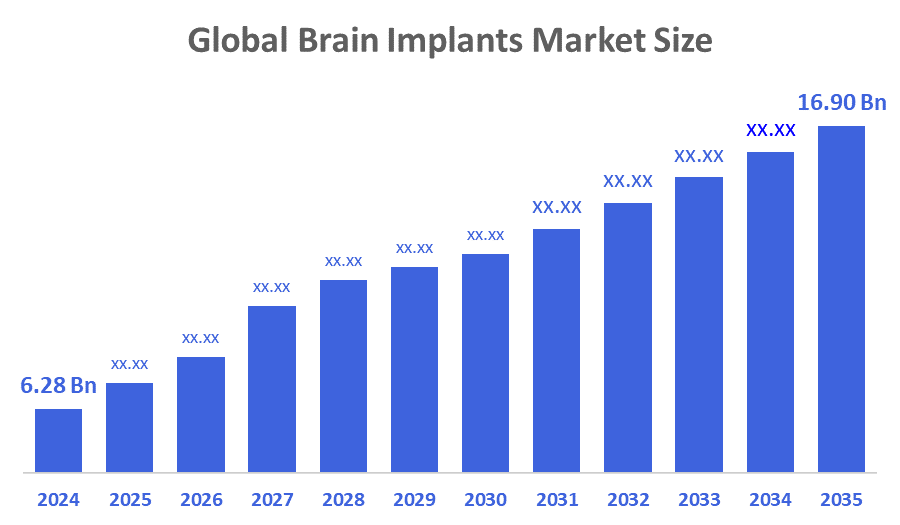
According to a research report published by Decisions Advisors and Consulting, The Global Brain Implants Market Size Was Worth Around USD 6.28 Billion In 2024 And Is Predicted To Grow To Around USD 16.90 Billion By 2035 With A Compound Annual Growth Rate (CAGR) Of 9.42% From 2025 To 2035. The demand for brain implants is primarily being boosted by the rising number of trauma cases and the increasing prevalence of brain cancers and the technological advancement in product development and the growing prevalence of brain aneurysms and other factors.
Market Overview
The global brain implants market refers to the worldwide industry involved in the development, manufacturing, and commercialization of implantable neurotechnology devices which doctors use to monitor and stimulate and restore brain function in patients with neurological disorders. The Brain Implants Market experiences growth because of research investments in neuroscience. Governments and private organizations dedicate significant financial resources to investigate human brain functions and create new medical treatments. For instance, brain research funding has increased significantly because researchers received billions of dollars to study brain functions while developing new treatment methods. The research funding boost not only speeds up scientific investigations but also creates opportunities for universities and businesses to work together in developing advanced brain implant technologies. The Brain Implants Market will grow because research findings create demand for new products and medical applications.
Report Coverage
This research report categorizes the brain implants market based on various segments and regions, forecasts revenue growth, and analyzes trends in each submarket. The report analyses the key growth drivers, opportunities, and challenges influencing the brain implants market. Recent market developments and competitive strategies such as expansion, type launch, development, partnership, merger, and acquisition, have been included to draw the competitive landscape in the market. The report strategically identifies and profiles the key market players and analyses their core competencies in each sub-segment of the brain implants market.
Driving Factors
The brain implants market currently sees a wave of technological advancements which improve both the operational capabilities and security features of brain implants. Material science progress enables the creation of implants which better connect with biocompatible materials for human brain interfacing. The field of wireless communication technology has developed new systems which provide essential capability for real-time brain activity monitoring through their data transmission functions. The market for brain implants will grow to USD 5 billion by 2026 because of technological progress according to current market estimates. The new developments in brain implants bring two main benefits which help patients while creating new possibilities for treating neurological disorders and enhancing cognitive functions. The Brain Implants Market will experience ongoing expansion because of technological progress and new market developments.
Restraining Factors
The solution to existing cost and regulatory difficulties requires implementation of approval processes which need simplification and insurance coverage extensions and creation of affordable implant products. The marketing strategies of Medtronic and NeuroPace show that these companies use safety compliance and clinical trial results to establish trust with hospitals and patients.
Market Segmentation
The brain implants market share is classified into product type and application
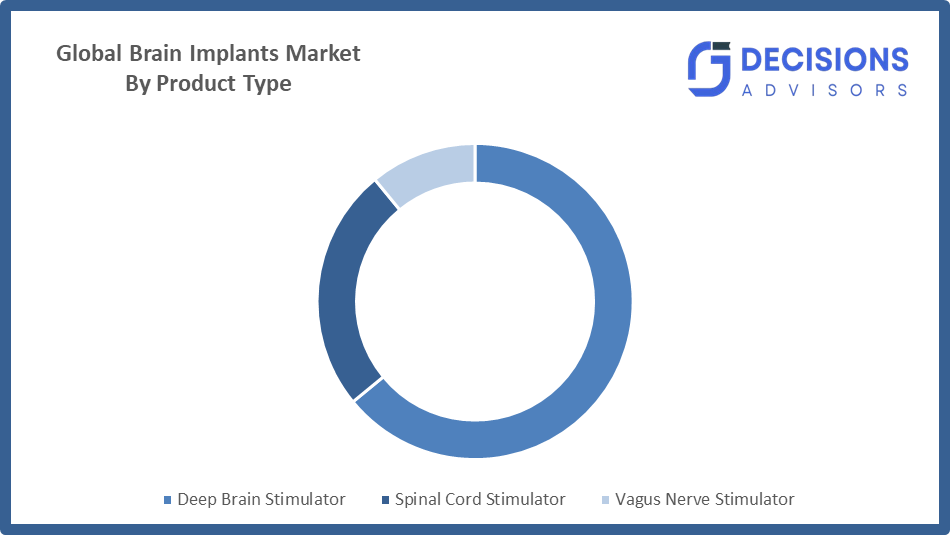
- The deep brain stimulator segment accounted for the largest share in 2024 and is anticipated to grow at a significant CAGR during the forecast period.
Based on the product type, the brain implants market is divided into deep brain stimulator, spinal cord stimulator, and vagus nerve stimulator. Among these, the deep brain stimulator segment accounted for the largest share in 2024 and is anticipated to grow at a significant CAGR during the forecast period. The demand for deep brain stimulators has increased because more people develop neurological disorders like Parkinson's disease and epilepsy and essential tremors. The American Association of Neurological Surgeons published an April 2024 study which found that 250000 people in the United States lived with dystonia. The neurological movement disorder which causes involuntary muscle contractions affected people from all age groups and all ethnic backgrounds because it caused them to display abnormal body movements and postures. The market experiences growth because of technological progress and development of less invasive medical techniques and successful clinical outcomes and new regulatory approvals. The FDA and other regulatory agencies established new DBS devices which now provide additional treatment alternatives.
- The chronic pain segment accounted for the highest market revenue in 2024 and is anticipated to grow at a significant CAGR during the forecast period.
Based on the application, the brain implants market is divided into chronic pain, epilepsy, parkinson's disease, depression, essential tremor, alzheimer's disease, and others. Among these, the chronic pain segment accounted for the highest market revenue in 2024 and is anticipated to grow at a significant CAGR during the forecast period. The growing use of brain implant technology for chronic pain treatment comes from recent breakthroughs in this field. A study conducted by the Guardian in November 2023 found encouraging outcomes for research conducted in the United Kingdom and European countries. Deep brain stimulation research demonstrates its ability to treat chronic pain conditions which include neuropathic pain and phantom limb pain that affects multiple people worldwide. Boston Scientific presented its Intercept system five-year results at the American Society of Pain and Neuroscience conference which took place in Florida United States during July 2024 to demonstrate its effectiveness for heterogeneous low back pain treatment. The development of closed-loop systems as technological breakthroughs increases treatment results while patients prefer less intrusive medical options. The increasing awareness of brain implants combined with research funding and growing acceptance of brain implant technology drives its adoption rate.
Regional Segment Analysis of the Brain Implants Market
- North America (U.S., Canada, Mexico)
- Europe (Germany, France, U.K., Italy, Spain, Rest of Europe)
- Asia-Pacific (China, Japan, India, Rest of APAC)
- South America (Brazil and the Rest of South America)
- The Middle East and Africa (UAE, South Africa, Rest of MEA)
North America is anticipated to hold the largest share of the brain implants market over the predicted timeframe.
North America is anticipated to hold the largest share of the brain implants market over the predicted timeframe. The current superior position of the company results from multiple reasons which include the rising occurrence of neurological disorders together with people becoming more knowledgeable about available treatments and their access to highly qualified medical doctors and established medical institutions. The increased government funding together with public education campaigns about movement disorders will create a higher regional need for deep brain stimulation devices. The Parkinson's Foundation dedicated USD 3.5 million in 2020 to support more than 34 research projects on Parkinson's disease. The combination of these factors will create a higher need for brain implants throughout this area.
Asia-Pacific is expected to grow at a rapid CAGR in the brain implants market during the forecast period. The region experiences rising neurological disorders because its population ages, with about 6 million Alzheimer’s patients existing in China according to 2023 data. The countries develop their healthcare systems while R&D funding creates new brain implant technologies that include DBS and spinal cord stimulators. The region experiences predictive brain implants and smart helmets that track brain activity and Carbon Cybernetics brain implants which enable long-term monitoring. An Australian study showed how intelligent BCI devices affect patient experience which helps the global brain implant market while providing ethical guidelines for future clinical BCI usage. The combination of these developments and increased public understanding will create new medical treatment methods which will enhance patient wellbeing. Supported by government policies and technology adoption by healthcare providers the healthcare sector achieves better patient results.
Competitive Analysis:
The report offers the appropriate analysis of the key organizations/companies involved within the brain implants market, along with a comparative evaluation primarily based on their type of offering, business overviews, geographic presence, enterprise strategies, segment market share, and SWOT analysis. The report also provides an elaborative analysis focusing on the current news and developments of the companies, which includes type development, innovations, joint ventures, partnerships, mergers & acquisitions, strategic alliances, and others. This allows for the evaluation of the overall competition within the market.
List of Key Companies
- Medtronic
- Boston Scientific Corporation
- Abbott
- NeuroPace, Inc.
- ALEVA NEUROTHERAPEUTICS
- LivaNova PLC
- SceneRay Co., Ltd.
- Others
Key Target Audience
- Market Players
- Investors
- End-users
- Government Authorities
- Consulting and Research Firm
- Venture capitalists
- Value-Added Resellers (VARs)
Market Segment
This study forecasts revenue at global, regional, and country levels from 2020 to 2035. Decisions Advisors has segmented the brain implants market based on the below-mentioned segments:
Global Brain Implants Market, By Product Type
- Deep Brain Stimulator
- Spinal Cord Stimulator
- Vagus Nerve Stimulator
Global Brain Implants Market, By Application
- Chronic Pain
- Epilepsy
- Parkinson's Disease
- Depression
- Essential Tremor
- Alzheimer's Disease
- Others
Global Brain Implants Market, By Regional Analysis
- North America
- US
- Canada
- Mexico
- Europe
- Germany
- UK
- France
- Italy
- Spain
- Russia
- Rest of Europe
- Asia Pacific
- China
- Japan
- India
- South Korea
- Australia
- Rest of Asia Pacific
- South America
- Brazil
- Argentina
- Rest of South America
- Middle East & Africa
- UAE
- Saudi Arabia
- Qatar
- South Africa
- Rest of the Middle East & Africa
Frequently Asked Questions (FAQ)
- What is the CAGR of the brain implants market over the forecast period?
A: The global brain implants market is projected to expand at a CAGR of 9.42% during the forecast period.
- What is the market size of the brain implants market?
A: The global brain implants market size is estimated to grow from USD 6.28 billion in 2024 to USD 16.90 billion by 2035, at a CAGR of 9.42% during the forecast period 2025-2035.
- Which region holds the largest share of the brain implants market?
A: North America is anticipated to hold the largest share of the brain implants market over the predicted timeframe.
- Who are the top 10 companies operating in the global brain implants market?
A: Medtronic, Boston Scientific Corporation, Abbott, NeuroPace, Inc., ALEVA NEUROTHERAPEUTICS, LivaNova PLC, SceneRay Co., Ltd., and Others.
- What are the market trends in the brain implants market?
A: The global brain implants market shows key trends that include AI-driven brain-computer interface systems and other technological advancements and the development of new treatment methods for movement disorders and the increasing occurrence of neurological diseases and the rising demand for wireless devices that require less invasive surgical methods.
Check Licence
Choose the plan that fits you best: Single User, Multi-User, or Enterprise solutions tailored for your needs.
We Have You Covered
- 24/7 Analyst Support
- Clients Across the Globe
- Tailored Insights
- Technology Tracking
- Competitive Intelligence
- Custom Research
- Syndicated Market Studies
- Market Overview
- Market Segmentation
- Growth Drivers
- Market Opportunities
- Regulatory Insights
- Innovation & Sustainability
Report Details
| Scope | Global |
| Pages | 250 |
| Delivery | PDF & Excel via Email |
| Language | English |
| Release | Feb 2026 |
| Access | Download from this page |