
Global Brain Monitoring Devices Market
 |
Author:
Disha B
|
Pages:
250
|
Author:
Disha B
|
Pages:
250
Global Brain Monitoring Devices Market Size, Share, and COVID-19 Impact Analysis, By Procedure (Invasive and Non-invasive), By Application (Epilepsy, Dementia, Parkinson's Disease, Huntington's Disease, Headache Disorders, Stroke, Traumatic Brain Injuries, Sleep Disorders and Others) and By Region (North America, Europe, Asia-Pacific, Latin America, Middle East, and Africa), Analysis and Forecast 2025-2035
CAGR
7.75%
REVENUE 2024
USD Billion 7.16
FORECAST 2035
USD Billion 16.28
REPORT COVERAGE
Global
Global Brain Monitoring Devices Market Size Insights Forecasts to 2035
- The Global Brain Monitoring Devices Market Size Was valued at USD 7.16 Billion in 2024
- The Global Brain Monitoring Devices Market Size is Expected to Grow at a CAGR of around 7.75% from 2025 to 2035
- The Worldwide Brain Monitoring Devices Market Size is Expected to Reach USD 16.28 Billion by 2035
- Asia-Pacific is expected to grow the fastest during the forecast period.
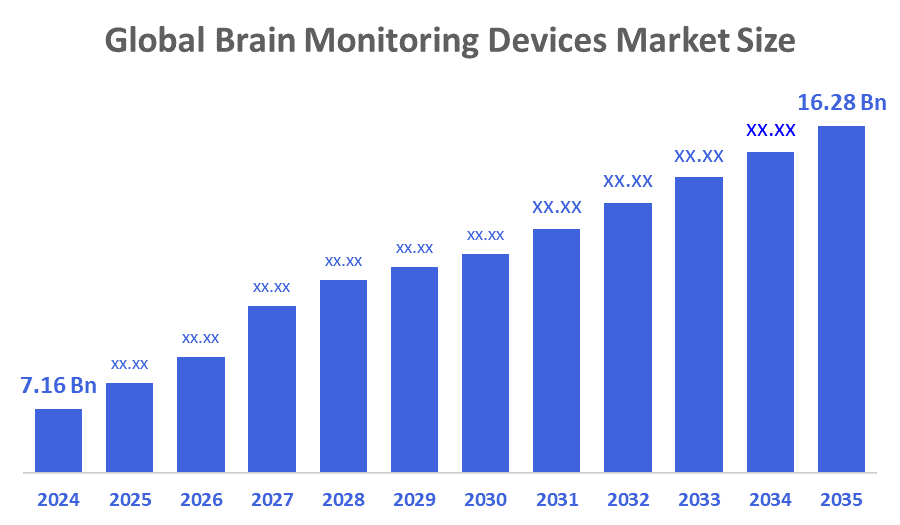
According to a research report published by Decisions Advisors and Consulting, The Global Brain Monitoring Devices Market Size Was Worth Around USD 7.16 Billion In 2024 And Is Predicted To Grow To Around USD 16.28 Billion By 2035 With A Compound Annual Growth Rate (CAGR) Of 7.75% From 2025 To 2035. The global brain monitoring devices market will experience future expansion through upcoming wearable and non-invasive technology developments together with AI-powered diagnostic prediction systems and expanding telehealth services and increasing needs from global aging populations.
Market Overview
The Global Brain Monitoring Devices Market Size includes all worldwide business operations that create and sell medical equipment which records brain activity data for use in diagnosis and therapy. The market includes medical equipment which consists of electroencephalography (EEG) systems, intracranial pressure monitors, magnetoencephalography (MEG) systems, and brain tissue oxygen monitors. The market expands because more people develop neurological disorders which include epilepsy and Alzheimer's disease and Parkinson's disease and stroke and traumatic brain injuries. Governments across countries are increasing funding for neuroscience research and neurological care programs. The United States and European public health agencies provide financial support for brain research projects while they grant funds to develop cutting-edge neurotechnology which helps build healthcare systems and promotes the use of new brain monitoring technologies.
Report Coverage
This research report categorizes the brain monitoring devices market based on various segments and regions, forecasts revenue growth, and analyzes trends in each submarket. The report analyses the key growth drivers, opportunities, and challenges influencing the brain monitoring devices market. Recent market developments and competitive strategies such as expansion, type launch, development, partnership, merger, and acquisition, have been included to draw the competitive landscape in the market. The report strategically identifies and profiles the key market players and analyses their core competencies in each sub-segment of the brain monitoring devices market.
Driving Factors
The increasing cases of epilepsy dementia Huntington's disease Parkinson's disease multiple sclerosis cerebral palsy stroke and headache disorders will create a rising need for brain monitoring devices throughout the next year. The growth in neurodegenerative diseases and psychiatric disorders, which has occurred during recent years, will result in a higher demand for these devices. The worldwide rise in elderly population has caused an increase in people who experience neurological disorders.
Restraining Factors
The Global Brain Monitoring Devices Market Size faces multiple restrictions which include expensive equipment costs and the need for strict regulatory approvals and the absence of funding for medical expenses and the lack of qualified personnel and data security issues and the restricted distribution networks in emerging countries.
Market Segmentation
The brain monitoring devices market share is classified into procedure and application.
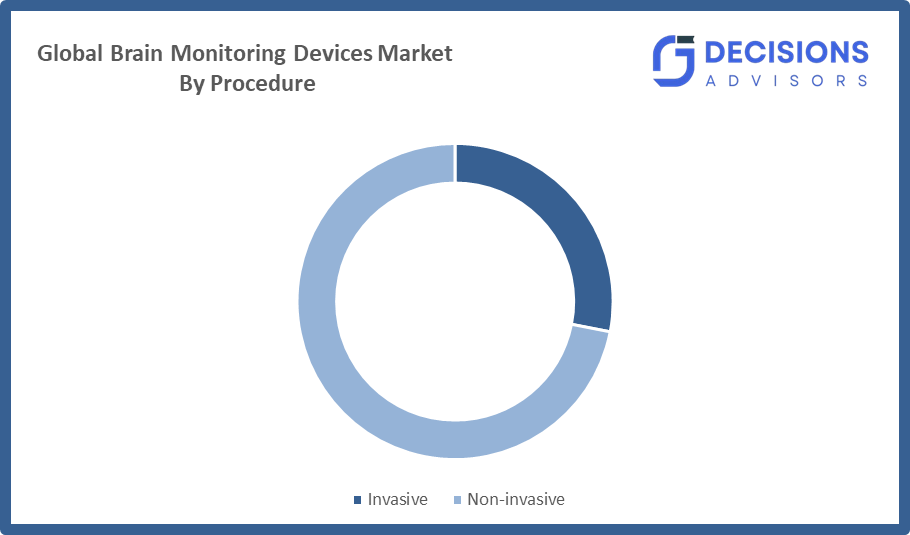
- The non-invasive segment accounted for the largest share in 2024 and is anticipated to grow at a significant CAGR during the forecast period.
Based on the procedure, the brain monitoring devices market is divided into invasive and non-invasive. Among these, the non-invasive segment accounted for the largest share in 2024 and is anticipated to grow at a significant CAGR during the forecast period. The devices EEG and TCD and wearable cerebral oximeters provide hospitals and clinics and home healthcare facilities with the capability to monitor patients continuously without requiring any surgical procedures. The medical field shows a growing trend toward using non-invasive techniques for diagnosing neurological disorders and monitoring sleep and conducting cognitive research studies. The combination of AI technology with cloud-based systems enables organizations to implement remote monitoring and data analysis while gaining predictive capabilities which helps enhance their overall business operations. The medical system benefits from non-invasive procedures because they achieve faster regulatory approval while gaining acceptance from both patients and healthcare professionals.
- The epilepsy segment accounted for the highest market revenue in 2024 and is anticipated to grow at a significant CAGR during the forecast period.
Based on the application, the brain monitoring devices market is divided into epilepsy, dementia, parkinson's disease, huntington's disease, headache disorders, stroke, traumatic brain injuries, sleep disorders and others. Among these, the epilepsy segment accounted for the highest market revenue in 2024 and is anticipated to grow at a significant CAGR during the forecast period. The worldwide population of people with epilepsy needs their seizures to be monitored continuously. EEG devices and wearable monitoring systems are used to diagnose patients and predict seizures and manage their therapy. The integration of AI algorithms for automated detection and alerting further strengthens the clinical utility and market dominance of this application segment. The increasing awareness of neurological disorders together with the rising patient demand for home-based monitoring systems leads to ongoing market requirements.
Regional Segment Analysis of the Brain Monitoring Devices Market
- North America (U.S., Canada, Mexico)
- Europe (Germany, France, U.K., Italy, Spain, Rest of Europe)
- Asia-Pacific (China, Japan, India, Rest of APAC)
- South America (Brazil and the Rest of South America)
- The Middle East and Africa (UAE, South Africa, Rest of MEA)
North America is anticipated to hold the largest share of the brain monitoring devices market over the predicted timeframe.
North America is anticipated to hold the largest share of the brain monitoring devices market over the predicted timeframe. The combination of advanced healthcare infrastructure and high prevalence of neurological disorders together with strong research and development investments and favorable reimbursement policies and early adoption of innovative neurodiagnostic technologies creates a situation where the United States and Canada.
Asia-Pacific is expected to grow at a rapid CAGR in the brain monitoring devices market during the forecast period. The market growth is being driven by three main factors which include rising healthcare costs and increasing neurological disorder cases and the growing use of advanced diagnostic equipment in China and Japan and India. The market is growing because of three factors which include expanding hospital networks and government initiatives that support digital healthcare services and increasing public knowledge about neurocritical care. The Asia-Pacific region is developing into a center for both production and research and development of brain monitoring devices which will make these devices more accessible and affordable to a larger number of patients.
Competitive Analysis:
The report offers the appropriate analysis of the key organizations/companies involved within the brain monitoring devices market, along with a comparative evaluation primarily based on their type of offering, business overviews, geographic presence, enterprise strategies, segment market share, and SWOT analysis. The report also provides an elaborative analysis focusing on the current news and developments of the companies, which includes type development, innovations, joint ventures, partnerships, mergers & acquisitions, strategic alliances, and others. This allows for the evaluation of the overall competition within the market.
List of Key Companies
- Medtronic plc
- Natus Medical Incorporated
- Compumedics Limited
- NeuroWave Systems Inc.
- Nihon Kohden Corporation
- Philips Healthcare (Koninklijke Philips N.V.)
- GE Healthcare
- Siemens Healthineers AG
- Masimo Corporation
- Advanced Brain Monitoring, Inc.
- Others
Key Target Audience
- Market Players
- Investors
- End-users
- Government Authorities
- Consulting and Research Firm
- Venture capitalists
- Value-Added Resellers (VARs)
Recent Development
- In August 2025, researchers at Stanford University developed a brain implant capable of decoding inner speech thoughts silently imagined by individuals who were unable to speak due to conditions such as ALS or brainstem stroke. The implant used electrode arrays implanted in the motor cortex to interpret phonemes directly from silent thought, achieving up to a 74% success rate in real-time decoding. This advancement offered a potential communication method for individuals with severe paralysis.
Market Segment
This study forecasts revenue at global, regional, and country levels from 2020 to 2035. Decisions Advisors has segmented the brain monitoring devices market based on the below-mentioned segments:
Global Brain Monitoring Devices Market, By Procedure
- Invasive
- Non-invasive
Global Brain Monitoring Devices Market, By Application
- Epilepsy, Dementia
- Parkinson's Disease
- Huntington's Disease
- Headache Disorders
- Stroke
- Traumatic Brain Injuries
- Sleep Disorders
- Others
Global Brain Monitoring Devices Market, By Regional Analysis
- North America
- US
- Canada
- Mexico
- Europe
- Germany
- UK
- France
- Italy
- Spain
- Russia
- Rest of Europe
- Asia Pacific
- China
- Japan
- India
- South Korea
- Australia
- Rest of Asia Pacific
- South America
- Brazil
- Argentina
- Rest of South America
- Middle East & Africa
- UAE
- Saudi Arabia
- Qatar
- South Africa
- Rest of the Middle East & Africa
Frequently Asked Questions (FAQ)
- What is the CAGR of the brain monitoring devices market over the forecast period?
A: The global brain monitoring devices market is projected to expand at a CAGR of 7.75% during the forecast period.
- What is the market size of the brain monitoring devices market?
A: The global brain monitoring devices market size is estimated to grow from USD 7.16 billion in 2024 to USD 16.28 billion by 2035, at a CAGR of 7.75% during the forecast period 2025-2035.
- Which region holds the largest share of the brain monitoring devices market?
A: North America is anticipated to hold the largest share of the brain monitoring devices market over the predicted timeframe.
- Who are the top 10 companies operating in the global brain monitoring devices market?
A: Medtronic plc, Natus Medical Incorporated, Compumedics Limited, NeuroWave Systems Inc., Nihon Kohden Corporation, Philips Healthcare (Koninklijke Philips N.V.), GE Healthcare, Siemens Healthineers AG, Masimo Corporation, Advanced Brain Monitoring, Inc., and Others.
- What are the market trends in the brain monitoring devices market?
A: The global brain monitoring devices market currently shows four main developments which include the fast adoption of both wearable and non-invasive devices, the use of artificial intelligence for instant data processing, the growth of remote and home monitoring systems, and increased demand from both neurological disorders and aging population groups which currently exists.
Check Licence
Choose the plan that fits you best: Single User, Multi-User, or Enterprise solutions tailored for your needs.
We Have You Covered
- 24/7 Analyst Support
- Clients Across the Globe
- Tailored Insights
- Technology Tracking
- Competitive Intelligence
- Custom Research
- Syndicated Market Studies
- Market Overview
- Market Segmentation
- Growth Drivers
- Market Opportunities
- Regulatory Insights
- Innovation & Sustainability
Report Details
| Scope | Global |
| Pages | 250 |
| Delivery | PDF & Excel via Email |
| Language | English |
| Release | Feb 2026 |
| Access | Download from this page |